Buy.com Monthly Coupon
Showing posts with label genocide. Show all posts

Saturday, December 21, 2024

Pakistan Must Reconcile with Bangladesh's 1971 Painful Legacy

Dr Muhammad Yunus (R), Chief Adviser of Bangladesh Interim Government meets Pakistan Prime Minister Shehbaz Sharif (L) at Cairo - Photo Collected
SALEEM SAMAD
After decades of hiatus, Bangladesh and Pakistan have made a major step toward a new era of regional cooperation in South Asia, which has been riddled with suspicion, distrust, disrespect, and a lack of neighbourliness among the eight countries.
When Nobel laureate Dr Muhammad Yunus, Chief Advisor of the Interim Government of Bangladesh embraced Pakistan Prime Minister Shehbaz Sharif with grins on their faces decided to put the bilateral relations at a new height.
Yunus and Sharif met on the sidelines at the D-8 Summit held by developing nations in Cairo, the capital of Egypt.
Shehbaz Sharif called for a strategic relationship between Dhaka and Islamabad and said “We are really looking forward to strengthening our relationship with our brother-in-country Bangladesh.”
Dr Yunus expressed his keenness to reactivate the South Asian Association for Regional Cooperation (SAARC) as “a top priority.” 
“I am a big fan of the idea of SAARC. I keep harping on the issue. I want a summit of SAARC leaders even if it is only for a photo session because that will carry a strong message,” the French news agency AFP quoted Yunus as telling Shehbaz.
The moribund eight-nation SAARC (Afghanistan, Bangladesh, Bhutan, India, Maldives, Nepal, Pakistan, and Sri Lanka) was largely stalled due to arguments between Islamabad and New Delhi.
Bangladesh and Pakistan are two wings of India and are not physically connected by land, rivers, and blue mountains. 
The two leaders expressed their desire to resolve outstanding grievances from the brutal birth of Bangladesh in 1971. The month of December is an emotional month for Bangladesh.
The day is observed with due solemnity to respect the millions of martyrs at the gigantic National Martyrs Memorial on the outskirts of the capital Dhaka.
All organizations, professional bodies, and political parties assemble at dawn to pay homage at the site, except for the Islamist party Jamaat-e-Islami, who were alleged henchmen and armed militias groups, which rampaged and pillaged thousands of villages during the nine months of liberation war.
On a historic day, Lieutenant General Amir Abdullah Khan Niazi, Commander of Eastern Command, Pakistan Army and Indian Lieutenant General Jagjit Singh Aurora of the Eastern Command, Indian Army flanked by a dozen Mukti Bahini commanders signed a historic ‘instrument of surrender’ in accordance to Geneva Convention.
An estimated 93,000 members of Pakistan’s armed forces, other auxiliary forces, civil officers, and their families surrendered on 16 December after a humiliating defeat, which created an independent Bangladesh.
It was the world’s largest surrender in terms of number of personnel since World War II. The prisoners of war (POWs) were repatriated under the Tripartite Agreement signed in April 1974 by Foreign Ministers of Bangladesh, Pakistan, and India in New Delhi. The Organization of Islamic Cooperation (OIC) held in Lahore, Pakistan in February 1974 helped resolve the issue of Bangladesh’s recognition intervened by Egypt and Algeria.
According to textbook history, the eastern province of Pakistan (known as East Pakistan) plunged into a bloody civil war after the military junta refused to accept the people’s mandate of the first-ever general elections in 1970.
The martial law government based in Rawalpindi launched a crackdown ‘Operation Searchlight’ in March 1971 after denying in handing over political power to the elected representatives. In hours the Awami League leader Sheikh Mujibur Rahman was detained and party banned.
When Mujib was picked up by the military in Dhaka, nearly 1,500 political and student leaders, intellectuals, acclaimed poets, senior lawyers, journalists and others were arrested from (western) Pakistan.
Relations between the two countries experienced hiccups during the last five decades. The three military dictators General Ziaur Rahman, General H.M. Ershad and General Moeen U Ahmed went ahead to thaw the bilateral relations with their counterpart military junta in Pakistan, which were never sustainable in the see-saw diplomatic maneuver by the autocratic regimes in both countries.
During the democratic era, the two Begums failed to build up the relationship between Bangladesh and Pakistan. The prestigious Pakistan newspaper The Dawn writes: In the years since the split (independence), Dhaka’s leaders — especially the recently ousted regime of Sheikh Hasina — stayed firmly in the Indian camp, preferring to maintain close ties with New Delhi and keeping Islamabad at arm’s length.
However, ever since a popular uprising that saw Hasina’s government toppled in August, there has been a thaw in ties between the two capitals, with trade and bilateral relations seeing a marked improvement, wrote the newspaper.
They also agreed to expand and deepen bilateral cooperation in all areas of mutual interest and emphasized the need to align efforts to achieve mutually beneficial development objectives.
Yunus told AFP “The issues (of 1971) have kept coming again and again. Let’s settle those issues for us to move forward.”
The two leaders acknowledged the importance of people-to-people contacts and cultural exchanges including enhanced exchange of artists, sportspersons, academics, students, etc.
Political historian Mohiuddin Ahmad said he does not see how the relationship would defrost the relationship which has deepened scars of the brutal independence war.
It is no denying that Clause 13 of the Tripartite Agreement, Pakistan agreed to put 195 senior military officers on trial for war crimes, crimes against humanity and rape as a weapon of war.
Unfortunately, lack of a guarantee clause in the agreement, the military dictator and also President, General Ziaul Huq instead pardoned the accused, which was a serious breach of the Delhi agreement, said the Mukti Bahini veteran Mohiuddin Ahmad.
Sharif said the 1974 Tripartite Agreement involving Bangladesh, Pakistan, and India settled things, “but if there are other outstanding issues,” he would be happy to look into it. Yunus said it would indeed be nice to resolve things “once and for all for the future generations.”
Former Ambassador Humayun Kabir doubts that settling down on the 1971 issue, who is also a liberation war veteran said it would not be easy for the millions of people who joined the guerrillas (Mukti Bahini), those became war refugees, the genocide survivors and of course the rape victims would be able to forget the nightmare and pardon the perpetrators, who were unfortunately not punished for committing crimes in 1971.
When military usurper General Pervez Musharraf visited Bangladesh in July 2002, he was greeted by a general strike and Dhaka University students fought a pitch battle with riot police in the capital demanding Pakistan should seek apology for what military troops had committed.
He (Musharraf) regretted the excesses committed during Bangladesh’s 1971 war of independence but called for burying the past in the spirit of friendship. Well, his statement was short of apology for the crimes committed during the war and said “Your brothers and sisters in Pakistan share the pains of the events of 1971.”
Perhaps stating only one word “apology” in public for crimes committed by Pakistan military during 1971 would melt the ice once and for all, remarks Ambassador Kabir.
First published in the Stratheia Policy Journal, Islamabad, Pakistan, 21 December 2024
Saleem Samad is an award-winning independent journalist based in Bangladesh. A media rights defender with the Reporters Without Borders (@RSF_inter). Recipient of Ashoka Fellowship and Hellman-Hammett Award. He could be reached at saleemsamad@hotmail.com; Twitter (X): @saleemsamad

Saturday, June 17, 2023

Bangladesh’s Patience is Waning for Rohingyas in Need


SALEEM SAMAD

Bangladesh has taken the brunt of Myanmar’s Rohingya exodus. Officials are anxious to send the 1.2 million refugees home, but rights groups say that they must not be pressured to return without guarantees of safety. Myanmar’s military government still does not recognize their citizenship, and many Rohingya fear they would be heading into new prisons if they return.

Despite receiving advisory notes from the United Nations High Commission for Refugees (UNHCR) and warnings from Human Rights Watch (HRW) in Washington, Bangladesh has shown indifference to the potential dangers faced by Rohingya refugees upon their forced return to Myanmar. These dangers include persecution and apartheid at the hands of the Myanmar military junta, not to mention the risk of natural disasters.

Meanwhile, China has engaged in intense diplomatic negotiations with the Myanmar military junta, urging them to address the Rohingya crisis to avoid potential repercussions from the International Court of Justice (ICJ), where Myanmar faces charges, brought by the Gambia, of genocide against the Rohingya ethnic minorities. The UN described the genocide of the Muslim Rohingya as a “textbook example of ethnic cleansing,” which Myanmar has repeatedly denied.

An exodus of millions

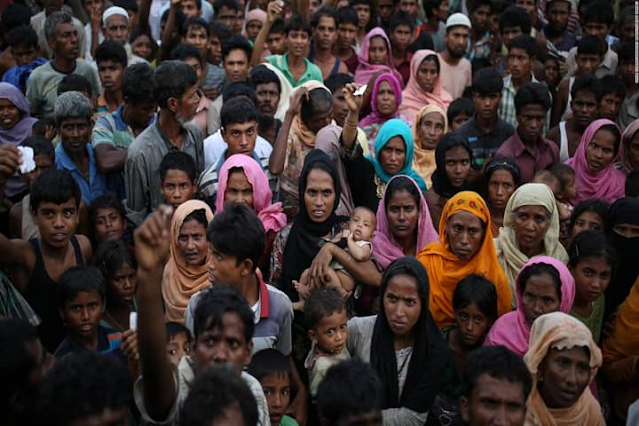
The genocidal campaign sparked the worst refugee crisis in South Asia, forcing a million to flee from the restive Rakhine state in Myanmar. Bangladesh has struggled to shelter 1.2 million Rohingyas in squalid camps in the southeast of the country.

An estimated 3.5 million Rohingya have dispersed worldwide, of whom a large percentage are in Bangladesh. Others are in India, Indonesia, Malaysia, Thailand, Saudi Arabia, United Arab Emirates and Pakistan. An estimated 600,000 Rohingya who remain in Rakhine State are victims of the Myanmar security forces’ persecution, deliberately confined 140,000 to guarded camps and villages without freedom of movement, and access to adequate food, health care, education, and livelihoods for more than 10 years.

Bangladesh, unfortunately, does not recognise these stateless people as refugees and instead describes them as “forcibly displaced Myanmar nationals.” Dhaka has yet to ratify the UN’s 1951 Refugee Convention, which protects the rights of asylum seekers. HRW has lamented that Bangladeshi authorities are also intensifying restrictions on work, movement, and education, creating a coercive environment designed to force people to consider premature returns.

Myanmar’s “all-weather friend” China stands beside the regime as it tries to weather a series of economic sanctions from the West, which slammed it after its persecution of Rohingyas and ouster of the country’s former democratically-elected leader Aung San Suu Kyi, who has been under house arrest since the military coup in February 2021.

China has been pushing the junta to initiate a so-called pilot “family-based repatriation” project, aiming to repatriate nearly a thousand refugees in the first phase.

Myanmar has an untrustworthy plan

Myanmar’s military junta wishes to appear as if it has undergone a sudden change of heart, ostensibly displaying compassion by committing to repatriate 6,000 Rohingyas by the end of the year. Myanmar has deemed these individuals foreign intruders or “illegal migrants,” denying them citizenship and subjecting them to abuse and discrimination.

In March, a delegation of Myanmar officials visited refugee camps in Bangladesh to conduct interviews and carry out a “verification” process for the pilot repatriation initiative.

“The figure of 6,000 Rohingya is a drop of water in an ocean,” says Asif Munier, a Rohingya refugee expert. The repatriation is a face-saving project of Myanmar amid country-wide embattlement with ethnic rebellions and economic crises that have worsened after economic sanctions by the United States, Canada and several European countries.

A delegation of Rohingya refugees, along with Bangladeshi government officials, toured the Hla Poe Kaung transit camp and Kyein Chaung resettlement camp in Rakhine State’s Maungdaw township on May 5. After the day-long “go and see” visit, the delegation expressed their dissatisfaction over the arrangements and facilities made by the Myanmar authorities.

Rohingya and Bangladeshi representatives seem to have two different interpretations of what they saw there. Bangladesh’s Refugee Relief and Repatriation Commissioner Mohammed Mizanur Rahman, who led the delegation, opined that “repatriation is the only solution to end the refugee crisis.” Rahman said Myanmar authorities did indeed prepare settlements for Rohingya under a pilot project. There are homes, employment opportunities and schools for Rohingya children as described by Myanmar officials.

The junta claims in the booklet that the UN Development Program, the UNHCR, and the Association of Southeast Asian Nations (ASEAN) will be involved in the pilot project  Altogether 3,500 Rohingya will be accommodated in 15 villages, says Rahman.

The delegation, however, found that their villages have been erased from the map and instead security forces occupied their lands and erected military and police barracks, outposts and check-posts. The authorities “even changed the name of my village in Rakhine,” a frustrated member of the delegation complained. Rohingya refugees are reluctant to return to Myanmar to “be confined in camps” again. They will only repatriate voluntarily if their security is guaranteed and they will be granted citizenship.

Rohingya don’t want to return to their country to be placed in glorified cages. They want to return to their own villages, from which they were forced to flee during the ethno-religious strife of August 2017. “Myanmar is our birthplace and we are citizens of Myanmar and will only go back with citizenship,” said refugee Abu Sufian, 35, father of three children told Reuters. It is not enough to move the refugees from one temporary camp in Bangladesh to another, concrete one in Myanmar. Without freedom of movement and guarantees of citizenship rights, the program is a non-starter.

Second-class citizenship for Rohingyas, if that

Refusing full citizenship to the ethnic minority, the authorities offer the Rohingya a consolation prize: a national verification card (NVC), which Rohingya refugees regard as insufficient protection. The draconian Citizenship Law of 1982 requires individuals to prove that their ancestors lived in Myanmar before 1823, and refuse to recognize Rohingya Muslims as one of the nation’s ethnic groups or list their language as a national language.

“We don’t want to be confined in camps,” Oli Hossain, who was among the refugees who visited Rakhine State in early May. He said they will never accept the NVC, which would effectively identify Rohingya as foreigners.

“Myanmar officials said that the confirmation of citizenship is a long process and would take more time to complete. Therefore, Myanmar won’t provide citizenship to the Rohingya people who want to repatriate under this pilot project,” Rahman told Turkish news agency Anadolu.

The booklet “Resettlement of Displaced Persons on their Return under the Pilot Project,” dated April 2023 and written in Burmese, English, and Bangalee, states that returnees will be housed at the Hla Poe Kaung transit camp for up to two months, then relocated to one of two resettlement camps with prefabricated houses or a land plot in one of 15 “designated villages,” where they can build a home through a cash-for-work program.

Since the crisis, Bangladesh has been trying to repatriate displaced Myanmar citizens with rights and dignity. Several attempts to repatriate the refugees fell flat in 2018 and 2019. After the failed attempts, Bangladeshi authorities echoed the UN Refugee Agency catch-phrase of safe, voluntary, dignified and sustainable repatriation of 1.2 million Rohingyas.

In April, in a crucial tripartite parley between senior Foreign Minister officials of Bangladesh, China and Myanmar in Kunming, China, the parties decided to expedite the repartition process to avoid further sanctions. Whether this will see any effects on the ground remains to be seen.

An official team from Myanmar arrived in Bangladesh for the second time in three months to build confidence among Rohingyas in early June. After the return of the Myanmar delegation from the camps in Cox’s Bazar, the refugees have been agitating to cancel the piecemeal plan, calling instead for ensurance of a dignified and sustainable repartition.

The UN Refugee Agency, after the visit of diplomats from eight ASEAN countries including Bangladesh to Rakhine State last March, said that “conditions in Rakhine State are currently not conducive to the sustainable return of Rohingya refugees,” adding that no refugee should be forced to return. Bangladesh’s hopes that the UN may be able to bring about a quick solution to the quagmire by going along with Myanmar’s pilot plan have been frustrated due to ongoing western sanctions against the military regime.

In a flurry of diplomatic consultations in Dhaka in early May, Bangladesh’s foreign minister sought the opinion of several European and North American diplomats, as well as the UN Refugee Agency. The diplomats insisted that Myanmar should restore the citizenship of Rohingya and ensure safety, security, and access to livelihood, education, healthcare and freedom of movement which were restricted after they were declared “alien” more than 40 years ago.

Western, Bangladeshi, Myanmarese, Chinese, and UN officials are all pushing for a resolution to the crisis, but the path forward remains unclear. What is certain is that no one wants a resolution more than the Rohingya people; still, they will not sacrifice their safety, liberty, or dignity for the sake of speed.

First published in the Fair Observer, 17 June 2023

Saleem Samad is an award-winning independent columnist and media rights defender based in Bangladesh. He became an Ashoka Fellow in 1991, and won the Hellman-Hammett Award in 2005. Saleem’s articles have appeared in top publications such as Time, India Today, Outlook, India Narrative, and The Times of India, and his research has been published by institutions like the Observer Research Foundation (ORF), the Kolkata Research Group, Jadavpur University, and the Maulana Abul Kalam Azad Institute of Asian Studies.

[Anton Schauble edited this piece.]

Wednesday, June 14, 2023

Is US encouraging rise of Bangladesh’s Islamist party to counter Sheikh Hasina?


SALEEM SAMAD

The next parliament elections are around the corner, expected in January 2024. The hardline Islamist political party Jamaat-e-Islami (JeI) after 10 years of hiatus held its first rally in Dhaka, on June 10.

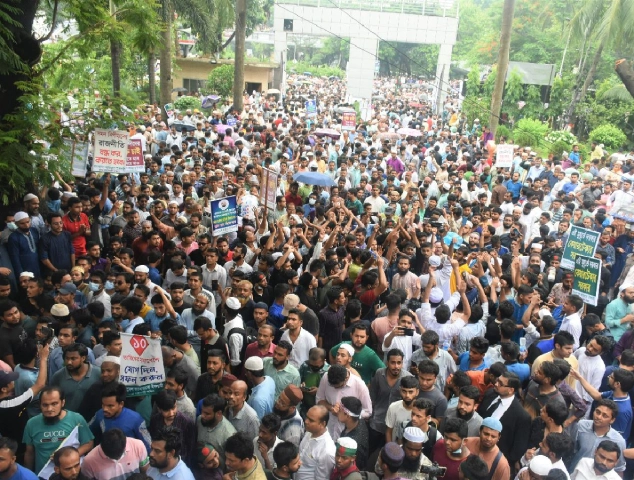
The three-hour-long event was held amid a huge deployment of riot police in armed gear and hundreds of armed officers in plain clothes, at the auditorium in the heart of the capital. Thousands of its members, who were unable to find space in the hall, spilt over in the compound and also occupied half of the streets. There was no law and order situation.

In a sudden move, the capital Dhaka’s police chief permitted on certain conditions, which raised eyebrows of the journalists, political observers, civil society and left-leaning parties.

Home Minister Asaduzzaman Khan on Sunday said that Awami League’s policy regarding Jamaat-e-Islami has not “changed our position.”

Several political observers argue that the threat of the United States visa policy has given extra mileage in obtaining permission. The US visa policy for Bangladesh says it would clamp down restrictions on officials, governing party leaders and the opposition in defence of democracy. This includes those responsible for voter intimidation, vote rigging, denial of free speech or freedom of assembly, and violence that seeks to undermine free and fair elections.

Moving away from tough repressive measures against the opposition, the district civil officials and police administration in holding elections of the local government or by-elections to the parliament are extra cautious in violating compliance stated by the US State Department on May 3.

Thus, the Islamist party got the desired “verbal permission” on the eve of their rally, after the police cancelled an event of a youth wing of another political party at the same venue.

The JeI rally has brought together the party leaders and members on a three-point demand which includes: elections under a caretaker government; release of their leaders and members in prison; control of the prices of essential grocery items.

JeI leaders claimed that in 14 years of Awami League era, nearly 1.5 lakh legal harassment cases are on their heads, and nearly 14,000 leaders and members are languishing in prisons, including their national ameer (chief) Dr Shafiqur Rahman, nayeb-e-ameer (vice-president) ANM Shamsul Islam and secretary general Mia Golam Porwar.

In their list of demands are to open the JeI’s party offices across the country, and permission for political assembly, which they pointed out that has been guaranteed by the Constitution – the Constitution which they do not recognise.

The JeI leaders have offered dialogue with the government on developing a framework for an interim government to hold free, fair, inclusive and credible elections and also ensure a level-playing field for all political parties.

The Islamist calls JeI a political party, but a majority of the people in Bangladesh are aware of the organisation’s antecedent – their demonic role during the brutal war of independence.

Fearing streets violence, the police headquarters ceased permission for JeI from February 2013 after the arrests of the party’s key leaders including their national ameer Matiur Rahman Nizami, secretary general Ali Ahsan Mohammad Mujahid, assistant secretary general Abdul Quader Molla and assistant secretary general ATM Azharul Islam indicted for war crimes in 1971.

In the 2008 election, Sheikh Hasina led Awami League had returned to power after a landslide victory. Her electoral promise to the nation was the trial of those responsible for war crimes and crimes against humanity committed in 1971 must face the music of justice.

Bangladesh’s International (War) Crimes Tribunal awarded capital punishments to scores of JeI, other Muslim parties and Islamist leaders. The tribunal considering an elderly person gave sentences for imprisonment until death to Ghulam Azam, former JeI chief in 1971, for recruitment, aiding and abetting with the marauding Pakistan military.

The Islamic evangelist leader Delwar Hossain Sayeedi, a key figure with JeI and his Muslim militia were held responsible for the deaths and rape of hundreds of Hindu community and pro-independence compatriots in southern Bangladesh in 1971, says Barrister Tapash Kanti Baul, a prosecutor in the tribunal.

In the first year of Bangladesh’s independence, Bangabandhu Sheikh Mujibur Rahman, the liberation war hero passed the world’s second secular Constitution after the Muslim majoritarian Turkey.

The Constitution had a blanket ban on religious political parties. The dreaded Jamaat-e-Islami party by default was struck off.

The newly born country has gone through the pains and agony of the bloody liberation war when Pakistan forces committed wanton war crimes and rape as a weapon of war. Their henchmen of the radicalised Muslim party, JeI in the name of Islam had committed genocide and extra-judicial killings of hundreds of intellectuals by a secret death squad Al Badr.

In a landmark judgement the Bangladesh High Court on August 1, 2013, deregistered the Islamist party, Jamaat-e-Islami, thereby banning it from participating in future elections.

The court found several contradictions between the principles of the JeI party’s manifesto (available on their website and printed documents) with the Bangladesh Constitution.

The JeI wishes to establish an Islamic Republic [of Bangladesh] instead of a secular country for which it sacrificed in blood in 1971. The Quran & Sunnah will override the state Constitution; implement the strictest Islamic Sharia laws and protect the Hindus and other religious minorities in an Islamic country.

The petitioner of the public interest litigation for the deletion of JeI’s registration with the Bangladesh Election Commission (EC) in the High Court, Maulana Ziaul Hasan, fails to understand how the EC will act JeI’s plans to participate in the elections after being deregistered.

Hasan, who is also the president of Bangladesh Sommilito Islami Jote (United Islamic Alliance), a like-minded platform against political Islam and an outspoken secularist is obviously worried about the rise of Islamism.

JeI documents claim their founder was controversial Islamic leader Syed Abul A’la Maududi, founder of Jamaat-e-Islami in Pakistan. He is responsible to instigate the worst racial riots in 1953 after the partition, which killed 200 Ahmadiyya Muslims after Maududi’s disciples heard his ‘Fatwa’ which mandates the Sunni Muslims in Pakistan to kill the heretics and infidels.

Barrister Tania Amir, a leading human rights lawyer argued in the court on behalf of the PIL against JeI registration that, “The Jamaat in principle does not recognise the powers of the Republic which belongs to the people, nor does it accept the undisputed power of the people’s representatives to make laws. The party discriminates against people based on religion and, therefore, should have its registration cancelled long ago.”

In December 2018, as the general election was approaching, the Bangladesh Election Commission scrapped its registration in accordance with the higher court’s verdict. Thus, JeI was rocking in troubled waters, as they were not eligible to participate in the elections and the party was in jeopardy.

The JeI members hurriedly negotiated with their all-weather ally, the rightist Bangladesh Nationalist Party (BNP) to be able to contest more than 20 seats, and they drowned.

For the last 12 years, the rhetoric of several top echelons of Awami League and senior Ministers reiterated their party’s position to make a law to ban Jamaat-e-Islami which ruthlessly opposed the independence of Bangladesh in being complicit to war crimes committed by Pakistan’s occupation military forces.

The policymakers did not hesitate to say that banning JeI is a matter of time. Now it seems those were empty promises.

The change of heart is understood by political analyst Sohrab Hasan. JeI has recently broken away from the BNP alliance. JeI is deemed an alternative to the government if BNP boycotts the upcoming elections, he wrote in the largest circulated newspaper Prothom Alo.

It seems that the same senior Ministers made a U-Turn on their rhetoric against JeI. As Dr Hasan Mahmud, Minister for Information and Broadcasting and also Joint General Secretary of Awami League said on Sunday that Jamaat-e-Islami was not banned. “Any political party can hold rallies. As long as it is not prohibited, they have the right to hold rallies,” he explained.

While Law Minister Anisul Huq said on Sunday that Jamaat-e-Islami should “not be termed guilty until the party is convicted.”

The judges have given their opinion that JeI should be banned based on sufficient evidence that came in the verdicts delivered by the war crimes tribunal.

The Saturday event has given a message that JeI is not weak and was able to brainwash thousands more youths in radical Islamic ideology.

After the war crimes tribunal indicted the key leadership of JeI, the party was demoralised but survived in a turbulent political climate.

After the tragic assassination of Sheikh Mujib in a military putsch in mid-August 1975, the regime of General Ziaur Rahman (later president) in May 1976 abrogated Clause 38 of the Constitution which bars the formation of a religious party.

Overnight the dreaded JeI resurfaced from the dead and began politicking, but of the tainted history of their engagement against the people of the country, they strategically changed its name to Islamic Democratic League.

The JeI bagged six seats in the 1979 parliament under a military dictator General Rahman. Surprisingly, the six JeI’s elected in the constituencies were all bordering the India-Bangladesh.

Fortunately, the people understood and rejected the Islamist party, which could be understood from the subsequent elections. JeI on average received nearly 4 per cent vote, said political scientist Dr Imtiaz Ahmed.

In the 1991 election after the departure of another military junta of General HM Ershad, JeI was elected in 18 seats, which was crucial for Khaleda Zia to form a coalition government. Despite a clear win, Awami League had to be seated on the opposition bench in the parliament as the party failed to muster a majority to form a government.

Awami League’s influential general secretary Obaidul Quader, hours after the event said the opposition BNP is behind Jamaat-e-Islami’s rally to conspire against the democratic process and jeopardise the forthcoming elections.

Indeed it’s rare in the world’s political history that a party which opposed the independence of a country had remained resilient and defiantly returned to politics, despite key leaders of the JeI leaders being handed down maximum punishment by the war crimes by the war crimes tribunal.

First published in the India Narrative, New Delhi, India on 14 June 2023

(Saleem Samad is an award-winning independent journalist based in Bangladesh. Views expressed are personal. Twitter: @saleemsamad)

Sunday, May 28, 2023

Imran Khan’s ‘Vandana’ For Bangabandhu Sheikh Mujib


SALEEM SAMAD

For more than a decade there was a simmering debate spearheaded by the netizens, academicians, journalists, researchers, social justice activists and civil society in Pakistan on war crimes, genocide and rape as a weapon of war by marauding Pakistan military during the brutal birth of Bangladesh in 1971.
Long before the cricketer-turned-politician Imran Khan became Prime Minister of the Islamic Republic of Pakistan at a talk show in Urdu anchored by celebrated anti-establishment journalist Hamid Mir, admitted that “some” atrocities had been committed in Bangladesh in 1971.
He also said that it was time to reconcile with Bangladesh what happened in 1971, and Pakistan should seek an apology for the war crimes.
Obviously, this news appeared in major dailies and argued on private TV channels during prime time talk-shows in Bangladesh.
Bangladesh’s relationship with Pakistan during Nawaz Sharif was all-time low after Sheikh Hasina in 2010 when she decided to put the war crimes suspects to face the music of justice.
Islamabad scolded Bangladesh envoy in Pakistan each time when the war crimes tribunal in Dhaka handed down maximum punishment for the Islamist leaders of Jamaat-e-Islami (JeI).
The key henchmen of the Pakistan military were indicted for crimes against humanity, especially kidnapping, torture and deaths of hundreds of intellectuals by a dreaded death squad, Al-Badr recruited by JeI.
Hasina was angry with Islamabad’s statement condemning the so-called “sham” trial targeting Muslim leaders.
Well, Turkey joined Pakistan in the vilification campaign against the trial of the accused for war crimes and crimes against humanity.
She decided to withdraw the diplomats from Islamabad and shut down the Bangladesh mission in Pakistan. Her government for several years refused to give accreditation to Pakistan’s nominated High Commissioner to Dhaka.
However, the Indian Prime Minister Narendra Modi, and Saudi Arabia and the United States in a similar diplomatic tone advised Hasina to not a harsh diplomatic decision.
Hasina backed out, understanding that the move would jeopardize South Asian regional cooperation and the war against terror campaign.
Her government continued to deny visas to Pakistan nationals from the Bangladesh missions in Islamabad and Karachi.
Well, during Khan’s tenure as head of government, he did not take any effort to thaw relations with Bangladesh, not to speak of seeking an apology for war crimes.
Hours after the much-dramatized arrest of former Prime Minister Imran Khan allegedly for corruption, the country rocked with violent street protests on May 9.
Angry protesters of the opposition Pakistan Tehreek-e-Insaf (PTI) seem to have a grudge against the military establishment.
Many are beginning to wonder if the military hawks can remain the hegemon that guides the nation, while the COAS General Asim Munir warns Khan and his cohorts from fresh attacks on military facilities.
Exasperated by the violent protests, Pakistan’s Prime Minister Shehbaz Sharif at a civil-military huddle a few days ago decided to observe May 9 as a ‘black day’ and remarked that “Such scenes were not witnessed since the fall of Dhaka during 1971.”
Sharif was referring to the surrender of Pakistan’s 96,000 troops and civilians in Dhaka under the joint command of the Indian army and Bangladesh Mukti Bahini on December 16, 1971 – labelled as the “darkest day” in the history of Pakistan.
Veteran political historian Mohiuddin Ahmad says if Pakistan believes that December 16 is the “darkest day” then they should also consider seeking a public apology for war crimes committed during the liberation war of Bangladesh.
Thousands of netizens in Pakistan and PTI cohorts poured onto social media and began to compare the 70-year-old Imran Khan ‘Vandana’ with Bangabandhu [Friend of Bangladesh] Sheikh Mujibur Rahman, an architect of independent Bangladesh.
Once a blue-eyed boy of the Pakistan military establishment, Khan blamed the top military hawks in Rawalpindi GHQ for orchestrating against him to eliminate him from politics in axis with the United States, and dubbed himself as ‘Mujibur 2.0’.
The Bangladesh media and social media did not feel comfortable comparing Imran Khan with founding father Sheikh Mujib. The media with scornful eyes rebuked the Pakistani netizens for comparing a man mountain with a Lilliput.
Dr Imtiaz Ahmed, a professor at Dhaka University is a leading political scientist who reacted to Khan’s comparison with the Father of Nation. He has demeaned Sheikh Mujib, who is adored by millions of people. Bangabandhu has never been smeared by allegations of corruption and hobnobbing with the military establishment to scale the ladder to power.

An Indian micro-blogger @Pavan_JaiHind reverberates with other netizens: History is repeating itself. Victims are [the] same, Pakistani people. [The] perpetrator is [the] same, Pakistan Army. Crimes are [the] same, Rape & Murders. [The] only leader of 1971 Sheikh Mujibur Rahman is replaced by Imran Khan in 2023.

Mehedi Hasan Shuvo @MHShuvo12053 on May 9 satires from Bangladesh: Remember these two things: 1. Every country has its own military; 2. Pakistan’s military has its own country.

The netizen in another tweet: Sheikh Mujibur Rahman whom you [have] known as a traitor, now see what your [Pakistan] army does to your own men.

“Everyone knows Mujibur Rahman and his party won the general elections in 1970. Instead of handing over power, a clever politician set Awami League and the army on a collision course,” said Khan.

A Pakistani micro-blogger Sohail @mosohail03 on May 10 tweets: Sheikh Mujibur Rahman told the military, “You can kill me, but you can’t suppress the people of Bangladesh. Sheikh Mujibur Rahman, the whole nation apologizes to you.”

In 1971, when Pakistan’s army battalion arrested Sheikh Mujibur Rahman, the “Father of the Nation” of Bangladesh, he was treated very badly. At that time, the Pakistan Army Chief (dictator) Yahya Khan was backed by a political puppet named Zulfikar Ali Bhutto #ImranKhanArrest

@OsintTV on May 11 tweets from Pakistan: History repeating itself…It was Sheikh Mujibur Rahman then now Imran Khani. Pakistan Army is [the] same.

“A shrewd politician (Zulfikar Ali Bhutto), in his greed for power, set the armed forces against the then largest party (Bangladesh’s Awami League), which had won elections, causing the dismemberment of the country,” lamented PTI chief during a road march in Gujranwala in last November, reports Dawn.
Khan was ousted as prime minister in April 2022 in a parliamentary no-confidence vote, reminded that Pakistan had split into two after Awami League with a legitimate political mandate was denied its right to rule. “Those who are behind all this don’t know what happened in East Pakistan.”
Despite all the deadly political drama, Imran is Pakistan’s most popular leader according to opinion polls.
The comparison of Imran Khan with Bangabandhu and the May 9 violent protests with the 1971 liberation, demonstrates appalling knowledge of the political history of the 1970 post-elections, the bloody liberation war in 1971 and culminating in the humiliating defeat of occupation troops of Pakistan.

First published in The News Times, 28 May 2023

Saleem Samad is an award-winning independent journalist, media rights defender, recipient of Ashoka Fellowship and Hellman-Hammett Award. He could be reached at <saleemsamad@hotmail.com>; Twitter @saleemsamad


Saturday, March 25, 2023

China has to ensure return of Rohingya to Myanmar


SALEEM SAMAD

The lights are dim at the end of the tunnel in case of repatriation of Rohingya refugees living in squalid camps in the coastal district of Cox’s Bazar in Bangladesh.

The country hosts nearly 1.2 million Muslim Rohingya people who have fled ethno religious strife in neighbouring Myanmar during a military genocidal campaign, which killed at least 9,000 people in 2017.

The Tatmadaw (Myanmar military) backed campaign that the United Nations labelled a “textbook example of ethnic cleansing” saw hundreds of thousands of Rohingya driven across the border into Bangladesh in September 2017.

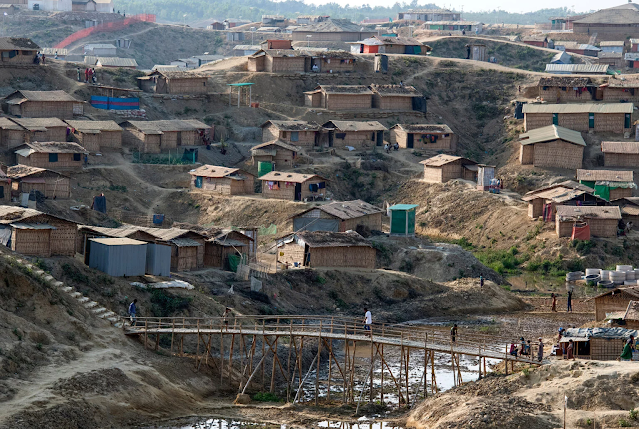
More than a million refugees are crammed in tens of thousands of make-shift huts made of bamboo, thin plastic sheets and corrugated tin roofs and the living conditions in the nauseating camps are dangerous. Often, fires blaze through the camps leaving thousands without shelter.

Last week, a 17-member delegation from Myanmar’s immigration and population ministries crossed into Bangladesh in mid-March and interviewed 480 Rohingya in Cox’s Bazar as part of a plan for possible repatriation to their country.

The Myanmar delegation, led by Aung Myo, the social welfare minister for Rakhine State, was selecting members for a pilot ‘family-based repatriation’ project.

The Myanmar delegation’s visit to the camps is believed to be brokered by China and facilitated by the UNHCR.

The Refugee Relief And Repatriation Commissioner (RRRC) in Cox’s Bazar, Mohammed Mizanur Rahman, said the Myanmar junta officials cleared 711 Rohingyas out of 1,140 recommended by Bangladesh. The newborn and newly married couples have been excluded from verification.

When journalists asked when the repatriation is expected to start, Rahman said that the “Myanmar delegation did not have the power to commit to a possible repatriation date.”

Before the visit of the delegation, the Myanmar junta for the first time since the 2017 crackdown, allowed diplomats from Bangladesh, India, China, and five other countries to tour the restive Rakhine State.

It was only then, the officials expressed the military junta’s plan to begin Rohingya repatriation under the pilot project.

Earlier, Bangladesh formally sought cooperation from China to repatriate Rohingya refugees to Myanmar during a visit by Foreign Minister Wang Yi and also China’s State Councillor promised to resolve a political solution to the Rohingya crisis.

China had used its influence in Myanmar to broker a November 2017 agreement to repatriate Rohingyas.

China’s ambassador to Bangladesh Yao Wen hoped that the first batch of displaced Rohingya would be repatriated to Myanmar soon while China continued its role as mediator, the official news agency Bangladesh Sangbad Sangstha reported.

On 17 March 2023, Bangladesh Foreign Minister Dr AK Abdul Momen also urged the Organisation of Islamic Cooperation (OIC) member states to take collective responsibility to ensure a safe and dignified return of the most persecuted Rohingyas to their homeland, Myanmar.

Indeed, OIC backed Gambia to file a genocide case with the International Court of Justice (ICJ). Only Turkey has a visible presence at the Rohingya camps in Cox’s Bazar.

India also launched “Operation Insaniyat” to provide relief assistance in response to the humanitarian crisis faced by a large influx of Rohingya refugees into Bangladesh from Myanmar.

Bangladesh and Myanmar began the negotiation for repatriation, but since 2018 none has returned so far and recent verification of a few hundred potential returnees for a pilot repatriation project remains unclear when they would be going home.

Despite attempts to send them back, the refugees refused, fearing insecurity in Myanmar, which was exacerbated by the military takeover last year.

Amid the situation, the United Nations High Commissioner for Refugees (UNHCR) in a statement on March 19 said they are observing developments of the Myanmar delegation’s visit to Bangladesh to verify a selected number of refugees on a bilateral pilot project on their possible returns.

The UN Refugee organisation reiterated that conditions in Myanmar’s Rakhine State are currently “not conducive to the sustainable return of Rohingya refugees”.

Bangladesh has consistently reaffirmed its commitment to “voluntary and sustainable repatriation” since the onset of the current crisis which echoes UNCHR policy that every refugee has a right to return to their home country based, make an informed choice and no refugee should be forced to repatriate.

China always wanted to impress upon their “feel good” diplomacy, but despite best intentions, it seems the repatriation has entered into a fresh deadlock as both Bangladesh and UNCHR, responsible for the safe return of the displaced Rohingyas are concerned about their safety and security in the Rakhine State.

The Rohingya issue must be addressed by China, a country [Myanmar] over which it has significant influence. Only China can make conclusive negotiations on the safe return of the Rohingyas, writes security analyst Samina Akhter in Modern Diplomacy.

Bangladesh and China have close political and military relations in addition to the fact that China is Bangladesh’s top trading and development partner.

Last week, Bangladesh has inaugurated a naval base in Cox’s Bazar with two conventional diesel-electric powered refurbished Chinese submarines bought for $205 million in 2016 to enhance Bangladesh’s naval capacity, after the demarcation of its maritime boundary with India and Myanmar.

It is equally true, that Myanmar’s military junta, which took power in a coup two years ago, has demonstrated no intention to take back any refugees.

Most importantly, the Rohingya refugee groups based in Bangladesh said for sustainable and dignified repatriation will only be possible when the Myanmar regime recognises the Rohingya as an ethnic community; provide legal citizenship which was stripped in 1982; school education; healthcare services; freedom of movement and livelihood.

Rohingya’s human rights groups believe the face-saving exercise to repatriate refugees happened after the Chinese exerted pressure on the Myanmar military junta to demonstrate a “feel good policy” otherwise face the compliance declared by the International Court of Justice (ICJ). The genocide case is resuming at ICJ on 24 April.

“Taking back a few refugees, even if it is less than one percent of the population, shall allow Myanmar to come up with a counterargument under the very false pretence they are sincere about the return of refugees,” the Arakan Rohingya National Alliance (ARNA) said in a statement.

First published in the India Initiative, New Delhi, India on 25 March 2023

Saleem Samad is an award-winning independent journalist based in Bangladesh

Friday, December 16, 2022

How Long Can Pakistan Troops Hold In East Pakistan?

SALEEM SAMAD

In a crucial meeting held in Washington DC, on the morning of December 6, 1971, was attended by senior officials of departments of State, Defence, Joint Chief of Staffs, CIA, USAID, and others.

The heavyweight US Secretary for State at the onset of the meeting asked Gen. Westmoreland: What is your military assessment? How long can Pakistan hold out in the east [Bangladesh]?

Gen. Westmoreland candidly said, up to three weeks. Once Pakistan Army runs out of supplies, all the troops in East Pakistan [Bangladesh] will become a hostage.

No doubt sly Kissinger was worried about the safety and security of marauding Pakistan’s troops battling in occupied Bangladesh.

The United States seriously wanted to stick with withdrawal and ceasefire not a humiliating surrender of Pakistan troops and Kissinger assured the Pakistan regime that they doing all the best they can do diplomatically.

The perturbed Kissinger believed that there would be a massacre of the disarmed troops in the hands of the Mukti Bahini (Bangladesh Liberation Forces) after enemy soldiers are disarmed.

Three days after a full-scale war between India-Pakistan on the eastern front and Bangladesh-India jointly against Pakistan in the eastern war theatre, Henry Kissinger asked how long Pakistan troops can hold in Bangladesh.

The officials discussed whether there were any possibilities of Pakistan troop evacuation. Gen. Westmoreland responded in negative.

A senior official of the State Department asked Gen. Westmoreland that assuming the Indians take over Bangladesh, how do you think it will happen.

Gen. Westmoreland: I think their primary thrust will be to cut off the seaport of Chittagong. This will virtually cut off any possibility of resupply. Then they will move to destroy Pakistan’s regular forces, in cooperation with the Mukti Bahini. They will then be faced with the major job of restoring some order to the country. I think there will be a revenge massacre — possibly the greatest in the twentieth century.

Kissinger asked shall the Indians withdraw their army once the Pakistan forces were disarmed.

Gen. Westmoreland replied that he thinks they [Indians] will leave three or four divisions to work with the Mukti Bahini and pull the remainder back to the West [Pakistan].

The officials expect that the Indians will pull out as quickly as they can. Once the Pakistan forces are disarmed, the Indians will have a friendly population. They can afford to move back to the border areas quickly.

Another official in the nerve-breaking meeting predicted that after the Indian Army has been in Bangladesh for two or three weeks, they will be accepted as a “Hindu army of occupation”.

Kissinger asked: What will India do with Bangladesh? Will they see it as an independent state or have them negotiate with Islamabad?

An official responded that India has already recognised Bangladesh as an independent country. Kissinger said then there is no hope for Pakistan to negotiate with Bangladesh.

The objective of the prudent Indian Prime Minister Indira Gandhi’s government was to force a surrender of the Pakistani troops in Bangladesh within 10 days.

In a telegram from New Delhi on December 6, US Ambassador Kenneth Barnard Keating reported that Indian Foreign Secretary Triloki Nath Kaul had expressed “disappointment, shock and surprise” that the United States had tabled the resolution it did in the UNSC.

On December 5 the Soviet representative on the United Nations Security Council (UNSC) vetoed an eight-power draft resolution that called for a ceasefire and mutual withdrawal of forces, as well as intensified efforts to create the conditions necessary for the return of refugees to their homes.

However, the UN Security Council accepted on December 6 that an impasse had been reached in its deliberations on the conflict in South Asia, and referred the issue to the General Assembly adopted by a vote of 11 to 0 with 4 abstentions.

On the other hand, Pakistan’s General Yahya Khan’s administration conveyed their intentions to retreat from their eastern wing to the United Nations on 10 December 1971, and a formal surrender was submitted and accepted when the Commander of Eastern Command and Governor of East Pakistan, General Niazi, signed an instrument of surrender with his counterpart, Lieutenant General Jagjit Singh Aurora, Commander of Eastern Command.

An estimated 93,000 Pakistan troops and civilians including family members made an unconditional public surrender in Dhaka on December 16, 1971, which is observed each year as Victory Day both in Bangladesh and by Indian armed forces.

The surrender was indeed the largest surrender that the world had witnessed since the end of the Second World War.

Conclusion: Despite the growing anger among the Mukti Bahini commanders to avenge the extreme barbarity unleashed by Pakistan troops, fortunately, none of the disarmed enemy troops was killed or died for being held captive in military garrisons inside Bangladesh.

Soon after the Prisoners of War (POWs) were transferred to India, as newly born Bangladesh did not have the ability to the containment of such a huge number of POWs.

Under Tripartite Agreement in April 1974 between Bangladesh, India and Pakistan signed in New Delhi enabled the repatriation of all the 79,676 uniformed POWs and 13,324 civilians to Pakistan, including the 195 officers held for suspected war crimes.

First published in The News Times, December 16, 2022

Saleem Samad, is an independent journalist, media rights defender, recipient of Ashoka Fellowship and Hellman-Hammett Award. He could be reached at <saleemsamad@hotmail.com>; Twitter @saleemsamad

Monday, October 31, 2022

US Congress To Recognise Bangladesh Genocide In 1971


SALEEM SAMAD
Recently United States Congressman Steve Chabot along with co-sponsor Congressman Ro Khanna and Congresswoman Katie Porter introduced a bipartisan resolution 1430 “Recognising the Bangladesh Genocide of 1971” in Capitol Hill, Washington DC.
The resolution demands that the United States government should recognise the genocide committed by the Pakistan armed forces during the brutal birth of the country in 1971, which disproportionately targeted members of the Hindu community, secularists, and nationalist groups in East Pakistan (now Bangladesh).
Congressman Steve Chabot is a member of the House Foreign Affairs Committee’s Subcommittee on Asia and the Pacific, and Co-Chair of the Bangladesh Caucus, introducing the resolution said, “There was a genocide. Millions of people were killed [in 1971] in what is now Bangladesh, and what was then East Pakistan.
About 80 per cent of those millions that were killed were Hindus. And it was, in my opinion, a genocide just like other genocides – like the Holocaust – happened. “
The historic resolution observes that the Pakistani ruling elite and officials harboured well-documented anti-Bangalee sentiment, considering Bangalees to be a lesser people group that had been corrupted by un-Islamic practices.
The infamous brutal crackdown “Operation Searchlight” involved widespread massacres of civilians. The operation targeted the Bangalee nationalists and especially the Hindus, who are dubbed with the demeaning word “Malaun” (cursed).
“The genocide against Bengalees and Hindus is one of the forgotten genocides of the 20th century and its lack of recognition remains an open wound for millions of people who were directly affected by the atrocities, remarked Senator Tabo”
Pakistan’s President, General Agha Muhammad Yahya Khan, is recorded as saying to his top military brass “[k]ill 3 million of them and the rest will eat out of our hands”.
Unfortunately, the genocide against ethnic Bangalees and Hindus is one of the forgotten genocides of the 20th century and its lack of recognition remains an open wound for millions of people who were directly affected by the atrocities.
Earlier, the United States based non-governmental organisations Genocide Watch and the Lemkin Institute for Genocide Prevention sought international recognition of the atrocities committed by the Armed Forces of Pakistan as ‘genocide’.
An estimated number killed in the atrocities was 3 million (an official figure of the Bangladesh government). Nearly several hundred thousand were victims of rape as a weapon of war.
The bloody war caused nearly 10 million war refugees and took shelter in camps along the borders of India for their safety and up to 50 per cent of the population was internally displaced.
On March 28, 1971, United States Consul General in Dhaka, Archer Blood, sent a telegram to Washington titled “Selective Genocide” in which he wrote “Moreover, with support of Pak[istan] military, non-Bengali Muslims are systematically attacking poor people’s quarters and murdering Bengalis and Hindus. Streets of Dacca are aflood with Hindus and others seeking to get out of Dacca…”
Senator Edward Kennedy, Chairman of the Senate Judiciary Committee in a report to the Committee on November 1, 1971, states “Nothing is more clear, or more easily documented, than the systematic campaign of terror—and its genocidal consequences—launched by the Pakistan army on the night of March 25th. Field reports to the U.S. Government, countless eye-witness journalistic accounts, reports of international agencies such as the World Bank, and additional information available to the Subcommittee document the continuing reign of terror which grips East Bengal. 
Hardest hit have been members of the Hindu community who have been robbed of their lands and shops, systematically slaughtered, and, in some places, painted with yellow patches marked ‘H’. All of this has been officially sanctioned, ordered and implemented under martial law from Islamabad.”
In a study published in 1972 titled “The Events in East Pakistan”, the Secretariat of the International Commission of Jurists states “There is overwhelming evidence that Hindus were slaughtered, and their houses and villages destroyed simply because they were Hindus.”
During the nine months of the war, the Pakistani military forces persecuted, tortured, and murdered representatives of Bangla culture and identity, including poets, musicians, professors, journalists, physicians, scientists, writers, and filmmakers.
Often debates are alive on the definition of genocide, persecution, atrocities and massacre rage among scholars and historians. The attempt to eliminate Hindus and the rape of women constitute crimes against humanity, war crimes, and genocide.
There is no confusion after the United Nations Convention on the Prevention and Punishment of the Crime of Genocide, signed on December 9, 1948, declares that genocide “means any of the following acts committed with the intent to destroy, in whole or in part, a national, ethnical, racial or religious group, as such: (a) Killing members of the group; (b) Causing serious bodily or mental harm to members of the group; (c) Deliberately inflicting on the group conditions of life calculated to bring about its physical destruction in whole or in part; (d) Imposing measures intended to prevent births within the group; (e) Forcibly transferring children of the group to another group.” and “The following acts shall be punishable: (a) Genocide; (b) Conspiracy to commit genocide; (c) Direct and public incitement to commit genocide; (d) Attempt to commit genocide; (e) Complicity in genocide.”
The resolution calls on the Pakistan authority, in the face of overwhelming evidence, to offer acknowledgement of its role in such genocide, offer formal apologies to the Government and people of Bangladesh, and prosecute, in accordance with international law, any perpetrators who are still living, the resolution said.
Meanwhile, the Human Rights Congress for Bangladesh Minorities (HRCBM) held a press conference at the National Press Club in Washington DC which was attended by journalists, human rights defenders, academics, social entrepreneurs, members of the Bangladeshi diaspora and also exiled rights defenders of Sindh and Balochistan.
Priya Saha, Executive Director of HRCBM said, “The Pakistani military and its militia forces, namely the death squad Al-Badr carried out the targeted assassination of more than 1,100 Bangla-speaking intellectuals and other professionals, to create an intellectual vacuum in the country. In Bangladesh, 1,942 mass graves were discovered.”
Speakers at the press conference discussed and answered questions about the impact of this historic resolution on the geopolitics of the Indo-Pacific and radical groups originating from Bangladesh and Pakistan.
Among the speakers were Dr Sachi Dastidar, distinguished professor emeritus at SUNY, recalled his family’s personal experience as victims of genocide.
Prof Dwijen Bhattacharjya of Columbia University and General Secretary of the Bangladeshi Hindu Buddhist Christian Unity Council in the United States believes that resolution 1430 will be departing from the 1971 United States policy on the genocide in Bangladesh.
Saleem Samad, General Sectary of the Forum for Freedom of Expression, Bangladesh said the Pakistan military committed genocide with an “intent to eliminate” a race, language, culture, heritage, traditional practices and of course religion
The ‘rape as a weapon of war’ was executed for several reasons. Firstly, to give birth to “war babies” to establish a so-called ‘superior’ race. Secondly, to change the identity of race and ethnicity. Thirdly to break the morale of a defiant nation.
Munawar “Sufi” Laghari, the Executive Director of Sindhi Foundation said the resolution to recognise the Bangladesh genocide would enable Pakistan’s ‘military establishment’ to halt ongoing ethnic persecution of Sindhi and Baloch, enforced disappearances and forced conversion of Hindus girls in the restive province of Sindh and Balochistan.
The press conference moderated by Adelle Nazrarian, Media Fellow at the Gold Institute for International Strategy (GIIS) and Communication and Legislative Director at HinduPACT urged the Bangladeshi diaspora in the United States, in particular, to work with their local representatives and requested that they support the resolution.
First published in The News Times, October 30, 2022
Saleem Samad, is an independent journalist, media rights defender, recipient of Ashoka Fellowship and Hellman-Hammett Award. He could be reached at <saleemsamad@hotmail.com>; Twitter @saleemsamad


Wednesday, March 09, 2022

Why Did Pakistan Crackdown In Bangladesh, Balochistan In March?


SALEEM SAMAD

It may be coincidental that the Islamic Republic of Pakistan has a weakness for the month of March!

The Islamic nation-state possibly felt the month of March was a ‘holy’ month or lucky month for the ruthless crackdown in Balochistan and after 23 years sadistically repeated it in Bangladesh.

Maybe the fortune-tellers to the military hawks in Rawalpindi decide their evil actions on the particular month of March. Whatever the motive, the evil axis occurred in March.

The regime in Rawalpindi launched fierce genocidal ‘Operation Searchlight’ in Bangladesh on the night of 25 March 1971.

In the nine months to freedom, 3 million martyrs were victims of genocide, and more than 400,000 women were raped as a weapon of war. Possibly the world’s largest war refugee was created in living history. More than 10 million war refugees took shelter in neighbouring India.

The Pakistan junta did not realise they will experience a humiliating defeat in December 1971. After the Second World War, another formal surrender occurred when 93,000 Pakistan troops signed the instrument of surrender at Dhaka on 16 December 1971.

Before the crackdown in Bangladesh in March 1971, Pakistan’s invasion of the largest princely states Balochistan on 27 March 1948 killed several thousand innocent Baloch. Their struggle for independence still rages in the rugged terrain of Balochistan.

However, the Pakistan official narratives claim that the State of Kalat acceded to Pakistan on 27 March after Mohammad Ali Jinnah sent a confidential letter to ‘Khan of Kalat’.

Jinnah was legal adviser to ‘Khan of Kalat’ and with his full knowledge, the Pakistan military attacked and invaded Quetta, the capital of Balochistan.

Well, history says differently. Balochistan became an independent country on 4 August 1947, much ahead of the independence of Pakistan on 14 August 1947.

The declaration of independence of Balochistan was announced on 11 August 1947, three days before Pakistan was created. Unfortunately, the independence of Balochistan was short-lived and lasted for 252 days.

Before the partition of India and Pakistan, Balochistan consisted of four princely states of Kalat, Lasbela, Kharan and Makran under the British Raj. Two of these provinces, Lasbela and Kharan, were ‘fiduciary states’ placed under Khan of Kalat’s rule by the British, as was Makran which was a district of Kalat.

In the notorious month of March, many political events occurred. On 23 March 1956, the road to military rule was paved when General Iskander Mirza was sworn in as the first President of Pakistan.

On 25 March 1969, in a bloodless coup d’état Pakistan Army chief General Yahya Khan took over power from General Ayub Khan, a dictator of a decade and proclaim Martial Law and dissolved the assemblies.

Pakistan first tried to trick the leaders of Balochistan into joining the renegade part of India in the name of ‘Muslim’, but when both Houses of Balochistan unanimously refused to annexe with Pakistan angered the hierarchy, then based in Karachi.

After the bloody independence of Bangladesh, the Pakistan troops were still Prisoners of War (POWs) in India, the Prime Minister Zulfiqar Ali Bhutto to rejuvenate the demoralised Pakistan troops, gave responsibilities to “Butcher of Bengal” General Tikka Khan, then army chief to crack down on Baloch separatists and dissidents.

Subsequently, the military operation against separatists commenced in Balochistan in 1973 and the armed nationalist movement was brutally suppressed. The fiercest Baloch people have been struggling against Pakistan’s occupation and fought in 1948, 1958, 1962 and 1974.

What is more frustrating for Pakistan is that it failed to defeat the Baloch liberation struggle despite killing thousands of Baloch nationalists. More than 20,000 were victims of enforced disappearances and “dumping”. Those captured were brutally tortured and bullet-ridden bodies of thousands of Baloch political prisoners are found on the roadside.

The brutal torture of state forces includes gouging the eyes of the victims, cutting their tongues, noses, amputating their limbs, drilling holes in their bodies and many other inhuman and brutal mediums of torture. Pakistan junta is still paying an enormous price for the crackdown in Balochistan.

First published in The News Times, 9 March 2022

Saleem Samad, is an independent journalist, media rights defender, recipient of Ashoka Fellowship and Hellman-Hammett Award. He could be reached at <saleemsamad@hotmail.com>; Twitter @saleemsamad

Wednesday, December 08, 2021

We won the war, but was Bangladesh liberated?

SALEEM SAMAD, Times of India

“Bottomless basket,” US national security adviser Henry Kissinger called Bangladesh soon after it was formed. Five decades on, Bangladesh has turned that around. But with hate speech growing and tolerance shrinking, are there bigger challenges ahead?

No liberation war in the world was as decisive as that of Bangladesh. The barefoot, half-naked soldiers of the Mukti Bahini had faced off with the Islamic militia of Pakistan and emerged victorious. A triumphant Sheikh Mujibur Rahman, the leader of the East Pakistan Awami League who led the resistance for an independent East Bengal, was released from prison in January 1972. When he took over the reins of the country, he had a huge task ahead of him. Corruption was raging, a famine was sweeping the nation and the ravages of over a decade of struggle had rent the people apart.

He got to work but his compatriots betrayed him. He was assassinated in a military putsch on 15 August 1975 – when India was celebrating its Independence Day. Fifty years on, the secular ethos he died defending is under threat.

What we fought for

India and Pakistan were partitioned once, in 1947. But Bangladesh was partitioned thrice — 1905, 1947 and 1971. The contentious theory of the origins of Bangladesh is that it goes back to 1905, when the British Viceroy of India Lord Curzon partitioned Bengal. Indian nationalists and the intellectuals of Bengal vehemently opposed it. The seeds of Bengali nationalism had been sown.

When the two-nation theory was floated, the name for the new homeland for Muslims, Pakistan, was suggested by a young Britain-educated lawyer Choudhary Rahmat Ali in 1933. P for Punjab, A for Afghan province (now Khyber-Pakhtunkhwa), K for Kashmir, I for Indus, S for Singh, and ‘stan’ for Balochistan. East Bengal found no mention. It angered the revolutionaries of Bengal.

In 1940, fiery Bengal politician AK Fazlul Huq proposed the Lahore Resolution on behalf of the All India Muslim League — it called for independent states of Muslims in India — and nationalists began imagining an independent East Bengal.

By the 1960s, it had turned into a movement. Bangabandhu (friend of Bangladesh) Mujib, incarcerated on and off, was sent off to jail again in 1968 in the infamous ‘Agartala Conspiracy’ case. Anger spilled onto the streets and spread to the rest of Pakistan, with violent student protests against Pakistan’s military junta in 1969. The anti-government agitation ousted the decade-long military dictatorship of General Ayub Khan. 

Mujib won a landslide victory in the first ever general elections in December 1970. He was poised to be the head of the government of Pakistan. Three months later, opposition leaders from the provinces of Punjab, Sindh, Balochistan and the North West Frontier Province (now Khyber Pakhtunkhwa) pledged allegiance to Mujib’s Six-Point Political Agenda, which sought regional autonomy for the provinces in Pakistan.

Between Mujib winning and this agenda being accepted by political leaders, General Khadim Hussain Raja, commander of the Eastern Command, planned Operation Blitz. It would mean suspension of all political activities and a return to military rule. The armed forces of Pakistan would be allowed to move against “defiant political leaders” and take them into “protective custody”. But Lieutenant General Yaqub Khan, who was chief of general staff of the Eastern Command, and Admiral Syed Mohammad Ahsan, who was governor of East Pakistan, scuttled the plan. Not for long, though.

The frustrated General Yahya Khan, president of Pakistan, ousted both Khan and Ahsan. Later, General Raja was also shown the door. 

Why the Mukti Bahini was formed 

Weeks before the genocidal campaign of March 25, 1971, codenamed Operation Searchlight, most officers and soldiers of the East Bengal Regiment and border guards East Pakistan Rifles revolted. The rebel officers and soldiers along with hundreds of border guard troops and policemen crossed into India, with fire cover from the Indian Border Security Force shielding them The rebel officers held a crucial meeting on April 12 at Teliapara in Sylhet — the Mukti Bahini (Bangladesh Liberation Force) was formed under the command of Colonel (later General) MAG Osmany. The Mukti Bahini decided it would go the guerrilla way, on the lines of what Vietnam rebels did, instead of conventional war. Thousands of students, youths and farmers, including women, joined the Mukti Bahini.

Where is Bangladesh now?

At the helm now is his daughter, Sheikh Hasina, who took over in 2009 after the country had seen three decades of autocratic regimes. The economy took off. She opened up the country to foreign investment from India, Japan, South Korea, the US, Turkey and European countries. Soon, Bangladesh became the second largest exporter of readymade garments. Pharmaceutical products are its other big export, to more than 70 countries, and frozen fish and food to Europe, North America, the Middle East and Australasia.

Bangladesh made big strides in meeting Sustainable Development Goals. Hasina has been elected Prime Minister thrice, holding office for 12 years. Her decision to take in more than a million Rohingya refugees who had fled Myanmar was appreciated globally.

But the human rights record at home has been controversial. Sectarian violence against Hindus in mid-October cast a shadow on the secular credentials of the country. Rights groups claim no perpetrator of sectarian violence against religious minorities, desecration of temples, arson and plunder faced criminal proceedings.

Before the 2018 general elections, the authorities ignored human rights groups, civil society and journalists’ bodies to enact the Digital Security Act, which was believed to throttle freedom of expression.

In three years since then, 1,516 cases have been filed under the law against 142 journalists, 35 teachers, 194 politicians and 67 students. None against Islamic evangelists who peddle hate speech online against women’s empowerment and elective democracy, and want a theocratic state. Nor against those uploading videos on YouTube demanding that the country’s flag be changed to a crescent and the national anthem be scrapped because a Hindu poet (Nobel laureate Rabindranath Tagore) wrote it. “It is a retreat from the commitments of 1971,” said acclaimed social scientist Prof Rehman Sobhan.

The authorities are yet to complete a non-controversial registration of liberation war veterans. Successive regimes failed to prepare a genuine list of veterans. Let’s not discuss the total number of genocide victims — researchers claim the number could be higher than 3 million. Tens of thousands of infants and elderly people died of cholera and diarrhoeal disease in refugee camps. Bangladesh has had seven governments since Mujib’s. Not one took up the issues of 1971 seriously.

Political historian Mohiuddin Ahmad quoted a Liberation War poster: “Banglar Hindu, Banglar Christian, Banglar Buddhist, Banglar Musalman, Amra shobai Bangalee (Bengali Hindus, Christians, Buddhists, Muslims — we are all Bengalis).” He added, “If I knew Islamism would triumph over secularism, pluralism and tolerance, I would not have joined Mukti Bahini to liberate the country.”

First published in TIMESOFINDIA.COM, 8 December 2021

The writer is an independent journalist and columnist based in Bangladesh