Buy.com Monthly Coupon
Showing posts with label Bangladesh-Myanmar. Show all posts

Saturday, June 17, 2023

Bangladesh’s Patience is Waning for Rohingyas in Need


SALEEM SAMAD

Bangladesh has taken the brunt of Myanmar’s Rohingya exodus. Officials are anxious to send the 1.2 million refugees home, but rights groups say that they must not be pressured to return without guarantees of safety. Myanmar’s military government still does not recognize their citizenship, and many Rohingya fear they would be heading into new prisons if they return.

Despite receiving advisory notes from the United Nations High Commission for Refugees (UNHCR) and warnings from Human Rights Watch (HRW) in Washington, Bangladesh has shown indifference to the potential dangers faced by Rohingya refugees upon their forced return to Myanmar. These dangers include persecution and apartheid at the hands of the Myanmar military junta, not to mention the risk of natural disasters.

Meanwhile, China has engaged in intense diplomatic negotiations with the Myanmar military junta, urging them to address the Rohingya crisis to avoid potential repercussions from the International Court of Justice (ICJ), where Myanmar faces charges, brought by the Gambia, of genocide against the Rohingya ethnic minorities. The UN described the genocide of the Muslim Rohingya as a “textbook example of ethnic cleansing,” which Myanmar has repeatedly denied.

An exodus of millions

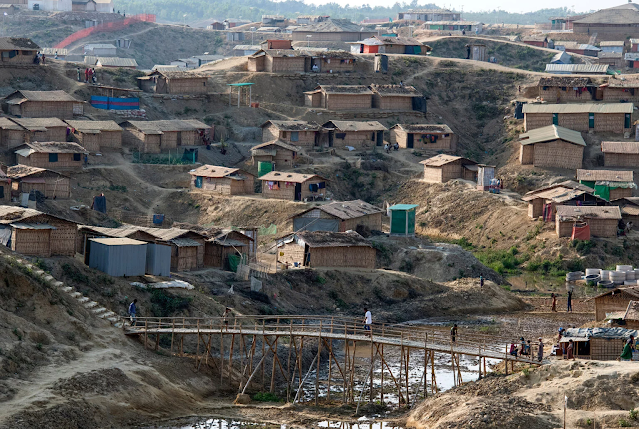
The genocidal campaign sparked the worst refugee crisis in South Asia, forcing a million to flee from the restive Rakhine state in Myanmar. Bangladesh has struggled to shelter 1.2 million Rohingyas in squalid camps in the southeast of the country.

An estimated 3.5 million Rohingya have dispersed worldwide, of whom a large percentage are in Bangladesh. Others are in India, Indonesia, Malaysia, Thailand, Saudi Arabia, United Arab Emirates and Pakistan. An estimated 600,000 Rohingya who remain in Rakhine State are victims of the Myanmar security forces’ persecution, deliberately confined 140,000 to guarded camps and villages without freedom of movement, and access to adequate food, health care, education, and livelihoods for more than 10 years.

Bangladesh, unfortunately, does not recognise these stateless people as refugees and instead describes them as “forcibly displaced Myanmar nationals.” Dhaka has yet to ratify the UN’s 1951 Refugee Convention, which protects the rights of asylum seekers. HRW has lamented that Bangladeshi authorities are also intensifying restrictions on work, movement, and education, creating a coercive environment designed to force people to consider premature returns.

Myanmar’s “all-weather friend” China stands beside the regime as it tries to weather a series of economic sanctions from the West, which slammed it after its persecution of Rohingyas and ouster of the country’s former democratically-elected leader Aung San Suu Kyi, who has been under house arrest since the military coup in February 2021.

China has been pushing the junta to initiate a so-called pilot “family-based repatriation” project, aiming to repatriate nearly a thousand refugees in the first phase.

Myanmar has an untrustworthy plan

Myanmar’s military junta wishes to appear as if it has undergone a sudden change of heart, ostensibly displaying compassion by committing to repatriate 6,000 Rohingyas by the end of the year. Myanmar has deemed these individuals foreign intruders or “illegal migrants,” denying them citizenship and subjecting them to abuse and discrimination.

In March, a delegation of Myanmar officials visited refugee camps in Bangladesh to conduct interviews and carry out a “verification” process for the pilot repatriation initiative.

“The figure of 6,000 Rohingya is a drop of water in an ocean,” says Asif Munier, a Rohingya refugee expert. The repatriation is a face-saving project of Myanmar amid country-wide embattlement with ethnic rebellions and economic crises that have worsened after economic sanctions by the United States, Canada and several European countries.

A delegation of Rohingya refugees, along with Bangladeshi government officials, toured the Hla Poe Kaung transit camp and Kyein Chaung resettlement camp in Rakhine State’s Maungdaw township on May 5. After the day-long “go and see” visit, the delegation expressed their dissatisfaction over the arrangements and facilities made by the Myanmar authorities.

Rohingya and Bangladeshi representatives seem to have two different interpretations of what they saw there. Bangladesh’s Refugee Relief and Repatriation Commissioner Mohammed Mizanur Rahman, who led the delegation, opined that “repatriation is the only solution to end the refugee crisis.” Rahman said Myanmar authorities did indeed prepare settlements for Rohingya under a pilot project. There are homes, employment opportunities and schools for Rohingya children as described by Myanmar officials.

The junta claims in the booklet that the UN Development Program, the UNHCR, and the Association of Southeast Asian Nations (ASEAN) will be involved in the pilot project  Altogether 3,500 Rohingya will be accommodated in 15 villages, says Rahman.

The delegation, however, found that their villages have been erased from the map and instead security forces occupied their lands and erected military and police barracks, outposts and check-posts. The authorities “even changed the name of my village in Rakhine,” a frustrated member of the delegation complained. Rohingya refugees are reluctant to return to Myanmar to “be confined in camps” again. They will only repatriate voluntarily if their security is guaranteed and they will be granted citizenship.

Rohingya don’t want to return to their country to be placed in glorified cages. They want to return to their own villages, from which they were forced to flee during the ethno-religious strife of August 2017. “Myanmar is our birthplace and we are citizens of Myanmar and will only go back with citizenship,” said refugee Abu Sufian, 35, father of three children told Reuters. It is not enough to move the refugees from one temporary camp in Bangladesh to another, concrete one in Myanmar. Without freedom of movement and guarantees of citizenship rights, the program is a non-starter.

Second-class citizenship for Rohingyas, if that

Refusing full citizenship to the ethnic minority, the authorities offer the Rohingya a consolation prize: a national verification card (NVC), which Rohingya refugees regard as insufficient protection. The draconian Citizenship Law of 1982 requires individuals to prove that their ancestors lived in Myanmar before 1823, and refuse to recognize Rohingya Muslims as one of the nation’s ethnic groups or list their language as a national language.

“We don’t want to be confined in camps,” Oli Hossain, who was among the refugees who visited Rakhine State in early May. He said they will never accept the NVC, which would effectively identify Rohingya as foreigners.

“Myanmar officials said that the confirmation of citizenship is a long process and would take more time to complete. Therefore, Myanmar won’t provide citizenship to the Rohingya people who want to repatriate under this pilot project,” Rahman told Turkish news agency Anadolu.

The booklet “Resettlement of Displaced Persons on their Return under the Pilot Project,” dated April 2023 and written in Burmese, English, and Bangalee, states that returnees will be housed at the Hla Poe Kaung transit camp for up to two months, then relocated to one of two resettlement camps with prefabricated houses or a land plot in one of 15 “designated villages,” where they can build a home through a cash-for-work program.

Since the crisis, Bangladesh has been trying to repatriate displaced Myanmar citizens with rights and dignity. Several attempts to repatriate the refugees fell flat in 2018 and 2019. After the failed attempts, Bangladeshi authorities echoed the UN Refugee Agency catch-phrase of safe, voluntary, dignified and sustainable repatriation of 1.2 million Rohingyas.

In April, in a crucial tripartite parley between senior Foreign Minister officials of Bangladesh, China and Myanmar in Kunming, China, the parties decided to expedite the repartition process to avoid further sanctions. Whether this will see any effects on the ground remains to be seen.

An official team from Myanmar arrived in Bangladesh for the second time in three months to build confidence among Rohingyas in early June. After the return of the Myanmar delegation from the camps in Cox’s Bazar, the refugees have been agitating to cancel the piecemeal plan, calling instead for ensurance of a dignified and sustainable repartition.

The UN Refugee Agency, after the visit of diplomats from eight ASEAN countries including Bangladesh to Rakhine State last March, said that “conditions in Rakhine State are currently not conducive to the sustainable return of Rohingya refugees,” adding that no refugee should be forced to return. Bangladesh’s hopes that the UN may be able to bring about a quick solution to the quagmire by going along with Myanmar’s pilot plan have been frustrated due to ongoing western sanctions against the military regime.

In a flurry of diplomatic consultations in Dhaka in early May, Bangladesh’s foreign minister sought the opinion of several European and North American diplomats, as well as the UN Refugee Agency. The diplomats insisted that Myanmar should restore the citizenship of Rohingya and ensure safety, security, and access to livelihood, education, healthcare and freedom of movement which were restricted after they were declared “alien” more than 40 years ago.

Western, Bangladeshi, Myanmarese, Chinese, and UN officials are all pushing for a resolution to the crisis, but the path forward remains unclear. What is certain is that no one wants a resolution more than the Rohingya people; still, they will not sacrifice their safety, liberty, or dignity for the sake of speed.

First published in the Fair Observer, 17 June 2023

Saleem Samad is an award-winning independent columnist and media rights defender based in Bangladesh. He became an Ashoka Fellow in 1991, and won the Hellman-Hammett Award in 2005. Saleem’s articles have appeared in top publications such as Time, India Today, Outlook, India Narrative, and The Times of India, and his research has been published by institutions like the Observer Research Foundation (ORF), the Kolkata Research Group, Jadavpur University, and the Maulana Abul Kalam Azad Institute of Asian Studies.

[Anton Schauble edited this piece.]

Friday, April 07, 2023

Pakistan’s fingerprints in formation of Rohingya militant group ARSA are unmistakable

SALEEM SAMAD

Initially Bangladesh, Myanmar and India failed to accept Arakan Rohingya Salvation Army (ARSA) a jihadist outfit. The militant group was described as ‘Rohingya Muslim vigilantes’ with a limited ordinance, disorganised, therefore nothing to be worried about.
The name ARSA first surfaced in August 2017, when the outfit claimed responsibility for attacks on several border police and army posts of Myanmar at the international borders with Bangladesh.
The attacks sparked Tatmadaw’s (Myanmar military) brutal genocidal campaign against Rohingya Muslims. The troops torched hundreds of villages and went on a killing rampage.
The ethnic community was forced to flee from the volatile Rakhine State of Myanmar and later sheltered in Bangladesh. The country hosts nearly 1.2 million Rohingyas.
The panicked Rohingyas poured into Bangladesh, through porous international borders, fuelling a historic migration crisis in Asia.
India is now worried that the jihadist outfit’s presence at the border of Bangladesh-Myanmar-India. ARSA’s recent skirmish with Myanmar troops has raised their eyebrows, while Bangladesh is alarmed by the visible presence of ARSA in the territory.
The ARSA militants are mostly recruited from the Rohingya refugees. It was not to anybody’s surprise that the leadership are Pakistan-born Saudi émigrés. They raise funds mostly from Rohingya living in Pakistan, Saudi Arabia and the United Arab Emirates (UAE).
Meanwhile, news surfaced that an undisclosed partnership between Bangladesh and Myanmar military led to a joint operation to address the ARSA insurgency.
The documents from a December 23 meeting of the Central Committee for Counter-Terrorism of the Myanmar Home Affairs Ministry, published by a private ‘Khit Thit Media’ on last January 10 have been verified by security experts.
The document stated that “During 2022, there have been only 4 skirmishes between our [Myanmar] forces and ARSA. We were able to meet, discuss and coordinate with the Bangladesh Border Guard Force over ARSA.
“The result was that Bangladesh special forces launched a military operation in the refugee camp where ARSA took shelter, killing the ARSA’s 2nd in Command and 2 terrorists. From one intelligence exchange with Bangladesh, we learned that the ARSA leader Ataullah and 60 of his followers are facing legal actions in Bangladesh.”
The Naypyidaw (capital of Myanmar) labelled ARSA as an “extremist Bengali [Bangalee] terrorists, also Rohingya Muslim terrorists,” warning that its goal is to establish an Islamic state in the region [South-East Asia].
In a rare interview with an international media, Ataullah Abu Ammar Jununi, commonly known simply as Ataullah, the supremo of ARSA said that their objective would be “open war” and “continued [armed] resistance” until “citizenship rights were reinstated” of Rohingyas in Myanmar.
Despite the denial of Ataullah, who was born in Karachi and moved to Saudi Arabia, of having links to the Islamic State or ISIS in a video and said he turned his back on support from Pakistani-based jihadists, security agencies of Bangladesh and India are sceptic of his claim.
A security expert in Bangladesh explains that ARSA has ideological differences from other terror outfits and has reason to distance itself from the transnational jihadist network.
The global terror network’s footprint is absent in the region. The territory is too hot to handle, as some experts explained, especially when India remains a deterrent to the physical presence of jihadists and terror networks.
The exodus of more than one million Rohingyas from restive Rakhine State has also brought the ARSA operatives and sympathisers into Bangladesh.
The security agency in Bangladesh has trained their eyes and ears on their activities. The agency explains ARSA is also known as ‘Al Yakin’ in the refugee camps – the militants prey on the refugees.
ARSA operatives are responsible for widespread kidnaps, extortions, tortures and executions of suspects. The crimes are committed to collect funds for local operations in the world’s largest squalid Rohingya camps in Cox’s Bazar, in southern Bangladesh.
Cash-starved Al Yakin, the volunteer group of ARSA is mostly responsible for gang war in the refugee camps to establish dominance over other non-militant groups in the camps.
The recruiters from sleepers-cell disseminate a message that joining ARSA or ‘Al Yakin’ was a Farj (a religious obligation).
However, ARSA remains focused on recruitment and indoctrination, followed by establishing small units and engaging in rudimentary military training.
Often breaking news from Rohingya refugee camps of robbers, dacoits, and armed gangs killed in encounters by anti-crime forces – the slain victims are radicalised Rohingya militants.
Despite ARSA’s name still commands a mix of cautious respect and fear among some in the Rohingya camps. The members remain low profile to avoid confrontation with Bangladesh security forces.
For funding the militant’s network, the foot soldiers are also engaged in providing armed escorts to cross-border smugglers and drug traders.
The intels still believe ARSA have a low ordinance and the militants were unable to launch any large-scale armed clash with Myanmar troops after August 2017.
However, Myanmar security forces do not agree and said that last year in mid-September, “the Arakan Army launched attacks in cooperating with ARSA from a certain distance on the Taungpyo Latwal police outpost near BP-31 between Myanmar and Bangladesh using small and heavy arms and three shells fell into the Bangladesh side and three exploded.
“On the other hand, their hit-and-run tactics were significantly neutralised after Myanmar troop’s crackdown on Rohingya Muslims [ARSA],” said Myanmar’s official website Info Sheet.
Myanmar blames Pakistan’s dreaded spy agency ISI for its share in mentoring the jihadist outfit. Their theory that ARSA has been raised, funded, provides logistics and indoctrination was masterminded by ISI and is also believed by both Bangladesh and India.
Consequently, the encampment at No-Man’s-Land or Zero-Point was attacked once again on January 18, 2023, resulting in the camp’s destruction, and the forced displacement of all Rohingya refugees living there, writes Saifur Rahman, a Rohingya journalist who is living in exile in a third country.

ARSA’s militancy capability remains poor due to strict surveillance by security agencies of India and Bangladesh and sharing mechanism of intels – reducing ARSA into a toothless tiger.

First published in the India Narrative on 7April 2023

Saleem Samad is an award-winning independent journalist based in Bangladesh

Saturday, September 07, 2013

Rohingya Muslim Migrants Caught in Limbo between India and Bangladesh


The historic conflict between the Indian state of West Bengal and the nation of Bangladesh has enacted a new chapter over concerns that many Rohingya Muslims have been illegally crossing into West Bengal from Bangladesh.

Officials with the Indian Border Security Force’s South Bengal Frontier (BSF) said they have arrested more than one hundred illegal Rohingya immigrants this year, and most of them likely came from Myanmar, where they have faced a brutal campaign of repression from the authorities.

“We increased our vigil on immigrants from Myanmar since the end of last year after some Rohingya Muslims were arrested… last November,” Santosh Mehra, the BSF’s inspector general said, according to Hindustan Times.

“It was tough to interact with them as they neither speak nor understand Hindi, Bengali or English.”

Rohingya also do not speak Urdu or any other Indian language. The Rohingya language is related to the Chittagonian tongue, a dialect related to Bengali that is spoken in southeastern Bangladesh, but differs from standard Bengali.

“As we don't know their [Rohingya] language, we have to get experts from universities or other agencies to act as interpreters,” Mehra told the Times of India.

The stream of illegal Rohingya immigrants has dramatically increased this year. Mehra added that in 2011 only two Myanmar Rohingya nationals were arrested in West Bengal in 2011, and just six last year.

A senior BSF official also told the Hindustan Times that the Bangladesh government has taken the initiative to expel Rohingya migrants back to Myanmar, where the overwhelmingly Buddhist majority does not want them. Myanmar authorities regard them as “illegal immigrants” from Bangladesh, while Dhaka rejects them as undocumented foreigners.

Mehra cited this catch-22 scenario by declaring that “we contact the Bangladesh High Commission [in India] after Bangladeshi migrants are held. [But] we cannot contact anyone after Rohingyas are held since no country recognizes them.”

He told the Times of India that “unlike illegal migrants from Bangladesh, it is difficult to send them back across the border … There are certain United Nations guidelines that have to be followed.”

Mehta also rejects concerns by some Indian intelligence officers that the Rohingya migrants are linked to terrorist groups, perhaps supported by entities in Bangladesh itself of even in Pakistan.

Intelligence agencies in New Delhi believe that some Rohingyas have received arms training from Islamic militant groups including the Lashkar-e-Taiba (LeT), a Pakistani-based terror outfit, in the Chittagong Hills district of Bangladesh.

Indian officials suspect that LeT -- as well as militant organizations like Jamaat-ud-Dawah and Jaish-e-Mohammad -- are using the plight of the unwanted Rohingya Muslims migrants to stir up trouble between Bangladesh and both of its neighbors,m Myanmar and India.

An Indian intelligence told Times of India that Bangladesh has assured India that it will look into the matter of training camps in the Chittagong.

“We have specific information that LeT and Jamaat-ud-Dawah created an outfit known as Difa-e-Musalman Arakan [Burma],” he said. “This outfit was assigned to tie-up with Islamic organizations in Myanmar and Bangladesh. There are several other terror groups that are involved with the Rohingyas. While the Rohingyas are receiving funds from Saudi Arabia, weapons are apparently being sourced from Thailand.”

The Times reported that over the past year-and-a-half some 10,000 Rohingya Muslims have crossed into India, residing in West Bengal, but also in Andhra Pradesh, Bihar and Uttar Pradesh. Three-thousand of them alone are living in the capital city of New Delhi. They exist in a kind of limbo, with no rights of residency and little hope of ever attaining citizenship.

But some Indians have taken up their cause.

Nawab Zafar Jung, a former vice-chancellor of Jamia Milia Islamia University, in New Delhi, in tandem with leftist student unions at Jawharlal Nehru University (JNU), are demanding the government grant the Rohingya Muslims official refugee status.

First published in International Business Times, September 06 2013


Palash Ghosh has worked as a business journalist for 21 years in New York.

Monday, July 29, 2013

Bangladesh: An Emerging Threat

SANCHITA BHATTACHARYA

On June 27, 2013, two displaced persons (DPs) were killed and another six were wounded when Security Forces (SFs) fired to disperse a crowd that had gathered at a military base in Kyein Ni Pyin, a camp for DPs in the Pauktaw area of Myanmar's Rakhine State.

Again, on June 30, 2013, three persons were injured as rioters torched two houses in the coastal town of Thandwe in Rakhine State, during clashes between Buddhists and Rohingya Muslims.

Through 2012, Myanmar had witnessed clashes between Rohingya Muslims and Buddhists in Rakhine State, resulting in about 200 deaths and displacement of some 22,000 people.

These clashes and the resultant sectarian divide in Myanmar seems to have provided an opportunity to Inter-Service Intelligence (ISI, Pakistan's external intelligence agency)-backed Islamist formations to consolidate their hold in Bangladesh making the Bangladesh-Myanmar Border their operational base.

Indeed, according to a July 21, 2013, report, India's external intelligence agency, Research and Analysis Wing (RAW), has confirmed that the Lashkar-e-Toiba (LeT) and its front, Jama'at-ud-Dawa (JuD) are working in tandem to extend their footprints along the Bangladesh-Myanmar border. While the JuD leader Hafiz Muhammad Saeed is personally leading the Myanmar campaign, espousing the cause of Rohingyas from various public platforms in Pakistan, his subordinates have been planning and undertaking visits to the Bangladesh-Myanmar border region. Intelligence sources indicate that the Pakistan-sourced support to the Rohingya's is conditional on radicalized Rohingyas undertaking operations against India as well.

In mid-2012, the JuD established a new forum, Difa-e-Musalman Arakan-Burma (Defence of Muslims in Arakan - Myanmar) in order to mobilise supporters for a campaign against the ruling military junta of Myanmar. The JuD deputed a two-member team comprising JuD 'spokesperson' Nadeem Awari and a member of the Jama'at's 'publication wing', Shahid Mehmood Rehmatullah, on August 10, 2012, for the task of forging links with senior representatives of Islamic institutions in Bangladesh and Myanmar.

In addition, Bangladesh agencies tracking one Shafiul Alam, a dual Pakistani-Nepalese passport holder, who travels frequently from Pakistan to Bangladesh, recently found that he and one Abdul Karim alias Mohammed Nur Alam, a Nepal-based Rohingya operative linked to hawala (illegal money transactions) and fake currency trafficking networks, had been trying to set up training camps along the Bangladesh-Myanmar border for Rohingya extremists, in consultation with the LeT 'commander' Ustad Abdul Hamid.

Assessing the Lashkar initiative, on February 27, 2013, Home Minister of Bangladesh Muhiuddin Khan Alamgir noted, "Pakistan-based Lashkar-e-Toiba (LeT) is active in Bangladesh and law enforcement agencies tracked down their network and kept them under sharp security vigil. It is the moral and legal obligation of the Government to uproot them totally."

Moreover, it has also been reported that other terror outfits such as Jaish-e-Mohammed (JeM) and Jama'atul Mujahideen Bangladesh (JMB), the latter with known links to Pakistan-based terrorist formations, are also trying to exploit the issue of the Rohingyas' 'plight' in Myanmar. In this effort, they are allying with NGOs led by Rohingyas, including the Rohingya Solidarity Organisation, to establish new bases in Bangladesh. Bangladeshi security agencies are examining whether Jammat-ul-Arakan, a new outfit comprising elements of JMB and extremist-minded Rohingya activists, is running militant camps in the Bandarban District along the Bangladesh-Myanmar border.

Meanwhile, links between Pakistani extremist formations and Rohingyas have also been uncovered by Bangladeshi security agencies. Bangladesh Police traced the funds in the bank account of one Maulana Mohammad Yunus, arrested in August 2012 from a madrasa (Islamic Seminary) in the Rau sub-district of Cox's Bazaar District, to Maulana Shabir Ali Ahmed, a Karachi-based, JeM-linked Bangladeshi national of Rohingya origin. Another madrasa operator, Abdur Rehman alias Imran alias Mustafa of Teknaf in Cox's Bazaar is suspected to have coordinated the arrival of Pakistan-trained Myanmarese mujahideen (holy warriors) at various locations of Cox's Bazaar at the end of 2012.

The expanding ISI footprint in the Rohingya belt of the Chittagong Hill Tracts (CHT) was also exposed following the arrest of one Noor-ul-Amin from the Idgah madarasa in Cox's Bazaar, on September 11, 2012. Amin had reportedly served as a militant 'talent spotter' and a recruiter of Rohingya cadres in the past. Confirming his association with the ISI during his interrogation, Amin disclosed that the ISI was involved in gun-running activity in the Rohingya refugee belt in CHT. According to estimates, there are about 26,000 documented refugees living in two camps in Cox's Bazar District in CHT, close to the Myanmar border. Bangladesh Minister for Foreign Affairs Dipu Moni stated that 300,000 to 500,000 Myanmar refugees had entered Bangladesh illegally. ISI agents are also known to have close connections with the drug cartels in South-east Asia.

Evidently, the sectarian clashes in Myanmar have significant potential to impact adversely on the security situation in Bangladesh, India, and Myanmar. An unnamed senior Indian official observed, "Economic and social hardships faced by Rohingya refugees apart, the involvement of the minority group in arms smuggling, narcotics, safe sanctuaries for terror elements, including setting up of training camps, is going to be a major counter-terrorism challenge in the regional context." Available intelligence inputs indicate that extremist activities of Rohingya Muslims were being funded mainly by sources in Saudi Arabia. The militant cadres among the Rohingyas were being trained by Pakistan-based terror groups and the weapons were being procured from Thailand.

At the official level, India and Myanmar have agreed to cooperate to prevent cross border movement of armed groups, share information on seizure of arms and check arms smuggling/drug trafficking. The agreement was reached during the (Joint Working Group) Meeting between Myanmar and India held at Bagan in Myanmar on June 19-20, 2013.

The cycle of violence in the border areas of Bangladesh and Myanmar has increased security vulnerabilities in the region. Accordingly, on May 18-19, 2013, a new sector and two battalions (Number 50 and 51) of Border Guard Bangladesh (BGB) were set up to ensure better border management along the Bangladesh-Myanmar border, especially in Cox's Bazar and Khagrachhari Districts. Another BGB sector has also been established in Bandarban District.

As the ISI and its terrorist proxies step in to fish in troubled waters, it is now imperative that Bangladesh, India and Myanmar act, at once and in concert, to ensure that a greater sagacity attends Myanmar's policies towards the Rohingyas, and to destroy the emerging criminal and terrorist networks that seek to exploit the opportunities of the present disorders to create greater violence and instability in the region.

First published in SOUTH ASIA INTELLIGENCE REVIEW, Weekly Assessments and Briefings,
Volume 12, No. 4, July 29, 2013

Sanchita Bhattacharya is Research Associate, Institute for Conflict Management