Buy.com Monthly Coupon
Showing posts with label Rohingya. Show all posts

Sunday, May 04, 2025

Bangladesh: ‘humanitarian corridor’ for Myanmarese

SALEEM SAMAD

Political parties from different shades of right, left, centrists, and Islamists are disturbed to hear from the media that Bangladesh has agreed to establish a ‘humanitarian corridor’ for the hungry people of war-torn Rakhine State in Myanmar.

The media in the country, quoting Foreign Affairs Ministry officials, have published sketchy information on the so-called humanitarian corridor. The Interim Government has yet to spell out details of the plan, which has raised suspicion which is now mixed with conspiracy theories.

The United Nations wants to dispatch food, medical supplies and other essentials to Rakhine, where silent famine persists.

The United Nation Development Program (UNDP) in an assessment report released in November 2024, painted a grave situation in the Rakhine state. It said the people caught in the civil war are experiencing a near famine and proposed that immediate food, medical aid, agriculture inputs, construction materials and other essentials need urgent attention from the international aid agencies.

UNDP report stated that Rakhine is on the verge of an unprecedented disaster due to a combination of interlinked issues. Restrictions on goods entering Rakhine, both internationally and domestically, have led to a severe lack of income, hyperinflation, and significantly reduced domestic food production. Essential services and a social safety net are almost non-existent, leaving an already vulnerable population at risk of collapse in the coming months.

The report shows that Rakhine’s economy has become almost dysfunctional. Critical sectors such as trade, agriculture, and construction have halted. Export-oriented, agro-based livelihoods are disappearing as markets become inaccessible due to blockades by the junta.

UN warns that Rakhine faces the imminent threat of acute famine. The worst victims of a lack of food are millions of internally displaced persons (IDPs), including Rohingyas.

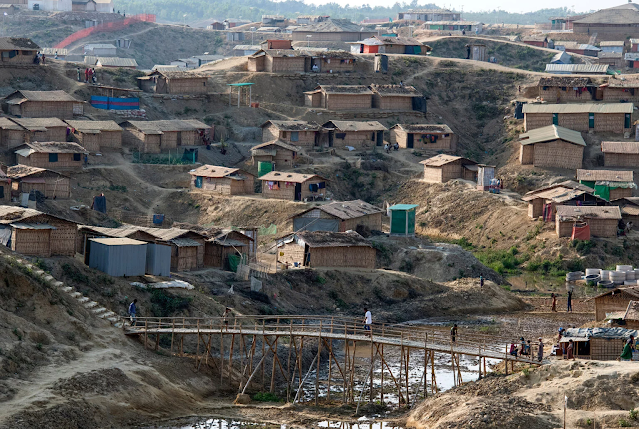
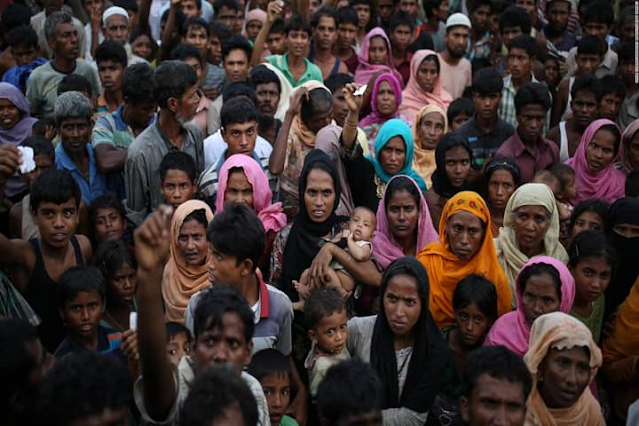
In the last couple of months, a fresh influx of Rohingya Muslims in Bangladesh has added to the already 1.2 million languishing in overcrowded camps in Cox’s Bazar, in Southeast Bangladesh.

However, there is no specific assessment of the number of IDPs in Rakhine, as they spread over the forests, hills and banks on the riverfront. The IDPs do not live in permanent shelters. They live in makeshift camps. The worst victims of internal displacement are children, women and elderly persons. They are suffering from severe malnutrition, communicable diseases and the absence of healthcare.

UN wants to address an unfolding humanitarian crisis in Rakhine and said it is only Bangladesh, its immediate neighbor separated by a kilometer-wide Naf River can save the hungry people, coupled with the absence of healthcare that has jeopardized their lives and living.

UN officials believe that Bangladesh is a trusted country which could extend help in facilitating supplies of food, medical and other essentials.

The United States Army Pacific (USARPAC) stationed in Hawaii is supposed to provide logistics and security for the IDPs in Rakhine state.

It is reported that the US military will be deployed for the logistics at the corridor at Silkhali, a small river port. The site has been secured by the Bangladesh Army, a no go for the civilians. The army would only facilitate logistics for the UN operation, said a senior government official, who is privy to the corridor.

UNDP report says that internal rice production is declining due to a lack of supplies of seeds, fertilizers, severe weather, and a rise in the number of IDPs that could no longer engage in agricultural production after the civil war erupted and repeatedly relocating to safer places has further exacerbated the miseries.

The UN estimates that with the near-total halt of trade, over 2 million people are at risk of starvation.

When UN Secretary-General Antonio Guterres visited the camps and had Iftar (food for breaking the fast in Ramadan) with the refugees, he told the Bangladesh authorities that a “humanitarian corridor” needed to be opened to reach the hungry people.

Before leaving Dhaka after a visit to Cox’s Bazar Rohingya camps, in mid-March, Guterres said he had discussed with Bangladesh authorities the possibilities of a humanitarian corridor would connect inside Myanmar as a means of creating conditions for Rohingya repatriation to Rakhine with the rebel Arakan Army which has captured except for few places resisted by the Myanmar military troops.

He said it would, however, require the “authorization and the cooperation of the parties to the conflict” in Rakhine, where the Myanmar junta is fighting the rebels, which has further caused frustration, pain and agony for the IDPs.

On the other hand, Tarique Rahman, the supremo of Bangladesh Nationalist Party (BNP), said from his London office, cautioned the Interim Government that such a decision can only be taken by the parliament.

Presently, there is no parliament, and the upcoming election is scheduled for the first half of 2026, after the Ramadan and Eid holidays. Therefore, the hungry people in Rakhine will have to wait for at least a year until an election is held in Bangladesh and a parliament begins to function.

Meanwhile, top US officials visiting Bangladesh a fortnight ago held secret meetings in Bangladesh with hybrid representatives of the United League of Arakan (ULA), a political wing of AA and Chin National Front (CNF), the political umbrella of Chin National Army.

The Chin National Army is a Chin ethnic armed organization in Myanmar. The armed wing of the Chin National Front (CNF) was founded on 20 March 1988.

The CNA and ULA are members of the United Nationalities Federal Council (UNFC), a coalition of opposition groups that aims to establish a federal system in Myanmar or achieve levels of autonomy and peace among the country’s various ethnic minorities.

Nobel laureate Aung San Suu Kyi, under house arrest and accused of sedition, is incommunicado. The former senior leaders of her party who could evade arrest and have gone underground safely are earnestly working with the ethnic rebels under the banner of UNFC.

Bangladesh Foreign Adviser Touhid Hossain told journalists that the Interim Government agreed in principle with the UN proposal on the corridor, but certain conditions must be met for its implementation.

A day later, BNP Secretary General Mirza Fakhrul Islam Alamgir slammed the interim government for making such a move without consulting the political parties.

“An interim government has no authority to make such a policy decision,” reads the statement by President Mohammad Shah Alam and General Secretary Ruhin Hossain Prince of the Communist Party of Bangladesh (CPB).

The CPB questioned that the West’s sudden interest in the Rohingya issue was “part of a broader imperialist conspiracy”.

The Islamist party Jamaat-e-Islami’s Ameer (chief), Shafiqur Rahman said the humanitarian corridor requests that the government make the issue transparent to the nation because it might involve many security issues.

Radical Islamic platform Hefazat-e-Islam Bangladesh’s fiery leader, Secretary General Mamunul Haque, opposing the move, said, “Imperialist powers are trying to implement their agenda by using Bangladesh. As a patriotic force, Hefazat-e-Islam does not support this in any way.”

In response to the concerns of the political party leaders regarding the humanitarian corridor being premature, said Shafiqul Alam, press secretary to the Chief Advisor Prof Muhammad Yunus.

To pacify the political parties, the government quickly said nothing had been finalized regarding the corridor. But said that the government would be willing to provide logistic support should there be UN-led humanitarian support to the state of Rakhine, said Khalilur Rahman, the National Security Adviser in charge of Rohingya issues, told French news agency AFP.

First published in the Stratheia Policy Journal, Islamabad, Pakistan, 4 May 2025

Saleem Samad is an award-winning independent journalist based in Bangladesh. A media rights defender with Reporters Without Borders (@RSF_inter). Recipient of Ashoka Fellowship and Hellman-Hammett Award. He could be reached at saleemsamad@hotmail.com; Twitter (X): @saleemsamad

Sunday, March 23, 2025

Rohingya Refugees Return Dim, Dimmer, and Dimmest


SALEEM SAMAD

Three significant developments have occurred in a week which once again brought the much-talked-about Rohingya refugee crisis to the global media.

First, last week United Nations Secretary General António Guterres visited the Rohingya refugees living in squalid camps in south-east Bangladesh. Besides Bangladesh, Rohingyas are languishing in camps in India, Indonesia, Malaysia and Thailand. The majoritarian Rohingyas are camped in Bangladesh.

Amid aid cuts, the Secretary-General emphasized that the international community cannot turn its back on the Rohingya crisis. “We cannot accept that the international community forgets about the Rohingyas,” he said, adding that he will “speak loudly” to world leaders that more support is urgently needed.

UN aid efforts in Rohingya camps are in jeopardy following reductions of funds announced by major donors, including the United States and several European nations. Guterres described Cox’s Bazar (where the Rohingya camps are situated) as “ground zero” for the impact of these cuts, warning of a looming humanitarian disaster if immediate action is not taken.

The visiting guest joined with the Rohingya for Iftar (not on the same menu as the refugees). The overwhelming majority of Rohingyas are Muslim, among an estimated 1.2 million refugees. A small number are Hindus and Christians. The Secretary-General could not promise how he would augment food aid and the deadline for the safe and sustainable return of the refugees to Myanmar.

Despite being a poor country, Bangladesh is hosting over one million Rohingya refugees who fled violence in neighboring Myanmar. The largest exodus followed brutal attacks by Tatmadaw (Myanmar security forces) in 2017. A series of dreadful events prompted the UN High Commissioner for Human Rights to describe the atrocities as a “textbook example of ethnic cleansing.”

Myanmar military junta under General Min Aung Hlaing who has ruled Myanmar as the State Administration Council (SAC) chairman since seizing power in the  February 2021 coup d’état overthrowing the elected government of Nobel laureate Aung San Suu Kyi.

Hlaing refuses to hold parley with the United Nations officials and does not speak with Bangladesh. Also has imposed restrictions on international NGOs and aid agencies. Such arrogance became visible after the United Nations Independent International Fact-Finding Mission on Myanmar, led by Marzuki Darusman, said that Min Aung Hlaing, along with four other Generals (Soe Win, Aung Kyaw Zaw, Maung Maung Soe, and Than Oo) should be tried for war crimes and crimes against humanity (including genocide) in the International Criminal Court (ICC), at The Hague, The Netherlands.

Recently, the Rakhine state, 36,762 square kilometers (14,194 sq mi) bordering Bangladesh has been overrun by battle-hardened Arakan Army (AA) guerillas. The AA dashed all hopes for the repartition of Rohingyas when the guerilla headquarters issued an official statement extending an olive branch to hold dialogue with Bangladesh authorities but on one condition. The agenda for discussion should not include the return of Bengali Muslims (which means Rohingya).

However, AA urges to continue trade and commerce, border security, and a few other bilateral issues. Bangladesh deliberately did not respond. Dhaka does not recognize ethnic military command to be a legitimate authority to hold official talks. Myanmar military junta and the rebels have similar mindsets identifying the Rohingyas as “Bengali Muslims” who have been blamed for illegally migrating from neighboring Bangladesh since a century ago.

The draconian Citizenship Law of 1982 requires individuals to prove that their ancestors lived in Myanmar before 1823, refuse to recognize Rohingya Muslims as one of the nation’s ethnic groups and delist their language as a national language.

Bangladesh has earlier raised the refugee crisis at several international platforms including the Organization of Islamic Cooperation (OIC), Non-Aligned Movement (NAM), the Commonwealth, the United Nations, and other global summits. Despite limited or no contributions for the ‘stateless’ Rohingya, instead the world Muslim countries lauded Bangladesh for providing food and shelter to them.

Unfortunately, several attempts to repatriate the refugees fell flat in 2018 and 2019. Instead, Bangladesh blames the intransigent policy of Suu Kyi’s government, which was ousted by military leaders and placed her under house arrest in February 2021. Academicians and researchers on forced migration and the refugee crisis are convinced that there is no light at the end of the tunnel.

Second, the United Nations World Food Program (WFP) warns of a critical funding shortfall for its emergency response operations in Bangladesh, jeopardizing food assistance for over one million Rohingya refugees in Bangladesh.

Without urgent new funding, monthly rations will be halved to US$6 per person, down from US$12.50 per person – just as refugees were preparing to observe Eid, the biggest Muslim festival at the end of Ramadan at the end of this month. To sustain full rations, WFP urgently requires US$15 million for April, and US$81 million until the end of 2025.

In recent months, as conflicts in Rakhine state were at the peak between AA and the junta’s soldiers, fresh waves of Rohingya refugees exceeding 100,000 have crossed into Bangladesh. The continued trickle of Rohingya seeking safety has further contributed to greater strain on already overstretched resources.

Bangladesh’s government for decades refused to recognize the Rohingya as “refugees”, in an excuse that the government has not signed the Convention on the Status of Refugees of 1951.

For a million population with no legal status, no freedom of movement outside the camps, confined inside barbed wires and no sustainable livelihood opportunities, further cuts will exacerbate protection and security risks, says the UN agency.

The vulnerability is likely to heighten risks of exploitation, trafficking, prostitution, and domestic violence among women and girls. Children are expected to drop out of learning schools and be forced into child labor. There will be a spike in child brides as families resort to desperate measures to survive on meager rations.

Third, on the day when Fortify Rights released its 78-page research report, “I May Be Killed Any Moment: Killings, Abductions, Torture, and Other Serious Violations by Rohingya Militant Groups in Bangladesh” in Dhaka, the special security forces nabbed the Islamic jihadist Arakan Rohingya Salvation Army (ARSA) supremo Ataullah Abu Ammar Jununi, commonly known as Ataullah near the capital Dhaka on 18 March without a firefight.

Fortify Rights, an international human rights investigation NGO, recommends that the Government of Bangladesh and international justice mechanisms – including the Independent Investigative Mechanism for Myanmar and the ICC – investigate Rohingya militant organizations operational in the refugee camps in Bangladesh and prosecute those responsible for war crimes.

Such specific Intel in capturing Ataullah must have been shared by Pakistan’s military establishment in Rawalpindi. International media has been blaming Pakistan’s spy agency ISI for recruitment, training and funding for ARSA.

Indian security agency Research and Analysis Wing (RAW) has kept ARSA under strict surveillance. Monitoring their leader’s sleeper cell, monetary exchanges, and their covert activities.

ARSA first came into the limelight in August 2017 after the jihadist overran several Myanmar’s Border Guards Forces outposts along Bangladesh-Myanmar international borders. After the firefight, ARSA fell back to Bangladesh’s no-man’s-land, which is covered by hill forests and scores of streams.

Earlier, Bangladesh, Myanmar and India refused to accept ARSA as a jihadist outfit. The militant group was described as ‘Rohingya Muslim vigilantes’ with a limited ordinance and disorganized, therefore nothing to be worried about was in their mind.

ARSA’s attacks sparked Tatmadaw’s (Myanmar military) to commit a brutal genocidal campaign against Rohingya Muslims. The troops torched hundreds of villages and went on a rampage for months despite international calls to cease brutality against the Rohingyas.

The Naypyidaw labeled ARSA as an “extremist Bengali terrorists, also Rohingya Muslim terrorists,” warning that its goal is to establish an Islamic state in the Rakhine state. Such an ambitious objective will be difficult to implement in a Buddhist-majority region.

Myanmar blames Pakistan’s dreaded Pakistan’s spy agency ISI for its share in mentoring the jihadist outfit. Their theory that ARSA has been raised, funded, and provides logistics and indoctrination was masterminded by ISI and is also believed by both Bangladesh and India.

Simultaneously, India became worried about the presence of the jihadist outfit at the border of Bangladesh-Myanmar-India. The skirmish with Myanmar troops has also raised the eyebrows of Bangladesh and expressed alarm on the visible presence of ARSA in its territory.

The ARSA militants were mostly recruited from the Rohingya refugees. It was not to anybody’s surprise that the leadership was Pakistan-born Saudi émigrés. They raise funds mostly from Rohingyas living in Pakistan, Saudi Arabia and the United Arab Emirates (UAE).

Several years ago, in a rare interview with an international media, Ataullah, chief of ARSA said that their objective would be “open war” and “continued [armed] resistance” against the Myanmar government until “citizenship rights were reinstated” of Rohingyas in Myanmar.

The jihadist leader denied having links to the Islamic State or ISIS in a video and said he turned his back on support from Pakistan-based jihadists. The Bangladesh security agencies were skeptical of his claim.

A security expert in Bangladesh explains that ARSA has ideological differences from other terror outfits in the region and has reason to distance itself from the transnational jihadist network.

ARSA operatives are responsible for widespread abduction, extortions, tortures and executions of suspects. The crimes are committed to collect funds for local operations in the world’s largest Rohingya camps, says Fortify Rights in their latest report.

Cash-starved Al Yakin, the volunteer group of ARSA is mostly responsible for gang war in the refugee camps to establish dominance over other non-militant groups in the sprawling camps.

Often breaking news from Rohingya refugee camps of robbers, dacoits, and armed gangs killed in encounters by anti-crime forces – the slain victims are radicalized Rohingya militants.

Fortify Rights urges that Bangladesh should hold the Rohingya militants accountable for war crimes. Bangladesh’s Interim Government should cooperate with international justice mechanisms to investigate crimes and bring potential war criminals to justice.

Donor governments should work with Bangladesh to redouble services for Rohingya at risk, including protective spaces and third-country resettlement, said Fortify Rights.

In an interview that aired on 4 March 2025, the head of Bangladesh Interim Government, Prof Muhammad Yunus, spoke about violence in the refugee camps, saying: “There is lots of violence, lots of drugs, lots of paramilitary activities inside the camps.”

“War crimes are usually committed within the immediate theater of armed conflict but, in this case, specific crimes in Bangladesh are directly connected to the war in Myanmar and constitute war crimes,” says John Quinley, Director at Fortify Rights.

Rohingya refugees in Bangladesh have suffered years of violence and killings at the hands of Rohingya militant groups. Reported killings by camp-based militants numbered 22 in 2021, 42 in 2022, 90 in 2023, and at least 65 in 2024.

The majority of the killings by Rohingya militants documented by Fortify Rights occurred with impunity in the camps, creating a climate of fear for all camp residents, said Fortify Rights.

ARSA and a rival Islamist militant outfit, the Rohingya Solidarity Organization (RSO) are engaged in Myanmar’s internal armed conflict. They are both fighting with the Myanmar junta and against the Arakan Army, with very little impact militarily.

To reinforce their armed campaigns inside Myanmar, ARSA, and RSO have abducted refugees in Bangladesh and forced them to fight in Myanmar. Such acts are grave violations of the laws of war and should be investigated as possible war crimes.

The ICC has already established jurisdiction and opened an investigation into cross-border atrocity crimes occurring against Rohingya in both Bangladesh and Myanmar. This should include crimes committed by ARSA and similar groups, said Fortify Rights.

In 2019, the British-born ICC Chief Prosecutor Karim Ahmad Khan at the time said the court was “aware of a number of acts of violence allegedly committed by ARSA,” noting that the allegations would be kept “under review.”

First published in the Stratheia Policy Journal, Islamabad, Pakistan on 23 March 2025 

Saleem Samad is an award-winning independent journalist based in Bangladesh. A media rights defender with the Reporters Without Borders (@RSF_inter). Recipient of Ashoka Fellowship and Hellman-Hammett Award. He could be reached at saleemsamad@hotmail.com; Twitter (X): @saleemsamad

Friday, February 23, 2024

The fractured state of Myanmar

Myamnar rebels gains ground - Photo: Public Domain 

SALEEM SAMAD

If anybody reads Myanmar's state-run daily newspaper, the Global New Light of Myanmar, the oldest English Daily which covers news, the state Myanmar Radio and Television (MRTV), one would not fathom the crisis faced by the Myanmar government.

News coming in from dissidents, journalists and media activists inside Myanmar rebel-held regions gives diametrically opposite news, which is not comfortable for the military junta in the capital, Naypyidaw.

The rebels are upbeat when they could make the government troops withdraw from northern Rakhine State after the onslaught of the rebel Arakan Army (AA).

The AA is one of the three ethnic armies in the Brotherhood Alliance, which launched Operation 1027 against the Myanmar military dictator, which ousted an elected government of Nobel laureate Aung San Suu Kyi in February 2021, ending a 10-year experiment with democracy and plunging the Southeast Asian nation into bloody turmoil.

Armed insurgencies by the People's Defence Force (PDF) of the National Unity Government (NUG) have erupted throughout Myanmar in response to the military government's crackdown on anti-coup protests.

As of February 7, 2024, at least 6,337 civilians, including children, have been killed by the junta forces and 21,000 arrested.

Meanwhile, pictures and videos surfaced on social media and several other websites of the rebels, indicating that they have taken control of six towns in Rakhine State—Pauktaw, Kyauktaw, Minbya, Mrauk-U, Taungpyoletwe and Myebon—and one in Chin State, Paletwa.

The government soldiers, in retaliation, are attacking civilians in the south. The Rohingyas in the north of Rakhine State have also taken the brunt and fled from their settlement.

The guards of the Rohingya settlements have long abandoned their checkposts and the ethnic community has scattered for safety and security.

Unfortunately, the Arakan Army is equally not so kind to them. The Rohingya forced them to flee towards the coasts of the Naf River, with advice to cross into Bangladesh.

They are asked to join their relatives and neighbours living in squalid refugee camps in Cox’s Bazar.

Intensified patrols and vigilance of Bangladesh Border Guards (BGB) and Coast Guards have discouraged them from crossing the river, which borders Bangladesh with Myanmar.

Several sources in Ukhiya in Cox’s Bazar and Ghumdhum in Bandarban have indicated that some Rohingya, after taking dangerous journeys through the hill forests, have trekked into the camps.

Officials working with international NGOs have confirmed the incidents of some illegal migration and have been sheltered in the camps by relatives mostly.

The NGO officials declined to be named and said they are not expecting a huge or even moderate influx of Rohingya people, as the borders are sealed.

The refugee leaders and camp leaders are reviewing the situation across the border into Rakhine State. They are in touch with scores of Rohingyas who are living in extreme difficulties.

The Home boss and Chief of BGB have reiterated that they will not allow a single Rohingya to enter Bangladeshi territory under any circumstances.

UN Special Rapporteur on Myanmar

On the other end of the world, Myanmar’s ruling military junta has “doubled down” on civilian attacks while showing signs of becoming “increasingly desperate” by imposing military service, the UN special rapporteur UN’s Tom Andrews said at Geneva on Wednesday.

“While wounded and increasingly desperate, the Myanmar military junta remains extremely dangerous,” the UN’s Tom Andrews said in a statement.

Earlier this month, the conscription law, the junta was trying to justify and expand its pattern of forced recruitment.

The junta faces widespread armed opposition to its rule three years after seizing power from an elected civilian government and has recently suffered a series of stunning losses to an armed alliance of ethnic minority groups.

Junta Families Evacuated

On last Saturday, a naval vessel reportedly carrying family members of the junta and police personnel was seen departing from Maday Island, where the Kyaukphyu deep-sea port project is located.

Earlier, on February 15 and 16, the family members were evacuated from Ma Ei town by helicopter. Later the soldiers and police personnel were seen leaving Ma Ei police station in military vehicles.

Following the Arakan Army's capture of many towns after the conflicts erupted in Ramree, Taungup and Kyaukphyu localities, the military regime relocated their family members to Kyaukphyu, Thandwe and Ann localities. Later, the officer’s families were shifted to Yangon.

Sittwe Braced for Street Fight

Fighting continued in northern and southern Rakhine State since the AA launched an offensive against Myanmar’s junta in mid-November last year.

The AA has seized Mrauk-U, Minbya, Kyauktaw and Pauktaw towns and Paletwa in southern Chin State, along with numerous junta bases and border outposts. Only Sittwe remains to be occupied by AA.

The AA has urged the government’s Regional Operations Command in the state capital, Sittwe, to surrender. Sittwe is the junta’s administrative seat in Rakhine.

The junta forces are systematically fortifying their defence arrangements in Sittwe. They have obstructed the access of roads and even destroyed many bridges to obstruct AA advancements.

Civil administrative officials and residents have left Sittwe in fear for their lives during the street battle. Many residents cannot afford to leave and there is no way out from Sittwe if fighting breaks out.

Commodities and fuels in Sittwe are running low since the roads were blocked. Shops are selling off their stocks as they are in a hurry to leave the city.

Despite the night curfew in Sittwe, the hospitals and clinics are still operational, but the city is in panic.

The Brotherhood Alliance warned civilians of the rising danger of landmines in Rakhine State, saying the junta’s military is placing landmines around its outposts and bases there.

Nervous Junta

Junta troops arrested around 600 civilians after their flights from Yangon landed at two airports in Sittwe and Kyaukphyu city in Rakhine state, according to family members, who said the military is holding them on suspicion of attempting to join the armed rebels.

The arrests come amid the enactment of a conscription law that has sent draft-eligible civilians fleeing from Myanmar’s cities, saying they would rather leave the country or join anti-junta forces in remote border areas than fight for the military.

India-Myanmar Military Forge Ties

Myanmar Tatmadaw and the Indian Armed Forces to forge friendly ties and further cooperation.

The Vice-Chairman of the State Administration Council Deputy Commander-in-Chief of Defence Services Commander-in-Chief (Army) Vice-Senior General Soe Win held parleys with an India Army delegation led by Lt-Gen Harjeet Singh Sahi, the General Officer Commanding III Corps of the Indian Armed Forces, at the capital Naypyidaw on Wednesday, according to the official daily The Global New Light of Myanmar.

They cordialy discussed friendly relations between Myanmar and India and the two armed forces and promotion of further cooperation, and plans to cooperate in peace and stability, security and development at the border regions between the two countries.

First published in The Daily Mesenger, 23 February 2024

Saleem Samad, is Deputy Editor of The Daily Messenger, an award-winning independent journalist, and recipient of the Ashoka Fellowship and Hellman-Hammett Award. He could be reached at <saleemsamad@hotmail.com>; Twitter (X) @saleemsamad

Saturday, June 17, 2023

Bangladesh’s Patience is Waning for Rohingyas in Need


SALEEM SAMAD

Bangladesh has taken the brunt of Myanmar’s Rohingya exodus. Officials are anxious to send the 1.2 million refugees home, but rights groups say that they must not be pressured to return without guarantees of safety. Myanmar’s military government still does not recognize their citizenship, and many Rohingya fear they would be heading into new prisons if they return.

Despite receiving advisory notes from the United Nations High Commission for Refugees (UNHCR) and warnings from Human Rights Watch (HRW) in Washington, Bangladesh has shown indifference to the potential dangers faced by Rohingya refugees upon their forced return to Myanmar. These dangers include persecution and apartheid at the hands of the Myanmar military junta, not to mention the risk of natural disasters.

Meanwhile, China has engaged in intense diplomatic negotiations with the Myanmar military junta, urging them to address the Rohingya crisis to avoid potential repercussions from the International Court of Justice (ICJ), where Myanmar faces charges, brought by the Gambia, of genocide against the Rohingya ethnic minorities. The UN described the genocide of the Muslim Rohingya as a “textbook example of ethnic cleansing,” which Myanmar has repeatedly denied.

An exodus of millions

The genocidal campaign sparked the worst refugee crisis in South Asia, forcing a million to flee from the restive Rakhine state in Myanmar. Bangladesh has struggled to shelter 1.2 million Rohingyas in squalid camps in the southeast of the country.

An estimated 3.5 million Rohingya have dispersed worldwide, of whom a large percentage are in Bangladesh. Others are in India, Indonesia, Malaysia, Thailand, Saudi Arabia, United Arab Emirates and Pakistan. An estimated 600,000 Rohingya who remain in Rakhine State are victims of the Myanmar security forces’ persecution, deliberately confined 140,000 to guarded camps and villages without freedom of movement, and access to adequate food, health care, education, and livelihoods for more than 10 years.

Bangladesh, unfortunately, does not recognise these stateless people as refugees and instead describes them as “forcibly displaced Myanmar nationals.” Dhaka has yet to ratify the UN’s 1951 Refugee Convention, which protects the rights of asylum seekers. HRW has lamented that Bangladeshi authorities are also intensifying restrictions on work, movement, and education, creating a coercive environment designed to force people to consider premature returns.

Myanmar’s “all-weather friend” China stands beside the regime as it tries to weather a series of economic sanctions from the West, which slammed it after its persecution of Rohingyas and ouster of the country’s former democratically-elected leader Aung San Suu Kyi, who has been under house arrest since the military coup in February 2021.

China has been pushing the junta to initiate a so-called pilot “family-based repatriation” project, aiming to repatriate nearly a thousand refugees in the first phase.

Myanmar has an untrustworthy plan

Myanmar’s military junta wishes to appear as if it has undergone a sudden change of heart, ostensibly displaying compassion by committing to repatriate 6,000 Rohingyas by the end of the year. Myanmar has deemed these individuals foreign intruders or “illegal migrants,” denying them citizenship and subjecting them to abuse and discrimination.

In March, a delegation of Myanmar officials visited refugee camps in Bangladesh to conduct interviews and carry out a “verification” process for the pilot repatriation initiative.

“The figure of 6,000 Rohingya is a drop of water in an ocean,” says Asif Munier, a Rohingya refugee expert. The repatriation is a face-saving project of Myanmar amid country-wide embattlement with ethnic rebellions and economic crises that have worsened after economic sanctions by the United States, Canada and several European countries.

A delegation of Rohingya refugees, along with Bangladeshi government officials, toured the Hla Poe Kaung transit camp and Kyein Chaung resettlement camp in Rakhine State’s Maungdaw township on May 5. After the day-long “go and see” visit, the delegation expressed their dissatisfaction over the arrangements and facilities made by the Myanmar authorities.

Rohingya and Bangladeshi representatives seem to have two different interpretations of what they saw there. Bangladesh’s Refugee Relief and Repatriation Commissioner Mohammed Mizanur Rahman, who led the delegation, opined that “repatriation is the only solution to end the refugee crisis.” Rahman said Myanmar authorities did indeed prepare settlements for Rohingya under a pilot project. There are homes, employment opportunities and schools for Rohingya children as described by Myanmar officials.

The junta claims in the booklet that the UN Development Program, the UNHCR, and the Association of Southeast Asian Nations (ASEAN) will be involved in the pilot project  Altogether 3,500 Rohingya will be accommodated in 15 villages, says Rahman.

The delegation, however, found that their villages have been erased from the map and instead security forces occupied their lands and erected military and police barracks, outposts and check-posts. The authorities “even changed the name of my village in Rakhine,” a frustrated member of the delegation complained. Rohingya refugees are reluctant to return to Myanmar to “be confined in camps” again. They will only repatriate voluntarily if their security is guaranteed and they will be granted citizenship.

Rohingya don’t want to return to their country to be placed in glorified cages. They want to return to their own villages, from which they were forced to flee during the ethno-religious strife of August 2017. “Myanmar is our birthplace and we are citizens of Myanmar and will only go back with citizenship,” said refugee Abu Sufian, 35, father of three children told Reuters. It is not enough to move the refugees from one temporary camp in Bangladesh to another, concrete one in Myanmar. Without freedom of movement and guarantees of citizenship rights, the program is a non-starter.

Second-class citizenship for Rohingyas, if that

Refusing full citizenship to the ethnic minority, the authorities offer the Rohingya a consolation prize: a national verification card (NVC), which Rohingya refugees regard as insufficient protection. The draconian Citizenship Law of 1982 requires individuals to prove that their ancestors lived in Myanmar before 1823, and refuse to recognize Rohingya Muslims as one of the nation’s ethnic groups or list their language as a national language.

“We don’t want to be confined in camps,” Oli Hossain, who was among the refugees who visited Rakhine State in early May. He said they will never accept the NVC, which would effectively identify Rohingya as foreigners.

“Myanmar officials said that the confirmation of citizenship is a long process and would take more time to complete. Therefore, Myanmar won’t provide citizenship to the Rohingya people who want to repatriate under this pilot project,” Rahman told Turkish news agency Anadolu.

The booklet “Resettlement of Displaced Persons on their Return under the Pilot Project,” dated April 2023 and written in Burmese, English, and Bangalee, states that returnees will be housed at the Hla Poe Kaung transit camp for up to two months, then relocated to one of two resettlement camps with prefabricated houses or a land plot in one of 15 “designated villages,” where they can build a home through a cash-for-work program.

Since the crisis, Bangladesh has been trying to repatriate displaced Myanmar citizens with rights and dignity. Several attempts to repatriate the refugees fell flat in 2018 and 2019. After the failed attempts, Bangladeshi authorities echoed the UN Refugee Agency catch-phrase of safe, voluntary, dignified and sustainable repatriation of 1.2 million Rohingyas.

In April, in a crucial tripartite parley between senior Foreign Minister officials of Bangladesh, China and Myanmar in Kunming, China, the parties decided to expedite the repartition process to avoid further sanctions. Whether this will see any effects on the ground remains to be seen.

An official team from Myanmar arrived in Bangladesh for the second time in three months to build confidence among Rohingyas in early June. After the return of the Myanmar delegation from the camps in Cox’s Bazar, the refugees have been agitating to cancel the piecemeal plan, calling instead for ensurance of a dignified and sustainable repartition.

The UN Refugee Agency, after the visit of diplomats from eight ASEAN countries including Bangladesh to Rakhine State last March, said that “conditions in Rakhine State are currently not conducive to the sustainable return of Rohingya refugees,” adding that no refugee should be forced to return. Bangladesh’s hopes that the UN may be able to bring about a quick solution to the quagmire by going along with Myanmar’s pilot plan have been frustrated due to ongoing western sanctions against the military regime.

In a flurry of diplomatic consultations in Dhaka in early May, Bangladesh’s foreign minister sought the opinion of several European and North American diplomats, as well as the UN Refugee Agency. The diplomats insisted that Myanmar should restore the citizenship of Rohingya and ensure safety, security, and access to livelihood, education, healthcare and freedom of movement which were restricted after they were declared “alien” more than 40 years ago.

Western, Bangladeshi, Myanmarese, Chinese, and UN officials are all pushing for a resolution to the crisis, but the path forward remains unclear. What is certain is that no one wants a resolution more than the Rohingya people; still, they will not sacrifice their safety, liberty, or dignity for the sake of speed.

First published in the Fair Observer, 17 June 2023

Saleem Samad is an award-winning independent columnist and media rights defender based in Bangladesh. He became an Ashoka Fellow in 1991, and won the Hellman-Hammett Award in 2005. Saleem’s articles have appeared in top publications such as Time, India Today, Outlook, India Narrative, and The Times of India, and his research has been published by institutions like the Observer Research Foundation (ORF), the Kolkata Research Group, Jadavpur University, and the Maulana Abul Kalam Azad Institute of Asian Studies.

[Anton Schauble edited this piece.]

Monday, May 29, 2023

Why Rohingya repartition plan to Myanmar has hit a roadblock


SALEEM SAMAD

The million Rohingya refugees living in squalid camps in southeast Bangladesh refused to be resettled into another encampment in Myanmar.

The refusal of the refugees to return to Myanmar has not come as a surprise. They argue that unless Myanmar guarantees their citizenship rights, freedom of movement, access to livelihood, healthcare and education, a sustainable repartition will be half-hearted.

The response by the Rohingya refugees follows Myanmar government’s sudden offer to repatriate by the end of the year 6,000 Rohingya who were regarded as “illegal migrants” in Myanmar.

In persuasion of the repartition offer, a delegation of Rohingya refugees along with Bangladesh government officials recently visited Maungdaw Township and adjoining villages in the Rakhine State resettlement plan.

The settlements were built with support from China, India and Japan. Altogether 3,500 Rohingya will be accommodated in 15 villages, says Rahman.

Bangladesh’s Refugee Relief and Repatriation Commissioner (RRRC) in Cox’s Bazar, Mohammed Mizanur Rahman who led the delegation observed that “repatriation was the only solution to end the refugee crisis”.

However, on their return, they expressed dissatisfaction over the arrangements and facilities made by the Myanmar authority.

Myanmar’s capital Naypyidaw conspicuously remain silent over the returnees citizenship rights, but assured that the Rohingya will be given a c, which the Rohingya refugees regard as too little and too less.

The controversial Citizenship Law of 1982 requires individuals to prove that their ancestors lived in Myanmar before 1823, and refuse to recognise Rohingya Muslims as one of the nation’s ethnic groups or list their language as a national language.

“We don’t want to be confined in resettlement camps,” remarked Oli Hossain, a refugee delegate. He explained that they will never accept NVC, which apparently identifies the Rohingya as ‘aliens’.

Bangladesh authorities also told the United Nations High Commission for Refugees (UNHCR) or UN Refugee Agency, which advocates for the safe, voluntary, dignified and sustainable repatriation of 1.2 million Rohingya refugees who fled the ethno-religious strife in 2017 amid a military crackdown.

The crackdown was sparked after the Islamic jihadist Arakan Rohingya Salvation Army (ARSA) overran a couple of Myanmar Border Guards Forces outposts in August 2017.

Naypyidaw for several years refused to hold dialogue regarding the return of Rohingya, stating that they are not citizens of Myanmar.

Bangladesh has raised the refugee crisis at several international platforms and other global summits. The world leaders lauded Bangladesh leader Sheikh Hasina for providing food and shelter to a million ‘stateless’ Rohingya.

Unfortunately, several attempts to repatriate the refugees fell flat in 2018 and 2019. Instead, Bangladesh blames the intransigent policy of the Nobel laureate Aung San Suu Kyi who was placed under house arrest in February 2021, in the wake of her government’s ouster by military leaders.

Finally, Myanmar’s ‘all-weather friend’ China could pursue Naypyidaw to renew the negotiation on repartition.

Recently, at a critical tripartite meeting of the Foreign Ministry officials between Bangladesh, China and Myanmar in Kunming, despite reservation from the UN Human Rights Office and UN Refugee Agency that Rakhine State is unsafe for repatriation.

Beijing has a crucial regional agenda and several mega Belt and Road Initiative (BRI) projects are in progress with Naypyidaw.

Some hiccups have emerged in ties between Bangladesh and China especially after Dhaka gave a thumbs-up to join the Indo-Pacific security axis.

Furthermore, Bangladesh has cancelled the deep-sea port in the Bay of Bengal, a multi-purpose barrage over the Teesta River and a couple of other projects after India raised objections.

Researchers on forced migration said they do not see any light at the end of the tunnel for the refugees to return to their homes by the end of this year.

First published in the India Narrative, 29 May 2023

(Saleem Samad is an award-winning independent journalist based in Bangladesh. Views expressed are personal. Twitter: @saleemsamad)


Friday, April 07, 2023

Pakistan’s fingerprints in formation of Rohingya militant group ARSA are unmistakable

SALEEM SAMAD

Initially Bangladesh, Myanmar and India failed to accept Arakan Rohingya Salvation Army (ARSA) a jihadist outfit. The militant group was described as ‘Rohingya Muslim vigilantes’ with a limited ordinance, disorganised, therefore nothing to be worried about.
The name ARSA first surfaced in August 2017, when the outfit claimed responsibility for attacks on several border police and army posts of Myanmar at the international borders with Bangladesh.
The attacks sparked Tatmadaw’s (Myanmar military) brutal genocidal campaign against Rohingya Muslims. The troops torched hundreds of villages and went on a killing rampage.
The ethnic community was forced to flee from the volatile Rakhine State of Myanmar and later sheltered in Bangladesh. The country hosts nearly 1.2 million Rohingyas.
The panicked Rohingyas poured into Bangladesh, through porous international borders, fuelling a historic migration crisis in Asia.
India is now worried that the jihadist outfit’s presence at the border of Bangladesh-Myanmar-India. ARSA’s recent skirmish with Myanmar troops has raised their eyebrows, while Bangladesh is alarmed by the visible presence of ARSA in the territory.
The ARSA militants are mostly recruited from the Rohingya refugees. It was not to anybody’s surprise that the leadership are Pakistan-born Saudi émigrés. They raise funds mostly from Rohingya living in Pakistan, Saudi Arabia and the United Arab Emirates (UAE).
Meanwhile, news surfaced that an undisclosed partnership between Bangladesh and Myanmar military led to a joint operation to address the ARSA insurgency.
The documents from a December 23 meeting of the Central Committee for Counter-Terrorism of the Myanmar Home Affairs Ministry, published by a private ‘Khit Thit Media’ on last January 10 have been verified by security experts.
The document stated that “During 2022, there have been only 4 skirmishes between our [Myanmar] forces and ARSA. We were able to meet, discuss and coordinate with the Bangladesh Border Guard Force over ARSA.
“The result was that Bangladesh special forces launched a military operation in the refugee camp where ARSA took shelter, killing the ARSA’s 2nd in Command and 2 terrorists. From one intelligence exchange with Bangladesh, we learned that the ARSA leader Ataullah and 60 of his followers are facing legal actions in Bangladesh.”
The Naypyidaw (capital of Myanmar) labelled ARSA as an “extremist Bengali [Bangalee] terrorists, also Rohingya Muslim terrorists,” warning that its goal is to establish an Islamic state in the region [South-East Asia].
In a rare interview with an international media, Ataullah Abu Ammar Jununi, commonly known simply as Ataullah, the supremo of ARSA said that their objective would be “open war” and “continued [armed] resistance” until “citizenship rights were reinstated” of Rohingyas in Myanmar.
Despite the denial of Ataullah, who was born in Karachi and moved to Saudi Arabia, of having links to the Islamic State or ISIS in a video and said he turned his back on support from Pakistani-based jihadists, security agencies of Bangladesh and India are sceptic of his claim.
A security expert in Bangladesh explains that ARSA has ideological differences from other terror outfits and has reason to distance itself from the transnational jihadist network.
The global terror network’s footprint is absent in the region. The territory is too hot to handle, as some experts explained, especially when India remains a deterrent to the physical presence of jihadists and terror networks.
The exodus of more than one million Rohingyas from restive Rakhine State has also brought the ARSA operatives and sympathisers into Bangladesh.
The security agency in Bangladesh has trained their eyes and ears on their activities. The agency explains ARSA is also known as ‘Al Yakin’ in the refugee camps – the militants prey on the refugees.
ARSA operatives are responsible for widespread kidnaps, extortions, tortures and executions of suspects. The crimes are committed to collect funds for local operations in the world’s largest squalid Rohingya camps in Cox’s Bazar, in southern Bangladesh.
Cash-starved Al Yakin, the volunteer group of ARSA is mostly responsible for gang war in the refugee camps to establish dominance over other non-militant groups in the camps.
The recruiters from sleepers-cell disseminate a message that joining ARSA or ‘Al Yakin’ was a Farj (a religious obligation).
However, ARSA remains focused on recruitment and indoctrination, followed by establishing small units and engaging in rudimentary military training.
Often breaking news from Rohingya refugee camps of robbers, dacoits, and armed gangs killed in encounters by anti-crime forces – the slain victims are radicalised Rohingya militants.
Despite ARSA’s name still commands a mix of cautious respect and fear among some in the Rohingya camps. The members remain low profile to avoid confrontation with Bangladesh security forces.
For funding the militant’s network, the foot soldiers are also engaged in providing armed escorts to cross-border smugglers and drug traders.
The intels still believe ARSA have a low ordinance and the militants were unable to launch any large-scale armed clash with Myanmar troops after August 2017.
However, Myanmar security forces do not agree and said that last year in mid-September, “the Arakan Army launched attacks in cooperating with ARSA from a certain distance on the Taungpyo Latwal police outpost near BP-31 between Myanmar and Bangladesh using small and heavy arms and three shells fell into the Bangladesh side and three exploded.
“On the other hand, their hit-and-run tactics were significantly neutralised after Myanmar troop’s crackdown on Rohingya Muslims [ARSA],” said Myanmar’s official website Info Sheet.
Myanmar blames Pakistan’s dreaded spy agency ISI for its share in mentoring the jihadist outfit. Their theory that ARSA has been raised, funded, provides logistics and indoctrination was masterminded by ISI and is also believed by both Bangladesh and India.
Consequently, the encampment at No-Man’s-Land or Zero-Point was attacked once again on January 18, 2023, resulting in the camp’s destruction, and the forced displacement of all Rohingya refugees living there, writes Saifur Rahman, a Rohingya journalist who is living in exile in a third country.

ARSA’s militancy capability remains poor due to strict surveillance by security agencies of India and Bangladesh and sharing mechanism of intels – reducing ARSA into a toothless tiger.

First published in the India Narrative on 7April 2023

Saleem Samad is an award-winning independent journalist based in Bangladesh

Saturday, March 25, 2023

China has to ensure return of Rohingya to Myanmar


SALEEM SAMAD

The lights are dim at the end of the tunnel in case of repatriation of Rohingya refugees living in squalid camps in the coastal district of Cox’s Bazar in Bangladesh.

The country hosts nearly 1.2 million Muslim Rohingya people who have fled ethno religious strife in neighbouring Myanmar during a military genocidal campaign, which killed at least 9,000 people in 2017.

The Tatmadaw (Myanmar military) backed campaign that the United Nations labelled a “textbook example of ethnic cleansing” saw hundreds of thousands of Rohingya driven across the border into Bangladesh in September 2017.

More than a million refugees are crammed in tens of thousands of make-shift huts made of bamboo, thin plastic sheets and corrugated tin roofs and the living conditions in the nauseating camps are dangerous. Often, fires blaze through the camps leaving thousands without shelter.

Last week, a 17-member delegation from Myanmar’s immigration and population ministries crossed into Bangladesh in mid-March and interviewed 480 Rohingya in Cox’s Bazar as part of a plan for possible repatriation to their country.

The Myanmar delegation, led by Aung Myo, the social welfare minister for Rakhine State, was selecting members for a pilot ‘family-based repatriation’ project.

The Myanmar delegation’s visit to the camps is believed to be brokered by China and facilitated by the UNHCR.

The Refugee Relief And Repatriation Commissioner (RRRC) in Cox’s Bazar, Mohammed Mizanur Rahman, said the Myanmar junta officials cleared 711 Rohingyas out of 1,140 recommended by Bangladesh. The newborn and newly married couples have been excluded from verification.

When journalists asked when the repatriation is expected to start, Rahman said that the “Myanmar delegation did not have the power to commit to a possible repatriation date.”

Before the visit of the delegation, the Myanmar junta for the first time since the 2017 crackdown, allowed diplomats from Bangladesh, India, China, and five other countries to tour the restive Rakhine State.

It was only then, the officials expressed the military junta’s plan to begin Rohingya repatriation under the pilot project.

Earlier, Bangladesh formally sought cooperation from China to repatriate Rohingya refugees to Myanmar during a visit by Foreign Minister Wang Yi and also China’s State Councillor promised to resolve a political solution to the Rohingya crisis.

China had used its influence in Myanmar to broker a November 2017 agreement to repatriate Rohingyas.

China’s ambassador to Bangladesh Yao Wen hoped that the first batch of displaced Rohingya would be repatriated to Myanmar soon while China continued its role as mediator, the official news agency Bangladesh Sangbad Sangstha reported.

On 17 March 2023, Bangladesh Foreign Minister Dr AK Abdul Momen also urged the Organisation of Islamic Cooperation (OIC) member states to take collective responsibility to ensure a safe and dignified return of the most persecuted Rohingyas to their homeland, Myanmar.

Indeed, OIC backed Gambia to file a genocide case with the International Court of Justice (ICJ). Only Turkey has a visible presence at the Rohingya camps in Cox’s Bazar.

India also launched “Operation Insaniyat” to provide relief assistance in response to the humanitarian crisis faced by a large influx of Rohingya refugees into Bangladesh from Myanmar.

Bangladesh and Myanmar began the negotiation for repatriation, but since 2018 none has returned so far and recent verification of a few hundred potential returnees for a pilot repatriation project remains unclear when they would be going home.

Despite attempts to send them back, the refugees refused, fearing insecurity in Myanmar, which was exacerbated by the military takeover last year.

Amid the situation, the United Nations High Commissioner for Refugees (UNHCR) in a statement on March 19 said they are observing developments of the Myanmar delegation’s visit to Bangladesh to verify a selected number of refugees on a bilateral pilot project on their possible returns.

The UN Refugee organisation reiterated that conditions in Myanmar’s Rakhine State are currently “not conducive to the sustainable return of Rohingya refugees”.

Bangladesh has consistently reaffirmed its commitment to “voluntary and sustainable repatriation” since the onset of the current crisis which echoes UNCHR policy that every refugee has a right to return to their home country based, make an informed choice and no refugee should be forced to repatriate.

China always wanted to impress upon their “feel good” diplomacy, but despite best intentions, it seems the repatriation has entered into a fresh deadlock as both Bangladesh and UNCHR, responsible for the safe return of the displaced Rohingyas are concerned about their safety and security in the Rakhine State.

The Rohingya issue must be addressed by China, a country [Myanmar] over which it has significant influence. Only China can make conclusive negotiations on the safe return of the Rohingyas, writes security analyst Samina Akhter in Modern Diplomacy.

Bangladesh and China have close political and military relations in addition to the fact that China is Bangladesh’s top trading and development partner.

Last week, Bangladesh has inaugurated a naval base in Cox’s Bazar with two conventional diesel-electric powered refurbished Chinese submarines bought for $205 million in 2016 to enhance Bangladesh’s naval capacity, after the demarcation of its maritime boundary with India and Myanmar.

It is equally true, that Myanmar’s military junta, which took power in a coup two years ago, has demonstrated no intention to take back any refugees.

Most importantly, the Rohingya refugee groups based in Bangladesh said for sustainable and dignified repatriation will only be possible when the Myanmar regime recognises the Rohingya as an ethnic community; provide legal citizenship which was stripped in 1982; school education; healthcare services; freedom of movement and livelihood.

Rohingya’s human rights groups believe the face-saving exercise to repatriate refugees happened after the Chinese exerted pressure on the Myanmar military junta to demonstrate a “feel good policy” otherwise face the compliance declared by the International Court of Justice (ICJ). The genocide case is resuming at ICJ on 24 April.

“Taking back a few refugees, even if it is less than one percent of the population, shall allow Myanmar to come up with a counterargument under the very false pretence they are sincere about the return of refugees,” the Arakan Rohingya National Alliance (ARNA) said in a statement.

First published in the India Initiative, New Delhi, India on 25 March 2023

Saleem Samad is an award-winning independent journalist based in Bangladesh

Tuesday, October 05, 2021

Rohingya: What next after Mohibullah’s killing?

SALEEM SAMAD

The reality of the presence of ARSA in Bangladesh is full of contradictions

The assassination of Rohingya refugee leader Mohammed Mohibullah in broad daylight on September 29 has shocked the world. The United Nations, the European Union, and leading human rights organizations including Amnesty International and Human Rights Watch have condemned the incident and demanded a judicious probe into the murder of the popular leader.

A prompt joint statement of 29 Rohingya organizations spread in Europe, North America, and Australasia, claiming that Mohibullah was shot dead by assassins belonging to the Arakan Rohingya Salvation Army (ARSA), an Islamic militant outfit.

They blamed the militant Rohingya outfit for creating a reign of terror in the Rohingya camps and engaging in extortion, looting, and pilferage of relief materials, abduction for ransom, and torture of “helpless refugees.”

Mohibullah’s mission was to protect the more than a million refugees living in squalid camps in the tip of southeast Bangladesh bordering Myanmar. The refugees fled from Rakhine State after they were declared “stateless” and victims of “textbook-style genocide” by the Tatmadaw, the Myanmar armed forces.

The Rohingya militants have strong links with Jamaat-e-Islam (JeI) in Bangladesh and the militant leadership is headed by a 40-plus-year old Ataullahabu Ammar Junjuni, and has been aided and abetted by Jamaat-e-Islam. A top security agency official who is privy to the intel monitoring unit said that Bangladesh has been able to gather enough intelligence to engage in counter-terrorism operations and rout ARSA militancy.

Bangladeshi security forces intermittently raid hideouts and exchange firefights, which have significantly reduced the activities of ARSA. The military operation has forced ARSA to reduce militancy and instead mingle with the refugees.

Earlier, Bangladesh was utterly disappointed and aggrieved at Myanmar's allegation of the existence of Arakan Army and ARSA bases in Bangladesh. In a prompt media statement, the Bangladesh Ministry of Foreign Affairs protested such “baseless and provocative accusations.” 

The spokesperson for the Myanmar President's Office on January 7, 2020, had alleged that there was an existence of two Arakan Army bases and three ARSA bases in Bangladesh.

The reality of the presence of ARSA is full of contradictions. When administering the camps, their presence is reportedly visible. There is a semblance of an authority structure, but publicly acknowledging ARSA’s presence and activities within the camps could jeopardize the confidence of international aid and praises of global leaders.

A communication officer of Unicef-Bangladesh, while sharing her experience after her visit to the Rohingya camps, said that the militant outfit often barges into Brac’s community facilities, learning centres, and even child-friendly spaces and hands down fresh notes of Taka 100 and Taka 50 to each person in the centres, which causes chaos.

According to the law of the country, a refugee cannot be recruited for any paid job. Therefore, they are recruited as volunteers. Officials of the UN refugee agency UNHCR, the International Organization of Migrations (IOM), the Medecins Sans Frontieres (MSF), and international NGOs complain that the volunteers’ lives were threatened by ARSA.

The killing of Mohibullah will continue to haunt the camp dwellers and cause worries among international bodies and rights organizations who are watching Bangladesh’s progress in the criminal investigation of the death of the Rohingya refugee leader.

First published in the Dhaka Tribune, 5 October 5th, 2021

Saleem Samad, is an independent journalist, media rights defender, recipient of Ashoka Fellowship and Hellman-Hammett Award. He could be reached at <saleemsamad@hotmail.com>; Twitter @saleemsamad

Tuesday, August 17, 2021

Is ARSA a threat to Bangladesh?

Ataullah Abu Ammar Jununi supremo
video conference at an unknown location

SALEEM SAMAD

Does the militant group’s presence spell trouble for Bangladesh?

Early this month, on information that members of the Arakan Rohingya Salvation Army (ARSA) were holding a secret meeting in a mosque in a Rohingya camp, the Armed Police Battalion raided the site. When the raid occurred at Chakmarkul Rohingya Block-3 camp, Amtala mosque, the members escaped the dragnet. The police seized 72 pairs of sandals as evidence of the botched meeting.

The ARSA members are mostly recruits from among the Rohingya refugees. They mostly raise funds from the Rohingya living in Pakistan, Saudi Arabia, and the United Arab Emirates.

ARSA is the fledgling Rohingya militant group whose attacks on police posts across northern Rakhine State on August 25, 2017, provided an excuse for the Tatmadaw’s (Myanmar military) brutal ethnic cleansing campaign against the Rohingya that prompted the region’s most severe refugee crisis. The exodus of more than one million Rohingya from the restive Rakhine State has also brought ARSA supporters into Bangladesh, and have taken shelter in squalid refugee camps.

Explaining in a rare interview to the international media, Ataullah Abu Ammar Jununi, commonly known simply as Ataullah, the supremo of ARSA said that their objective would be “open war” and “continued [armed] resistance” until “citizenship rights were reinstated” of the Rohingya in Myanmar. Ataullah denied any links to the Islamic State or ISIS in his August 2017 video and claimed he turned his back on support from Pakistani-based militants.

A security expert in Bangladesh explains that ARSA has ideological differences with other terror outfits and has reason to distance itself from the transnational jihadist network, which would compel Bangladeshi security forces to move against them.

For obvious reasons, the global terror network’s footprint is absent in the region. The territory is too hot to handle, as some experts explained, especially when India remains a threat to their physical presence. With dried ordinance, the militants were unable to launch any large-scale skirmishes with Myanmar troops after August 2017.

On the other hand, their hit-and-run tactics were significantly neutralized after the Myanmar troops’ crackdown on Rohingya Muslims. The Myanmar government labelled ARSA as “extremist Bangali terrorists,” warning that its goal is to establish an Islamic state in the region.

Myanmar also blames Pakistan’s spy agency ISI, claiming it has provided funds and logistics to ARSA. The security agencies have trained their eyes and ears on their activities. The officials said ARSA is also known as “Al Yakin” in the refugee camps, and the militants prey on people. 

They are responsible for a series of kidnaps, extortions, tortures, and executions of suspects. The recruiters from sleeping-cells disseminate a message that joining ARSA or “Al Yakin” is a Farj (a religious obligation).

However, ARSA remains focused on recruitment and indoctrination, followed by establishing small units and engaging in rudimentary military training. One such session of recruits was in progress in the Amtala mosque earlier this month.

The International Crisis Group, a conflict resolution nonprofit organization, claims that the network of members and supporters in Bangladesh are fairly large. The cash-starved Al Yakin, the volunteer group of ARSA, is mostly responsible for gang war to establish dominance over other non-militant groups in the camps. 

Often, there is breaking news from Rohingya refugee camps -- of robbers, dacoits, and armed gangs killed in encounters with anti-crime forces. The slain victims are radicalized Rohingya militants.

Despite that, ARSA’s name still commands a mix of cautious respect and fear among some in the Rohingya camps. The members maintain a low profile to avoid confrontation with Bangladesh security forces. 

For survival, the foot soldiers are engaged in providing armed escorts to cross-border smugglers and drug traders. ARSA’s militancy capabilities remain poor due to strict surveillance by security agencies -- reducing ARSA into a toothless tiger.

First published in the Dhaka Tribune, 17 August 2021

Saleem Samad is an independent journalist, media rights defender. Recipient of Ashoka Fellowship and Hellman-Hammett Award. He could be reached at saleemsamad@hotmail.com; Twitter: @saleemsamad

Wednesday, February 10, 2021

Checkmate for Suu Kyi

Her failure to own up to the crackdown on the Rohingya has sullied her reputation

SALEEM SAMAD

A military coup in Myanmar was imminent for two reasons, which immediately invited widespread protests within the country and international condemnation.

First, the Tatmadaw (Myanmar army) since they took the reign of the country in 1962 failed an “election engineering” plan in favour of a pro-military political party. Secondly, Nobel laureate Aung San Suu Kyi gained popularity which brought her confidence in further reforms to democratize the nation, which the military generals were watching with frowns.

Suu Kyi, who spent 15 years under house arrest in the struggle to bring democracy to Myanmar, has been detained along with other leaders of her political party in a military coup.

Meanwhile, the anti-military coup protests swell in Myanmar, and riot police battle demonstrators in Myanmar’s capital Naypyidaw and cities and towns across the country.

The supporters of Suu Kyi, leader of the pro-democracy National League for Democracy (NLD), call for a campaign of civil disobedience -- amidst a blockage of Facebook, fearing further anti-military street protests.

The Buddhist monks, doctors, nurses, teachers, have openly joined protests against the Myanmar coup, which has surprisingly grown louder every hour, since the military coup on February 1.

Myanmar has been a country of military coups and military rule -- shortly since independence from British colonialists in 1948.

In an uneasy power-sharing agreement in 2008, the military made a political partnership in running the country. The army had 25% of the seats in parliament.

Well, the 2015 elections established the road to democracy and installed the first civilian government after 50 years of global isolation and a ruthless military regime.

The February coup derails years of Western-backed efforts to establish democracy in Myanmar, where neighbouring China also has a powerful influence.

China was conspicuously silent in condemning the military coup, which occurred hours before parliament was due for the maiden session since the NLD’s landslide win in a November 8 election.

China was sceptical in strengthening bilateral relations with Myanmar, keeping Suu Kyi in power.

Suu Kyi’s party, the NLD won 396 seats out of 476 in the upper and lower houses of parliament, which has been interpreted by political observers as a referendum on Suu Kyi’s fledgling democratic rule.

Well, the main opposition party, the military-aligned Union Solidarity and Development Party (USDP), bagged only 33 seats (nearly 7%) in the last elections, eight fewer seats than in 2015.

In response to military chief General Min Aung Hlaing’s claim that the November poll was an “election fraud,” however, Myanmar’s Union Election Commission rejected the claims of voter fraud.

The defenders of democracy fear that Myanmar’s army is likely to scrap the constitution, despite the army chief Gen Hlaing saying the 2008 constitution was “the mother law for all laws” and should be respected.

Its guarantee of military power makes the constitution a “deeply unpopular” document, according to Yangon-based political analyst Khin Zaw Win.

On top of the military junta’s strings of accusations against the pro-democracy leader, Suu Kyi is already accused of ethnic cleansing and genocide of the ethnic Rohingya Muslim population, which the United Nations said had “the hallmarks of genocide.”

She took the responsibilities for the infamous military crackdown on the Rohingya and denied genocide at the International Court of Justice in The Hague, and explained the claims as “incomplete and misleading.”

Soon after shouldering responsibilities of the Myanmar military, Suu Kyi fell from the grace of world leaders and as an icon of democracy, primarily because she mishandled the crisis when more than a million ethnic Rohingya fled the restive Rakhine state into neighbouring Bangladesh in 2016 and 2017, which the United Nations dubbed as a “textbook ethnic cleansing.”

While still hugely popular at home -- the daughter of the independence hero Aung San (who was assassinated in 1947) -- her international reputation has been damaged after she failed to stop the forced expulsion of hundreds of thousands of Rohingya from the western Rakhine State in 2017.

To judge whether she has failed the world, the democratization of the country, or is a saviour of the nation from the yoke of the military, is a matter of time.

First Published in the Dhaka Tribune, 10 February 2021

Saleem Samad is an independent journalist, media rights defender, recipient of Ashoka Fellowship and Hellman-Hammett Award. He can be reached at saleemsamad@hotmail.com. Twitter @saleemsamad