Buy.com Monthly Coupon
Showing posts with label rape as a weapon of war. Show all posts

Saturday, December 21, 2024

Pakistan Must Reconcile with Bangladesh's 1971 Painful Legacy

Dr Muhammad Yunus (R), Chief Adviser of Bangladesh Interim Government meets Pakistan Prime Minister Shehbaz Sharif (L) at Cairo - Photo Collected
SALEEM SAMAD
After decades of hiatus, Bangladesh and Pakistan have made a major step toward a new era of regional cooperation in South Asia, which has been riddled with suspicion, distrust, disrespect, and a lack of neighbourliness among the eight countries.
When Nobel laureate Dr Muhammad Yunus, Chief Advisor of the Interim Government of Bangladesh embraced Pakistan Prime Minister Shehbaz Sharif with grins on their faces decided to put the bilateral relations at a new height.
Yunus and Sharif met on the sidelines at the D-8 Summit held by developing nations in Cairo, the capital of Egypt.
Shehbaz Sharif called for a strategic relationship between Dhaka and Islamabad and said “We are really looking forward to strengthening our relationship with our brother-in-country Bangladesh.”
Dr Yunus expressed his keenness to reactivate the South Asian Association for Regional Cooperation (SAARC) as “a top priority.” 
“I am a big fan of the idea of SAARC. I keep harping on the issue. I want a summit of SAARC leaders even if it is only for a photo session because that will carry a strong message,” the French news agency AFP quoted Yunus as telling Shehbaz.
The moribund eight-nation SAARC (Afghanistan, Bangladesh, Bhutan, India, Maldives, Nepal, Pakistan, and Sri Lanka) was largely stalled due to arguments between Islamabad and New Delhi.
Bangladesh and Pakistan are two wings of India and are not physically connected by land, rivers, and blue mountains. 
The two leaders expressed their desire to resolve outstanding grievances from the brutal birth of Bangladesh in 1971. The month of December is an emotional month for Bangladesh.
The day is observed with due solemnity to respect the millions of martyrs at the gigantic National Martyrs Memorial on the outskirts of the capital Dhaka.
All organizations, professional bodies, and political parties assemble at dawn to pay homage at the site, except for the Islamist party Jamaat-e-Islami, who were alleged henchmen and armed militias groups, which rampaged and pillaged thousands of villages during the nine months of liberation war.
On a historic day, Lieutenant General Amir Abdullah Khan Niazi, Commander of Eastern Command, Pakistan Army and Indian Lieutenant General Jagjit Singh Aurora of the Eastern Command, Indian Army flanked by a dozen Mukti Bahini commanders signed a historic ‘instrument of surrender’ in accordance to Geneva Convention.
An estimated 93,000 members of Pakistan’s armed forces, other auxiliary forces, civil officers, and their families surrendered on 16 December after a humiliating defeat, which created an independent Bangladesh.
It was the world’s largest surrender in terms of number of personnel since World War II. The prisoners of war (POWs) were repatriated under the Tripartite Agreement signed in April 1974 by Foreign Ministers of Bangladesh, Pakistan, and India in New Delhi. The Organization of Islamic Cooperation (OIC) held in Lahore, Pakistan in February 1974 helped resolve the issue of Bangladesh’s recognition intervened by Egypt and Algeria.
According to textbook history, the eastern province of Pakistan (known as East Pakistan) plunged into a bloody civil war after the military junta refused to accept the people’s mandate of the first-ever general elections in 1970.
The martial law government based in Rawalpindi launched a crackdown ‘Operation Searchlight’ in March 1971 after denying in handing over political power to the elected representatives. In hours the Awami League leader Sheikh Mujibur Rahman was detained and party banned.
When Mujib was picked up by the military in Dhaka, nearly 1,500 political and student leaders, intellectuals, acclaimed poets, senior lawyers, journalists and others were arrested from (western) Pakistan.
Relations between the two countries experienced hiccups during the last five decades. The three military dictators General Ziaur Rahman, General H.M. Ershad and General Moeen U Ahmed went ahead to thaw the bilateral relations with their counterpart military junta in Pakistan, which were never sustainable in the see-saw diplomatic maneuver by the autocratic regimes in both countries.
During the democratic era, the two Begums failed to build up the relationship between Bangladesh and Pakistan. The prestigious Pakistan newspaper The Dawn writes: In the years since the split (independence), Dhaka’s leaders — especially the recently ousted regime of Sheikh Hasina — stayed firmly in the Indian camp, preferring to maintain close ties with New Delhi and keeping Islamabad at arm’s length.
However, ever since a popular uprising that saw Hasina’s government toppled in August, there has been a thaw in ties between the two capitals, with trade and bilateral relations seeing a marked improvement, wrote the newspaper.
They also agreed to expand and deepen bilateral cooperation in all areas of mutual interest and emphasized the need to align efforts to achieve mutually beneficial development objectives.
Yunus told AFP “The issues (of 1971) have kept coming again and again. Let’s settle those issues for us to move forward.”
The two leaders acknowledged the importance of people-to-people contacts and cultural exchanges including enhanced exchange of artists, sportspersons, academics, students, etc.
Political historian Mohiuddin Ahmad said he does not see how the relationship would defrost the relationship which has deepened scars of the brutal independence war.
It is no denying that Clause 13 of the Tripartite Agreement, Pakistan agreed to put 195 senior military officers on trial for war crimes, crimes against humanity and rape as a weapon of war.
Unfortunately, lack of a guarantee clause in the agreement, the military dictator and also President, General Ziaul Huq instead pardoned the accused, which was a serious breach of the Delhi agreement, said the Mukti Bahini veteran Mohiuddin Ahmad.
Sharif said the 1974 Tripartite Agreement involving Bangladesh, Pakistan, and India settled things, “but if there are other outstanding issues,” he would be happy to look into it. Yunus said it would indeed be nice to resolve things “once and for all for the future generations.”
Former Ambassador Humayun Kabir doubts that settling down on the 1971 issue, who is also a liberation war veteran said it would not be easy for the millions of people who joined the guerrillas (Mukti Bahini), those became war refugees, the genocide survivors and of course the rape victims would be able to forget the nightmare and pardon the perpetrators, who were unfortunately not punished for committing crimes in 1971.
When military usurper General Pervez Musharraf visited Bangladesh in July 2002, he was greeted by a general strike and Dhaka University students fought a pitch battle with riot police in the capital demanding Pakistan should seek apology for what military troops had committed.
He (Musharraf) regretted the excesses committed during Bangladesh’s 1971 war of independence but called for burying the past in the spirit of friendship. Well, his statement was short of apology for the crimes committed during the war and said “Your brothers and sisters in Pakistan share the pains of the events of 1971.”
Perhaps stating only one word “apology” in public for crimes committed by Pakistan military during 1971 would melt the ice once and for all, remarks Ambassador Kabir.
First published in the Stratheia Policy Journal, Islamabad, Pakistan, 21 December 2024
Saleem Samad is an award-winning independent journalist based in Bangladesh. A media rights defender with the Reporters Without Borders (@RSF_inter). Recipient of Ashoka Fellowship and Hellman-Hammett Award. He could be reached at saleemsamad@hotmail.com; Twitter (X): @saleemsamad

Wednesday, June 14, 2023

Is US encouraging rise of Bangladesh’s Islamist party to counter Sheikh Hasina?


SALEEM SAMAD

The next parliament elections are around the corner, expected in January 2024. The hardline Islamist political party Jamaat-e-Islami (JeI) after 10 years of hiatus held its first rally in Dhaka, on June 10.

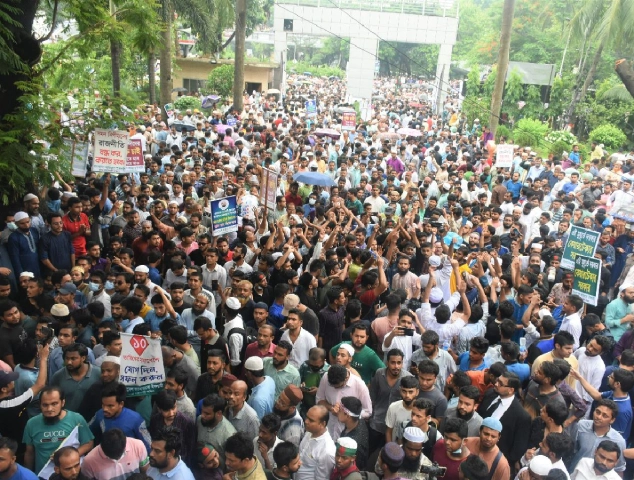
The three-hour-long event was held amid a huge deployment of riot police in armed gear and hundreds of armed officers in plain clothes, at the auditorium in the heart of the capital. Thousands of its members, who were unable to find space in the hall, spilt over in the compound and also occupied half of the streets. There was no law and order situation.

In a sudden move, the capital Dhaka’s police chief permitted on certain conditions, which raised eyebrows of the journalists, political observers, civil society and left-leaning parties.

Home Minister Asaduzzaman Khan on Sunday said that Awami League’s policy regarding Jamaat-e-Islami has not “changed our position.”

Several political observers argue that the threat of the United States visa policy has given extra mileage in obtaining permission. The US visa policy for Bangladesh says it would clamp down restrictions on officials, governing party leaders and the opposition in defence of democracy. This includes those responsible for voter intimidation, vote rigging, denial of free speech or freedom of assembly, and violence that seeks to undermine free and fair elections.

Moving away from tough repressive measures against the opposition, the district civil officials and police administration in holding elections of the local government or by-elections to the parliament are extra cautious in violating compliance stated by the US State Department on May 3.

Thus, the Islamist party got the desired “verbal permission” on the eve of their rally, after the police cancelled an event of a youth wing of another political party at the same venue.

The JeI rally has brought together the party leaders and members on a three-point demand which includes: elections under a caretaker government; release of their leaders and members in prison; control of the prices of essential grocery items.

JeI leaders claimed that in 14 years of Awami League era, nearly 1.5 lakh legal harassment cases are on their heads, and nearly 14,000 leaders and members are languishing in prisons, including their national ameer (chief) Dr Shafiqur Rahman, nayeb-e-ameer (vice-president) ANM Shamsul Islam and secretary general Mia Golam Porwar.

In their list of demands are to open the JeI’s party offices across the country, and permission for political assembly, which they pointed out that has been guaranteed by the Constitution – the Constitution which they do not recognise.

The JeI leaders have offered dialogue with the government on developing a framework for an interim government to hold free, fair, inclusive and credible elections and also ensure a level-playing field for all political parties.

The Islamist calls JeI a political party, but a majority of the people in Bangladesh are aware of the organisation’s antecedent – their demonic role during the brutal war of independence.

Fearing streets violence, the police headquarters ceased permission for JeI from February 2013 after the arrests of the party’s key leaders including their national ameer Matiur Rahman Nizami, secretary general Ali Ahsan Mohammad Mujahid, assistant secretary general Abdul Quader Molla and assistant secretary general ATM Azharul Islam indicted for war crimes in 1971.

In the 2008 election, Sheikh Hasina led Awami League had returned to power after a landslide victory. Her electoral promise to the nation was the trial of those responsible for war crimes and crimes against humanity committed in 1971 must face the music of justice.

Bangladesh’s International (War) Crimes Tribunal awarded capital punishments to scores of JeI, other Muslim parties and Islamist leaders. The tribunal considering an elderly person gave sentences for imprisonment until death to Ghulam Azam, former JeI chief in 1971, for recruitment, aiding and abetting with the marauding Pakistan military.

The Islamic evangelist leader Delwar Hossain Sayeedi, a key figure with JeI and his Muslim militia were held responsible for the deaths and rape of hundreds of Hindu community and pro-independence compatriots in southern Bangladesh in 1971, says Barrister Tapash Kanti Baul, a prosecutor in the tribunal.

In the first year of Bangladesh’s independence, Bangabandhu Sheikh Mujibur Rahman, the liberation war hero passed the world’s second secular Constitution after the Muslim majoritarian Turkey.

The Constitution had a blanket ban on religious political parties. The dreaded Jamaat-e-Islami party by default was struck off.

The newly born country has gone through the pains and agony of the bloody liberation war when Pakistan forces committed wanton war crimes and rape as a weapon of war. Their henchmen of the radicalised Muslim party, JeI in the name of Islam had committed genocide and extra-judicial killings of hundreds of intellectuals by a secret death squad Al Badr.

In a landmark judgement the Bangladesh High Court on August 1, 2013, deregistered the Islamist party, Jamaat-e-Islami, thereby banning it from participating in future elections.

The court found several contradictions between the principles of the JeI party’s manifesto (available on their website and printed documents) with the Bangladesh Constitution.

The JeI wishes to establish an Islamic Republic [of Bangladesh] instead of a secular country for which it sacrificed in blood in 1971. The Quran & Sunnah will override the state Constitution; implement the strictest Islamic Sharia laws and protect the Hindus and other religious minorities in an Islamic country.

The petitioner of the public interest litigation for the deletion of JeI’s registration with the Bangladesh Election Commission (EC) in the High Court, Maulana Ziaul Hasan, fails to understand how the EC will act JeI’s plans to participate in the elections after being deregistered.

Hasan, who is also the president of Bangladesh Sommilito Islami Jote (United Islamic Alliance), a like-minded platform against political Islam and an outspoken secularist is obviously worried about the rise of Islamism.

JeI documents claim their founder was controversial Islamic leader Syed Abul A’la Maududi, founder of Jamaat-e-Islami in Pakistan. He is responsible to instigate the worst racial riots in 1953 after the partition, which killed 200 Ahmadiyya Muslims after Maududi’s disciples heard his ‘Fatwa’ which mandates the Sunni Muslims in Pakistan to kill the heretics and infidels.

Barrister Tania Amir, a leading human rights lawyer argued in the court on behalf of the PIL against JeI registration that, “The Jamaat in principle does not recognise the powers of the Republic which belongs to the people, nor does it accept the undisputed power of the people’s representatives to make laws. The party discriminates against people based on religion and, therefore, should have its registration cancelled long ago.”

In December 2018, as the general election was approaching, the Bangladesh Election Commission scrapped its registration in accordance with the higher court’s verdict. Thus, JeI was rocking in troubled waters, as they were not eligible to participate in the elections and the party was in jeopardy.

The JeI members hurriedly negotiated with their all-weather ally, the rightist Bangladesh Nationalist Party (BNP) to be able to contest more than 20 seats, and they drowned.

For the last 12 years, the rhetoric of several top echelons of Awami League and senior Ministers reiterated their party’s position to make a law to ban Jamaat-e-Islami which ruthlessly opposed the independence of Bangladesh in being complicit to war crimes committed by Pakistan’s occupation military forces.

The policymakers did not hesitate to say that banning JeI is a matter of time. Now it seems those were empty promises.

The change of heart is understood by political analyst Sohrab Hasan. JeI has recently broken away from the BNP alliance. JeI is deemed an alternative to the government if BNP boycotts the upcoming elections, he wrote in the largest circulated newspaper Prothom Alo.

It seems that the same senior Ministers made a U-Turn on their rhetoric against JeI. As Dr Hasan Mahmud, Minister for Information and Broadcasting and also Joint General Secretary of Awami League said on Sunday that Jamaat-e-Islami was not banned. “Any political party can hold rallies. As long as it is not prohibited, they have the right to hold rallies,” he explained.

While Law Minister Anisul Huq said on Sunday that Jamaat-e-Islami should “not be termed guilty until the party is convicted.”

The judges have given their opinion that JeI should be banned based on sufficient evidence that came in the verdicts delivered by the war crimes tribunal.

The Saturday event has given a message that JeI is not weak and was able to brainwash thousands more youths in radical Islamic ideology.

After the war crimes tribunal indicted the key leadership of JeI, the party was demoralised but survived in a turbulent political climate.

After the tragic assassination of Sheikh Mujib in a military putsch in mid-August 1975, the regime of General Ziaur Rahman (later president) in May 1976 abrogated Clause 38 of the Constitution which bars the formation of a religious party.

Overnight the dreaded JeI resurfaced from the dead and began politicking, but of the tainted history of their engagement against the people of the country, they strategically changed its name to Islamic Democratic League.

The JeI bagged six seats in the 1979 parliament under a military dictator General Rahman. Surprisingly, the six JeI’s elected in the constituencies were all bordering the India-Bangladesh.

Fortunately, the people understood and rejected the Islamist party, which could be understood from the subsequent elections. JeI on average received nearly 4 per cent vote, said political scientist Dr Imtiaz Ahmed.

In the 1991 election after the departure of another military junta of General HM Ershad, JeI was elected in 18 seats, which was crucial for Khaleda Zia to form a coalition government. Despite a clear win, Awami League had to be seated on the opposition bench in the parliament as the party failed to muster a majority to form a government.

Awami League’s influential general secretary Obaidul Quader, hours after the event said the opposition BNP is behind Jamaat-e-Islami’s rally to conspire against the democratic process and jeopardise the forthcoming elections.

Indeed it’s rare in the world’s political history that a party which opposed the independence of a country had remained resilient and defiantly returned to politics, despite key leaders of the JeI leaders being handed down maximum punishment by the war crimes by the war crimes tribunal.

First published in the India Narrative, New Delhi, India on 14 June 2023

(Saleem Samad is an award-winning independent journalist based in Bangladesh. Views expressed are personal. Twitter: @saleemsamad)