Buy.com Monthly Coupon
Showing posts with label International Crimes Tribunal. Show all posts

Saturday, November 29, 2025

Sheikh Hasina’s Political Career at a Cross Road

SALEEM SAMAD

In the wake of the International Crimes Tribunal (ICT) verdict for the death penalty for Sheikh Hasina, will her political career come to an end on the road? It would be difficult for her to return to Bangladesh with a death penalty and lead the Awami League to survive in a rough sea.

Hasina’s father (Sheikh Mujibur Rahman) originally set up Bangladesh’s International Crimes Tribunal to try cases of atrocities during the Liberation War. The ICT was supposed to put on trial 195 Pakistani military officers accused of war crimes in the 1971 bloody independence war.

Hasina revived the tribunal when she assumed power in 2009. The current regime has used it against her opponents, wrote Bhagyasree Sengupta in the FirstPost. Hasina did not show remorse for the crimes against humanity in killing 1,400 protesters during last year’s July-August bloody uprising.

Hasina refused to accept defeat. Her party members also refused—especially those who fled to India. She must be having sleepless nights and worrisome days. The woman who ruled Bangladesh for nearly 20 years with an iron hand did not express her remorse for misrule.

For the past 15 months, even while staying in India, Hasina has been spewing venom about the July–August uprising and, in a way, attempting to call for the overthrow of this government.

In the past, she lived in exile in Delhi. For her, it was not a new city when she lived a low-profile life for six years until 1981, forming close relationships with leaders like Indira Gandhi and Pranab Mukherjee. During her tenure as Prime Minister, she gradually tilted towards India for security, intelligence sharing, trade, bilateral relations, and other crucial issues.

Hasina became an all-weather friend of India. Delhi reciprocated unflinching support to Dhaka in the regional forum and international forum. She listened to Delhi and destroyed the South Asian Association of Regional Cooperation (SAARC). The platform for regional understanding and cooperation collapsed after Islamabad announced that host the SAARC Summit.

Indian Prime Minister boycotted the event, and promptly, Hasina also cancelled her visit to Pakistan. Islamabad has postponed the summit. Since the boycott of the SAARC Summit in 2016, Bangladesh-Pakistan bilateral relations have plummeted. At one stage, Hasina decided to snap diplomatic relations. She called back senior diplomats, including the High Commissioner to Dhaka and kept them idle. She refused to give clearance to the new Pakistan High Commissioner to Bangladesh for several years.

The news of ice-breaking was first known through Pakistan’s news media that a new High Commissioner has arrived and met Sheikh Hasina at the Prime Minister’s Office. It was not clear what changed the mindset of Hasina to meet the High Commissioner. Whether there was external influence or other compulsion. Dhaka also sent High Commissioners to Islamabad, which eased the diplomatic relations.

The country twice declared two diplomats of Pakistan persona non grata. Islamabad reciprocated by deporting one Bangladeshi diplomat. It could not be determined whether the diplomats sent back home were on the basis of tit-for-tat.

Meanwhile, trade and commerce continued at a slow pace. Both countries depended on each other’s products. Bangladesh is dependent on several products, as raw materials, to feed the export-oriented industries. What will happen to her party is difficult to predict.

However, several political observers say the days will become thinner for Hasina. The extravagant pomp and glory that she enjoyed will be no more, no doubt, said a political analyst, Mohiuddin Ahmad, political historian and writer.

Well, Hasina will not be extradited by India, where she is living in a safe home, somewhere in New Delhi, presumed to be an armed force establishment. Dhaka has once again sent a note verbale in reference to the verdict of the death penalty, and the ICT has declared her a fugitive.

India, as usual, is dead silent over the issue of extradition. The Ministry of External Affairs has issued a brief statement acknowledging the ICT verdict and carefully did not mention the Delhi plan about Hasina’s status. The silence gave a clear message that Delhi will not hand over its loyal friend, Hasina and will not speak a word about her status.

There will be no resolution to these questions while this current government remains in power. The government has made it clear that the Awami League will not be allowed to contest the election during this term. What happens next will depend entirely on the government that comes afterwards—our future course and the structure of our politics will be shaped by that, wrote once a fiery student leader, Mahmudur Rahman Manna, in the largest circulated Bangla daily Prothom Alo.

Returning Hasina and her co-accused to Home Minister Asaduzzaman Kamal is dark. She and he co-accused, will live in Indian as guest. No Indian government will send her back when her life is in danger.

Delhi may reject the ICT and deny its legitimate existence and trial in a tribunal which was exclusively set up by Hasina for the trial of war criminals and crimes against humanity committed during the 1971 war.

The Indian statement, soon after the verdict of Hasina’s death penalty it has put the International Crimes Tribunal in question. Which means Delhi does not recognize the tribunal.

Indian could use the exception clause in the 2013 Bangladesh-India Extradition Treaty. There are certain clauses which could give leverage to India, refusing to hand over Hasina and others, said Suhasini Haidar with The Hindu.

To keep the diplomatic channels open to discuss Bangladesh’s concerns, convey India’s concern and possibly push Bangladesh for an inclusive election to allow Hasina’s party, Awami League, to participate in the upcoming February election, said Haider.

Presently, the government has imposed restrictions on party activities, and the Election Commission has deleted the boat symbol from the list of election symbols.

The death sentence awarded to Sheikh Hasina, former Prime Minister of Bangladesh, is a seismic political event that will be seared into the nation’s collective memory for a long time. Its tremors will be felt through the country’s institutions even if the death sentence is never executed.

Ironically, Hasina has now fallen victim to the system she created by weaponizing the judiciary against her political opponent, Bharat Bhushan writes.

First published in the Stratheia Policy Journal, Pakistan, on 27 November 2025

Saleem Samad is an independent journalist based in Bangladesh and a media rights defender with Reporters Without Borders. He is the recipient of the Ashoka Fellowship and the Hellman-Hammett Award. He could be reached at: saleem.samad.1971@gmail.com; Twitter (X): @saleemsamad

Thursday, October 17, 2024

How will Delhi react to Sheikh Hasina’s arrest warrant?

SALEEM SAMAD 

The International Crimes Tribunal (ICT) in Bangladesh has issued a warrant of arrest against the Iron Lady Sheikh Hasina to surrender by November 18.

Her autocratic regime collapsed on August 5 after a 36-day-long countrywide student-led bloody Monsoon Revolution, which killed more than 700 students and protesters.

The cases against Hasina have held her responsible for the deaths of hundreds of students and protesters in the anti-government street demonstration, which turned violent.

When she announced that the doors of Gonobhaban, the official residence of the Prime Minister were open for the student leaders, it was too late and too little.

Instead of negotiating with the student protesters, she ordered the police to shoot, kill and detain protesters. More than 10,000 protesters were bundled in prison vans and taken to magistrate courts accused of terrorism.

The ICT was established in Hasina’s tenure for the trial of those who have committed crimes against humanity during the brutal birth of Bangladesh in the 1971 liberation war.

The majority of the indicted persons were Islamist political leaders, a few police and local village elites. It was believed that political Islam would come to an end after the trial.

Hasina has been squarely blamed for indulging political leaders, party henchmen, and civil and police administration into kleptocracy. All the Prime Minister’s men were involved in money laundering, siphoning money from banks, buying properties in foreign countries, stashing money in off-shore banks and procuring second-country resident permits and dual citizenship after depositing millions of dollars in various countries.

After the ICT has issued a warrant of arrest, it is time to observe how Delhi’s South Block will react to the pressing issue.

International media has already made screaming news of the arrest warrant against Hasina and others. She is presently living in a safe house on the fringes of New Delhi, the capital of India.

She fled Bangladesh on August 5 by a Bangladesh Air Force transport aircraft from Kurmitola Air Force base in Dhaka.

On her arrival, Ajit Doval, the National Security Adviser to the Indian government, met her at the Hindan Air Force Base at Ghaziabad, not far from New Delhi.

No senior officials of Indian Prime Minister Narendra Modi’s administration have met her at the safe house since she arrived more than two months ago.

Her Red Passport, a diplomatic travel document and her Deshi Green Passport, have been revoked by the Interim Government. The United States and several countries in Europe and the United Kingdom have refused her entry.

Meanwhile, even after 73 days, more than two months Hasina’s eldest son Sajeeb Wazed Joy, living in Washington DC, USA, and her daughter Saima Wazed Putul have been unable to meet her.

Saima, who is working in Delhi as Saima Wazed, has been serving as the South East Asian Regional Director for the World Health Organisation (WHO) since November 2023 and lamented in her Twitter (X) that she has not been able to hug her and wrote a strange message that she is too busy in her workplace, series of planning meetings, meeting delegations and visit to several countries.

A high-profile Indian journalist who was with Ajit Doval’s outfit National Security Council, who is privy to the issue and does not wish to be named, said Delhi South Block has unofficially explored possibilities with a few countries for her stay in a third country.

Hasina is literally stranded in India and has nowhere to go. Delhi bigwigs are in dilemma about what should be their next step after India’s friendly countries did not respond to requests.

Well, it is too early for the Indian government to react as they will have to wait and see what is likely to happen after the deadline for appearance at the ICT expires.

Delhi will have to further wait for the verdict against the cases against Hasina to be delivered by the ICT. It is not likely before another year or more, as defence lawyers will appeal to the higher court against the verdict, which will take several additional months.

First published in the Northeast News, Guwahati, India, 17 October 2024

Saleem Samad is an award-winning independent journalist based in Bangladesh. A media rights defender with the Reporters Without Borders (@RSF_inter). Recipient of Ashoka Fellowship and Hellman-Hammett Award. He could be reached at saleemsamad@hotmail.com; Twitter (X): @saleemsamad

Wednesday, June 14, 2023

Is US encouraging rise of Bangladesh’s Islamist party to counter Sheikh Hasina?


SALEEM SAMAD

The next parliament elections are around the corner, expected in January 2024. The hardline Islamist political party Jamaat-e-Islami (JeI) after 10 years of hiatus held its first rally in Dhaka, on June 10.

The three-hour-long event was held amid a huge deployment of riot police in armed gear and hundreds of armed officers in plain clothes, at the auditorium in the heart of the capital. Thousands of its members, who were unable to find space in the hall, spilt over in the compound and also occupied half of the streets. There was no law and order situation.

In a sudden move, the capital Dhaka’s police chief permitted on certain conditions, which raised eyebrows of the journalists, political observers, civil society and left-leaning parties.

Home Minister Asaduzzaman Khan on Sunday said that Awami League’s policy regarding Jamaat-e-Islami has not “changed our position.”

Several political observers argue that the threat of the United States visa policy has given extra mileage in obtaining permission. The US visa policy for Bangladesh says it would clamp down restrictions on officials, governing party leaders and the opposition in defence of democracy. This includes those responsible for voter intimidation, vote rigging, denial of free speech or freedom of assembly, and violence that seeks to undermine free and fair elections.

Moving away from tough repressive measures against the opposition, the district civil officials and police administration in holding elections of the local government or by-elections to the parliament are extra cautious in violating compliance stated by the US State Department on May 3.

Thus, the Islamist party got the desired “verbal permission” on the eve of their rally, after the police cancelled an event of a youth wing of another political party at the same venue.

The JeI rally has brought together the party leaders and members on a three-point demand which includes: elections under a caretaker government; release of their leaders and members in prison; control of the prices of essential grocery items.

JeI leaders claimed that in 14 years of Awami League era, nearly 1.5 lakh legal harassment cases are on their heads, and nearly 14,000 leaders and members are languishing in prisons, including their national ameer (chief) Dr Shafiqur Rahman, nayeb-e-ameer (vice-president) ANM Shamsul Islam and secretary general Mia Golam Porwar.

In their list of demands are to open the JeI’s party offices across the country, and permission for political assembly, which they pointed out that has been guaranteed by the Constitution – the Constitution which they do not recognise.

The JeI leaders have offered dialogue with the government on developing a framework for an interim government to hold free, fair, inclusive and credible elections and also ensure a level-playing field for all political parties.

The Islamist calls JeI a political party, but a majority of the people in Bangladesh are aware of the organisation’s antecedent – their demonic role during the brutal war of independence.

Fearing streets violence, the police headquarters ceased permission for JeI from February 2013 after the arrests of the party’s key leaders including their national ameer Matiur Rahman Nizami, secretary general Ali Ahsan Mohammad Mujahid, assistant secretary general Abdul Quader Molla and assistant secretary general ATM Azharul Islam indicted for war crimes in 1971.

In the 2008 election, Sheikh Hasina led Awami League had returned to power after a landslide victory. Her electoral promise to the nation was the trial of those responsible for war crimes and crimes against humanity committed in 1971 must face the music of justice.

Bangladesh’s International (War) Crimes Tribunal awarded capital punishments to scores of JeI, other Muslim parties and Islamist leaders. The tribunal considering an elderly person gave sentences for imprisonment until death to Ghulam Azam, former JeI chief in 1971, for recruitment, aiding and abetting with the marauding Pakistan military.

The Islamic evangelist leader Delwar Hossain Sayeedi, a key figure with JeI and his Muslim militia were held responsible for the deaths and rape of hundreds of Hindu community and pro-independence compatriots in southern Bangladesh in 1971, says Barrister Tapash Kanti Baul, a prosecutor in the tribunal.

In the first year of Bangladesh’s independence, Bangabandhu Sheikh Mujibur Rahman, the liberation war hero passed the world’s second secular Constitution after the Muslim majoritarian Turkey.

The Constitution had a blanket ban on religious political parties. The dreaded Jamaat-e-Islami party by default was struck off.

The newly born country has gone through the pains and agony of the bloody liberation war when Pakistan forces committed wanton war crimes and rape as a weapon of war. Their henchmen of the radicalised Muslim party, JeI in the name of Islam had committed genocide and extra-judicial killings of hundreds of intellectuals by a secret death squad Al Badr.

In a landmark judgement the Bangladesh High Court on August 1, 2013, deregistered the Islamist party, Jamaat-e-Islami, thereby banning it from participating in future elections.

The court found several contradictions between the principles of the JeI party’s manifesto (available on their website and printed documents) with the Bangladesh Constitution.

The JeI wishes to establish an Islamic Republic [of Bangladesh] instead of a secular country for which it sacrificed in blood in 1971. The Quran & Sunnah will override the state Constitution; implement the strictest Islamic Sharia laws and protect the Hindus and other religious minorities in an Islamic country.

The petitioner of the public interest litigation for the deletion of JeI’s registration with the Bangladesh Election Commission (EC) in the High Court, Maulana Ziaul Hasan, fails to understand how the EC will act JeI’s plans to participate in the elections after being deregistered.

Hasan, who is also the president of Bangladesh Sommilito Islami Jote (United Islamic Alliance), a like-minded platform against political Islam and an outspoken secularist is obviously worried about the rise of Islamism.

JeI documents claim their founder was controversial Islamic leader Syed Abul A’la Maududi, founder of Jamaat-e-Islami in Pakistan. He is responsible to instigate the worst racial riots in 1953 after the partition, which killed 200 Ahmadiyya Muslims after Maududi’s disciples heard his ‘Fatwa’ which mandates the Sunni Muslims in Pakistan to kill the heretics and infidels.

Barrister Tania Amir, a leading human rights lawyer argued in the court on behalf of the PIL against JeI registration that, “The Jamaat in principle does not recognise the powers of the Republic which belongs to the people, nor does it accept the undisputed power of the people’s representatives to make laws. The party discriminates against people based on religion and, therefore, should have its registration cancelled long ago.”

In December 2018, as the general election was approaching, the Bangladesh Election Commission scrapped its registration in accordance with the higher court’s verdict. Thus, JeI was rocking in troubled waters, as they were not eligible to participate in the elections and the party was in jeopardy.

The JeI members hurriedly negotiated with their all-weather ally, the rightist Bangladesh Nationalist Party (BNP) to be able to contest more than 20 seats, and they drowned.

For the last 12 years, the rhetoric of several top echelons of Awami League and senior Ministers reiterated their party’s position to make a law to ban Jamaat-e-Islami which ruthlessly opposed the independence of Bangladesh in being complicit to war crimes committed by Pakistan’s occupation military forces.

The policymakers did not hesitate to say that banning JeI is a matter of time. Now it seems those were empty promises.

The change of heart is understood by political analyst Sohrab Hasan. JeI has recently broken away from the BNP alliance. JeI is deemed an alternative to the government if BNP boycotts the upcoming elections, he wrote in the largest circulated newspaper Prothom Alo.

It seems that the same senior Ministers made a U-Turn on their rhetoric against JeI. As Dr Hasan Mahmud, Minister for Information and Broadcasting and also Joint General Secretary of Awami League said on Sunday that Jamaat-e-Islami was not banned. “Any political party can hold rallies. As long as it is not prohibited, they have the right to hold rallies,” he explained.

While Law Minister Anisul Huq said on Sunday that Jamaat-e-Islami should “not be termed guilty until the party is convicted.”

The judges have given their opinion that JeI should be banned based on sufficient evidence that came in the verdicts delivered by the war crimes tribunal.

The Saturday event has given a message that JeI is not weak and was able to brainwash thousands more youths in radical Islamic ideology.

After the war crimes tribunal indicted the key leadership of JeI, the party was demoralised but survived in a turbulent political climate.

After the tragic assassination of Sheikh Mujib in a military putsch in mid-August 1975, the regime of General Ziaur Rahman (later president) in May 1976 abrogated Clause 38 of the Constitution which bars the formation of a religious party.

Overnight the dreaded JeI resurfaced from the dead and began politicking, but of the tainted history of their engagement against the people of the country, they strategically changed its name to Islamic Democratic League.

The JeI bagged six seats in the 1979 parliament under a military dictator General Rahman. Surprisingly, the six JeI’s elected in the constituencies were all bordering the India-Bangladesh.

Fortunately, the people understood and rejected the Islamist party, which could be understood from the subsequent elections. JeI on average received nearly 4 per cent vote, said political scientist Dr Imtiaz Ahmed.

In the 1991 election after the departure of another military junta of General HM Ershad, JeI was elected in 18 seats, which was crucial for Khaleda Zia to form a coalition government. Despite a clear win, Awami League had to be seated on the opposition bench in the parliament as the party failed to muster a majority to form a government.

Awami League’s influential general secretary Obaidul Quader, hours after the event said the opposition BNP is behind Jamaat-e-Islami’s rally to conspire against the democratic process and jeopardise the forthcoming elections.

Indeed it’s rare in the world’s political history that a party which opposed the independence of a country had remained resilient and defiantly returned to politics, despite key leaders of the JeI leaders being handed down maximum punishment by the war crimes by the war crimes tribunal.

First published in the India Narrative, New Delhi, India on 14 June 2023

(Saleem Samad is an award-winning independent journalist based in Bangladesh. Views expressed are personal. Twitter: @saleemsamad)

Sunday, February 05, 2023

Shahbag Square Thunderous Slogan ‘Joy Bangla'

SALEEM SAMAD

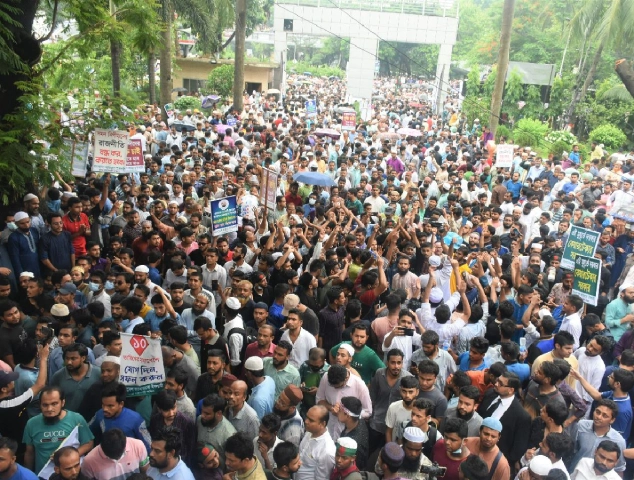
On 5 February 2013, suddenly Shahbagh intersection become lively as thousands of angry and frustrated young people thronged the place to demand maximum punishment of war criminals indicted for war crimes and a crime against humanity during the brutal birth of Bangladesh.

On the tenth anniversary of Gono Jagaron Moncho, remembered for the revival of the war cry of Bangladeshi nationalism ‘Joy Bangla’ was significant. Tens of thousands of young people from all walks of life have turned up to protest the life sentences handed out to Islamists.

The platform for trial and punishment of Bangladesh-born henchmen of occupation Pakistan armed forces imbibed millions of young people despite they were born after the liberation war. They did not forget what the war criminals have committed to their motherland.

Popular belief suggests that Bangladesh is a conservative Sunni Muslim majority. The melee of thousands of young women at the square belies this. The women are there, with children in tow, on their lap or shoulder way past midnight.

The deafening roar of the youths at Shahbag Square, the epicentre of protest in Dhaka, is awe-inspiring. Mainly because over one lakh youth chanted “Joy Bangla” (Long Live Bangladesh) throughout the day and night.

Joy Bangla was the war cry of the Mukti Bahini (Bangladesh Liberation Forces) during the 1971 bloody liberation war.

The Joy Bangla slogan became taboo after the assassination of independence hero Sheikh Mujibur Rahman in 1975.

“Today I walk in the streets shouting the slogan without fear, prejudice or being bashful,” Shamsuddin Ahmed, journalist and writer tells me. “I haven’t heard that slogan in over 40 years since the country was liberated.”

The revival of the war cry of Bangladeshi nationalism is significant. Young people from all walks of life have turned out in their thousands to protest the life sentences handed out to an Islamist war criminal by the Bangladesh International Crimes Tribunal.

If the tribunal persists, Bangladesh could become the world’s first Muslim nation to bury political Islam once and for all. It is a devil which needs to be contained. And here’s why they were at Shahbag.

The struggle against the Islamic Republic of Pakistan was sparked off in its erstwhile eastern province in March 1971. Nine months later, the new nation of Bangladesh emerged, after a bloody gruesome war for millions of Muslims, Hindus, Christians and Buddhists and Adivasis alike.

Pakistan’s marauding army with their local henchmen committed genocide, crime against humanity and forced abductions for nine months of the independence war, nearly 4.5 lakh women were victims of rape as a weapon of war, and intellectuals were murdered and abducted.

Bangladesh war historian Prof. Muntasir Mamoon claims genocide of three million people. These were people whose only crime was to believe in the independence of Bangladesh. The marauding Pakistan forces and their henchmen were blamed for the genocide.

The peasants and students fought the elite Pakistan military forces and their auxiliary forces, largely recruited from among the Bangalee Muslim population in the country.

Their spirits were not dampened and we have demanded the trial of these henchmen, collaborators of war crimes. For forty years our voice was not heard. But most underestimated the new generation.

Their thunderous cry is not just audible over Shahbag Square. It echoes over social media, Twitter and Facebook. It is an angry voice demanding justice.

In the Arab Spring, the protests were anti-government. The Arab protester’s objective was to achieve democracy, freedom and justice. In Bangladesh, the scenario is dramatically different.

The protester’s quest is to seek justice for crimes committed in 1971, when Bangladesh, formerly the Eastern province of Pakistan, attained its independence. The crowd listens patiently to the chorus, poetry recitation and brief speeches for hours. Thousands chant slogans repeatedly.

Today Gono Jagaron Moncho which bonded millions of youngsters is a history, despite the controversy and myths around the movement. Forty-two years after its difficult birth, Bangladesh witnessed a rebirth in Shahbag Square.

First published in The News Times, February 5, 2023

Saleem Samad, is an award winning independent journalist, media rights defender, recipient of Ashoka Fellowship and Hellman-Hammett Award. He could be reached at <saleemsamad@hotmail.com>; Twitter @saleemsamad

Wednesday, December 02, 2020

A prisoner’s tale

SALEEM SAMAD

Of fictitious cases, police brutality, and state-sanctioned intimidation

“Saleem Samad, a freelance reporter and local correspondent for the international press watchdog Reporters Sans Frontiers, was arrested earlier today (November 29, 2002) in connection with Channel 4,” writes The Guardian newspaper.

My arrest was made three days after British journalist Zaiba Malik and Italian cameraman Bruno Sorrentino who were commissioned by Channel 4 TV to produce a documentary on terrorism for its Unreported World, were also arrested along with their interpreter Priscilla Raj.

Journalist/film-maker Shahriar Kabir was also arrested under the sedition case. The rightist regime was enraged by his campaign for the trial of the war criminals of 1971.

The regime to harass critics also accused Advocate Rana Das Gupta (presently prosecutor of the International Crimes Tribunal) and former Dainik Janakantha’s Cox’s Bazar correspondent Tofael Ahmed.

During the repressive regime during 2002-2006 of the Bangladesh Nationalist Party’s (BNP) coalition with Islamist party Jamaat-e-Islami, at least 80 journalists were arrested and tortured -- another 200 journalists were slapped with trumped-up charges.

Scores of journalists were brutally attacked and were hospitalized, mostly in the southern districts -- from Satkhira to Bhola. Many fled their district for their safety, either after being physically attacked or receiving death threats.

The infamous Hawa Bhaban was the mastermind of harassment and intimidation -- which led to numerous arrests, including war crimes historian Prof Muntassir Mamun, Enamul Hoque Chowdhury (present editor of the Daily Sun), and journalist Barun Bhaumik Nayan, among many others. Both the journalists were brutalized during interrogation to sign fictitious confessional statements.

In a shameful move, the pro-government journalist leaders of Bangladesh Federal Union of Journalists (BFUJ), Dhaka Union of Journalists (DUJ), and National Press Club refrained from protesting the arrests, torture, and intimidations of hundreds of journalists. Instead, the journalist leaders, spearheaded by Shaukat Mahmood, a journalist turned politician desired to “teach the journalists a lesson” with the blessing of Hawa Bhaban, the office of Tarique Rahman, and the rogue son of former Prime Minister Khaleda Zia.

It felt as if a thunderbolt struck me when Mozzem Hossain, a journalist of BBC Bangla in Bush House, London told me that the foreign journalists, Priscilla Raj, and the driver of a rented vehicle were arrested under a fictitious sedition case.

I quickly gave my first reaction to both BBC Bangla, BBC World Service, and numerous international media. The daily newspapers and private news channels had been agog with the sensational news of the detention of foreign journalists.

The news also splashed in major global media, as the regime’s “Operation Clean Heart” was squarely blamed for extra-judicial deaths and enforced disappearances of hundreds of opposition members deemed a threat to the ruling party. Janakantha newspaper reported that the FIR filed with Motijheel Police Station had only four names -- foreign journalists, an interpreter, and the name of a driver. 

Next to the driver’s name was the handwritten name “alias Saleem Samad.” My name was blue-pencilled by the Home Affairs Ministry, by the hybrid journalist leaders. 

My defense lawyers, Barrister Amirul Islam and Barrister Tania Amir, explained that I was neither aged 28, nor a driver by profession, and my parent’s name and address do not match the one mentioned in the police report. 

On the fourth day, the home of my parents in Pallabi, where I also lived with my family, was thoroughly searched for 28 (RPT 28) hours. 

My family was on the run, as security agencies wanted to retrieve the spare hard-disk from my son Atisha Rahbar. My parents were locked downstairs, while every inch of the two-storied house was thoroughly searched. All the books and documents were carefully scanned. 

On the fifth day, in the wee hours of Friday during the month of Ramadan, I was picked up by detectives from a flat in Uttara belonging to a Crack Platoon veteran, my school-mate Ishtiaq Aziz Ulfat. 

I was brought to the Detective Branch office at Mintoo Road. A delinquent police officer Kohinoor Miah attacked me with a baton and, also brandishing his service pistol on my forehead, accused me of betraying the country and slandering the image of the state. Well, it was Khaleda’s regime that smeared the country.

After 55 days, on the order of the High Court, I was freed on January 18, 2003.

First published in the Dhaka Tribune on 1 December 2020

Saleem Samad is an independent journalist, media rights defender, and recipient of Ashoka Fellowship and Hellman-Hammett Award. He can be reached at saleemsamad@hotmail.com; Twitter @saleemsamad

Wednesday, December 24, 2014

Bangladesh: Visible Gains, Hidden Dangers

S. BINODKUMAR SINGH

On December 18, 2014, the International Crimes Tribunal-2 (ICT-2) indicted Forkan Mallik, an alleged Razakar (a paramilitary force organized by the Pakistan Army) commander from Mirzaganj sub-District in Patuakhali District, for his involvement in crimes against humanity during the Liberation War of 1971. The tribunal framed five charges against Forkan, a supporter of the main opposition Bangladesh Nationalist Party (BNP).

On November 24, 2014, ICT-1 awarded the death penalty to Mobarak Hossain aka Mobarak Ali (64), former rukon (union member) of the Jamaat-e-Islami (JeI) and commander of the Razakar force. Mobarak was indicted on April 23, 2013, on five specific incidents of murder, abduction, confinement, torture and loot.

On November 13, 2014, ICT-1 sentenced Zahid Hossain Khokon alias Khokon (70), vice-president of BNP's Nagarkanda unit and a Razakar commander of Faridpur District, to death in absentia. Khokon was indicted on October 9, 2013, on 11 charges, including genocide, torture, abduction and confinement during the Liberation War. He is absconding and, while Bangladeshi authorities say they have no information regarding his whereabouts, reports suggest that he may be residing in Sweden with his elder son and daughter.

The War Crimes (WC) Trials began on March 25, 2010, and through 2014, the two ICTs indicted nine persons and delivered four verdicts. Thus far, the ICTs have indicted 25 leaders, including 13 from JeI, five from Muslim League (ML), four from BNP, two from Jatiya Party (JP) and one Nizam-e-Islami leader. Verdicts against 14 of them have already been delivered – 12 were awarded death sentence while the remaining two received life sentences. One of the 12 who received the death sentence has already been executed, while the remaining 11 death penalties are yet to be executed. The two persons who were awarded life sentences have already died serving their sentence. They were JeI Ameer (Chief) Ghulam Azam (91), who died on October 23, 2014; and former BNP minister Abdul Alim (83), who died on August 30, 2014.

Sheikh Hasina Wajed’s Awami League (AL)-led Government, which retained power winning the 10th General Elections held on January 5, 2014 in the face of a comprehensive Opposition boycott, has enormously consolidated its secular commitments and kept its promise to punish the perpetrators of the 1971 genocide. By bringing the war crimes' perpetrators to justice, Dhaka has also succeeded in minimizing the threat of Islamist extremists within the country, both because they have become conscious of the clear intent of the incumbent Government, and because many of their top leaders are among those arraigned or convicted for the War Crimes.

The Government also remained determined in its approach to dealing with JeI, the country's largest right-wing party and main Islamist extremist troublemaker. Law Minister Anisul Huq, speaking at Dhaka city on December 7, 2014, announced, "The Draft Bill to ban JeI will be placed in the Cabinet this month and it is expected to be passed in the first session of the Parliament in 2015." Notably, in a landmark ruling, the Dhaka High Court, on August 1, 2013, had declared the registration of JeI as a political party, illegal. A three-member Special Bench, including Justice M. Moazzam Husain, Justice M. Enayetur Rahim and Justice Quazi Reza-Ul Hoque, passed the judgment, accepting a writ petition challenging the legality of JeI's registration as a political party.

Further, in a major blow to JeI, Election Commissioner Shah Nawaz, on November 7, 2013, declared that the party could not participate in the General Elections of January 2014, in line with the High Court order. JeI was, of course, one of the Opposition parties that boycotted the Election.

Significantly, Security Force (SF) personnel arrested at least 1,757 cadres of JeI and Islami Chhatra Shibir (ICS), the student wing of JeI, through 2014, in addition to 4,038 such arrests in 2013. 

Nevertheless, disruptive elements led by the BNP-JeI-ICS combine, continued to engage in violent activities through 2014. According to partial data compiled by the South Asia Terrorism Portal (SATP), a total of 60 people, including 29 civilians, nine SF personnel and 22 extremists, were killed in incidents related to Islamist extremism in 2014 (data till December 21), in addition to 379 persons, including 228 civilians, 18 SF personnel and 133 extremists, killed in 2013.

As the Government continued with its policy of checking the growth of Islamist extremist forces led by the BNP-JeI-ICS combine, it deprived the Islamist terrorist formations of any opportunity to revive their activities within the country, despite sustained efforts, through 2014. The Rapid Action Battalion (RAB) arrested JMB chief coordinator Abdun Noor and four of his close aides from the Sadar Sub-District Railway Station of Sirajganj District, on October 31, 2014, and recovered 49 detonators, 26 electronic detonators, four time bombs, 155 different kinds of circuits, 55 jihadi books, and a power regulator. During preliminary interrogations, the JMB operatives confessed that they were planning to carry out large-scale bomb attacks across the country, particularly in Dhaka city.

In a disturbing development, the Detective Branch (DB) of Dhaka Metropolitan Police (DMP) arrested two cadres of the Ansarul Bangla Team (ABT), Tanjil Hossain Babu (26), who had some technological expertise, and Muhamad Golam Maula Mohan (25), a Computer Sciences and Engineering graduate, along with a plastic frame of a drone, electronic devices and some books on jihad, from Dhaka city's Jatrabari area on December 16, 2014. After their interrogation, Joint Commissioner Monirul Islam of DB claimed, "They reached the final stages of making the drone after a six-month planning and research. Once completed, the drone could be flown up to around 25th floor of a building to launch an attack." ABT is an al Qaeda inspired terrorist formation that crystallized in 2013 from the remnants of the Jamaat-ul-Muslimeen.

Nevertheless, under the sustained pressure exerted by Security Forces, the country did not record a single major terrorist incident (resulting in three or more fatalities) by any Islamist terror outfit through 2014. In fact, only one violent incident involving such groups was reported through the year. On February 23, 2014, a Police Constable was killed and another two Policemen were injured, as an armed gang of 10 to 15 unidentified terrorists ambushed a prison van that was carrying three convicted Jama'at-ul-Mujahideen Bangladesh (JMB) terrorists in the Trishal Sub-District of Mymensingh District. All the three convicts managed to escape during the ambush. Though Police arrested one of them soon after, the whereabouts of the other two remain unknown.

On the other hand, a total of 96 terrorists were arrested through 2014, adding to the 163 detained in 2013. Of these 96, 43 belonged to JMB, 25 to Hizb-ut-Tahrir (HuT), 12 to Harkat-ul-Jihad-al Islami Bangladesh (HuJI-B), six to Kalamaye Jamaat, five to ABT, three to Hizb-ut-Towhid (HT), and one each to Kalema Dawat and Islamic State.

Dhaka has also continued its campaign against an incipient Left Wing Extremist (LWE) movement in a somewhat one-sided battle. Through 2014, 16 LWE cadres were killed - 11 of the Purbo Banglar Communist Party (PBCP), three of the Purbo Banglar Sarbahara Party (PBSP), one of the Biplobi Communist Party (BCP), and one unidentified. No civilian or SF fatality took place in LWE-linked violence through 2014. In 2013, a total of 25 fatalities were connected to LWE violence, including four civilians and 21 militants.

The nation, however, continues to face a significant threat from Islamist extremism. India’s National Investigation Agency (NIA), investigating the October 2, 2014, accidental blasts at Burdwan in West Bengal, uncovered a plot by JMB to assassinate Prime Minister Sheikh Hasina Wajed and BNP Chairperson Begum Khaleda Zia.

According to revelations made by arrested accused in the case, JMB was planning to establish an 'Islamic state' in Bangladesh through armed struggle. The projected 'Islamic state' was also intended to incorporate the Districts of Murshidabad, Nadia, and Malda in West Bengal. Referring to the development, Bangladesh's National and Security Intelligence (NSI) Director General, Mohammad Shamsul Haque, observed, on December 15, 2014,

We have largely neutralized radical groups like the JMB or HuJI-B, but now they seem to have found sanctuaries across the border. If we think we have neutralized a group and sit easy, it is (a) big mistake. There is no room for complacency. We need to closely monitor their activities even if a few terrorists are left in the fray. Because they may well set up bases across the border, make fresh recruitment, acquire weapons and plan attacks.

Further, on September 5, 2014, Asim Umar, the leader of the newly formed al-Qaeda in the Indian Subcontinent (AQIS) based in Pakistan, incited Muslims to engage in the global jihad (holy war) and expressed his group’s determination to extend the fighting from Pakistan to Bangladesh, Myanmar and India. Further, a video released on November 29, 2014, and attributed to the 'Bangladesh division' of AQIS, encouraged Bangladeshi Muslims to come to the jihadi battlefield and included glimpses of a base of fighters in the Afghanistan-Pakistan region.

Threats from the Islamic State (IS, formerly the Islamic State of Iraq and al Sham, ISIS) are also very much a reality. On September 29, 2014, a 24-year-old British citizen was arrested in Dhaka city on suspicion of recruiting people to fight alongside IS cadres in Syria. When asked about Bangladesh’s position on the IS and the Syrian crisis, Foreign Minister A.H. Mahmood Ali disclosed, on September 30, 2014, “We have not heard about any presence of the [ISIS] group, but a British citizen of Bangladeshi origin was arrested.”

Bangladesh’s achievements on the counter-terrorism and internal security fronts through 2014 have been remarkable. Further, over the last few years, the WC Trials have also progressed quite well. A note of caution, nevertheless, remains to be sounded, as the residual capacities of subversive and extremist elements, prominently including JeI-ICS, are still significant, and their alliance with BNP remains sound. Further, surviving fragments of a range of other outfits, including JMB, HuT, HT, HuJI and ABT, also have a potential for regrouping and fomenting violence. In the unstable environment of South Asia and the wider Asian region, there is little space for complacence.

First published in South Asia Intelligence Review, Weekly Assessments & Briefings, Volume 13, No. 25, December 22, 2014

S. Binodkumar Singh is Research Associate, Institute for Conflict Management, India

Sunday, May 11, 2014

Bangladesh War Crimes Trials Follow Evidence, Not Politics


MOHAMMAD A. ARAFAT

Bangladesh won its independence from Pakistan in 1971, but at a terrible price. Pakistan didn’t just oppose Bangladeshi liberation on the battlefield. It unleashed one of the most shameful genocides of the 20th century on ethnic Bengali citizens with the help of local extremist groups. As many as three million Bengalis were killed in just nine months and more than two hundred thousand women were raped and tortured.

As is the case with war crimes elsewhere, many decades later those responsible for the massacre are finally being brought to justice. In 2009, a domestic War Crimes Tribunal (ICT-BD) was established in Bangladesh to investigate and prosecute those accused of crimes against humanity.

Bangladesh’s war crimes victims deserve justice and so do their families. The passing of time cannot wipe away the horrors of that period even though many of those responsible for mass murder have avoided justice, some by taking refuge in foreign countries. Others have even worked their way into the country’s political establishment.

The purpose of the tribunal is to set right this great wrong. Over the past year, it and a second tribunal have heard evidence against two accused ringleaders of the genocide — Motiur Rahman Nizami and Delwar Hossain Sayeedi. The evidence against both is extensive, compelling and ghastly.

If they are found guilty, they likely will hang, as the death penalty is still part of Bangladeshi law. Verdicts may come at any time.

Nizami is not just an accused killer. He is also the head of Jamaat-e-Islami, an extremist group responsible for a wave of murder and violence across Bangladesh during the past year. Its attacks have resulted in 500 deaths. Jamaat has deep roots in the region going back to its collaboration with the Pakistani military during Bangladesh’s war for independence. Back then, Jamaat launched the fearsome paramilitary group called Al-Badr, which were death squads similar to Adolph Hitler’s SS during World War II.

Jamaat, in essence, it is a domestic terror organization with a political arm. It has worked since Bangladesh’s independence to destroy the country’s pluralistic constitutional democracy and to replace it with a primitive version of Sharia law.

Nizami faces 16 counts of crimes against humanity including genocide, murder, torture, rape and property destruction, all of which are based on eyewitness accounts. As Al-Badr’s chief leader during the genocide, Nizami is accused of either personally carrying out or ordering the deaths of nearly 600 ethnic Bengalis as well as the rape and the torture of many women.

Some of the worst atrocities came at the infamous Mohammadpur Physical Training Institute in Dhaka, which was a human abattoir reminiscent of Nazi death camps.


An entire of generation of Bangladesh’s best minds were wiped out at the Institute, tribunal prosecutors charge, because Nizami and other collaborators devised a systematic plan to torture and execute professors, engineers, artists and scientists. The plan was that if Pakistan could not prevent Bangladesh’s independence, it would seek to cripple the young state in its infancy by destroying its top intellectuals.

First published in The Daily Caller, 09 May, 2014

Mohammad A. Arafat, Executive Director, Shuchinta Foundation

Monday, March 31, 2014

Jam'atul Mujahideen Bangladesh: Latent Threat

SANCHITA BHATTACHARYA

In an attempt to re-assert itself in Bangladesh, extremists belonging to the banned Jam'atul Mujahideen Bangladesh (JMB) targeted a prison van and freed three of their comrades on February 23, 2014. The prison transport was taking them from Kashimpur Prison in Gazipur District to a court in the Trishal Sub-district area of Mymenshingh District. The driver of the van, Police Constable Atiqul Islam, was killed in the attack, while two other Policemen sustained injuries. The freed terrorists were identified as Jahidul Islam alias Boma Mizan, Salauddin Salehin alias Sunny and Hafez Mahmud alias Raqib Hasan alias Rasel. All three were members of the Majlish-e-Shura(highest decision making body) of JMB. Later, on February 24, 2014, Raqib was killed in crossfire between terrorists and the Police in the Mirzapur sub-District area of the neighbouring Tangail District.

While Raqib and Salauddin were on death row, Jahidul was serving a life sentence, each for his involvement in the August 17, 2005, countrywide explosions. 459 explosions had occurred in 63 of Bangladesh's 64 Districts (excluding Munshiganj) killing three and injuring more than 100 people. On the day of the prison van attack, the three were scheduled to appear before the court in connection with another bombing at a cinema hall in Mymenshingh on December 7, 2002, in which 18 people were killed and 300 were injured.

A massive manhunt is underway for their capture and authorities have declared a bounty of BDT 200,000 for each of them. A high alert has also been issued in prisons across Bangladesh, where convicted or under-trial Islamist radicals are lodged.

Tangail Police have claimed that the present JMB 'chief' Anwar Hossain Faruk led the operation and over BDT six million was spent for the mission. On September 15, 2012, in a report handed over to the Government by the Financial Action Task Force (FATF), it was stated that Bangladesh faced a significant risk of money laundering and some risk of terrorism financing. The report, inter alia, also observed that some outfits, including JMB, were active in Bangladesh and JMB cadres had publicly claimed receiving funds from Saudi Arabia.

With the exception of this latest attack, the JMB has not carried out any significant operation in the recent past. However, in 2011, JMB had threatened to kill Prime Minister Sheikh Hasina of Bangladesh, and to blow up the Chittagong District Central Jail and Court Building. A letter, claimed to have been signed by JMB terrorist, Abdul Mannan reached the Jailor, Rafiqul Quader, by post on January 5, 2011, threatening to bomb the Jail and Court building if detained JMB cadres and leaders were not released within a month. The attack never took place. The last major attack carried out by JMB was on November 14, 2005, when a JMB cadre belonging to the suicide squad exploded a bomb, killing two senior assistant judges, Shaheed Sohel Ahmed and Jagannath Pandey, and wounding three people in the District Headquarters of Jhalakathi District.

The long hiatus in activities was, most likely, primarily due to intensive security measures undertaken by the Security Forces (SFs). Most recently, on February 24, 2014, Police recovered one shotgun, one bullet and three shells from Tangail District after killing Raqib. Again, on March 14, 2014, 4.5 kilograms of explosives were recovered from a JMB hideout in Mymenshingh District, and two JMB terrorists were arrested. Earlier, on August 23, 2013, a cache of arms and ammunition, including a Submachine Gun (SMG), a Light Machine Gun (LMG), foreign made pistols, and 80 bullets, were recovered from three JMB terrorists in Thanthania of Bogra District. On, January 9, 2012, several publications of the banned organisation and some books giving instructions on how to make bombs and operate firearms like AK-47, were recovered from the Uttara area of Dhaka city, along with the arrest of JMB activist Emdadul Haque Uzzal.

According to partial data collected by Institute for Conflict Management, since 2005, a total of 521 JMB terrorists have been arrested from across Bangladesh in 260 incidents (data till March 28, 2014). Prominent among these were: former 'chief' Moulana Saidur Rahman; 'commander' of the Dhaka zone, Mohtasim Billah alias Bashir; former 'second-in-command' Mahtab Khamaru; Mohammad Asaduzzaman 'chief' of the Khulna divisional unit; Mohammad Wahab, 'head' of the Savar zone; former 'acting chief' Anwar Alam alias Nazmul alias Bhagne Shahid; Chittagong 'divisional commander’ Javed Iqbal; Mehedi Hasan alias Abeer, in charge of  the Khulna Division; Zahirul Islam alias Zahid alias Badal, in charge of the Dhaka Division (North); Dhaka ‘divisional commander’ Salahuddin alias Salehin; Sherpur ‘district commander’ Mujahidul Islam Sumon; and Emranul Haque alias Rajib 'chief' of the information technology (IT) wing.

These arrests, as well as intermittent recoveries, enormously weakened the outfit. Crucially, JMB lost its strength considerably in 2007. On March 30, 2007, six top JMB terrorists, including the outfit’s then 'chief' Abdur Rahman and ‘second-in-command’, Siddiqul Islam alias Bangla Bhai’ were executed. The other terrorists hanged were Majlish-e-Shura members Abdul Awal, Khaled Saifullah and Ataur Rahman Sunny and suicide squad member Iftekhar Hasan Al-Mamun.

JMB was founded in 1998 by Shaikh Abdur Rahman, with the objective of establishing Islamic rule in Bangladesh and to replace the current state and constitution. It opposes the existing political system and seeks to "build a society based on the Islamic model laid out in Holy Quran-Hadith." It opposes democracy, socialism as well as cultural functions, cinema halls, shrines and NGOs. A report issued in November 2011 by the Combating Terrorism Center at West Point notes: “JMB's actual cadre strength is unknown. Bangladeshi law enforcement agencies identified 8,096 JMB members, of which 2,000 were allegedly part of the group's ‘suicide squad’...”

Current reports suggest that JMB still has around 1,000 active workers, mostly in the Ahl-e-Hadis belt of northern Bangladesh. Its current strategy is to re-build the outfit into a Taliban-like organisation to establish a Shariah based state.

Intelligence sources indicate that the Bangladesh Government had succeeded in arresting and trying a significant number of terrorists over the last seven years. According to media report, between 2007 and 2014, 478 JMB operatives were tried in 177 cases; of these, 51 top leaders of the outfit were sentenced to death, but are also facing trials in several other cases and accordingly, their execution may take years. Meanwhile, many of the arrested terrorists have slipped through legal loopholes and regrouped to strengthen the terrorist formation. Moreover, another approximately 270 cadres, wanted in different cases are still at large, raising a significant threat of terror attacks.

The enormity and protraction of ongoing cases and the lack of a fast-track trial process creates ample opportunities for the outfit to attempt future 'hijack' incidents to rescue their convicted operatives. Unsurprisingly, on February 24, 2014, Prime Minister Sheikh Hasina Wajed asked the Law Ministry to take effective measures to ensure speedy disposal of cases relating to terrorism.

Crucially, since the establishment of International Crimes Tribunal (ICT) on March 15, 2010, the country has been engrossed with the War Crimes Trials, even as the administration is preoccupied with protest rallies and general shutdowns orchestrated by Islamist extremists led by the Jamaat-e-Islami (JeI) and its students' wing Islami Chhatra Shibir (ICS) in collusion with the main opposition Bangladesh Nationalist Party (BNP). The rising graph of fatalities in attacks carried out by these extremists since the establishment of the ICT has become a matter of immediate concern. At least 435 people - 255 civilians, 27 SF personnel and 153 terrorists - have been killed in such violence between March 15, 2010 and March 30, 2014. This has resulted in a measure of neglect as far as other terrorist formations in the country are concerned, primarily including JMB, which also has proven links with the JeI. In July 2010, detained then 'chief' of JMB, Saidur Rahman had disclosed the JMB link with JeI.

Inspector General of Police Hassan Mahmood Khandker, on February 23, 2014, admitted that “terrorists are still active in the country,” but asserted further that “the situation is under our control now.” With desperate efforts at revival, however, the surviving extremist organisations in the country continue to pose a tangible threat to the fragile sense of control that has been established in Bangladesh, and the danger of a rash of terrorist incidents is never entirely excluded. The freeing of leadership elements of the JMB in the February 23 incidents underlines, and can only compound, this latent risk.

First published South Asia Intelligence Review, Weekly Assessments & Briefings
Volume 12, No. 39, March 31, 2014

Sanchita Bhattacharya is a Research Associate, Institute for Conflict Management

Tuesday, January 21, 2014

Bangladesh Human Rights Watch World Report 2014

Bangladesh tumbled backwards on human rights in 2013. The government led by Prime Minister Sheikh Hasina, which has long claimed to be liberal and democratic, engaged in a harsh crackdown on members of civil society and the media. In August, it jailed prominent human rights defender Adilur Rahman Khan on politically motivated charges. “Atheist” bloggers were arrested, as was a newspaper editor. The government increasingly accused those who criticized its actions or policies, ranging from the World Bank to Grameen Bank founder and Nobel laureate Muhammad Yunus, of being involved in plots against it.

On many occasions the government employed violent and illegal measures against protesters, including against followers of the Hefazat-e-Islami movement and those demonstrating against deeply flawed war crimes trials which ended in death sentences against many accused.

Dire conditions for workers in the garment and other industries remained largely unreformed in spite of promises of improvements following the tragic collapse of the Rana Plaza garment factory in April and the deaths of over 1,100 workers. The government finally dropped frivolous charges against several labor rights leaders. The courts also ordered all charges to be dropped against Limon Hossain, a young man wrongfully shot and maimed by security forces in a botched operation in 2011.

Elections scheduled for January 2014 led to increased tensions. Although the Awami League campaigned for a caretaker system while in opposition to guard against fraud and manipulation, once in power it abolished the system, leading to opposition party threats to boycott the elections and increasing the chances of violent confrontations between security forces and protesters.

Crackdown on Civil Society, Media, and Opposition
In February, Bangladesh was gripped by large-scale protests, political unrest, and violence after the International Crimes Tribunal (ICT) sentenced a leader of the Jamaat-e-Islaami party, Abdul Qader Mollah, to life in prison instead of death. Hundreds of thousands of people throughout Bangladesh took to the streets in peaceful protests to demand that Mollah be hanged. The situation took a more violent turn after the ICT, on February 28, sentenced another Jamaat leader, Delwar Hossain Sayedee, to death for war crimes. Following this verdict, Jamaat supporters took to the streets. Jamaat supporters were responsible for a number of deaths, but the security forces killed many more with often indiscriminate attacks on protesters and bystanders.

At the same time, the government began a crackdown on critics. Several bloggers who criticized the government for appearing to appease Islamic extremism were arrested.

In April, the law minister announced that the government would increase its control over social media, blogs, and online news websites. On February 16, the Bangladesh Telecommunication Regulatory Commission shut down the Sonar Banglablog, known to be operated by Jamaat activists, for spreading “hate speech and causing communal tension.” In a further attack on free speech, on April 11 the police arrested Mahmdur Rahman, the editor of an opposition news outlet, Amar Desh. Rahman was subsequently charged with sedition and unlawful publication of a hacked conversation between the ICT judges and an external consultant initially published by theEconomist magazine. On April 14, police raided the offices of another opposition newspaper, Daily Sangram, and its editor was subsequently charged for printing Amar Desh.

In August, Adilur Rahman Khan of Odhikar, a leading human rights group, was arrested under the Information and Communication Technology Act for allegedly false reporting about killings by government security forces when they dispersed the May 5-6 demonstration by Hefazat, a fundamentalist group demanding greater adherence to Islamic principles. Police raided Odhikar’s offices on the night of August 11, seizing computers which may contain sensitive information on victims and witnesses. Khan was denied bail several times and kept in prison for two months before being granted bail in October on appeal.

In October, parliament passed a bill amending the Information and Communication Technology Act to increase the length of sentences, according the police greater powers to arrest, and making certain offenses non-bailable.

At time of writing, the ICT, set up to prosecute war crimes during the country’s independence war in 1971, had handed down eight convictions, five of which resulted in death sentences. While human rights organizations have long called for fair trials of those responsible, the trials fell short of international human rights standards. In December 2012, theEconomist published damning evidence of collusion between judges, prosecutors, and the government showing that judges were instructing the prosecution on the conduct of the trials, the questioning of witnesses, and written submissions. The revelations led to the resignation of the ICT’s chief judge, but defense motions for retrials were rejected.

Although the ICT had the authority to order measures for victim and witness protection, it summarily dismissed credible claims of witness insecurity. In the Delwar Hossain Sayedee case, judges dismissed credible evidence that an important defense witness was abducted from the courthouse gates and did not order an independent investigation into the allegation. Contradictory statements by key prosecution witnesses were not taken into account in several cases, and judges severely limited the number of defense witnesses. The Appellate Division of the Supreme Court reversed the life sentence given to Abdur Qader Mollah and imposed the death penalty after the government pushed through retrospective amendments to the ICT Act, in clear violation of Bangladesh’s obligations under article 15 of the International Covenant on Civil and Political Rights (ICCPR). The amendment allowed the prosecution to appeal against the life sentence handed down by the trial judges, which the ICT Act had not previously allowed.

Human Rights Watch and the Economist, journalists and television show guests were issued orders by the ICT to show cause for contempt for critical remarks and reporting on the tribunal.

Unlawful Violence Against Protesters
Bangladeshi security forces frequently used excessive force in responding to street protests, killing at least 150 protesters and injuring at least 2,000 between February and October 2013. While large numbers of protesters were arrested, Bangladeshi authorities made no meaningful efforts to hold members of the security forces accountable. At least 90 protesters were killed by security force gunfire during the clashes among the Shahbagh movement, Jamaat-e-Islaami supporters, and security forces in March and April.

In response to the May 5-6 Hefazat protests, the police, the paramilitary Rapid Action Battalion (RAB), and the Border Guards Bangladesh (BGB) fired indiscriminately into crowds and brutally and unlawfully beat protesters, leading to approximately 50 deaths. At least a dozen members of the security forces and police officers were also killed, as well as three members of the ruling Awami League party.

Labor Rights and Conditions of Workers
Bangladesh has long had notoriously poor workplace safety, with inadequate inspections and regulations. This issue was spotlighted in April, when the Rana Plaza building, which housed five garment factories, collapsed. The building had been evacuated the day before due to cracks in the structure, but the workers had then been ordered back to work. More than 1,100 workers died.

Under domestic and international pressure, on July 15, 2013, the Bangladeshi parliament enacted changes to the Labour Act. The amendments, which did away with the requirement that unions provide the names of leaders to employers at the time of registration and allow workers to seek external expert assistance in bargaining, failed to lift a number of other restrictions on freedom of association. The law also provided exemptions to export processing zones where most garments are made. Even after Rana Plaza, Bangladeshi law remains out of compliance with core International Labour Organization standards, including Convention No. 87 on freedom of association and Convention No. 98 on the right to organize and bargain collectively.

The government also undertook to have more regular inspections of factories in 2013, but inspections which were due to start in September remained stalled by administrative delays.

In a welcome move, the authorities dropped charges against the leaders of the Bangladesh Centre for Worker Solidarity, who had been hampered and harassed in their work for years by frivolous criminal charges.

Tannery workers in the Hazaribagh neighborhood of Dhaka, one of the world’s most polluted urban sites, continue to face highly toxic working conditions. Some 150 leather tanneries operate in the area, producing leather primarily for export and discharging 21 thousand cubic meters of untreated effluent into the nearby Buriganga River each day. The government's planned relocation of the tanneries to a dedicated industrial zone, delayed numerous times since 2005, was again put off in mid-2013.

The Department of the Environment fined two tanneries for their failure to treat waste in 2013, the first time environmental laws have been enforced against Hazaribagh tanneries. Enforcement of environmental and labor laws is otherwise lacking, with negative consequences for the health and well-being of tannery workers and local residents.

Women’s Rights
Leading human rights groups in the country had discussions with doctors to revise medico-legal protocols for the treatment and examination of rape victims to exclude degrading practices like the two-finger test to draw conclusions about a woman’s “habituation to sex.” Such groups are challenging the practice as a violation of the fundamental rights to life and health with dignity in the High Court Division of the Bangladesh Supreme Court.

Key International Actors
India, Bangladesh’s most influential international interlocutor, remained largely silent on the human rights situation. Bangladesh and India continued to hold talks on issues linked to their shared border including illegal trade and the use of excessive force by Indian border guards leading to deaths and injuries to Bangladeshi and Indian nationals.

Bangladesh’s donors were more vocal, pressing the government to end its crackdown on critics. Donors were swift in denouncing the arrest of Adilur Rahman Khan, with members of the international community observing court proceedings. However, donors were largely silent on the lack of fair trials at the ICT.

Following the Rana Plaza collapse, over 70 European companies signed an international accord designed to better protect Bangladeshi workers by requiring regular inspections of factories and making the results public. However, American buyers refused to join this accord and signed a separate agreement which has been criticized for not allowing workers to freely form unions.

The government publicly agreed to allow international monitors to observe the January 2014 elections. The international community, in particular the US, have been vocal in calling for the various parties to come to an agreement well beforehand in order to avoid contentious and potentially violent protests and a non-credible election result.

First published by Human Rights Watch, January 21, 2014