Buy.com Monthly Coupon
Showing posts with label war crimes. Show all posts

Friday, April 18, 2025

Bangladesh’s sudden claim of pre-1971 assets jolts Pakistan

SALEEM SAMAD

On the eve of Pakistan Foreign Secretary Amna Baloch’s official visit to the Foreign Office Consultation (FOC) in the capital, Dhaka, the Interim Government of Prof Muhammad Yunus has prepared US $4.52 billion in financial claims from Pakistan authorities, comprising its fair share of undivided Pakistan’s pre-1971 assets, including aid money, provident funds, and savings instruments.

The FOC meeting of diplomatic engagement, held after 15 years of hiatus, between Dhaka and Islamabad, seeks to normalize bilateral relations.

The relations between the two South Asian countries have never been warm since the independence of Bangladesh in 1971. Pakistan President Zulfiqar Ali Bhutto visited Bangladesh in 1974 with a promise to restore the tattered relations. In 1985, President Muhammad Zia-ul-Haq visited Bangladesh, Prime Minister Benazir Bhutto (1989) and President Pervez Musharraf (2002).

On the other hand, Bangladesh’s first President, Sheikh Mujibur Rahman, attended the Lahore OIC Summit in 1974. Later, President H.M. Ershad visited Islamabad (1986), and Prime Minister Sheikh Hasina visited Pakistan (1998). The relationship failed to attain heights. Instead, the ties got entangled in a stalemate, caused by mistrust, suspicion, and a lack of diplomatic understanding.

However, relations slightly normalized under the military regimes of General Ziaur Rahman (1976-1992) and General Hussain Muhammad Ershad (1993-1990) with Pakistan. Both the Generals graduated from Kakul Pakistan Military Academy and had several course mates who were at the helms of affairs in Rawalpindi military headquarters.

At the FOC meeting, Bangladesh formally demanded $4.52 billion from Pakistan as its share of pre-1971 assets, along with a formal apology for war crimes committed against Bangladeshis by the marauding Pakistan military, said Foreign Secretary Jashim Uddin.

Pakistan’s delegation, led by its Foreign Secretary, Amna Baloch, assured Bangladesh officials of “remaining engaged” on the issues of settling $4.52 billion owed to Bangladesh and making an apology for the Pakistani war crimes committed in 1971.

However, after the collapse of the autocrat Sheikh Hasina’s regime last August, Pakistani Prime Minister Shehbaz Sharif and Chief Adviser Prof Muhammad Yunus have twice had parleys – on the sidelines of the UN General Assembly in New York in September last year and at the D-8 summit in Cairo in December.

Since then, Bangladesh and Pakistan have eased the visa regime for both nationals of Pakistan and Bangladesh.

Both countries are showing keen interest in boosting trade, said an official who is privy to the FOC, adding that Pakistan also wants to enhance cultural exchanges and establish direct air connectivity.

Bangladesh High Commissioner to Pakistan Iqbal Hussain Khan told journalists in Dhaka that a Pakistani airline – Fly Jinnah has secured approval for direct flights between Dhaka and Karachi, while Air Sial, another private one, has applied for permission to operate flights. No official and private Bangladesh airlines expressed their desire to fly Dhaka-Karachi flights.

Pakistan exported products like cotton, sugar, rice, and wheat in FY 2023–24. Bangladesh exported $61.98 million to Pakistan and imported goods worth $627.8 million.

As Pakistan serves as a gateway for goods to Afghanistan, Dhaka can explore the potentiality of trading premium quality goods to and from the landlocked country through Pakistan.

The last FOC in 2015 covered sensitive issues, which remain unresolved. However, officials stress these should not hinder current engagement.

Meanwhile, Indian Modi Media writes that the Bangladesh-Pakistan FOC meeting is a big threat for India as Pakistan and Bangladesh decide to come closer.

Nivedita Dash writes on India.com that after the fall of Sheikh Hasina, relations between Bangladesh and Pakistan are continuously deepening. Yunus government supported by pro-Pakistan fundamentalists has completely opened the doors of Dhaka to Islamabad.

There is a threat to regional stability and security issues will be jeopardized, with the two South Asian countries coming close and closer.

Her article dipped in a sauce of lies and more lies, further claims that “During the 15-year rule of Sheikh Hasina in Bangladesh, Dhaka had completely cut off ties with Pakistan, but the interim government led by Mohammad Yunus has rolled out the red carpet for Pakistan. Since then, Islamabad has completely intensified its activities in Dhaka.”

Like India, Hasina has never cut ties with Pakistan nor intended to sever relations. Well, both Dhaka and Islamabad lowered their diplomatic status and there were no High Commissioner in each other’s capitals for quite some time.

Two diplomats, one each from Dhaka and Islamabad were declared persona non grata.

On the diplomatic front, Hasina had announced a moratorium on visas for Pakistan nationals, except for official visits to Bangladesh. Pakistan also reciprocated. This impacted on direct flights from Karachi-Dhaka route and PIA flights were stalled until now for lack of passengers.

The row over lowering diplomatic ties sparked after Pakistan’s parliament adopted a resolution condemning Bangladesh for the trials of those Islamist leaders, who were henchmen of Pakistan occupation forces and had raised armed militia and committed crimes against humanity in Bangladesh.

The parliament resolution read that those war criminals hanged in Bangladesh had sacrificed their lives for the sake of the unity of Pakistan and were regarded as martyrs.

Nivedita Dash is also worried that Pakistan’s army and its spy agency ISI (Inter-Service Intelligence) have become active in Bangladesh. Along with this, Pakistan is now also trying to increase its trade presence with Bangladesh.

The claim includes $200m foreign aid sent to East Pakistan (now Bangladesh) after the 1970 Bhola Cyclone, which was deliberately diverted to Lahore during independence war in 1971.

The Bhola Cyclone was a catastrophic tropical cyclone that struck a coastal region in November 1970. It is considered the deadliest tropical cyclone ever recorded, with an estimated 300,000 to 500,000 deaths.

The foreign aid deposited with the Dhaka branch of the State Bank of Pakistan was siphoned in 1971 to its bank’s Lahore branch, Ministry of Foreign Affairs officials stated.

Bangladesh officials argued at the FOC that comprising its fair share of undivided Pakistan’s pre-1971 assets, including aid money, provident funds, and savings instruments.

The financial claims do not include reparation for an untold humanitarian crisis caused by war crimes, when ten million war refugees who took shelter in neighboring India and rape as a weapon of war was employed during the brutal birth of Bangladesh in 1971.

Some categories of those affected in the war are still being compensated through modest monthly doles.

Similarly, hundreds of Bangla-speaking government employees who had been stationed in West Pakistan were later repatriated home in 1973-74. On their return, they discovered that their provident fund balances and savings instruments accrued were never refunded by Pakistan. These financial losses are part of the broader US $4.52 billion claim.

The Foreign Ministry officials said Bangladesh has consistently sought its rightful share for the return of the US $200 million in cyclone aid that was illegally misappropriated at the peak of the liberation war in 1971.

According to foreign ministry records, based on population alone, Bangladesh was entitled to 56 per cent of those assets. If contributions to foreign exchange earnings are considered, the share stands at 54 per cent, and by any parity principle, Bangladesh should be entitled to at least 50 per cent.

A post-war assessment prepared by the Bangladesh Planning Commission on 16 December 1971 estimated that West Pakistan had withheld Bangladesh Taka (BDT) 9 million (Pakistan Rupees 20.76 million) in provident fund deposits belonging to East Pakistani civil servants.

Similarly, BDT 15.7 million (Rupees 36.26 million) held in the Rupali Bank’s (formerly Muslim Commercial Bank) Karachi branch during the war was never returned. Pakistan later converted this amount into shares and informed Muslim Commercial Bank – unfortunately, the bank never responded and money was never transferred.

Adding to the grievance, the Bangladesh government honored the obligations of various pre-independence instruments sold by the Pakistani government – including defense savings certificates and income tax bonds – effectively paying debts that it believes Pakistan should have settled.

A report titled “Statement of Bangladesh Bank Claims Receivable from State Bank of Pakistan and Government of Pakistan” lays out a detailed breakdown.

As of 16 December 1971, the total value of the currency in circulation was Rupees 8.71 million, at least half of which Bangladesh owes. Pakistan’s bank sectors alone owe Bangladesh, Rupees 56 million.

The Bangladesh government also accepted liability of BDT 213.8 million (Rupees 493.50 million) of some of Pakistan’s central government and provincial government debt securities, claims which Dhaka has lodged.

These include BDT 140.7 million (Rupee 324.77 million) in central government loans, BDT 27.7 million (Rupee 63.94 million) in East Pakistan government loans, BDT 11.5 million (Rupee 26.55 million) in West Pakistan government loans, BDT 24.6 million (Rupee 56.79 million) in savings certificates issued against international trading unit investments, and BDT 0.65 million (Rupee 1,500 million) in Savings Certificates linked to Pakistani Prize Bonds.

It is understood that Islamabad will review the claim of Bangladesh US$4.52 and hold further parleys to resolve the debt issue. Bangladesh had waited for 54 years to speak up, it will take another several years for Pakistan to make up its mind and relay its decision on the financial claims.

Meanwhile, according to data from the State Bank of Pakistan, Pakistan’s reserves stood at $15.75 billion, reports BBC news portal.

That is, Pakistan will have to spend more than a quarter of its reserves to meet Bangladesh’s demands, BBC concluded.

First published in the Stratheia Policy Journal, Islamabad, Pakistan on 18 April 2025 

Saleem Samad is an award-winning independent journalist based in Bangladesh. A media rights defender with Reporters Without Borders (@RSF_inter). Recipient of Ashoka Fellowship and Hellman-Hammett Award. He could be reached at saleemsamad@hotmail.com; Twitter (X): @saleemsamad

https://stratheia.com/bangladeshs-sudden-claim-of-pre-1971-assets-jolts-pakistan/

Saturday, December 21, 2024

Pakistan Must Reconcile with Bangladesh's 1971 Painful Legacy

Dr Muhammad Yunus (R), Chief Adviser of Bangladesh Interim Government meets Pakistan Prime Minister Shehbaz Sharif (L) at Cairo - Photo Collected
SALEEM SAMAD
After decades of hiatus, Bangladesh and Pakistan have made a major step toward a new era of regional cooperation in South Asia, which has been riddled with suspicion, distrust, disrespect, and a lack of neighbourliness among the eight countries.
When Nobel laureate Dr Muhammad Yunus, Chief Advisor of the Interim Government of Bangladesh embraced Pakistan Prime Minister Shehbaz Sharif with grins on their faces decided to put the bilateral relations at a new height.
Yunus and Sharif met on the sidelines at the D-8 Summit held by developing nations in Cairo, the capital of Egypt.
Shehbaz Sharif called for a strategic relationship between Dhaka and Islamabad and said “We are really looking forward to strengthening our relationship with our brother-in-country Bangladesh.”
Dr Yunus expressed his keenness to reactivate the South Asian Association for Regional Cooperation (SAARC) as “a top priority.” 
“I am a big fan of the idea of SAARC. I keep harping on the issue. I want a summit of SAARC leaders even if it is only for a photo session because that will carry a strong message,” the French news agency AFP quoted Yunus as telling Shehbaz.
The moribund eight-nation SAARC (Afghanistan, Bangladesh, Bhutan, India, Maldives, Nepal, Pakistan, and Sri Lanka) was largely stalled due to arguments between Islamabad and New Delhi.
Bangladesh and Pakistan are two wings of India and are not physically connected by land, rivers, and blue mountains. 
The two leaders expressed their desire to resolve outstanding grievances from the brutal birth of Bangladesh in 1971. The month of December is an emotional month for Bangladesh.
The day is observed with due solemnity to respect the millions of martyrs at the gigantic National Martyrs Memorial on the outskirts of the capital Dhaka.
All organizations, professional bodies, and political parties assemble at dawn to pay homage at the site, except for the Islamist party Jamaat-e-Islami, who were alleged henchmen and armed militias groups, which rampaged and pillaged thousands of villages during the nine months of liberation war.
On a historic day, Lieutenant General Amir Abdullah Khan Niazi, Commander of Eastern Command, Pakistan Army and Indian Lieutenant General Jagjit Singh Aurora of the Eastern Command, Indian Army flanked by a dozen Mukti Bahini commanders signed a historic ‘instrument of surrender’ in accordance to Geneva Convention.
An estimated 93,000 members of Pakistan’s armed forces, other auxiliary forces, civil officers, and their families surrendered on 16 December after a humiliating defeat, which created an independent Bangladesh.
It was the world’s largest surrender in terms of number of personnel since World War II. The prisoners of war (POWs) were repatriated under the Tripartite Agreement signed in April 1974 by Foreign Ministers of Bangladesh, Pakistan, and India in New Delhi. The Organization of Islamic Cooperation (OIC) held in Lahore, Pakistan in February 1974 helped resolve the issue of Bangladesh’s recognition intervened by Egypt and Algeria.
According to textbook history, the eastern province of Pakistan (known as East Pakistan) plunged into a bloody civil war after the military junta refused to accept the people’s mandate of the first-ever general elections in 1970.
The martial law government based in Rawalpindi launched a crackdown ‘Operation Searchlight’ in March 1971 after denying in handing over political power to the elected representatives. In hours the Awami League leader Sheikh Mujibur Rahman was detained and party banned.
When Mujib was picked up by the military in Dhaka, nearly 1,500 political and student leaders, intellectuals, acclaimed poets, senior lawyers, journalists and others were arrested from (western) Pakistan.
Relations between the two countries experienced hiccups during the last five decades. The three military dictators General Ziaur Rahman, General H.M. Ershad and General Moeen U Ahmed went ahead to thaw the bilateral relations with their counterpart military junta in Pakistan, which were never sustainable in the see-saw diplomatic maneuver by the autocratic regimes in both countries.
During the democratic era, the two Begums failed to build up the relationship between Bangladesh and Pakistan. The prestigious Pakistan newspaper The Dawn writes: In the years since the split (independence), Dhaka’s leaders — especially the recently ousted regime of Sheikh Hasina — stayed firmly in the Indian camp, preferring to maintain close ties with New Delhi and keeping Islamabad at arm’s length.
However, ever since a popular uprising that saw Hasina’s government toppled in August, there has been a thaw in ties between the two capitals, with trade and bilateral relations seeing a marked improvement, wrote the newspaper.
They also agreed to expand and deepen bilateral cooperation in all areas of mutual interest and emphasized the need to align efforts to achieve mutually beneficial development objectives.
Yunus told AFP “The issues (of 1971) have kept coming again and again. Let’s settle those issues for us to move forward.”
The two leaders acknowledged the importance of people-to-people contacts and cultural exchanges including enhanced exchange of artists, sportspersons, academics, students, etc.
Political historian Mohiuddin Ahmad said he does not see how the relationship would defrost the relationship which has deepened scars of the brutal independence war.
It is no denying that Clause 13 of the Tripartite Agreement, Pakistan agreed to put 195 senior military officers on trial for war crimes, crimes against humanity and rape as a weapon of war.
Unfortunately, lack of a guarantee clause in the agreement, the military dictator and also President, General Ziaul Huq instead pardoned the accused, which was a serious breach of the Delhi agreement, said the Mukti Bahini veteran Mohiuddin Ahmad.
Sharif said the 1974 Tripartite Agreement involving Bangladesh, Pakistan, and India settled things, “but if there are other outstanding issues,” he would be happy to look into it. Yunus said it would indeed be nice to resolve things “once and for all for the future generations.”
Former Ambassador Humayun Kabir doubts that settling down on the 1971 issue, who is also a liberation war veteran said it would not be easy for the millions of people who joined the guerrillas (Mukti Bahini), those became war refugees, the genocide survivors and of course the rape victims would be able to forget the nightmare and pardon the perpetrators, who were unfortunately not punished for committing crimes in 1971.
When military usurper General Pervez Musharraf visited Bangladesh in July 2002, he was greeted by a general strike and Dhaka University students fought a pitch battle with riot police in the capital demanding Pakistan should seek apology for what military troops had committed.
He (Musharraf) regretted the excesses committed during Bangladesh’s 1971 war of independence but called for burying the past in the spirit of friendship. Well, his statement was short of apology for the crimes committed during the war and said “Your brothers and sisters in Pakistan share the pains of the events of 1971.”
Perhaps stating only one word “apology” in public for crimes committed by Pakistan military during 1971 would melt the ice once and for all, remarks Ambassador Kabir.
First published in the Stratheia Policy Journal, Islamabad, Pakistan, 21 December 2024
Saleem Samad is an award-winning independent journalist based in Bangladesh. A media rights defender with the Reporters Without Borders (@RSF_inter). Recipient of Ashoka Fellowship and Hellman-Hammett Award. He could be reached at saleemsamad@hotmail.com; Twitter (X): @saleemsamad

Sunday, February 05, 2023

Shahbag Square Thunderous Slogan ‘Joy Bangla'

SALEEM SAMAD

On 5 February 2013, suddenly Shahbagh intersection become lively as thousands of angry and frustrated young people thronged the place to demand maximum punishment of war criminals indicted for war crimes and a crime against humanity during the brutal birth of Bangladesh.

On the tenth anniversary of Gono Jagaron Moncho, remembered for the revival of the war cry of Bangladeshi nationalism ‘Joy Bangla’ was significant. Tens of thousands of young people from all walks of life have turned up to protest the life sentences handed out to Islamists.

The platform for trial and punishment of Bangladesh-born henchmen of occupation Pakistan armed forces imbibed millions of young people despite they were born after the liberation war. They did not forget what the war criminals have committed to their motherland.

Popular belief suggests that Bangladesh is a conservative Sunni Muslim majority. The melee of thousands of young women at the square belies this. The women are there, with children in tow, on their lap or shoulder way past midnight.

The deafening roar of the youths at Shahbag Square, the epicentre of protest in Dhaka, is awe-inspiring. Mainly because over one lakh youth chanted “Joy Bangla” (Long Live Bangladesh) throughout the day and night.

Joy Bangla was the war cry of the Mukti Bahini (Bangladesh Liberation Forces) during the 1971 bloody liberation war.

The Joy Bangla slogan became taboo after the assassination of independence hero Sheikh Mujibur Rahman in 1975.

“Today I walk in the streets shouting the slogan without fear, prejudice or being bashful,” Shamsuddin Ahmed, journalist and writer tells me. “I haven’t heard that slogan in over 40 years since the country was liberated.”

The revival of the war cry of Bangladeshi nationalism is significant. Young people from all walks of life have turned out in their thousands to protest the life sentences handed out to an Islamist war criminal by the Bangladesh International Crimes Tribunal.

If the tribunal persists, Bangladesh could become the world’s first Muslim nation to bury political Islam once and for all. It is a devil which needs to be contained. And here’s why they were at Shahbag.

The struggle against the Islamic Republic of Pakistan was sparked off in its erstwhile eastern province in March 1971. Nine months later, the new nation of Bangladesh emerged, after a bloody gruesome war for millions of Muslims, Hindus, Christians and Buddhists and Adivasis alike.

Pakistan’s marauding army with their local henchmen committed genocide, crime against humanity and forced abductions for nine months of the independence war, nearly 4.5 lakh women were victims of rape as a weapon of war, and intellectuals were murdered and abducted.

Bangladesh war historian Prof. Muntasir Mamoon claims genocide of three million people. These were people whose only crime was to believe in the independence of Bangladesh. The marauding Pakistan forces and their henchmen were blamed for the genocide.

The peasants and students fought the elite Pakistan military forces and their auxiliary forces, largely recruited from among the Bangalee Muslim population in the country.

Their spirits were not dampened and we have demanded the trial of these henchmen, collaborators of war crimes. For forty years our voice was not heard. But most underestimated the new generation.

Their thunderous cry is not just audible over Shahbag Square. It echoes over social media, Twitter and Facebook. It is an angry voice demanding justice.

In the Arab Spring, the protests were anti-government. The Arab protester’s objective was to achieve democracy, freedom and justice. In Bangladesh, the scenario is dramatically different.

The protester’s quest is to seek justice for crimes committed in 1971, when Bangladesh, formerly the Eastern province of Pakistan, attained its independence. The crowd listens patiently to the chorus, poetry recitation and brief speeches for hours. Thousands chant slogans repeatedly.

Today Gono Jagaron Moncho which bonded millions of youngsters is a history, despite the controversy and myths around the movement. Forty-two years after its difficult birth, Bangladesh witnessed a rebirth in Shahbag Square.

First published in The News Times, February 5, 2023

Saleem Samad, is an award winning independent journalist, media rights defender, recipient of Ashoka Fellowship and Hellman-Hammett Award. He could be reached at <saleemsamad@hotmail.com>; Twitter @saleemsamad

Monday, October 31, 2022

US Congress To Recognise Bangladesh Genocide In 1971


SALEEM SAMAD
Recently United States Congressman Steve Chabot along with co-sponsor Congressman Ro Khanna and Congresswoman Katie Porter introduced a bipartisan resolution 1430 “Recognising the Bangladesh Genocide of 1971” in Capitol Hill, Washington DC.
The resolution demands that the United States government should recognise the genocide committed by the Pakistan armed forces during the brutal birth of the country in 1971, which disproportionately targeted members of the Hindu community, secularists, and nationalist groups in East Pakistan (now Bangladesh).
Congressman Steve Chabot is a member of the House Foreign Affairs Committee’s Subcommittee on Asia and the Pacific, and Co-Chair of the Bangladesh Caucus, introducing the resolution said, “There was a genocide. Millions of people were killed [in 1971] in what is now Bangladesh, and what was then East Pakistan.
About 80 per cent of those millions that were killed were Hindus. And it was, in my opinion, a genocide just like other genocides – like the Holocaust – happened. “
The historic resolution observes that the Pakistani ruling elite and officials harboured well-documented anti-Bangalee sentiment, considering Bangalees to be a lesser people group that had been corrupted by un-Islamic practices.
The infamous brutal crackdown “Operation Searchlight” involved widespread massacres of civilians. The operation targeted the Bangalee nationalists and especially the Hindus, who are dubbed with the demeaning word “Malaun” (cursed).
“The genocide against Bengalees and Hindus is one of the forgotten genocides of the 20th century and its lack of recognition remains an open wound for millions of people who were directly affected by the atrocities, remarked Senator Tabo”
Pakistan’s President, General Agha Muhammad Yahya Khan, is recorded as saying to his top military brass “[k]ill 3 million of them and the rest will eat out of our hands”.
Unfortunately, the genocide against ethnic Bangalees and Hindus is one of the forgotten genocides of the 20th century and its lack of recognition remains an open wound for millions of people who were directly affected by the atrocities.
Earlier, the United States based non-governmental organisations Genocide Watch and the Lemkin Institute for Genocide Prevention sought international recognition of the atrocities committed by the Armed Forces of Pakistan as ‘genocide’.
An estimated number killed in the atrocities was 3 million (an official figure of the Bangladesh government). Nearly several hundred thousand were victims of rape as a weapon of war.
The bloody war caused nearly 10 million war refugees and took shelter in camps along the borders of India for their safety and up to 50 per cent of the population was internally displaced.
On March 28, 1971, United States Consul General in Dhaka, Archer Blood, sent a telegram to Washington titled “Selective Genocide” in which he wrote “Moreover, with support of Pak[istan] military, non-Bengali Muslims are systematically attacking poor people’s quarters and murdering Bengalis and Hindus. Streets of Dacca are aflood with Hindus and others seeking to get out of Dacca…”
Senator Edward Kennedy, Chairman of the Senate Judiciary Committee in a report to the Committee on November 1, 1971, states “Nothing is more clear, or more easily documented, than the systematic campaign of terror—and its genocidal consequences—launched by the Pakistan army on the night of March 25th. Field reports to the U.S. Government, countless eye-witness journalistic accounts, reports of international agencies such as the World Bank, and additional information available to the Subcommittee document the continuing reign of terror which grips East Bengal. 
Hardest hit have been members of the Hindu community who have been robbed of their lands and shops, systematically slaughtered, and, in some places, painted with yellow patches marked ‘H’. All of this has been officially sanctioned, ordered and implemented under martial law from Islamabad.”
In a study published in 1972 titled “The Events in East Pakistan”, the Secretariat of the International Commission of Jurists states “There is overwhelming evidence that Hindus were slaughtered, and their houses and villages destroyed simply because they were Hindus.”
During the nine months of the war, the Pakistani military forces persecuted, tortured, and murdered representatives of Bangla culture and identity, including poets, musicians, professors, journalists, physicians, scientists, writers, and filmmakers.
Often debates are alive on the definition of genocide, persecution, atrocities and massacre rage among scholars and historians. The attempt to eliminate Hindus and the rape of women constitute crimes against humanity, war crimes, and genocide.
There is no confusion after the United Nations Convention on the Prevention and Punishment of the Crime of Genocide, signed on December 9, 1948, declares that genocide “means any of the following acts committed with the intent to destroy, in whole or in part, a national, ethnical, racial or religious group, as such: (a) Killing members of the group; (b) Causing serious bodily or mental harm to members of the group; (c) Deliberately inflicting on the group conditions of life calculated to bring about its physical destruction in whole or in part; (d) Imposing measures intended to prevent births within the group; (e) Forcibly transferring children of the group to another group.” and “The following acts shall be punishable: (a) Genocide; (b) Conspiracy to commit genocide; (c) Direct and public incitement to commit genocide; (d) Attempt to commit genocide; (e) Complicity in genocide.”
The resolution calls on the Pakistan authority, in the face of overwhelming evidence, to offer acknowledgement of its role in such genocide, offer formal apologies to the Government and people of Bangladesh, and prosecute, in accordance with international law, any perpetrators who are still living, the resolution said.
Meanwhile, the Human Rights Congress for Bangladesh Minorities (HRCBM) held a press conference at the National Press Club in Washington DC which was attended by journalists, human rights defenders, academics, social entrepreneurs, members of the Bangladeshi diaspora and also exiled rights defenders of Sindh and Balochistan.
Priya Saha, Executive Director of HRCBM said, “The Pakistani military and its militia forces, namely the death squad Al-Badr carried out the targeted assassination of more than 1,100 Bangla-speaking intellectuals and other professionals, to create an intellectual vacuum in the country. In Bangladesh, 1,942 mass graves were discovered.”
Speakers at the press conference discussed and answered questions about the impact of this historic resolution on the geopolitics of the Indo-Pacific and radical groups originating from Bangladesh and Pakistan.
Among the speakers were Dr Sachi Dastidar, distinguished professor emeritus at SUNY, recalled his family’s personal experience as victims of genocide.
Prof Dwijen Bhattacharjya of Columbia University and General Secretary of the Bangladeshi Hindu Buddhist Christian Unity Council in the United States believes that resolution 1430 will be departing from the 1971 United States policy on the genocide in Bangladesh.
Saleem Samad, General Sectary of the Forum for Freedom of Expression, Bangladesh said the Pakistan military committed genocide with an “intent to eliminate” a race, language, culture, heritage, traditional practices and of course religion
The ‘rape as a weapon of war’ was executed for several reasons. Firstly, to give birth to “war babies” to establish a so-called ‘superior’ race. Secondly, to change the identity of race and ethnicity. Thirdly to break the morale of a defiant nation.
Munawar “Sufi” Laghari, the Executive Director of Sindhi Foundation said the resolution to recognise the Bangladesh genocide would enable Pakistan’s ‘military establishment’ to halt ongoing ethnic persecution of Sindhi and Baloch, enforced disappearances and forced conversion of Hindus girls in the restive province of Sindh and Balochistan.
The press conference moderated by Adelle Nazrarian, Media Fellow at the Gold Institute for International Strategy (GIIS) and Communication and Legislative Director at HinduPACT urged the Bangladeshi diaspora in the United States, in particular, to work with their local representatives and requested that they support the resolution.
First published in The News Times, October 30, 2022
Saleem Samad, is an independent journalist, media rights defender, recipient of Ashoka Fellowship and Hellman-Hammett Award. He could be reached at <saleemsamad@hotmail.com>; Twitter @saleemsamad


Wednesday, December 08, 2021

We won the war, but was Bangladesh liberated?

SALEEM SAMAD, Times of India

“Bottomless basket,” US national security adviser Henry Kissinger called Bangladesh soon after it was formed. Five decades on, Bangladesh has turned that around. But with hate speech growing and tolerance shrinking, are there bigger challenges ahead?

No liberation war in the world was as decisive as that of Bangladesh. The barefoot, half-naked soldiers of the Mukti Bahini had faced off with the Islamic militia of Pakistan and emerged victorious. A triumphant Sheikh Mujibur Rahman, the leader of the East Pakistan Awami League who led the resistance for an independent East Bengal, was released from prison in January 1972. When he took over the reins of the country, he had a huge task ahead of him. Corruption was raging, a famine was sweeping the nation and the ravages of over a decade of struggle had rent the people apart.

He got to work but his compatriots betrayed him. He was assassinated in a military putsch on 15 August 1975 – when India was celebrating its Independence Day. Fifty years on, the secular ethos he died defending is under threat.

What we fought for

India and Pakistan were partitioned once, in 1947. But Bangladesh was partitioned thrice — 1905, 1947 and 1971. The contentious theory of the origins of Bangladesh is that it goes back to 1905, when the British Viceroy of India Lord Curzon partitioned Bengal. Indian nationalists and the intellectuals of Bengal vehemently opposed it. The seeds of Bengali nationalism had been sown.

When the two-nation theory was floated, the name for the new homeland for Muslims, Pakistan, was suggested by a young Britain-educated lawyer Choudhary Rahmat Ali in 1933. P for Punjab, A for Afghan province (now Khyber-Pakhtunkhwa), K for Kashmir, I for Indus, S for Singh, and ‘stan’ for Balochistan. East Bengal found no mention. It angered the revolutionaries of Bengal.

In 1940, fiery Bengal politician AK Fazlul Huq proposed the Lahore Resolution on behalf of the All India Muslim League — it called for independent states of Muslims in India — and nationalists began imagining an independent East Bengal.

By the 1960s, it had turned into a movement. Bangabandhu (friend of Bangladesh) Mujib, incarcerated on and off, was sent off to jail again in 1968 in the infamous ‘Agartala Conspiracy’ case. Anger spilled onto the streets and spread to the rest of Pakistan, with violent student protests against Pakistan’s military junta in 1969. The anti-government agitation ousted the decade-long military dictatorship of General Ayub Khan. 

Mujib won a landslide victory in the first ever general elections in December 1970. He was poised to be the head of the government of Pakistan. Three months later, opposition leaders from the provinces of Punjab, Sindh, Balochistan and the North West Frontier Province (now Khyber Pakhtunkhwa) pledged allegiance to Mujib’s Six-Point Political Agenda, which sought regional autonomy for the provinces in Pakistan.

Between Mujib winning and this agenda being accepted by political leaders, General Khadim Hussain Raja, commander of the Eastern Command, planned Operation Blitz. It would mean suspension of all political activities and a return to military rule. The armed forces of Pakistan would be allowed to move against “defiant political leaders” and take them into “protective custody”. But Lieutenant General Yaqub Khan, who was chief of general staff of the Eastern Command, and Admiral Syed Mohammad Ahsan, who was governor of East Pakistan, scuttled the plan. Not for long, though.

The frustrated General Yahya Khan, president of Pakistan, ousted both Khan and Ahsan. Later, General Raja was also shown the door. 

Why the Mukti Bahini was formed 

Weeks before the genocidal campaign of March 25, 1971, codenamed Operation Searchlight, most officers and soldiers of the East Bengal Regiment and border guards East Pakistan Rifles revolted. The rebel officers and soldiers along with hundreds of border guard troops and policemen crossed into India, with fire cover from the Indian Border Security Force shielding them The rebel officers held a crucial meeting on April 12 at Teliapara in Sylhet — the Mukti Bahini (Bangladesh Liberation Force) was formed under the command of Colonel (later General) MAG Osmany. The Mukti Bahini decided it would go the guerrilla way, on the lines of what Vietnam rebels did, instead of conventional war. Thousands of students, youths and farmers, including women, joined the Mukti Bahini.

Where is Bangladesh now?

At the helm now is his daughter, Sheikh Hasina, who took over in 2009 after the country had seen three decades of autocratic regimes. The economy took off. She opened up the country to foreign investment from India, Japan, South Korea, the US, Turkey and European countries. Soon, Bangladesh became the second largest exporter of readymade garments. Pharmaceutical products are its other big export, to more than 70 countries, and frozen fish and food to Europe, North America, the Middle East and Australasia.

Bangladesh made big strides in meeting Sustainable Development Goals. Hasina has been elected Prime Minister thrice, holding office for 12 years. Her decision to take in more than a million Rohingya refugees who had fled Myanmar was appreciated globally.

But the human rights record at home has been controversial. Sectarian violence against Hindus in mid-October cast a shadow on the secular credentials of the country. Rights groups claim no perpetrator of sectarian violence against religious minorities, desecration of temples, arson and plunder faced criminal proceedings.

Before the 2018 general elections, the authorities ignored human rights groups, civil society and journalists’ bodies to enact the Digital Security Act, which was believed to throttle freedom of expression.

In three years since then, 1,516 cases have been filed under the law against 142 journalists, 35 teachers, 194 politicians and 67 students. None against Islamic evangelists who peddle hate speech online against women’s empowerment and elective democracy, and want a theocratic state. Nor against those uploading videos on YouTube demanding that the country’s flag be changed to a crescent and the national anthem be scrapped because a Hindu poet (Nobel laureate Rabindranath Tagore) wrote it. “It is a retreat from the commitments of 1971,” said acclaimed social scientist Prof Rehman Sobhan.

The authorities are yet to complete a non-controversial registration of liberation war veterans. Successive regimes failed to prepare a genuine list of veterans. Let’s not discuss the total number of genocide victims — researchers claim the number could be higher than 3 million. Tens of thousands of infants and elderly people died of cholera and diarrhoeal disease in refugee camps. Bangladesh has had seven governments since Mujib’s. Not one took up the issues of 1971 seriously.

Political historian Mohiuddin Ahmad quoted a Liberation War poster: “Banglar Hindu, Banglar Christian, Banglar Buddhist, Banglar Musalman, Amra shobai Bangalee (Bengali Hindus, Christians, Buddhists, Muslims — we are all Bengalis).” He added, “If I knew Islamism would triumph over secularism, pluralism and tolerance, I would not have joined Mukti Bahini to liberate the country.”

First published in TIMESOFINDIA.COM, 8 December 2021

The writer is an independent journalist and columnist based in Bangladesh

Tuesday, April 13, 2021

Remembering the forgotten reports of the Hamoodur Rahman Commission

SALEEM SAMAD

Judge Hamoodur Rahman, along with two Pakistan High Court judges, worked tediously for five years and was able to submit the final reports on the Pakistan military’s failure since they launched the notorious “Operation Searchlight.” 

However, the report lies buried, with little or no accountability; the report never saw the light of day and was kept as highly classified documents in fear of backlash. 

The Hamoodur Rahman Commission (also known as the War Enquiry Commission), assessed Pakistan’s military involvement from 1947 to 1971. The commission was set up on December 26, 1971. 

When the Mukti Bahini and the Indian army threw their full might, the occupation forces had to negotiate an instrument of surrender on December 16, 1971. The surrender at Dhaka, according to war historians, was the largest surrender of the military after the historic surrender of Germany, Italy, and Japan, which brought an end to WWII.

The Commission interviewed 213 persons of interest that included former president Yahya Khan, politician Nurul Amin, Abdul Hamid Khan (Chief of Army), Abdul Rahim Khan (Chief of Air Force), Muzaffar Hassan (Chief of Navy), Zulfikar Ali Bhutto, senior commanders, activists, journalists, and various political leaders.

The Commission also interviewed Gen Tikka Khan, Gen AAK Niazi, and Gen Rao Farman Ali who were responsible for the horrific war crimes in Bangladesh.

In 1974, the Commission again resumed its work and interviewed 300 freed POWs and recorded 73 more bureaucrats’ testimonies that served on government assignments in East Pakistan (now Bangladesh).

The report recognized the atrocities and systematic massacre at Dhaka University which led to recommendations of holding public trials for civilian bureaucrats and court-martials for the senior officers. It is theorized that the first report is very critical of the Pakistan military’s interference in politics and misconduct of politicians in the country’s political atmosphere.

The military headquarters in Rawalpindi and Bhutto himself maintained that the first report should be classified to “save [the military’s] honour”. The report was marked Top Secret because Bhutto told Indian journalist Salil Tripathi in 1976 that he was concerned that it would demoralize the military and might trigger unrest.

Both the first and the supplementary report lashed out at the Pakistan Army for “senseless and wanton arson, killings in the countryside, killing of intellectuals and professionals and burying them in mass graves, killing of officers of East Pakistan Army and soldiers on the pretense of quelling their rebellion, killing East Pakistani civilian officers, businessmen and industrialists, raping a large number of East Pakistani women as a deliberate act of revenge, retaliation and torture, and deliberate killing of members of the Hindu minority.”

The report also did not hesitate to accuse military dictator General Yahya Khan of being a womanizer, debaucher, and an alcoholic. He was forced to step down after Pakistan’s defeat in December 1971.

Rahman asked Bhutto for the feedback and status of the report. Bhutto remained silent for a while and replied that the report was missing. It was either lost, or stolen, and was nowhere to be found, he remarked.

Justice Rahman also asked the Chief of Army Staff General Zia-ul-Haq on the fate of the report who also commented that the original report was nowhere to be found, and nobody knew where the report went missing -- either at the Army GHQ or the National Archives of Pakistan.

In the 1990s, curiosity over the report grew when a Pakistan daily newspaper leaked the classified report which was lying at the army HQ in Rawalpindi. 

The trials of Gul Hassan, Abdul Rahim Khan, and Muzaffar Hassan were held in the light of the Hamoodur Rahman Commission’s recommendations. 

In December 2000, 29 years after the report was compiled, the War Report was finally declassified by Pakistan’s military dictator Pervez Musharraf. Subsequently, Bangladesh officially requested a copy of the report through diplomatic channels.

First published in the Dhaka Tribune on 13 April 2021

Saleem Samad is an independent journalist, media rights defender, and recipient of Ashoka Fellowship and Hellman-Hammett Award. He could be reached at saleemsamad@hotmail.com; Twitter @saleemsamad

Tuesday, April 06, 2021

Understanding Arab world’s response to Bangladesh Liberation War

Liberation war guerrillas with Bangladesh flag - Photo: Anwar Hossain Foundation

SALEEM SAMAD

The conspicuous silence of the Arab world in 1971 shouldn’t be interpreted as mysterious, as the Muslim countries blatantly supported Pakistan’s occupation of Bangladesh.

The heavily censored media of the Arabs failed to speak out on the crimes against humanity, war refugees, and the persecution of people who dreamed of an independent homeland.

Overtly, China, the United States, and the rest of the Arab countries joined Pakistan without understanding what conspired after the crackdown of “Operation Searchlight,” a genocidal campaign to neutralize the self-determination of its Eastern province (now Bangladesh).

The Arabs were carried away by the conspiracy theory that a Hindu nation, India, had hatched plans to bifurcate the world’s largest Muslim nation -- Pakistan, and eventually colonize East Pakistan.

Well, the culture, language, tradition, heritage, physical features, and even the weather of the four provinces of Pakistan were starkly different from East Bengal.

The only bond between the five provinces (including East Bengal) of Pakistan was laid on the thin rope of Islam. Fresh jargons of “Islam is in danger” were repeatedly heard since the weak “Unity Government” was overthrown in a bloodless military coup d’état in 1958.

Mohammad Redowanul Karim, a researcher on Islamic history and culture writes: “Consequently, an independent Bangladesh was inevitable. After starting the Liberation War of Bangladesh in 1971, the myth that Islam was a stronger binding force than cultural heritage [was] refuted.”

The Liberation War and independence of Bangladesh shattered the much talked about “Two-Nation Theory” articulated by the founder of Pakistan, Muhammad Ali Jinnah.

The doctrine rationalized the division of India politically into two independent nations -- India and Pakistan -- in the 1940s on the eve of the winding up of the British rule in India.

The Arab leaders were convinced that Pakistan’s military operations, besides flushing out “miscreants” and anti-Islamic terrorists, are also exterminating “kafirs” (or kufrs) from the “Muslim holy land.”

Therefore, it’s obvious that Pakistan, under the state obligation, had to exercise excessive force to restore law and order -- blaming the political crisis on Sheikh Mujibur Rahman, his Awami League, and millions of his sympathizers in the eastern province.

The Arabs were also convinced that to restore a political crisis, the military had to come down heavily. Most importantly, India had to be given a “befitting reply” for “interfering into internal affairs of Pakistan,” as repeated by Radio Pakistan.

The Arab leaders unwittingly provided moral, spiritual, political, and diplomatic support to Pakistan, despite knowing the marauding army was committing genocide and ethnic cleansing of religious minorities. 

In absence of elective democracy and free press in the 1970s, the Arab governments under kingdoms or autocratic regimes swallowed the narrative of their all-weather friend Pakistan.

The two alliances, the Arab League and the Organization of Islamic Cooperation (OIC), instead of cautioning Pakistan, had extended moral and political support to strengthen “Islamic nationalism,” which provided the base for united Pakistan which was in the spirit of “Muslim Ummah,” while the Pakistan military committed war crimes in Bangladesh.

The discourse of the liberation war which transformed East Pakistan into Bangladesh was not understood by the Middle East leaders and Arab organizations.

Obviously, during the Cold War, the Arabs were left out by the superpowers. From Algeria to Egypt, Saudi Arabia, Turkey, Iran, and Pakistan embraced the Western hegemony of America as their trusted ally.

Bangladesh, while licking the scars of the Liberation War, did not hesitate to connect with the Arab nations and establish diplomatic relations with them, thus, opening a strategic inroad to the Arabs.

Sheikh Mujib’s statesmanship dented the wall created by Pakistan and penetrated deep into the heartland of the Middle East. In July 1972, Iraq was the first Arab country to recognize Bangladesh as an independent state, and gradually all countries accepted the existence of the newly independent country.

First published in the Dhaka Tribune, 6 April 2021

Saleem Samad, is an independent journalist, media rights defender, and recipient of Ashoka Fellowship and Hellman-Hammett Award. He can be reached at saleemsamad@hotmail.com; Twitter @saleemsamad


Tuesday, March 23, 2021

Pakistan: Getting away with genocide

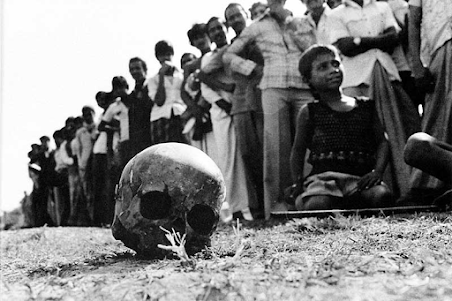
Anwar Hossain's photo of skull in 1971-Photo: Anwar Hossain

How the 195 Pakistani officers escaped prosecution for their war crimes

SALEEM SAMAD

Many believed that another Nuremberg trial would commence once Bangladesh accused 195 Pakistan military officers of war crimes and other related crimes.

Pakistan’s Attorney General, fearing for the officers, filed a petition, “Trial of Pakistani Prisoners of War” (Pakistan versus India) on May 11, 1973, seeking the intervention of the International Court of Justice (ICJ), in the Hague, Netherlands.

Pakistan instituted proceedings against India concerning the 195 POWs; according to Pakistan, India proposed to hand over to Bangladesh, who was suspected of acts of genocide and war crimes.

Pakistan’s application was filed in ICJ, instituting proceedings against India in respect of a “dispute concerning charges of genocide against 195 Pakistani nationals, prisoners of war, or civilian internees in Indian custody.”

India stated that there was no legal basis for the court’s jurisdiction in the matter and that Pakistan’s application was without legal effect. Pakistan hurriedly informed the court that negotiations had taken place, and requested to discontinue the application in July 1973. Accordingly, the case was removed from the list in December 1973.

On July 2, 1972 -- eight months after the POWs issue, Pakistan’s President Zulfikar Ali Bhutto and Indian Prime Minister Indira Gandhi signed the historic Simla Agreement. The crucial negotiation was held following the brutal birth of Bangladesh in 1971 and nearly 93,000 Pakistani forces and civilians were taken as POWs. The deal enabled India to agree to release all the POWs.

Earlier on Sheikh Mujib’s requests in March 1972 and for their safety and well-being, the POWs were transported to India. India treated the war prisoners in accordance with the Geneva Convention, 1925, but used this issue as a tool to coerce Pakistan into recognizing the sovereignty of Bangladesh after three countries reached a compromise in 1974.

Bangladesh was processing formalities to bring charges against the 195 prisoners for war crimes in their special courts established in Dhaka. To punish the 195 war criminals, Bangladesh enacted the International Crimes (Tribunals) Act (ICT Act 1973), to authorize the investigation and prosecution of the persons responsible for genocide, crimes against humanity, war crimes, and other crimes under international law committed in 1971.

Once Mujib announced that Bangladesh would put the war crimes suspects on the docks, the military hawks in Rawalpindi interned almost all the Bangla-speaking officers and soldiers in the army, navy, air force, border guards, police, and civil bureaucrats as POWs.

Bhutto also announced that several officers and civil bureaucrats would be tried for sedition and other crimes according to the Pakistan Army Act of 1952. This news alarmed Mujib who immediately sought help from friendly countries to exert diplomatic pressure on Pakistan.

Thus, both Bangladesh and India succumbed to the political blackmail of Pakistan. The three countries signed a historic “Bangladesh-India-Pakistan: Agreement of Prisoners of War and Civilian Internees” on April 9, 1974.

Dr Kamal Hossain, then Foreign Minister of Bangladesh, stated in the agreement: “The excesses and manifold crimes committed by those prisoners of war constituted, according to the relevant provisions of the UN General Assembly resolutions and international law, war crimes, crimes against humanity, and genocide, and that there was universal consensus that the persons charged with such crimes as the 195 Pakistani prisoners of war should be held to account and subjected to the due process of law.”

The negotiators of the Tripartite Agreement failed to have included a guarantee clause of the military trial of the war crimes suspects. Therefore, the 195 returned safely to Pakistan without being produced in any tribunal in Bangladesh nor were they charged under the Pakistan Military Act.

First published in the Dhaka Tribune, 23 March 2021

Saleem Samad is an independent journalist, media rights defender, and recipient of Ashoka Fellowship and Hellman-Hammett Award. He can be reached at saleemsamad@hotmail.com; Twitter @saleemsamad

Tuesday, March 09, 2021

Born for the flag

Photo: MAHMUD HOSSAION OPU

The story of Salam Sikder and his loyalty to the Bangladesh flag

SALEEM SAMAD

Liberation War veteran Salam Sikder, born in a poor peasant family, left home in early 1971. He told his wife that henceforth, she must take care of their two children.

When filmmaker Kawsar Chowdhury met him in 1997 at Gollamari in Khulna, his eyes were glowing with pride, instilled with the glory of the Liberation War. He was in his early thirties when he joined the Mukti Bahini guerrillas. He and his combatants operated stealthily for months in Khulna and Bagerhat region under Sector 9, commanded by Major Jalil.

The ragtag foot soldiers survived on bare food ration but were defiant against marauding forces. Their objective was one -- to liberate the motherland from the brutal occupation of Pakistan. Salam did not remember how many hit and run operations they conducted in Dacope, Batiaghata, Gollamari, Rampal, and adjoining areas.

On December 16, 1971, heads held high, Salam along with a small unit of foot soldiers, marched into war-ravaged Khulna city. Several dead bodies were strewn all over the city. The flow of the Gollamari canal, a tributary of river Moyur, was blocked by countless corpses in the waterway.

On December 16, in a simple ceremony, the flag of independent Bangladesh was hoisted at a small field on the back of the Gollamari canal. Quickly a flag-stand made of a bamboo pole was erected. A flag was tied to a rope. Who would take the privilege to hoist the flag?

Commander Kamruzzaman Tuku asked Salam Sikder to hoist the flag. He began to cry and said that he was not the right choice when there were other valiant guerrilla fighters.

Finally, all hands joined to raise the flag. It was also decided to build a martyr’s memorial at the same site. The Mukti Bahini commander and others decided that the caretaker would be Salam Sikder and he would hoist the flag at dawn and lower at dusk.

The story does not end here. Till the last day of his life, he raised the flag and lowered it, as demanded by the commander.

He took the honorary job seriously. He lived in a dilapidated thatched house adjacent to the martyr’s memorial. Not a single day, till 1997, had Salam taken a day off. When he did visit neighbours and relatives, he quickly returned before evening to lower the flag.

He never requested his family members to wash the flag. The flag was washed with care as if he was bathing an infant. He lamented that his son often asked why he had spent his entire life for a flag and never took care of the family. He explained that when he left their mother with two sons, he could have been killed in the battlefront.

He appealed to them to seek blessings from the Almighty that their father was alive and said: “I have been born for the flag and I will die for the flag.”

The award-winning Liberation War documentary filmmaker Kawsar Chowdhury in 2004 visited the martyr’s memorial and also met the warrior in fragile health. A brain stroke left him physically challenged and with memory loss.

The following year, the loyal flag caretaker Salam Sikder died -- unfortunately unrecognized for his contribution. 

First published in the Dhaka Tribune, 9 March 2021

Saleem Samad is an independent journalist, media rights defender, recipient of Ashoka Fellowship and Hellman-Hammett Award. He can be reached at saleemsamad@hotmail.com; Twitter @saleemsamad

Tuesday, January 19, 2021

Should China apologise to Bangladesh?

Sheikh Mujibur Rahman greeted by Mao Tse Tung, chairman of the Peoples Republic of China, during his goodwill visit to Beijing in 1957

SALEEM SAMAD

The Chinese were desperate for a kind of “wolf-warrior” diplomacy to take diplomatic and economic ties with Bangladesh to a new height during the post-Mujib era. In subsequent years, China emerged as the major economic partner in mega-infrastructure development projects in Bangladesh.

In the meantime, Prime Minister Sheikh Hasina told her officials that Bangladesh should give a second thought regarding any multi-billion dollar development projects offered by China. 

Not very long ago, she reassured the Indian journalists that India is an “organic” friend of Bangladesh; they jointly shed blood during the brutal birth of Bangladesh, and China is a development partner -- there is no conflict of interest with the two countries.

Recently, the PM reiterated that marauding Pakistani troops must make an apology for committing war crimes during Bangladesh independence. Pakistan had received unlimited military supply and political support from China to suppress the people in Bangladesh. The brass-coated “Made in China” bullets were responsible for several million martyrs -- for a crime to dream of an independent Bangladesh.

The architect of Bangladesh’s independence, Bangabandhu Sheikh Mujibur Rahman took charge of a war-ravaged nation with a promise to feed the hungry people and the task to rehabilitate the millions of refugees that slowly trickled back home from India. However, even after the return of Bangabandhu from Pakistan’s prison, China continued to politically and diplomatically harass the newly independent nation.

The trouble started when Bangladesh sought membership in the United Nations in 1972. China vetoed Bangladesh’s membership at the UN when the country desperately needed international aid for rehabilitation of the returnees from India. 

To withstand China, Sheikh Mujib, to add diplomatic clout, joined the Non-Aligned Movement (NAM), the Commonwealth, and the Organization of Islamic Conference (OIC), which helped strengthen Bangladesh’s image.

Even after diplomatic recognition by Pakistan under the duress of Islamic nations’ leaders in 1974, China continued to intimidate the government of Sheikh Mujib.

Overtly, the pro-Beijing communist parties in the country received political blessings from CCP. Why? Because the left parties opposed the Liberation War and expressed dissent on the government of Sheikh Mujib, blaming him to be a “stooge of Indian expansionist ideas.”

Mujib, as he stated in his book Amar Dekha Naya Chin (New China As I Saw) had visited China twice. First, in 1952 and the second visit in 1957. During his visit, he met the founder of New China, Mao Zedong, along with Zhou Enlai and other key figures of CCP. 

He was confident that the Chinese leaders would listen to his request to recognize Bangladesh.

Sheikh Mujib opened diplomatic channels to win the hearts of CCP. Pakistan’s veteran envoy to Beijing (1969-1972), Ambassador Khwaja Mohammad Kaiser was Mujib’s special emissary to Chinese leaders. Chinese Prime Minister Zhou Enlai confided to Ambassador Kaiser that he should understand his difficulties. Kaiser, however, returned to Beijing, as Bangladesh Ambassador in 1984 for two years.

Mujib also dispatched journalist and poet Faiz Ahmed to Beijing. Faiz had friends in high places among CCP leadership when he was working in Radio Peking (now Beijing) Bangla Service in the 1960s. Faiz, despite being a radical left, was Mujib’s play-card partner in prison during 1966-1969. Unfortunately, he too returned home with an empty hand and the mission reached a dead end.

China was among the last few countries to recognize Bangladesh on August 31, 1975. Well, not to an elected government of Sheikh Mujib, but after his brutal assassination in mid-August 1975. China, unfortunately, recognized an illegal regime headed by the assassins of Bangabandhu.

China should admit certain responsibility for the genocide perpetrated by Pakistan’s military hawks in Bangladesh due to CCP’s policy for providing military aid to Pakistan during the Liberation War. CCP should also regret intimidating Bangabandhu Sheikh Mujibur Rahman’s government.

First published in the Dhaka Tribune, 19 January 2021

Saleem Samad is an independent journalist, media rights defender, and recipient of Ashoka Fellowship and Hellman-Hammett Award. He can be reached at saleemsamad@hotmail.com; Twitter@saleemsamad


Friday, December 18, 2020

Thaw in Bangladesh, Pakistan, relations?

SALEEM SAMAD

The Pakistani press deliberately avoided the exchange between the Pakistan High Commissioner to Bangladesh Imran Ahmed Siddique and the Bangladesh PM.

There was lots of enthusiasm in the national press in Pakistan and among the Hawks in Islamabad, regarding the ‘quiet diplomacy’ of a rare meeting of Pakistan’s envoy with Bangladesh prime minister Sheikh Hasina.

The Hawks in Islamabad failed to realise why Hasina cleverly gave an appointment in December at her official residence Gonobhaban.

Bangladesh observes 16 December as ‘Victory Day’ when 93,000 marauding Pakistan armed forces and civilians surrendered at Dhaka in 1971, and Bangladesh was liberated.

The Pakistani press deliberately avoided the exchange between the Pakistan High Commissioner to Bangladesh Imran Ahmed Siddique and the Bangladesh PM.

Hasina during the parley maintaining social distancing in the wake of coronavirus pandemic, did not hesitate to state that “The incidents of 1971 can’t be forgotten. The pain will remain there forever,” says official news agency BSS.

She also referred to the volumes of a book titled “Secret Documents of Intelligence Branch on Father of the Nation Bangabandhu Sheikh Mujibur Rahman”, the prime minister said people can learn historical incidents that occurred during 1948-1971. The documents describe how Pakistan junta interpreted his political activities and intermittently put him behind bars years after years.

She said both the English and Urdu version of the book “Unfinished Memoirs” by Sheikh Mujibur Rahman is one of the bestsellers in Pakistan. “It’s also well-read in Pakistan apart from other countries.”

When the diplomat raised that different bilateral and regional forums have remained inactive for some time and sought Dhaka’s initiative to reactivate the Foreign Office consultations (FCO) between the two countries, Hasina responded that as she believes in regional cooperation and there is no problem in the functioning of the forums.

Hasina, daughter of the architect of Bangladesh independence, Sheikh Mujibur Rahman reiterated Bangladesh’s foreign policy “friendship to all malice towards none”, and said she believes in continuing relationships with other countries too.

Well, the daily newspapers Dawn, Express Tribune, and other online newspapers published spoon-fed news tailored by the Press Information Department in Islamabad –what the citizens of Pakistan would love to hear.

Both Urdu and English press welcomed Hasina’s meeting with the Pakistan diplomat. Whereas she refused to meet the outgoing Indian envoy during the coronavirus lockdown.

The parley was interpreted as yet another sign suggesting warming up of nearly a decade old tensions between the two countries since Bangladesh bifurcated from Pakistan after a bloody war of independence in 1971.

Kamran Yousaf writes in the Express Tribune that the meeting of the Pakistani envoy with the Bangladeshi PM was the result of a ‘quiet diplomacy’.

The ice melted first in July when the Pakistani High Commissioner held a meeting with the Bangladeshi Foreign Minister during the coronavirus outbreak at its peak. The meeting that raised eyebrows in India, the wise-man writes.

A similar circus occurred when Imran Khan and his Bangladeshi counterpart spoke by phone.

What the press in Karachi, Lahore, and Islamabad censored was that Hasina, confidently told the Naya Pakistan leader Khan, that his country must express apology for war crimes committed by the Pakistan military during the brutal birth of Bangladesh in 1971.

The diplomatic relationship between the two countries was experiencing hiccups after Pakistan repeatedly condemned the verdicts of the International Crimes Tribunal against the war criminals who are Bangladesh born and possess the nationality of Bangladesh.

Hasina was furious after recurring outlandish statements by Islamabad on war crimes trials were issued. In 2016, Pakistan’s parliament passed a unanimous resolution condemning the “politically motivated” trials.

Bangladesh protested to Pakistan’s condemnation, and diplomatic relations began to deteriorate. The ties sank in a quagmire.

She decided to call back the Bangladesh High Commissioner from Islamabad and lower the diplomatic status of the mission.

Her anger could be understood when she wanted to close down the Bangladesh mission in Islamabad and severe diplomatic relations with Pakistan.

Hastily at the request of India, Saudi Arabia, and the United States, Hasina changed her mind and instead kept the status low by withdrawing High Commissioner, Deputy High Commissioner, and other senior diplomatic officials.

The final blow comes when an official announcement that no tourist visa would be issued except for official visits and business visas. Pakistan also reciprocated the visa regime no visa is issued from Dhaka. Thus the only air connectivity by PIA had to cancel the flights for lack of passengers.

Despite Pakistan’s academia in Karachi, Lahore, and Islamabad, intellectuals, rights groups, and mainstream Urdu and English language media often write about Pakistan debacles in Bangladesh war theatre, war crimes trial, and advocates for a thaw in the estranged relationship between two countries. Still, some reactionary elements, mostly Islamist groups, remained negative about the Bangladesh war crimes trial.

The Pakistan media admits that the strained relationship occurred after Bangladesh went ahead with the trial of the war criminals in 2009.

However, the politicians and Islamist parties argue that Sheikh Hasina is settling scores against her opponents and Islamic evangelist and key leaders of the Islamist party Jamaat-e-Islami.

The politicians do not say that political leaders of the ruling Awami League, Jatiya Party, and Bangladesh Nationalist Party (BNP) were also indicted and given maximum punishment.

Not surprised that the nationalist movements in Balochistan and Sind eagerly urge Bangladesh to raise the crime against humanity in their provinces at the international forum. Especially the enforced disappearances, torture, and atrocities against the Baloch and Sindhi nationals.

Recently the human rights abuses against Pashtun nationalists and human rights activists have sharply risen.

Well, the Islamic Republic of Pakistan is a dangerous country for religious minorities, especially the Ahmadiyya, Christian, Sikh, and worst are the Hindus. The Hindu teenage and minor girls are victims of abduction, forced conversion, and married to elderly polygamist husbands, happening mostly in Sindh.

Finally, Kamran Yousaf writes that the statement issued by the Bangladeshi Prime Minister’s Office said the incidents of 1971 cannot be forgotten and forgiven. This shows that the Bangladesh government is still adamant that Pakistan must formally apologise over the events of 1971.

To bury the past and thaw the relationship among two South Asian countries, Islamabad must seek a public apology for committing war crimes and thus open a new chapter with Bangladesh.

First published in news portal Shuddhashar, published from Norway on 18 December 2020

Saleem Samad is an independent journalist, media rights defender, recipient of Ashoka Fellowship and Hellman-Hammett Award. He could be reached at <saleemsamad@hotmail.com>; Twitter @saleemsamad