Buy.com Monthly Coupon
Showing posts with label International Court of Justice. Show all posts

Tuesday, March 23, 2021

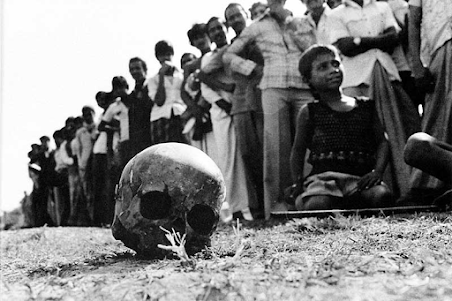
Pakistan: Getting away with genocide

Anwar Hossain's photo of skull in 1971-Photo: Anwar Hossain

How the 195 Pakistani officers escaped prosecution for their war crimes

SALEEM SAMAD

Many believed that another Nuremberg trial would commence once Bangladesh accused 195 Pakistan military officers of war crimes and other related crimes.

Pakistan’s Attorney General, fearing for the officers, filed a petition, “Trial of Pakistani Prisoners of War” (Pakistan versus India) on May 11, 1973, seeking the intervention of the International Court of Justice (ICJ), in the Hague, Netherlands.

Pakistan instituted proceedings against India concerning the 195 POWs; according to Pakistan, India proposed to hand over to Bangladesh, who was suspected of acts of genocide and war crimes.

Pakistan’s application was filed in ICJ, instituting proceedings against India in respect of a “dispute concerning charges of genocide against 195 Pakistani nationals, prisoners of war, or civilian internees in Indian custody.”

India stated that there was no legal basis for the court’s jurisdiction in the matter and that Pakistan’s application was without legal effect. Pakistan hurriedly informed the court that negotiations had taken place, and requested to discontinue the application in July 1973. Accordingly, the case was removed from the list in December 1973.

On July 2, 1972 -- eight months after the POWs issue, Pakistan’s President Zulfikar Ali Bhutto and Indian Prime Minister Indira Gandhi signed the historic Simla Agreement. The crucial negotiation was held following the brutal birth of Bangladesh in 1971 and nearly 93,000 Pakistani forces and civilians were taken as POWs. The deal enabled India to agree to release all the POWs.

Earlier on Sheikh Mujib’s requests in March 1972 and for their safety and well-being, the POWs were transported to India. India treated the war prisoners in accordance with the Geneva Convention, 1925, but used this issue as a tool to coerce Pakistan into recognizing the sovereignty of Bangladesh after three countries reached a compromise in 1974.

Bangladesh was processing formalities to bring charges against the 195 prisoners for war crimes in their special courts established in Dhaka. To punish the 195 war criminals, Bangladesh enacted the International Crimes (Tribunals) Act (ICT Act 1973), to authorize the investigation and prosecution of the persons responsible for genocide, crimes against humanity, war crimes, and other crimes under international law committed in 1971.

Once Mujib announced that Bangladesh would put the war crimes suspects on the docks, the military hawks in Rawalpindi interned almost all the Bangla-speaking officers and soldiers in the army, navy, air force, border guards, police, and civil bureaucrats as POWs.

Bhutto also announced that several officers and civil bureaucrats would be tried for sedition and other crimes according to the Pakistan Army Act of 1952. This news alarmed Mujib who immediately sought help from friendly countries to exert diplomatic pressure on Pakistan.

Thus, both Bangladesh and India succumbed to the political blackmail of Pakistan. The three countries signed a historic “Bangladesh-India-Pakistan: Agreement of Prisoners of War and Civilian Internees” on April 9, 1974.

Dr Kamal Hossain, then Foreign Minister of Bangladesh, stated in the agreement: “The excesses and manifold crimes committed by those prisoners of war constituted, according to the relevant provisions of the UN General Assembly resolutions and international law, war crimes, crimes against humanity, and genocide, and that there was universal consensus that the persons charged with such crimes as the 195 Pakistani prisoners of war should be held to account and subjected to the due process of law.”

The negotiators of the Tripartite Agreement failed to have included a guarantee clause of the military trial of the war crimes suspects. Therefore, the 195 returned safely to Pakistan without being produced in any tribunal in Bangladesh nor were they charged under the Pakistan Military Act.

First published in the Dhaka Tribune, 23 March 2021

Saleem Samad is an independent journalist, media rights defender, and recipient of Ashoka Fellowship and Hellman-Hammett Award. He can be reached at saleemsamad@hotmail.com; Twitter @saleemsamad

Tuesday, November 10, 2020

Myanmar polls a step closer to China

Will a Suu Kyi win help Myanmar stay in China’s good graces?

SALEEM SAMAD

When the world was extremely preoccupied with the tense Trump-Biden American elections, Myanmar held its parliamentary polls on Sunday (November 8), which are expected to deliver a government with a strong popular mandate in Southeast Asia.

Suu Kyi’s National League for Democracy party (NLD) won a landslide in 2015 and established the first civilian government after 50 years of global isolation and ruthless military regime. Five years later, Suu Kyi remains popular, but 2020 has widened the image from 2015.

Suu Kyi has fallen from the grace of world leaders and is no longer a democracy icon, primarily because she mishandled the rogue military crackdown against the ethnic Rohingya Muslim population, which the United Nations said had “the hallmarks of genocide.”

More than a million Rohingya fled from Rakhine State into neighbouring Bangladesh in 2016 and 2017 after the military waged a campaign of persecution, which the United Nations dubbed as “textbook ethnic cleansing.”

The Rohingya’s citizenship rights were deliberately and permanently erased, restricting them to vote under the discriminatory 1982 Citizenship Law. Even the Rohingya political parties were banned from contesting the elections.

In the face of global criticism, last year Suu Kyi defended her country’s military crackdown and denied genocide at the International Court of Justice in The Hague, explaining that the claims were “incomplete and misleading.”

Many international observers fear that the November elections will not be free, fair, and credible, citing disenfranchisement and campaign restrictions imposed by the Union Election Commission (UEC).

Military chief Gen Min Aung Hlaing’s warnings to the UEC on electioneering directives soured relationships with the government. President U Win Myint stated that the military’s “remarks over the election were inciting instability and causing public concern.”

Bertil Lintner, a Swedish journalist who has written extensively about Myanmar’s armed conflicts, politics, and ethnic crises for nearly 40 years, says it is unfortunate that elections have been suspended in several constituencies, primarily in ethnic areas where armed conflict rages against the Myanmar regime.

China wants Suu Kyi to win Myanmar’s polls. China’s interests will be better served by the Suu Kyi-led status quo than a return to military-dominated rule. Much has changed since the leaders in Beijing favoured Myanmar’s authoritarian military regime and were deeply suspicious of then opposition leader Suu Kyi.

The Chinese Communist Party has made no secret that they would prefer to see Suu Kyi and her National League for Democracy (NLD) win and are wary of the military top brass, whom they find increasingly difficult to influence and control.

Lintner also agrees that the Myanmar foreign policy will likely take its course after the poll -- towards a stronger and closer relationship with China. While the Tatmadaw sees it as their pledge to defend the nation’s sovereignty and seeks to lessen dependence on China, Suu Kyi turned to Beijing for the economic and controversial Belt and Road Initiative (BRI) after her allies and admirers in the West distanced themselves from her over the Rohingya refugee crisis.

First published in the Dhaka Tribune on 10 November 2020

Saleem Samad, is an independent journalist, media rights defender, recipient of Ashoka Fellowship and Hellman-Hammett Award. He could be reached at saleemsamad@hotmail.com. Twitter @saleemsamad

Monday, February 17, 2020

How likely is Myanmar to make policy changes after the ICJ ruling?

Myanmar’s denial of organized human rights abuses hold little water Photo: REUTERS
SALEEM SAMAD
Does Myanmar have any obligation to take the world court -- the International Court of Justice (ICJ) in The Hague – seriously?
The second question is whether Myanmar’s quasi-military ruler has the political will to implement the landmark judgment of January 23. Myanmar has officially rejected the International Court of Justice’s historic ruling and accused international rights groups of making exaggerated statements about the prevailing situation. It also rejected the UN fact-finding mission’s report on the basis of being “one-sided.”
It is well understood that the ICJ has no legal jurisdiction over Myanmar or any individual nation.
The ICJ ordered Myanmar to implement vital measures to protect its Rohingya population from facing any further atrocities. This ruling has been hailed as an “accomplishment of international justice.” The court further ordered Myanmar to ensure protection from the destruction of any evidence of “possible” genocide.
The ruling means that a global body, for the first time, has officially recognized the threat of abuse against the Rohingya, and ordered Myanmar to protect the community.
The verdict was indeed a significant triumph for the forcefully displaced Rohingya currently in refuge in Bangladesh. This ruling was also hailed by the government of Bangladesh, as the country is host to more than 1 million displaced Rohingya presently languishing in camps.
A lawsuit was brought to the ICJ by the Gambia, an impoverished Muslim state in Africa. The legal process was backed by the 57-nation Organization of Islamic Cooperation (OIC) in November at the highest body -- the United Nations -- for dispute resolution between states.
The OIC accused Myanmar of genocide against the Rohingya, in violation of a 1948 Genocide Convention. The Islamic body, as well as the United Nations, has condemned Myanmar’s refusal to repatriate the Rohingya as citizens of the country. Both bodies have raised concerns over the appalling human rights violations.
The challenges that remain the most significant impediments to the ICJ are that it has no power to execute its decisions and that it is voluntary in nature.
In 1993, the ICJ issued similar measures against Serbia after Bosnia had accused it of genocide. Just two years later, Serb forces killed thousands of Bosnian Muslim men and boys in what has become known as the Srebrenica massacre.
The ruling could not stop a second genocide in Europe after World War II.
Myanmar established an Independent Commission of Enquiry (ICOE) which acknowledges committing war crimes but not genocide during the military campaign.
The Myanmar government, headed by Nobel laureate for Peace Aung San Suu Kyi, has strongly denied organized human rights abuses. The regime systematically said that the military action, which followed militant attacks on Myanmar security forces in August 2017,  was “a legitimate counter-insurgency operation.”
The ICOE inquiry report mentions that nearly 900 people were killed. The commission failed to find assertions of gang-rape, or evidence to presume any intent of genocide. No one was surprised at the discrepancy between Myanmar and the international community over committing genocide.
The head of a UN fact-finding mission in Myanmar warned that there was a serious risk of genocide, and the mission did not hesitate to state in its final report, submitted in September 2019, that Myanmar should be held responsible in international legal forums for alleged genocide against the Rohingya.
Myanmar has questioned the legitimacy of the world court but is obliged under international law to comply with the ICJ ruling to provide regular reports to the ICJ, starting next May, to say what steps it has taken to prevent further abuse against the Rohingya.
It is highly unlikely that Myanmar will make any major policy changes to combat the discrimination against the Rohingya community, or provide support for international justice efforts. The United Nations Security Council (UNSC) has been paralyzed over the Rohingya crisis so far, with China shielding Myanmar from censure, which makes enforcement more difficult.
In this regard, an effective measure could be exerting diplomatic pressure by the international community, which has political and economic clout within the UN Security Council and can bring Myanmar to justice. The Convention against Genocide imposes a duty on states that are signatories to “prevent and to punish” genocide, as seen by Gambia’s ability to bring the case to the ICJ.
Until then, Myanmar will have an excuse to not take any measures for the repatriation, as well as the rehabilitation, of the displaced Rohingya. This difficultly will continue with a possible veto from China.
Whether Myanmar abides by the ICJ rulings remains to be seen. 

First published in Dhaka Tribune, 17 February 2020

Saleem Samad is an independent journalist, media rights defender, and is a recipient of the Ashoka Fellow and Hellman-Hammett Award. He can be followed on Twitter @saleemsamad