Buy.com Monthly Coupon
Showing posts with label United States. Show all posts

Sunday, August 18, 2024

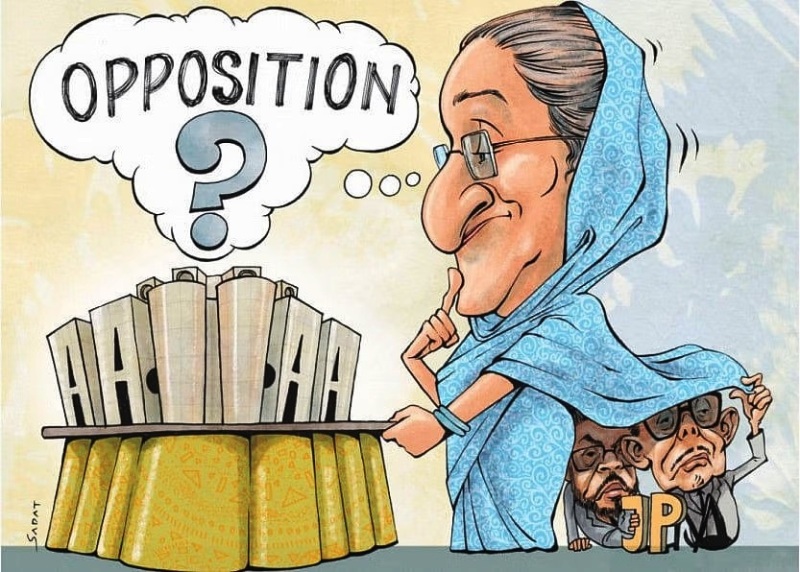
America, India both lost its influence in Bangladesh

Cartoon: Sadatuddin Ahmed Emil, The Daily Star

SALEEM SAMAD

A bombshell article published in the Washington Post on 15 August claims that India pressed the United States to tone down its criticism of Prime Minister Sheikh Hasina and to scuttle any fresh sanctions against her neighbouring Bangladesh.

The article jointly by Gerry Shih, Ellen Nakashima and John Hudson says that both countries must fall back, whether they mishandled Bangladesh.

The story goes a year before her government was toppled in the first week of August in a student uprising, Indian officials began to lobby their U.S. counterparts to stop pressuring Hasina, who ruled Bangladesh for 15 years with an iron fist.

American diplomats had publicly warned the 76-year-old Hasina for jailing thousands of her rivals, critics, dissidents and journalists ahead of a parliamentary election held last January.

Earlier, the Biden administration had sanctioned Bangladesh’s elite anti-crime police unit Rapid Action Battalion (RAB) accused of committing enforced disappearances and extra-judicial killings of suspects and had threatened to impose visa restrictions on those who undermined democracy or committed human rights abuses.

In a series of parleys, Indian officials demanded that the United States tone down its pro-democracy rhetoric. If the opposition were allowed to gain power in a free, fair and inclusive election, Indian officials argued, Bangladesh would become a breeding ground for Islamist militancy posing a security threat to India.

In several engagements, Indian Minister of External Affairs Subrahmanyam Jaishankar and Defence Minister Rajnath Singh met with Secretary of State Antony Blinken and Defence Secretary Lloyd Austin in November in New Delhi.

While Indian national security adviser Ajit Doval also played a key role in presenting the Indian case during a visit to Washington that autumn.

These diplomatic engagements stirred a magical potion in the cooking pot. Soon after some “White House officials considered the downside of antagonising India, which made a series of appeals to the U.S. that it moderate its pressure on Hasina,” writes the prestigious newspaper publishing for 147 years.

“You approach it at the level of democracy, but for us, the issues are much more serious and existential,” said an Indian government adviser on the condition of anonymity.

The American foreign policy bigwigs concluded that after the private parleys between top officials of the United States and India, “This is a core concern for us, and you can’t take us as a strategic partner unless we have some kind of strategic consensus.”

Finally, when Biden visited New Delhi in September 2023, he took a selfie with Sheikh Hasina and her smart daughter Saima Wazed, several analysts got a message of thaw between Dhaka and Washington.

Well, the Biden administration substantially softened its criticism and shelved threats of further sanctions against Hasina’s autocratic regime after the flawed January election, disappointing several civil societies in Bangladesh.

Now, after protesters defied the army’s curfew orders and marched on Hasina’s official residence, compelling her to flee to India, policymakers in both New Delhi and Washington went backstage to preview whether they mishandled Bangladesh.

The policymakers in the State Department believe that the ground reality often fails the balancing act in Bangladesh, as there are many places where the situation on the ground is complicated and you want to work with the partners you have in a way that is not inconsistent with what the American people expect.

The United States was in a dilemma regarding diplomatic engagement with Bangladesh vis-à-vis keeping India in good humour. Biden administration viewed India as a crucial partner in countering China.

Its smaller neighbours in South Asia increasingly view India itself as a meddling, aggressively nationalist power under Prime Minister Narendra Modi. India’s meddling in Maldives, Nepal and Sri Lanka backfired. The episode and kept a safe distance to avoid further embarrassment.

Several sources in Washington told the writers of the article that in the months leading up to the January election, divisions emerged within the U.S. government over how to handle Bangladesh.

Many former senior diplomats, who were assigned in Dhaka, and the State Department recommended a tougher stance against Hasina, particularly since President Joe Biden had campaigned on restoring democracy in Bangladesh.

Other U.S. officials felt there was little to be gained from further alienating Hasina and risking the safety of U.S. diplomats, including Ambassador Peter Haas, who had received threats from Hasina’s political henchmen.

The Post journalists wrote that for India, the dramatic developments in Bangladesh have turned a spotlight on its decade-long, all-in bet on Hasina, even as she grew autocratic and unpopular.

In January, after Hasina claimed victory in a flawed election, keeping thousands of opposition leaders in jail or hiding, Indian officials did not hesitate to the election results, fuelling calls from the opposition and like-minded groups for a boycott of Indian imports.

Jon Danilowicz, a retired U.S. diplomat who served as deputy chief of mission in Dhaka said, “New Delhi and Washington have to show some humility and acknowledge they got Bangladesh wrong by not siding with the Bangladeshi people and their democratic aspirations.”

After the elections, which were neither free nor fair, some criticised the U.S. for not imposing more restrictions on Bangladeshis, falsely attributing this to Indian influence, remarked Danilowicz.

The anti-quota movement spearheaded by the students of Dhaka University spread to all state universities and scores of private universities, and the “helmet behind” [vigilante recruits from Awami League’s students and youths] backed by riot police attacked the street protests.

The street protests turned violent and turned into anti-government uprisings which killed more than 600 people, according to the. Hasina made a hasty decision to flee the country and took refuge in India, at a Delhi military base.

After Hasina’s ouster, Indian officials have publicly changed tack and expressed willingness to work with the inventor of microcredit Dr Muhammad Yunus.

Last week, Modi sent his “best wishes” to Muhammad Yunus, the Nobel Prize-winning banker who took charge of Bangladesh’s interim government, even though he criticized India for backing Hasina. Yunus has called for new, free, and fair elections once the country's stability is restored.

As India grapples with the shock of suddenly losing one of its closest allies, Indian foreign policy circles and media have been awash with speculation that Washington orchestrated the removal of Hasina, who has long had a chilly relationship with the United States. U.S. officials have staunchly denied the claim.

First published in the Northeast News, Guwahati, India on 18 August 2024

Saleem Samad is an award-winning independent journalist based in Bangladesh. A media rights defender with the Reporters Without Borders (@RSF_inter). Recipient of Ashoka Fellowship and Hellman-Hammett Award. He could be reached at saleemsamad@hotmail.com; Twitter (X): @saleemsamad

Tuesday, December 05, 2023

Sheikh Hasina hints at dealing with sanctions after the election

SALEEM SAMAD

Looming threats of sanctions on labour issues have raised eyebrows among the government, policymakers, garment entrepreneurs and industrial bodies.

Most ready-made-garments (RMG) factories have failed or partially implemented international compliance and ethical practices, which has ignited labour unrest.

Recently, Bangladesh has witnessed intense labour unrest and violent protests related to wage disputes in the garment industry. The dispute on fair wages for RMG workers has sparked widespread protests demanding against the government’s Wage Board decision to increase BDT 12,500 ($113) per month for garment workers, effective from 1 December.

The labour groups rejected the new wage structure due to its inadequacy in addressing their financial needs. The unions dismissed the decision, arguing that the pay hike does not adequately address the rising costs of food, housing, healthcare, and school fees for their children.

The prices of essentials have dramatically risen and the wages of workers cannot meet both ends. Inflation in Bangladesh rose to 9 per cent between 2022 and 2023, the highest average rate in 12 years.

The garment industry employs some of the poorest and most vulnerable people recruited from rural areas. Ensuring fair wages and safe working conditions remains a critical challenge for the industry.

The garment industry in Bangladesh employs some of the poorest and most vulnerable people, making fair wages and safe working conditions critical issues.

Thousands of garment workers took to the streets, demanding better wages for the country’s four million garment workers. The worker’s agitation escalated and clashed with the riot police.

Police lobbed hundreds of tear gas shells and fired rubber bullets which failed to contain the riots.

The worker’s protests led to shut down of scores of factories, paralysing Bangladesh’s position as the world’s second-largest garment manufacturing hub after China.

At least three workers were killed during the protest and 70 factories ransacked since. Tragically, protesters set fire to a factory, resulting in the death of a worker named Imran Hossain.

The police shot and killed another worker, Rasel Howlader. Among them was Anjuara Khatun, a 26-year-old machine operator at a factory in Gazipur, north of the capital.

The worker’s protest has coincided with other anti-government demonstrations when the opposition is demanding that Hasina step down, cancel the election schedule and hold the national election under an interim government. The demands seem to have fallen flat.

Bangladesh Prime Minister Sheikh Hasina urged the garment workers to return to work with the newly-announced wages. Bangladesh’s 3,500 garment factories contribute to approximately 85% of the country’s USD 55 billion in annual exports, supplying major global brands including Levi’s, Zara, and H&M.

Hasina threatened the workers, that if they continue to abstain from work despite the wage increase, she stated, “If they take to the streets to protest at someone’s instigation, they will lose their job, lose their work, and will have to return to their village. If these factories are closed, if production is disrupted, and exports are disrupted, where will their jobs be? They (workers) have to understand that.”

The majority of the workers slowly returned to work. Which means they have accepted the new wage announced by the government.

Immediately, the US State Department expressed concern about the ongoing repression of workers and trade unionists. Washington urged a tripartite process to revisit the minimum wage decision to address the economic pressures faced by workers and their families.

The Bangladesh embassy in Washington DC on 20 November raised concerns that Bangladesh might face stringent measures, including sanctions, trade penalties, and visa restrictions outlined in the US Presidential Memorandum on labour rights.

While the memorandum has global implications and is not specifically targeted at Bangladesh, recent weeks of labour unrest in the country’s readymade garment industry, centred on demands for improved pay and marked by violent clashes with the police resulting in at least four worker fatalities, have prompted the embassy to issue a warning to Dhaka.

After the call from the USA, good sense prevailed upon President Mohammad Shahabuddin has sent back the Bangladesh Labour (Amendment) Bill, 2023 without giving his assent.

The two sub-sections of Section 294 of the Labour Act, 2006, propose to amend some of the penalties for illegal labour strikes and illegal lockouts by employers.

The law provides for imprisonment of up to six months or a fine of up to BDT 5,000, or both if a worker goes on an unlawful strike. There is a legal provision that any factory owner will also face the same punishment if he makes an illegal lockout.

Interestingly, in 2023, the amendment to the law, which was passed in Parliament, increased the fine in case of illegal strike of workers from BDT 5,000 to 20,000. But in the case of the owners, the fine has been kept at the same as before (BDT 5,000).

In the national election fever, there will not be any parliament session. The fresh bill will have to be placed in the parliament next year.

On the other hand, many garment industries have fallen short of fully implementing international compliance guidelines. In the context of the garment industry, adherence to international compliance guidelines is crucial for ensuring ethical and safe working conditions. While some garment industries fully implement these guidelines, others may only partially comply.

Additionally, compliance covers various other aspects such as equal remuneration, anti-discrimination policies, child labour abolition, and safety measures to ensure adherence to guidelines, which create a favourable working environment for their employees.

Bangladesh Garment Manufacturers and Exporters Association (BGMEA), Bangladesh Knitwear Manufacturers Export Association (BKMEA), and Bangladesh Employers Federation (BEF) are expected to play a crucial role in monitoring factories to ensure ethical practices, fair wages, and safe working conditions in RMG industry.

A recent survey by Quality Inspection, Management, and Assurance (QIMA), a global company that offers quality inspections, audits, and testing services, ranked Bangladesh second in “Ethical Manufacturing,” just behind Taiwan.

Bangladesh’s local suppliers in the international supply chain have been recognised for their good practices.

A day ago, ruling Awami League’s President Sheikh Hasina told the leaders of the 14-party that a conspiracy was being hatched over the election. Without naming Uncle Sam, she said that sanctions may come.

Hasina, pointing fingers towards the United States said, is trying to make the Awami League government uncomfortable over the labour issue. “Where will you find cheap labourers producing at competitive prices? I will also see. I am not afraid of domestic and foreign conspiracies.”

She warned that a new crisis may arise after the election. “If I survive, I will overcome this,” Hasina snapped.

First published in the Northeast News,  5 December 2023

Saleem Samad is an award-winning independent journalist based in Bangladesh. A media rights defender with the Reporters Without Borders (@RSF_inter). Recipient of Ashoka Fellowship and Hellman-Hammett Award. He could be reached at saleemsamad@hotmail.com; Twitter: @saleemsamad

Saturday, October 14, 2023

China-Russia-America, who is the friend of Bangladesh?


SALEEM SAMAD

As the much-talked-about general elections expected in early January 2024 approach, the global superpowers are zooming their hawkish eyes on Bangladesh.

Most concerned people in the West, of course, the Bangladeshi expatriates and especially the Indians frankly ask why the superpowers are interested in the political development in a country of 173 million people.

In one word – the “China card”. The West, neighbouring India and even Japan are feeling jittery over the growing Chinese influence in the Sheikh Hasina-led government and her party Awami League.

Once an Indian diplomat in a private gathering sought opinion on why China’s mega-projects get approval quickly, and India’s infrastructure development projects are delayed due to bureaucratic red tape. He was told that the Japanese had a similar experience of projects falling through the faultline of bureaucracy.

China’s inroad to Bangladesh and getting contracts for mega projects had irked India, Japan and the United States.

Indian media have written on the expansion and development project of the third largest airport at Sylhet, in northeast Bangladesh and the proposed Teesta River Comprehensive Management and Restoration Project. However, the later project was shelved showing errors in the loan proposal.

The Osmani International Airport in Sylhet is in close proximity to Assam and Arunachal state is further north, where India borders with Tibet in China. The airport is in a strategic location for eavesdropping into Indian northeast states, it is feared by Delhi. Recently China’s official map shows Arunachal as South Tibet, inviting fresh ruckus with Red Dragon.

What is China’s interest in the Teesta River, a transboundary river that flows through India and Bangladesh? The proposed project has raised eyebrows in the region. The river is a significant source of water for both India and Bangladesh.

Indeed, the river is crucial for the economic development of the region as it is a source of water for agriculture and hydroelectric power generation. The river water sharing has been a bone of contention between the two neighbours for decades.

China’s involvement in the Teesta River dispute has added a new dimension to the conflict. The Red Dragon’s interest in the Teesta River can be attributed to its strategic ambitions in the region. The river originates in the Himalayas and flows through the Indian states of Sikkim and West Bengal before entering Bangladesh, says a river morphologist.

Japan has undertaken to construct the largest deep-sea port on Maheskhali island, in the Bay of Bengal and has been able to bulldoze the Chinese proposal of a second deep-sea port in Sonadia, not far from the ongoing project of the Rising Sun.

Tokyo has been able to convince Delhi that the deep-sea port on the Bangladesh coast which serves adequately to export/import of northeast Indian states, will boost economic growth and immensely contribute to the country’s GDP.

Bangladesh, last week became the 33rd member of the nuclear club. The under-construction Russian project Rooppur Nuclear Power Plant will augment electric generation in energy-starved northern Bangladesh.

Other than the nuclear power plant, Russia does not have a second mega project in Bangladesh.

Bangladesh imports food grains from Russia and exports various garments items, jute, frozen foods, tea, leather, home textiles and ceramic products.

Bangladesh, however, has a historic relationship with Russia. The former Soviet Union took a proactive position in favour of Bangladesh’s independence war in 1971.

Delhi and Moscow signed a historic Indo–Soviet Treaty of Peace, Friendship and Cooperation which expedited the bloody independence of Bangladesh.

Meanwhile, the United States is being bombarded by cyber-warriors with anti-American rhetoric in social media after Washington announced visa restrictions on officials of the governing party, opposition, government officials, police administration, judiciary and media persons. This applies to those who undermine or cause hindrance to the democratic elections in Bangladesh, the axe will fall upon individuals and their immediate family members.

It is understood that the visa restriction by the USA triggers a chain reaction in Australia, Canada, France Germany, Italy, Spain, the United Kingdom, and the allies in the West in denial of entry to their countries.

The US Embassy in Dhaka to counter the rhetoric has launched the #DidYouKnow campaign for Bangladesh’s audience in social media.

For example: #DidYouKnow, the United States is the biggest foreign direct investor in #Bangladesh?

Bangladesh received USD 3.44 billion in foreign direct investment (FDI) during 2021-2022 for three broad sectors of FDI inflows: infrastructure, manufacturing, and services, according to Bangladesh Bank (the central bank).

The USA FDI stood at $575 million in 2022, while China seems the largest FDI source of Bangladesh climbed to $940 million for 2022, reported Dhaka Tribune.

Diverse sectors offer opportunities for U.S. companies, including natural gas exploration and production, power generation, financial services, infrastructure, agribusiness, information technology, consulting services, and civil aviation to name just a few.

The garment sector has been a key driver of economic growth for Bangladesh over the past few decades. The US-Bangladesh has a $14 billion trade relationship and it’s growing, tweets the US Embassy in Dhaka.

What irks Bangladesh is when America expresses concern on stellar human rights record, democratic election process, freedom of the press and freedom of expression.

The relations went cold in 2021 when the US imposed punitive measures, in support of US Global Magnitsky human rights sanctions, targeting six of the elite anti-crime Rapid Action Battalion’s (RAB’s) former officials, including current and immediate past heads of the Bangladesh police.

The sanction did make an impact. A study claimed that RAB’s extra-judicial killings and enforced disappearances have dramatically reduced, which received accolades from human rights organisations.

Meanwhile, Abed Khan, Chief Editor of Dainik Kalbela warns that in a week several economic sanctions against individuals, business establishments and government entities are likely to be imposed citing corruption and money-laundering, which is now a transnational crime.

Journalist Chandan Nandy, based in New Delhi writes in the Northeast News portal (blocked by Bangladesh authorities) also claims that sanction is in the offing against money laundering and corruption.

Foreign Minister Dr AK Abdul Momen trashed rumours of fresh sanctions by the US, in response to media reports told journalists. “We were in the US…they (US) only want free and fair elections. Even the words – participatory or caretaker government – were not mentioned,” he remarked.

While the United States pressure on the current government on the upcoming general election is visible, China and Russia’s position contradicts the United States, quoting unnamed sources in Washington DC.

The polarisation of the rivals United States, China and Russia has been observed, writes a commentator for BBC Bangla Service.

Humayun Kabir, a former Bangladesh ambassador to Washington, opines that Bangladesh has become the new ‘field of polarisation’ of the United States, China and Russia.

He said that the US President Joe Biden administration’s foreign policy envisages ‘establishing democracy and human rights’ in different countries of the world and Bangladesh is in the bigger canvass to neutralise China’s hegemony in South and South East Asia.

Another reason is that America’s Indo-Pacific strategy has focused on actively implementing the United States domination in the Asia region, with new and old allies.

Kabir said, the European Union too also want Bangladesh to strengthen democracy and hold free and fair elections in upcoming polls. In exchange, Bangladesh will benefit equally, especially from the trade facility, which is believed to strengthen the democratic process in the country.

China is a development partner of Bangladesh, retorted Prime Minister Sheikh Hasina, when she was confronted by overjealous Indian journalists.

Professor Imtiaz Ahmed of Dhaka University says Bangladesh is caught in a triangle of Russia, China and America, because of its geo-strategic position.

Bangladesh, positioned on the coast of the Bay of Bengal which merges with the Indian Ocean and the Pacific Ocean comes under the fold of strategic partnership with America, Japan and India.

Political historian Mohiuddin Ahmad said the reason Bangladesh is a strategic partner in Asia because the country has made dramatic economic development and has been fairing on the parameters of Sustainable Development Goals (SDG), which gives hope to the big powers rivals that the country is not a failed state like Pakistan or Somalia.

Therefore, the agenda of the United States, European Union, Japan and India to encourage Bangladesh to hold free, fair and credible elections and remain steadfast on the path to democracy will enable Sheikh Hasina to be the longest-serving prime minister to return to power for the fifth tenure.

First published in Northeast News, Guwahati, Assam, India, 14 October 2023

Saleem Samad is an award-winning independent journalist based in Bangladesh. A media rights defender with the Reporters Without Borders (@RSF_inter). Recipient of Ashoka Fellowship and Hellman-Hammett Award. He could be reached at saleemsamad@hotmail.com; Twitter: @saleemsamad


Friday, September 29, 2023

US visa policy for Bangladesh causes worries for all


SALEEM SAMAD

Fresh US Visa policy announced recently to be on the ‘red list’ of individuals with ruling and opposition parties, government officials, judiciaries, and media professionals would be tagged including their immediate family members responsible for, or complicit in, undermining the democratic election process.

Those who will hinder holding free, fair, credible and inclusive elections the Swords of Damocles will fall upon that individual.

Over the last two years, the US has maintained pressure on Sheikh Hasina, the world’s longest-serving women Prime Minister, urging her to ensure a free and fair election in upcoming national polls expected in the first week of January 2024.

Since December 2021, the US Treasury Department imposed sanctions on the top officials of Bangladesh’s Rapid Action Battalion (RAB), an elite police unit targeting crime and terrorism, which has been accused of extrajudicial killings and enforced disappearances.

Hasina at a press conference in May retorted why should her government be afraid of being sanctioned by foreign countries. “Why should we be sanctioned,” she lamented.

The visa policy has indeed made shivers run through the spines of the Awami League, ‘golden boys’ (pro-government delinquent students and youths], and civil and police administration.

While the critics, dissidents and ‘aam janata’ (mango people) of the regime are rejoicing, the visa policy seems to have cut across all tiers of the government and ruling parties.

Political analyst Badiul Alam Majumder said: “I see this restriction as a preventive measure. This could avert efforts by individuals to rig elections in their favour,” he told Reuters.

However, anguish and frustration were visible in the body language of the people in power.

Well, a few weeks ago, the ruling party leaders, members, activists, and cheerleaders among all professional bodies were excited and shared pleasant posts of the selfie photos of Sheikh Hasina and US President Joe Biden at the G-20 Summit in New Delhi.

The confidence of the sycophants and partisan government officials, including police and district administration further heightened after the news of Hasina attended a banquet reception hosted by Biden on the sidelines of the United Nations General Assembly in New York.

When the Bangladesh Prime Minister was in New York, her government in Dhaka was informed of the implementation of the visa policy by the US Administration.

Earlier, on 3 May the US Administration informed Bangladesh that it would announce a policy for restricting visas to those who would obstruct the democratic election process or be part of such action.

Then on 24 May US Secretary of State Antony Blinken formally announced the decision and said the “[visa] policy to lend our support to all those seeking to advance democracy in Bangladesh.”

On 22 September, the US State Department spokesperson Matthew Miller said that the visa restrictions had started to be implemented on Bangladeshi individuals.

After the US announced its new visa policy, Bangladesh Foreign Minister AK Abdul Momen hoped that the new visa policy would help Bangladesh hold free and fair elections.

The US State Department in a statement said that it was “heartened” that the Bangladesh government welcomed its decision to impose visa restrictions on those who undermine the democratic election process in Bangladesh.

In describing actions that impeded the election process, the US mentioned vote rigging, threatening voters, restoring to violence to obstruct people’s freedom to assemble and their right to hold peaceful gatherings, and other actions that prevented political parties, voters, the civil society or the news media from expressing their views.

In response, the Bangladesh foreign ministry issued a statement, “The government apparatus will take necessary measures to prevent and address any unlawful practices or interference … to compromise the smooth and participatory conduct of the elections.”

“The electoral process will remain under strict vigilance, including by international observers as accredited by the Election Commission,” the statement added.

Walla, overnight the hell has broken loose! The troll armies, digital mercenaries, and lie factories — weapons of the government in collaboration with recruits from Awami League and Chhatra League, both at home and abroad began to shred the US Visa policy.

The wolf warriors unleashed a smear campaign against the US Administration. Even the US Embassy in Dhaka and Ambassador Peter Haas were not spared.

The US Embassy and the Ambassador were showered with threatening messages. Former Justice Shamsuddin Chowdhury Manik demanded the US Ambassador should be expelled from the country.

A ‘golden boy’ Siddique Nazmul Alam, former general secretary of Bangladesh Chhatra [Student] League (BCL) posted a status on his verified Facebook page: ‘We are seriously concerned about your actions and you have already crossed your limits in Bangladesh. Remember, this time is not 1975, it’s 2023.’

Investigative journalist in exile Zulkarnain Saer Sami tweets: Regrettably, recent events have witnessed the @USAmbBangladesh becoming the target of unjustified criticism from various groups and individuals with close ties to the Bangladeshi government. These individuals have resorted to the use of social media to abuse him [US Ambassador Peter Haas], [and] derogatory comments have been made about the ambassador on multiple television programs.

For the second time, US Ambassador Haas expressed fears for the physical security of his embassy staff and the embassy itself, said in an interview with a Channel 24 TV network on 23rd September.

Once the visa restriction begins to be implemented, besides the United States, the names of individuals and family members will be on the red list category by Canada, the United Kingdom, the European Union, Australia, and New Zealand.

The red-listed individual possibly may only perform Hajj and Umrah in Saudi Arabia and pilgrimages to Ajmer in India – nowhere else to go, commented political historian and writer Mohiuddin Ahmad.

Recently, Dr Momen in a signed article published in a Bangladesh English press on 27 September 2023 writes: “Anchored in our shared values of democracy, human rights and rule of law, the relations between Bangladesh and the USA have evolved over the past 52 years into a robust partnership characterised as dynamic, multifaceted and forward-looking. Like in any matured relationship, we collaborate on areas where we have alignment in our views and agree to disagree where you don’t.”

The article deliberately avoided the diplomatic tension between Dhaka and Washington. The article does not mention a word about the much-debated visa policy, sanctions on RAB, etcetera, etcetera.

First published in the Northeast News, 29 September 2023

Saleem Samad is an award-winning independent journalist based in Bangladesh. A media rights defender with the Reporters Without Borders (@RSF_inter). Recipient of Ashoka Fellowship and Hellman-Hammett Award. He could be reached at saleemsamad@hotmail.com; Twitter: @saleemsamad

https://nenews.in/opinion/us-visa-policy-for-bangladesh-causes-worries-for-all/3057/

Tuesday, September 19, 2023

Will Selfie Diplomacy Reset Relations with the United States?


US president Joe Biden (L), Saima Wazed (C) and Bangladesh Prime Minister Sheikh Hasina (R)

SALEEM SAMAD

Most political observers are curious to know, what’s next after United States President Joe Biden and the world’s longest-serving women Prime Minister of Bangladesh Sheikh Hasina, both posed for selfie shots in New Delhi recently.

The two leaders met during a break at the G-20 Summit in Delhi in early September. Bangladesh Foreign Minister Dr Abul Kalam Abdul Momen admitted to the media that he approached Biden and sought his consent that his prime minister wished to take a photo with the leader of a super-power.

In a candid confession to television media, Dr. Momen said Biden promptly agreed with a smile. Hasina accompanied by her only daughter Saima Wazed approached for a selfie spree with Biden.

A grin of excitement from Biden, Hasina and Saima were reflected in the shots.

The Prime Minister’s Office (PMO) press wing made urgent requests on WhatsApp group of embedded journalists accompanying the PM’s media entourage to publish the selfie photos. Within a few hours, the selfies were splashed on the online edition of major news organisations. Why this hullabaloo of selfies?

Hasina’s ranting against the USA came to a grinding halt. The following day, the governing Awami League party general secretary Obaidul Quader shot an arrow toward the opposition Bangladesh Nationalist Party (BNP) and told cheering crowds that “BNP shocked seeing Biden taking selfie with Sheikh Hasina.”

For months, Hasina’s political rhetoric against America hit hard on its foreign policy towards third-world countries, especially Bangladesh and pressure on the issue of human rights records, labour rights and vote fraud which severely dented Bangladesh’s image.

She once said that America proposed to establish a naval base at 8 Sq. Km of Saint Martin’s island in the southwest of the country on the Bay of Bengal. Her denial of such a proposal has made Washington determined not to see her (Hasina) in power again.

She also went a step forward and said the USA has struck a deal with BNP to establish a military base at a ‘critically endangered’ coral island. The base was to keep watch over a huge swatch of the Bay of Bengal, which merges with the Indian Ocean to monitor merchant vessels and battleships of China, which indeed an absurd proposition, says the former Ambassador to Washington.

Meanwhile, intermittent visits of US officials, the European Union and the United Nations call on the government to hold free, fair, credible and inclusive elections in the upcoming January 2024 general elections and to respect human rights compliance.

On selfie diplomacy, when asked whether the USA relations with Bangladesh is likely to thaw. Humayun Kabir disagrees and said a tête-à-tête between two heads of government and photoshoots usually will not make any change in US foreign policy.

The policy is prepared by a team of think tanks, consisting of seasoned diplomats and international security experts, and then the US State Department draws a road map with individual countries and Bangladesh is no exception.

Earlier, Washington threatened to restrict the issuance of visas to travel to the USA of any official, judiciary, individual, as well as governing and opposition responsible for or complicit in undermining the democratic election process in Bangladesh.

Her government has reiterated that the next elections would be “free, fair and violence-free elections”. The foreign dignitaries visiting Bangladesh and listening to stakeholders including opposition leaders are not convinced of the government’s commitment to an inclusive election.

The crackdown on opposition and intimidation by henchmen of Awami League often pounce upon opposition rallies, while the police remain a silent spectator.

Several thousand opposition members were arrested and thousands are languishing in prison for months. The New York Times writes that the opposition was deliberately targeted to punish them for demanding a ‘caretaker government’ to oversee the elections as they have lost hope in Hasina’s government to hold credible general elections.

On the other hand, she is visibly annoyed over 170 global leaders and Nobel laureates who have urged the government to suspend legal proceedings against Muhammad Yunus.

In an open letter dated 27 August, leaders, including former US President Barack Obama, former UN Secretary-General Ban Ki-moon and more than 100 Nobel laureates, said the case of Nobel Peace Prize laureate Prof. Muhammad Yunus. “We are alarmed that he has recently been targeted by what we believe to be continuous judicial harassment,” the letter read.

The UN also voiced alarm at using legal proceedings in the South Asian country to intimidate and harass rights advocates and civil society leaders, including Yunus.

“While Yunus will have the opportunity to defend himself in court, we are concerned that smear campaigns against him, often emanating from the highest levels of government, risk undermining his right to a fair trial and due process in line with international standards, the letter said.”

Angry Hasina said that such a statement challenges the integrity and credibility of the judiciary system of a country and remarked that the law should take its path in the case of Yunus.

Without naming Hillary Clinton, the former Foreign Minister of the USA, she invited her to come to Dhaka and defend Yunus against his “corruption” and robbing financial benefits of the staff of Grameen Telecom.

Law Minister Anisul Huq told Deutsche Welle of Germany that the lawsuits were not meant to harass the Nobel laureate. “Those who faced injustice sought remedy at the court. It’s their right as citizens of Bangladesh. It will be decided at the court trial whether he committed any crime,” Huq concluded.

Some say Hasina became infuriated when Yunus announced he would form a King’s party in 2007 when a military-backed caretaker government took charge of the country.

However, the plan to formally float the King’s party fell flat in a few weeks of its announcement. Since then Yunus never showed any interest in politics.

In yet another political development, a fresh global outcry was caused after sending two prominent human rights defenders Adilur Rahman Khan and ASM Nasiruddin Elan of Odhikar for two years.

They were accused 10 years ago of exaggerating the number of deaths during the police midnight crackdown on Islamist organisation Hefazat-e-Islam during a seize of downtown Dhaka on 5 & 6 May 2013.

Human Rights Watch reported at least 58 people killed in police action, Amnesty International said 44 died, government claims only 11, while Odhikar said 61 were killed.

Besides, nearly a hundred eminent citizens and several international rights organisations, Canada, the European Union, France, Germany, Switzerland, the United Kingdom, United Nations Human Rights and the United States called on the government to release the defenders, which the UN said: “Such reprisals also have a chilling effect and may deter others from reporting on human rights issues and cooperating with the UN, its representatives and mechanisms.”

“Have you ever seen a regime so insecure that they feel more threatened for critiquing the government,” political historian Mohiuddin Ahmad poses the question.

Whenever or whoever raises the issues of human rights abuse, or holding of free and fair elections, the government starts shaking and scores of pro-government cyber warrior launches misinformation and disinformation campaign, remarked Ahmad.

As China and the US jostle for influence in Asia, French President Emmanuel Macron offered an alternative to Bangladesh during a recent short visit to Dhaka.

While the United States and China compete for influence in the wider region, Macron has pushed France as an alternative partner for Bangladesh, writes Arafatul Islam of German Deutsche Welle.

Sadia Aktar Korobi, a researcher on international affairs and studying at the University of Dhaka writes in the Fair Observer that India sees Bangladesh as both an economic and strategic investment, other major powers have their own goals with Dhaka.

Obviously, the US has shown a keen interest in Bangladesh, but its policies are complicated by Washington’s ever-consistent need to interfere in the internal matters of others, says the researcher Korobi.

On one hand, the US wants Bangladesh to join the Quadrilateral Security Dialogue (QUAD) to restrain China’s growing influence in the Indo-Pacific. The growing frustration caused by incidents like this is pushing Bangladesh more towards China and India, the researcher concludes.

First published in nenews.in, 19 September 2023

Saleem Samad is an award-winning independent journalist based in Bangladesh. A media rights defender with the Reporters Without Borders (@RSF_inter). Recipient of Ashoka Fellowship and Hellman-Hammett Award. He could be reached at saleemsamad@hotmail.com; Twitter: @saleemsamad

Sunday, July 09, 2023

Fears of an American base at Saint Martin’s Island kicks fresh row in Bangladesh politics


SALEEM SAMAD

In the mid-60s the radical students of the East Pakistan Chattra (Student) League and also a few leftist elements to arouse dissent against the regime of a military dictator General Ayub Khan of Pakistan said that he has leased Saint Martin’s island in the southeast tip of the country to the United States to build a military base to counter India.

After the independence of Bangladesh, the myth loaded with political jargon melted away. A similar story of St. Martin’s being given away to America popped up several times since its independence in 1971. A couple of times during the military juntas of a liberation war hero, General Ziaur Rahman (1977-1981) and founder of Bangladesh Nationalist Party (BNP), and General Hussain Muhammad Ershad (1982-1990), founder of Jatiya Party were in power. They were deliberately blamed for facilitating inroads for America to counter the regional influence of India.

Once again, Bangladesh’s only coral island, Saint Martin’s is in fresh controversy for being given away to the Americans, this time not to counter India, but China’s hegemony in the South Asia region.

This time, Prime Minister Sheikh Hasina herself exploded a bomb, when she asked “How did BNP come to power in 2001?” at the press conference at her official residence Ganabhaban on 21 June.

“They came to power by pledging to sell gas [to India]. Now do they want to sell the country [to the United States] or come to power by pledging to sell Saint Martin’s island,” she told.

Well, she did not mention the name of any country, but it is understood by political analysts, that she pointed her fingers towards two countries. The export of natural gas through a pipeline to energy-starved West Bengal, India and the coral island to the American for a military base.

She was upbeat to politically admonish BNP that the ‘Kings party’ had negotiated with India, which helped the rightist party leader Khaleda Zia to return to power in the 2001 October elections.

She blames BNP negotiated with Washington DC to give away the ‘critically endangered’ coral island to America for a military establishment to watch over a huge swatch of the Bay of Bengal, which merge with the Indian Ocean in the far south.

Promptly, BNP secretary general Mirza Fakhrul Islam alleged that prime minister Sheikh Hasina, as of her political strategy, provided false information about BNP’s stance on St. Martin’s Island.

“The remark on St. Martin’s island is part of her political strategy. They want to gain an advantage through such statements. No country signs a deal with the opposition, it is signed with the government,” he remarked.

The United States State Department spokesperson Matthew Miller scoffed off the rumour centring on the island and the USA.

In a press briefing in Washington last week, he said that the ruling Awami League and its [political] allies have been alleging for the last few days that the US wants to take over Saint Martin’s island and the opposition Bangladesh Nationalist Party (BNP) wants to come to power by “making a pledge to lease it out”.

The US had no intentions to acquire Saint Martin’s Island. “We have never engaged in any conversations about taking over Saint Martin’s Island,” he remarked.

The spokesperson, putting away his diplomatic niceties did not hesitate to comment that in the “last 15 years, she [Sheikh Hasina] is in power without reflection of the will of the people of Bangladesh, though.”

The issue was first raised in the Jatiya Sangsad (parliament) on 14 June by a left leader, Rashed Khan Menon, president of Bangladesh Workers’ Party and an alliance of governing Awami League said the countries that “have the US as a friend, do not need any enemies”.

He stressed that the US sought Saint Martin’s and Bangladesh’s participation in the Quadrilateral Security Dialogue (Quad), a strategic Indo-Pacific alliance, where Australia, India, Japan and the United States are primary members.

Six days later, another radical politician Hasanul Haq Inu, president of Jatiya Samajtantrik Dal (JSD), also an ally of Awami League in his speech in parliament said, “The time has come for us to think about the reason for this over-enthusiasm of the US. Is it democracy or Saint Martin’s Island?”

A British team of surveyors’ in 1900 included Saint Martin’s island as part of the British Raj in India and named it after a Christian priest Saint Martin.

The Department of Environment (DoE) in 1999 declared the 8 Sq. Km island an Ecologically Critical Area (ECA). As per section 19 of the ECA Management Rules 2016, notwithstanding anything contained in any other law, the class of land of any ECA cannot be changed without permission of the DoE. Thus, any construction of establishments on the island is illegal and dangerous for saving the coral reef at Cox’s Bazar-Teknaf peninsula.

Despite several official notices and high court orders, the island has more than 230 hotels, resorts, cottages and restaurants, either one-storey or multi-storied.

Green activists and researchers say the island is home to several globally endangered marine turtles and birds, including rare Pacific reef-egret, red crab, dolphin and vulnerable olive Ridley sea turtles, which are also on the verge of disappearance.

Professor Kawser Ahmed, dean of the Earth and Environmental Sciences Faculty of Dhaka University in his article published in Ocean Science Journal in 2020 predicts that coral species would completely disappear by 2045.

Bangladesh Environmental Lawyers Association’s (BELA) chief executive Syeda Rizwana Hasan doubts whether an ecologically threatened island would be suitable for any military purpose.

The longstanding political debate over the island could be understood from a news report on 18 December 1980. The defunct Dainik Bangla published a report under the heading “None will be allowed to establish a naval base at Saint Martin’s”.

A stern warning was issued in a statement by the Bangladesh Ministry of Foreign Affairs. The statement alleged that several political parties claimed that a country [United States] has been allowed to set up its naval base at Saint Martin’s island is completely baseless.

However, political historian and researcher Mohiuddin Ahmad quoted in a reputed Bangla-vernacular newspaper Prothom Alo that he first heard in February 1971 about leasing Bhola’s Monpura island out to the USA.

The rumour had spread, soon after Bangabandhu Sheikh Mujibur Rahman held a parley with the US Ambassador to Pakistan, Joseph Simpson Farland, on 28 February 1971 – a month before the genocidal campaign ‘Operation Searchlight’ launched by Pakistan military, which sparked the liberation war.

The pro-Chinese left Maoist parties and their affiliated youth organisations printed a propaganda leaflet that Monpura Island will be given away to America, in exchange for US support for the independence of Bangladesh.

The disinformation against Sheikh Mujib died when the United States tilted towards Pakistan’s military junta during the bloody war of Bangladesh’s independence in 1971.

The blame game by political opponents in Bangladesh is a dilemma alleging the ruling elites are going to lease out Monpura or Saint Martin’s Island to the US or going to provide benefit to India are age-old political bashing, said writer Ahmad.

Some political observers believe that the imposition of sanctions by the USA against the anti-crime special unit Rapid Action Battalion’s (RABs) seven current and former senior officers were accused of violating human rights including extra-judicial killings and enforced disappearances – recent US visa restrictions for officials, the ruling party and opposition, whoever undermines democracy and cause hindrance to a free and fair parliament elections in January 2024, have raised eyebrows among political leaders and government officials.

They did not hesitate to slam the United States’ foreign policy and deemed the announcement as interference in the internal affairs of a sovereign country.

Meanwhile, Bangladesh Foreign Minister Dr AK Abdul Momen said this week “We welcome the continuous engagement with the US to wipe off misunderstanding between Dhaka and Washington if there was any.” He told reporters when he was asked to comment on the upcoming high-level official visit from the United States.

Dhaka would welcome if the US delegation led by US Under Secretary for Political Affairs Victoria Nuland and US Assistant Secretary of State for the Bureau of South and Central Asian Affairs Donald Lu scheduled in early July came up with a “bright idea” as Bangladesh is committed to hold free, fair and violence-free elections, said Dr Momen.

First published in the India Narrative, 9 July 2023

(Saleem Samad is an award-winning independent journalist based in Bangladesh. Views expressed are personal. Twitter: @saleemsamad)

Tuesday, April 18, 2023

Is Bangladesh slowly embracing an Indo-Pacific strategy?


SALEEM SAMAD

Bangladesh is visibly and invisibly leaning towards the superpowers including the United States, China and Russia. But it also has friends and allies in the Middle East. India has been a proven friend, which has partnered Bangladesh’s development.

Bangladesh is now inching closer to embracing the Indo-Pacific Strategy, despite the country’s professed non aligned foreign policy.

However, Bangladesh has never strayed from its founding principle of nonalignment and wisdom drawn from its independence hero Bangabandhu Sheikh Mujibur Rahman which can be summed up as Friendship to all and malice toward none.

Bangladesh essentially aims to balance relations with rival states. Many explain that Prime Minister Sheikh Hasina does not keep eggs in one basket. Thus, she wants to maintain diplomatic, economic and strategic partnerships albeit “unequally” with the United States, Russia, China, European Union, Arabs and of course India.

A month ago, the private news agency United News of Bangladesh (UNB)wrote that Dhaka has finalised a draft of its Indo-Pacific Outlook focused on objectives that mirror those of the Indo-Pacific Strategy. The draft plan dwells upon the need for a free, secure, and peaceful region, according to Foreign Policy’s South Asia brief prepared by Michael Kugelman, deputy director of the Asia Programme and Senior Associate for South Asia at the Wilson Centre, a nonpartisan research enterprise based in Washington DC.

Bangladesh It appears is moving closer to a full embrace of the Indo-Pacific Strategy pursued by the Americans and its partners in the region, which revolves around countering China. This move comes as the US and a few key allies have signalled that Bangladesh should be a part of the Indo-Pacific Strategy, according to the brief.

Japanese Prime Minister Fumio Kishida in New Delhi recently unveiled a new plan for the region, calling for strategic collaborations with Bangladesh, including a new economic partnership agreement.

A deep-sea port under construction in southern Bangladesh is shaping up to be a strategic linchpin for Japan and India as the Quad partners aim to counter Chinese influence, writes Nikkei Asia, an influential Japanese economic and finance media outlet.

Dhaka has friendly ties with the USA, and other members of the Quadrilateral Security Dialogue (known as the Quad) including India, and Europe.

Development of the deep-sea port of Matarbari – a natural gateway to both South and Southeast Asia will put a Japan-backed facility just north of Sonadia, another prime location on the Bay of Bengal where China was expected to develop a port. But the Chinese facility did not materialise. Dhaka silently dropped the idea a few years ago, which caused diplomatic hullabaloo with Beijing.

Some leading pundits tend to declare a strategic victory for India in a South Asian great game between big powers. Anu Anwar, a research associate at the Fairbank Centre for Chinese Studies at Harvard University, told Nikkei Asia the Sonadia port deal with China did not succeed because of India’s opposition, which the [government] in Dhaka could not simply override due to its overreliance on Delhi.  Also, India’s tag-team partner, Japan is also considered a winner in this scenario, though some observers see no game at all, says Faisal Mahmud and Ryohtaroh Satoh in a joint article in Nikkei Asia.

In New Delhi, Kishida said the industrial value chain from the deep-sea port in the Bay of Bengal and the hinterland of landlocked northeast states [so-called Seven Sisters] of India which neighbours China, Myanmar and Bangladesh, will be immensely beneficial from “the growth of the entire region. Japanese, Indian and Bangladeshi officials also discussed the plans with G. Kishan Reddy, India’s federal minister for the northeast, welcoming Japan’s initiative, Reuters reported.

An Independence Day message from US chief executive Joseph R. Biden to Sheikh Hasina has caught the attention of many political observers. Bangladesh is scheduled to hold parliamentary elections in January next year, Biden “reminded of the deep value both of our nations’ people place on democracy, equality, respect for human rights, and free and fair elections.” The message ended with the slogan ‘Joy Bangla’ (Victory for Bangladesh), which enthralled masses in Bangladesh.

A series of statements from the chief executive of the United States and other bigwigs of the country demonstrates that the stars are shining brightly over Bangladesh’s sky. In fact, US Secretary of State, Antony Blinken flattered Bangladesh and said the country is “quickly becoming a regional leader.”

On the occasion of the 52nd anniversary of the Independence of Bangladesh, the United States Congress introduced a resolution on 29 March recognising and commending Bangladesh and its remarkable socioeconomic progress under the leadership of Sheikh Hasina, official news agency Bangladesh Sangbad Sangstha (BSS) reported. The resolution said Bangladesh has successfully maintained a moderate Muslim society and curbed extremism in the country, but falls short of describing Bangladesh as a secular and pluralistic nation.

Despite the heart-warming tete-a-tete messages, Sheikh Hasina last week in the parliament in Dhaka did not hesitate to lambast America: “They are lecturing us on democracy and human rights. What’s the situation in their country?”

Amid the dilemma to decide or not to decide on a strategic partnership, China has stepped up its influence in Bangladesh through mega-infrastructure loans, which US officials have privately described as “bad deals” for the country.

It’s indeed an intriguing question as to why Bangladesh wishes to be associated with the Indo-Pacific Strategy and its goal of countering China. No doubt, participation in the US Indo-Pacific Strategy would bring Bangladesh closer to key trade and investment partners.

China is also a major supplier of arms to Bangladesh. So, getting Dhaka’s buy-in to the US-sponsored Indo-Pacific vision would be a strategic victory.

The current governments in Bangladesh and India are very close, and New Delhi is likely to have encouraged Dhaka to embrace the strategy, according to the brief by Wilson Centre.

Even as Bangladesh embraces the Indo-Pacific Strategy, it is still trying to placate China. Dhaka’s draft Indo-Pacific Outlook stipulates that it seeks to avoid rivalries and has no security goals, read the brief.

The Association of Southeast Asian Nations (ASEAN) – includes many states that have cordial relations with China – opted for the same term in its Indo-Pacific coalition. Dhaka has also not indicated that it would join the Quad. Several visits of high-profile dignitaries in recent times from the United States, United Kingdom and European Union enforce that “these countries would want Bangladesh to take part in the Indo-Pacific Strategy read the brief.

Kugelman said Bangladesh has become a battleground for great power competition. It is strategically located, bordering India and serving as a gateway to both South and Southeast Asia. China is definitely concerned about the development of a regional strategic alliance. A few weeks ago, the Chinese Ambassador Yao Wen to Bangladesh squarely blamed Washington for pushing Dhaka into the US-backed Quad against China.

To deepen relations with China, Bangladesh could certainly back off from the US Indo-Pacific Strategy. Bangladesh appears to believe its interests aren’t compromised by stretching the limits of nonalignment, according to the brief.

In the coming years, when the dozens of mega-projects funded by Japan, China, Russia and India are finally implemented, it could be understood which superpower and regional powers wins the heart and minds of Bangladesh.

First published in the India Narrative on April 18, 2023

Saleem Samad is an award-winning independent journalist based in Bangladesh. Views expressed are personal.  Twitter: @saleemsamad

Friday, December 16, 2022

How Long Can Pakistan Troops Hold In East Pakistan?

SALEEM SAMAD

In a crucial meeting held in Washington DC, on the morning of December 6, 1971, was attended by senior officials of departments of State, Defence, Joint Chief of Staffs, CIA, USAID, and others.

The heavyweight US Secretary for State at the onset of the meeting asked Gen. Westmoreland: What is your military assessment? How long can Pakistan hold out in the east [Bangladesh]?

Gen. Westmoreland candidly said, up to three weeks. Once Pakistan Army runs out of supplies, all the troops in East Pakistan [Bangladesh] will become a hostage.

No doubt sly Kissinger was worried about the safety and security of marauding Pakistan’s troops battling in occupied Bangladesh.

The United States seriously wanted to stick with withdrawal and ceasefire not a humiliating surrender of Pakistan troops and Kissinger assured the Pakistan regime that they doing all the best they can do diplomatically.

The perturbed Kissinger believed that there would be a massacre of the disarmed troops in the hands of the Mukti Bahini (Bangladesh Liberation Forces) after enemy soldiers are disarmed.

Three days after a full-scale war between India-Pakistan on the eastern front and Bangladesh-India jointly against Pakistan in the eastern war theatre, Henry Kissinger asked how long Pakistan troops can hold in Bangladesh.

The officials discussed whether there were any possibilities of Pakistan troop evacuation. Gen. Westmoreland responded in negative.

A senior official of the State Department asked Gen. Westmoreland that assuming the Indians take over Bangladesh, how do you think it will happen.

Gen. Westmoreland: I think their primary thrust will be to cut off the seaport of Chittagong. This will virtually cut off any possibility of resupply. Then they will move to destroy Pakistan’s regular forces, in cooperation with the Mukti Bahini. They will then be faced with the major job of restoring some order to the country. I think there will be a revenge massacre — possibly the greatest in the twentieth century.

Kissinger asked shall the Indians withdraw their army once the Pakistan forces were disarmed.

Gen. Westmoreland replied that he thinks they [Indians] will leave three or four divisions to work with the Mukti Bahini and pull the remainder back to the West [Pakistan].

The officials expect that the Indians will pull out as quickly as they can. Once the Pakistan forces are disarmed, the Indians will have a friendly population. They can afford to move back to the border areas quickly.

Another official in the nerve-breaking meeting predicted that after the Indian Army has been in Bangladesh for two or three weeks, they will be accepted as a “Hindu army of occupation”.

Kissinger asked: What will India do with Bangladesh? Will they see it as an independent state or have them negotiate with Islamabad?

An official responded that India has already recognised Bangladesh as an independent country. Kissinger said then there is no hope for Pakistan to negotiate with Bangladesh.

The objective of the prudent Indian Prime Minister Indira Gandhi’s government was to force a surrender of the Pakistani troops in Bangladesh within 10 days.

In a telegram from New Delhi on December 6, US Ambassador Kenneth Barnard Keating reported that Indian Foreign Secretary Triloki Nath Kaul had expressed “disappointment, shock and surprise” that the United States had tabled the resolution it did in the UNSC.

On December 5 the Soviet representative on the United Nations Security Council (UNSC) vetoed an eight-power draft resolution that called for a ceasefire and mutual withdrawal of forces, as well as intensified efforts to create the conditions necessary for the return of refugees to their homes.

However, the UN Security Council accepted on December 6 that an impasse had been reached in its deliberations on the conflict in South Asia, and referred the issue to the General Assembly adopted by a vote of 11 to 0 with 4 abstentions.

On the other hand, Pakistan’s General Yahya Khan’s administration conveyed their intentions to retreat from their eastern wing to the United Nations on 10 December 1971, and a formal surrender was submitted and accepted when the Commander of Eastern Command and Governor of East Pakistan, General Niazi, signed an instrument of surrender with his counterpart, Lieutenant General Jagjit Singh Aurora, Commander of Eastern Command.

An estimated 93,000 Pakistan troops and civilians including family members made an unconditional public surrender in Dhaka on December 16, 1971, which is observed each year as Victory Day both in Bangladesh and by Indian armed forces.

The surrender was indeed the largest surrender that the world had witnessed since the end of the Second World War.

Conclusion: Despite the growing anger among the Mukti Bahini commanders to avenge the extreme barbarity unleashed by Pakistan troops, fortunately, none of the disarmed enemy troops was killed or died for being held captive in military garrisons inside Bangladesh.

Soon after the Prisoners of War (POWs) were transferred to India, as newly born Bangladesh did not have the ability to the containment of such a huge number of POWs.

Under Tripartite Agreement in April 1974 between Bangladesh, India and Pakistan signed in New Delhi enabled the repatriation of all the 79,676 uniformed POWs and 13,324 civilians to Pakistan, including the 195 officers held for suspected war crimes.

First published in The News Times, December 16, 2022

Saleem Samad, is an independent journalist, media rights defender, recipient of Ashoka Fellowship and Hellman-Hammett Award. He could be reached at <saleemsamad@hotmail.com>; Twitter @saleemsamad

Friday, October 01, 2021

Taliban abuses cause widespread fear

SALEEM SAMAD

World leaders and international organizations are hesitant to recognize the Taliban’s government but are keeping abreast in the implementation of the Doha Agreement.

The landmark peace agreement was signed by Taliban leader Mullah Abdul Ghani Baradar and the United States on 29 February 2020. Baradar is currently the acting first deputy prime minister of the Islamic Emirate of Afghanistan.

The four-page Doha Agreement is also known as the Agreement for Bringing Peace to Afghanistan and to end the protracted war.

According to the compliance for peace, a comprehensive and sustainable peace agreement will include four parts, including guarantees to prevent the use of Afghan soil by any international terrorist group or individuals against the security of the United States and its allies; a timeline for the withdrawal of all American and coalition forces from Afghanistan; a political settlement resulting from intra-Afghan dialogue and negotiations between the Taliban and an inclusive negotiating team of the Islamic Republic of Afghanistan; and a permanent and comprehensive ceasefire.

Unfortunately, the compliance for peacebuilding was flouted. One of the reasons was that the two major factions within the Taliban hierarchy did not agree to the peace deal with their arch enemy – the United States.

Despite the peculiar situation prevalent in cities, towns, and villages, the Taliban are ignoring the decrees of Kabul.

Taliban spokesperson Zabiullah Mujahid said in an interview in Kabul in the first week of September that accompaniment of a ‘mahram’ (male family member) would only be required for travels longer than three days, not for daily chores such as attending work, school, shopping, medical appointments, and other needs. Nothing is found in reality.

Taliban officials in Herat have not been consistent in carrying out the ground rules. The majority of the women lamented that Taliban fighters had stopped them on the streets, at universities, and other public places, and barred them from going about their business if they were not accompanied by a male.

The Taliban in the western city of Herat is committing widespread and serious human rights violations against women and girls, Human Rights Watch and the San Jose State University (SJSU) Human Rights Institute said.

Since taking over the city on 12 August 2021, the Taliban has instilled fear among women and girls by searching out high-profile women; denying women freedom of movement outside their homes; imposing compulsory so-called Islamic dress codes; severely curtailing access to employment and education, and restricting the right to peaceful assembly.

Several victims told the two rights organizations that their lives had been completely upended the day the Taliban took control of the city.

Immediately after the Taliban’s arrival, the women found themselves trapped indoors, afraid to leave their house without a male family accompaniment or because of dress restrictions (burqa, niqab or hijab), with their access to education and employment fundamentally changed or ended entirely.

Meanwhile, the International Criminal Court (ICC) is likely to swing into a fresh probe into Taliban and Islamic State-Khorasan (known as IS-K or Daesh-K) ‘war crimes’ and ‘crimes against humanity’ since 2003.

The move shows the ICC’s determination to investigate contemporary as well as past crimes against humanity.

The Hague-based ICC’s new prosecutor Karim Khan, a British QC is determined to use international law to investigate and has notified the Taliban via Afghanistan’s embassy in the Netherlands that it intends to resume an investigation.

Well, there is no reaction from the interim regime in Kabul regarding the prosecutor’s probe into crimes against humanity. This gives a message that the Taliban regime in Afghanistan will not cooperate and refuse to allow the probe delegation to visit the country.

Earlier, in April 2o2o, the ICC inquiry was deferred following a request by former Afghanistan’s President Ashraf Ghani to enable time to collect and collate evidence in cooperation with ICC lawyers.

The probe will investigate ongoing effective domestic crimes within Afghanistan. The implications of de facto Talibanism for law enforcement and judicial activity in Afghanistan will be taken on board.

The prosecutor is likely to face the music for plans to deprioritize any alleged war crimes committed by the US and the Afghan army since they are not ongoing.

Khan argued that with the Taliban in charge of the country, there was “no longer the prospect of genuine and effective domestic investigations” and asked for permission to resume his offices’ inquiry.

One of the crimes likely to be investigated is the suicide bombing on 26 August at Kabul airport, which was claimed by IS-K.

Khan said his office would prioritize investigating alleged crimes committed by the Taliban and the IS-K, including attacks on civilians, extrajudicial executions, and the persecution of women and girls.

Well, in 2015 the ICC was unable to investigate Islamic States’ crimes against humanity in Syria since a referral would have had to come via the UN Security Council. Some Security Council’s members would have demanded ICC to investigate the crime against humanity against forces loyal to Syrian President Bashar al-Assad, something the Russians would have blocked using their veto on the Security Council.

First published in Pressenza IPA, 1 October 2021

SALEEM Samad is a freelance journalist and columnist, a correspondent of Reporters Without Borders (RSF) and recipient of Ashoka Fellow & Hellman-Hammett Award