Buy.com Monthly Coupon
Showing posts with label student protests. Show all posts

Thursday, September 19, 2024

Hasina Is Toast, But Will There Be An Election in Bangladesh?


SALEEM SAMAD

Chief Adviser to the Interim Government Dr Muhammad Yunus parried a question by the German news organization Deutsche Welle (DW) recently to mention specific timeframe for holding elections.

In a much-awaited address to the nation in the second week of September, coinciding with 30 days of the interim government (Sheikh Hasina fled the country on August 5, Yunus, delivered a timely, thoughtful, and comprehensive message to the people of Bangladesh.

Political observers believe that the fresh elections would only be held after the planned series of reforms are carried out. It means forget about the elections for a year or two.

The 2006 Nobel Peace Prize laureate said the interim government advisers would hold dialogue with political parties to determine how to make decisions regarding holding elections.

“We are committed to formulating an outline of a democratic Bangladesh for our children so that we don’t fall into the hands of any dictatorship and we can say we live in a democratic country…so that we all can claim that this country is ours – we’re working towards this goal,” he remarked.

He emphasized the need to implement various reforms to institutionalize democracy in the country, attending to the most pressing demands of our people.

All the constitutional and democratic institutions have collapsed during the 16 years of autocratic regime. The judiciary, bureaucracy, law enforcement agencies, Election Commission, parliament, education, media, local governments, decentralization, good governance, capacity building and other institutions – the pillars of democracy – crumbled in this period.

“However, we would like to remind the interim government that it has not one but two urgent tasks at hand. The first is to administer the country in these turbulent times and, simultaneously, to pursue reforms — both of which form a mammoth task,” says the editorial of The Daily Star, an independent newspaper.

Yunus said holding elections was a political decision and that he would leave it up to the people. “Here, we would like to commend him for reminding the nation where the power truly lies – with the people,” says the paper.

Yunus assured that a free, fair and participatory election would be held after necessary reforms were completed in the administration, judiciary, Election Commission, law and order, and information systems to ensure the success of the student uprising.

Yunus, who took oath on August 8, said the timing of the elections was a political decision that must be determined through political discussions.

Moreover, the chief adviser added that the Election Commission would be reformed as part of the government’s broader reforms.

He also expressed a desire to involve all stakeholders in discussions about the interim government’s tenure. But he did not make it clear how that could be achieved.

“Here, we believe the interim government needs to form a comprehensive framework for communicating with all stakeholders in society,” says the editorial of an influential newspaper the Daily Star.

Given the present state of the nation, the number of reforms needed may seem endless. However, pursuing all of them sounds neither realistic nor achievable in the short to medium term.

The interim government has decided to form six commissions to reform the judiciary, election system, administration, police, Anti-Corruption Commission, and the constitution.

The reforms aim to have a state system based on public ownership, accountability, and welfare, observed Yunus.

It has become essential to carry out some national reforms to prevent the re-emergence of fascistic or authoritarian rule in Bangladesh. At the core of these reforms is the establishment of a fair electoral system and good governance, said the Nobel laureate.

Nevertheless, the chief adviser mentioned that his administration has planned wide-ranging reforms that resonate with the demands of the student-led mass upsurge – the Monsoon Revolution that brought down the autocratic government of Sheikh Hasina on August 5.

The inventor of microcredit and empowering millions of disadvantaged rural women, Yunus has also called for comprehensive reforms in education, the empowerment of local government bodies, and many other initiatives including taking action to ensure press freedom and freedom of expression.

The Bangladesh constitution was authored by reputed jurist Dr Kamal Hossain, who was also the Minister for Parliamentary Affairs. He is regarded as an icon of secular democracy in South Asia.

After 52 years, the interim government announced to amend the constitution, while civil society, academicians and concerned of the citizenry are demanding to rewrite the constitution to break free from the cycle of centralized power and its misuse.

Distinguished professor of politics and government at Illinois State University, Ali Riaz, has said the constitution needs to be rewritten even through a constituent assembly if the democratic institutions are to be fixed.

He recently remarked, “We are talking about the rewriting of the constitution as there is no scope for amending the constitution. The possibility of amendment of the constitution is limited as one-third of the constitution is written in such a way that there is no room to change that. There are such matters here, you can do nothing if those are removed. As a result, the word ‘rewriting’ is being discussed. I am talking about the constituent assembly as a way of rewriting.”

A rewritten or new constitution will not allow the same person to become the party chief, leader in the parliament and prime minister. This was the case of the two Begums – Sheikh Hasina and Khaleda Zia.

The reforms are essential to prevent a return to a police state and a one-party rule, which would be a devastating outcome given the terrible suppression that people have endured for 15 years and the sacrifices made by so many to end fascistic rule.

Reforms are necessary to stop centralized power constitutionally, which will prevent creation of a Frankenstein or another elected dictator.

The people of Bangladesh eagerly await to see how institutional reforms can be safeguarded and how civil rights for the citizens can be protected from such egregious crimes in the future.

First published in Stratheia, a news portal. Islamabad, Pakistan on 19 September 2024

Saleem Samad is an award-winning independent journalist based in Bangladesh. A media rights defender with the Reporters Without Borders (@RSF_inter). Recipient of Ashoka Fellowship and Hellman-Hammett Award. He could be reached at saleemsamad@hotmail.com; Twitter (X): @saleemsamad

Sunday, August 18, 2024

America, India both lost its influence in Bangladesh

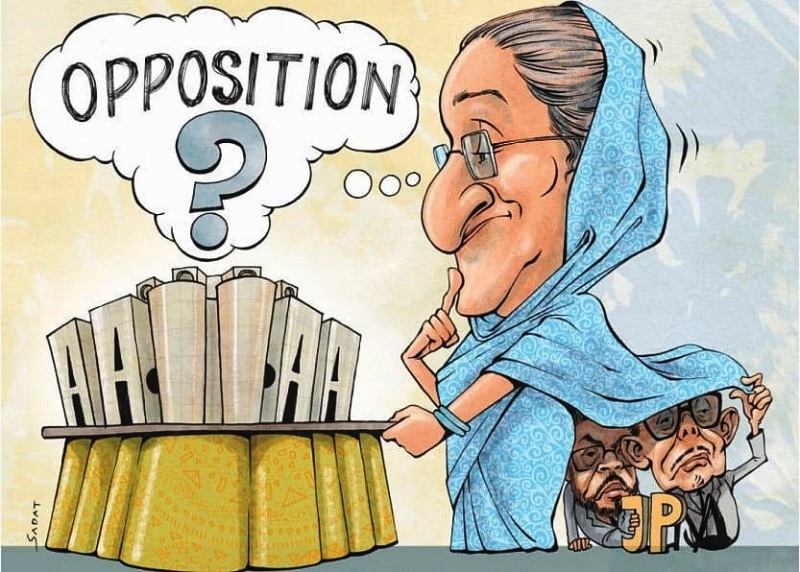
Cartoon: Sadatuddin Ahmed Emil, The Daily Star

SALEEM SAMAD

A bombshell article published in the Washington Post on 15 August claims that India pressed the United States to tone down its criticism of Prime Minister Sheikh Hasina and to scuttle any fresh sanctions against her neighbouring Bangladesh.

The article jointly by Gerry Shih, Ellen Nakashima and John Hudson says that both countries must fall back, whether they mishandled Bangladesh.

The story goes a year before her government was toppled in the first week of August in a student uprising, Indian officials began to lobby their U.S. counterparts to stop pressuring Hasina, who ruled Bangladesh for 15 years with an iron fist.

American diplomats had publicly warned the 76-year-old Hasina for jailing thousands of her rivals, critics, dissidents and journalists ahead of a parliamentary election held last January.

Earlier, the Biden administration had sanctioned Bangladesh’s elite anti-crime police unit Rapid Action Battalion (RAB) accused of committing enforced disappearances and extra-judicial killings of suspects and had threatened to impose visa restrictions on those who undermined democracy or committed human rights abuses.

In a series of parleys, Indian officials demanded that the United States tone down its pro-democracy rhetoric. If the opposition were allowed to gain power in a free, fair and inclusive election, Indian officials argued, Bangladesh would become a breeding ground for Islamist militancy posing a security threat to India.

In several engagements, Indian Minister of External Affairs Subrahmanyam Jaishankar and Defence Minister Rajnath Singh met with Secretary of State Antony Blinken and Defence Secretary Lloyd Austin in November in New Delhi.

While Indian national security adviser Ajit Doval also played a key role in presenting the Indian case during a visit to Washington that autumn.

These diplomatic engagements stirred a magical potion in the cooking pot. Soon after some “White House officials considered the downside of antagonising India, which made a series of appeals to the U.S. that it moderate its pressure on Hasina,” writes the prestigious newspaper publishing for 147 years.

“You approach it at the level of democracy, but for us, the issues are much more serious and existential,” said an Indian government adviser on the condition of anonymity.

The American foreign policy bigwigs concluded that after the private parleys between top officials of the United States and India, “This is a core concern for us, and you can’t take us as a strategic partner unless we have some kind of strategic consensus.”

Finally, when Biden visited New Delhi in September 2023, he took a selfie with Sheikh Hasina and her smart daughter Saima Wazed, several analysts got a message of thaw between Dhaka and Washington.

Well, the Biden administration substantially softened its criticism and shelved threats of further sanctions against Hasina’s autocratic regime after the flawed January election, disappointing several civil societies in Bangladesh.

Now, after protesters defied the army’s curfew orders and marched on Hasina’s official residence, compelling her to flee to India, policymakers in both New Delhi and Washington went backstage to preview whether they mishandled Bangladesh.

The policymakers in the State Department believe that the ground reality often fails the balancing act in Bangladesh, as there are many places where the situation on the ground is complicated and you want to work with the partners you have in a way that is not inconsistent with what the American people expect.

The United States was in a dilemma regarding diplomatic engagement with Bangladesh vis-à-vis keeping India in good humour. Biden administration viewed India as a crucial partner in countering China.

Its smaller neighbours in South Asia increasingly view India itself as a meddling, aggressively nationalist power under Prime Minister Narendra Modi. India’s meddling in Maldives, Nepal and Sri Lanka backfired. The episode and kept a safe distance to avoid further embarrassment.

Several sources in Washington told the writers of the article that in the months leading up to the January election, divisions emerged within the U.S. government over how to handle Bangladesh.

Many former senior diplomats, who were assigned in Dhaka, and the State Department recommended a tougher stance against Hasina, particularly since President Joe Biden had campaigned on restoring democracy in Bangladesh.

Other U.S. officials felt there was little to be gained from further alienating Hasina and risking the safety of U.S. diplomats, including Ambassador Peter Haas, who had received threats from Hasina’s political henchmen.

The Post journalists wrote that for India, the dramatic developments in Bangladesh have turned a spotlight on its decade-long, all-in bet on Hasina, even as she grew autocratic and unpopular.

In January, after Hasina claimed victory in a flawed election, keeping thousands of opposition leaders in jail or hiding, Indian officials did not hesitate to the election results, fuelling calls from the opposition and like-minded groups for a boycott of Indian imports.

Jon Danilowicz, a retired U.S. diplomat who served as deputy chief of mission in Dhaka said, “New Delhi and Washington have to show some humility and acknowledge they got Bangladesh wrong by not siding with the Bangladeshi people and their democratic aspirations.”

After the elections, which were neither free nor fair, some criticised the U.S. for not imposing more restrictions on Bangladeshis, falsely attributing this to Indian influence, remarked Danilowicz.

The anti-quota movement spearheaded by the students of Dhaka University spread to all state universities and scores of private universities, and the “helmet behind” [vigilante recruits from Awami League’s students and youths] backed by riot police attacked the street protests.

The street protests turned violent and turned into anti-government uprisings which killed more than 600 people, according to the. Hasina made a hasty decision to flee the country and took refuge in India, at a Delhi military base.

After Hasina’s ouster, Indian officials have publicly changed tack and expressed willingness to work with the inventor of microcredit Dr Muhammad Yunus.

Last week, Modi sent his “best wishes” to Muhammad Yunus, the Nobel Prize-winning banker who took charge of Bangladesh’s interim government, even though he criticized India for backing Hasina. Yunus has called for new, free, and fair elections once the country's stability is restored.

As India grapples with the shock of suddenly losing one of its closest allies, Indian foreign policy circles and media have been awash with speculation that Washington orchestrated the removal of Hasina, who has long had a chilly relationship with the United States. U.S. officials have staunchly denied the claim.

First published in the Northeast News, Guwahati, India on 18 August 2024

Saleem Samad is an award-winning independent journalist based in Bangladesh. A media rights defender with the Reporters Without Borders (@RSF_inter). Recipient of Ashoka Fellowship and Hellman-Hammett Award. He could be reached at saleemsamad@hotmail.com; Twitter (X): @saleemsamad

Thursday, August 08, 2024

Worries in Delhi grow if Yunus demands extradition of Hasina

SALEEM SAMAD

The delay in ousted Prime Minister Sheikh Hasina seeking asylum or stay in destination to North America, the United Kingdom or Europe, has caused the elites in India’s South Block and Indian Prime Minister’s Office in New Delhi to bite their nails.

Every day passes, Delhi is getting jittery for the unwelcome VVIP guest, who arrived unnoticed on a special military flight from Dhaka to Hindon Air Base in Ghaziabad, near the Indian capital Delhi.

On August 5, Sheikh Hasina flew in a helicopter from the Prime Minister’s official residence Gonobhaban to Kurmitola Air Base. She departed on a Bangladesh Air Force C-130J transport aircraft (Flight No. AJAX 1431) and flew her to India.

After a safe landing at 5:45 PM, Hasina’s transport plane landed at Hindon Airbase in Ghaziabad. Indian National Security Advisor Ajit Doval received her upon arrival and held an hour-long meeting high-level discussion. The agenda mostly centred around the current crisis in Bangladesh and her immediate plans.

Sheikh Hasina, the longest-serving woman prime minister in the world was elected to power for a fifth term only seven months ago in January. Her uninterrupted 15-year tenure as Bangladesh’s Prime Minister came to a dramatic end on August 5, when she fled the country amidst a mass street uprising of students and also joined by millions of people.

The unrest, which began with protests over job quotas on 1 July and escalated into calls for Hasina’s resignation, reached a tipping point with violent clashes in the first week of August.

The police and ‘Helmet Bahini’, armed vigilant gangs recruited from Awami League killed at least 400 people in the streets during the Red Revolution which lasted for the last six days of the student protests.

Hasina promoted her nephew General Waker-Uz-Zaman as the chief of the Bangladesh Army keeping in mind that she would protect her and her autocratic regime.

The military chief declared Hasina’s resignation in a national broadcast and stated that the military would establish a caretaker government to restore order. He also announced the formation of an interim government.

Hasina was the first leader and head of government who fled the country to avoid the wrath of the angry students and the public.

The following day, External Affairs Minister S Jaishankar convened an all-party meeting to discuss the Bangladesh crisis. The meeting was attended by Defense Minister Rajnath Singh, Home Minister Amit Shah, Leader of Opposition Rahul Gandhi, and Mallikarjun Kharge.

Jaishankar said the government is in a “wait-and-watch” mode, but hands-on and in touch with the Bangladesh Army. He said Sheikh Hasina’s presence in India is a courtesy move to ensure she settles down, recovers, and feels comfortable enough to discuss her plans.

He also described that Hasina is in a state of shock and the government is giving her time to recover before it speaks to her over various issues, including her plans.

Jaishankar told the Indian parliament that Hasina has “requested at very short notice” to come to India following her forced resignation as Bangladesh Prime Minister.

The parliament was informed that an estimated 19,000 Indian nationals of which about 9,000 are students. The bulk of students returned in July.

Indian foreign minister also referred to an address by Bangladesh Army chief General Waker-uz-Zaman – made last Monday, shortly after Hasina stepped down – in which he said, “I have met opposition leaders… we have decided to form an interim government…” and appealed for the violent protests to end.

The interim government headed by Nobel Laureate Dr Mohammad Yunus arrived in Dhaka in the afternoon (Thursday) and took the oath of office in the evening. He also announced a 15-member Adviser in his interim government.

For the restoration of democracy, a tentative date of election will be announced by the inventor of micro-credit.

Earlier, in an exclusive interview with NDTV from Paris, where Yunus attended as a Special Guest at the Paris Olympics and had a minor operation a vile warning that “India’s north-east, Myanmar will be affected if Bangladesh becomes unstable.”

Yunus for the last 12 years faced several legal harassments and was even awarded six months imprisonment in a labour case.

Several times, Hasina humiliated Yunus and even said he is a “bloodsucker” and profits from exorbitant loan interests from disadvantaged rural women.

She blamed Yunus for jeopardising the financial support of the World Bank for the construction of the mega project, the Padma Bridge. In a hate speech, at the inaugural event of Padma Bridge, said she wished to dip the Nobel laureate and ailing former Prime Minister Khaleda Zia into the yawning Padma River.

Hasina has nowhere to go in the next several weeks, she will stranded in a guest house on the outskirts of Delhi and India feel embarrassed to have her for long, which possibly dent the renewed bilateral relationship between two neighbours – Bangladesh and India of emerging new government under the rule of Prof Muhammad Yunus.

Several political observers understand, that Yunus after holding the reign of Bangladesh, is likely to appeal to global leaders to urge India to deport Hasina to stand trial for crimes committed against the people during her 15 years of repressive rule.

If Delhi bigwigs do not concede to Yunus’s appeal to send back Hasina, not only bilateral relations and trade would be affected, but would also would spark an anti-India campaign resulting in a call for ‘Boycott India’ and would also more persecution against Hindus in Bangladesh, which will difficult for the interim government to neutralise.

First published in The Northeast News, Guwahati, India on 8 August 2024

Saleem Samad is an award-winning independent journalist based in Bangladesh. A media rights defender with the Reporters Without Borders (@RSF_inter). Recipient of Ashoka Fellowship and Hellman-Hammett Award. He could be reached at saleemsamad@hotmail.com; Twitter @saleemsamad

Sunday, July 28, 2024

Why does Prof Yunus demand a mid-term election in Bangladesh?

SALEEM SAMAD 

In a bombshell opinion, the country’s lone Nobel laureate Professor Muhammad Yunus has reached out to world leaders, including the Indian government to restore democracy in Bangladesh.

In an exclusive interview with India’s prestigious daily, The Hindu, Yunus suggested that Bangladesh should hold a mid-term election within a ‘short time’ to overcome the crisis by restoring democracy with a public mandate. Democracy laid down all solutions.

Prof Yunus, inventor of social business and pioneer in micro-credit for the poor, appealed for the international community, particularly India, to reach out to Bangladesh Prime Minister Sheikh Hasina to call for calm. India and Bangladesh are historical friends and should urge to restrain from committing crimes against the people, he remarked.

Dr Yunus condemns the killing of students and the common public as an ‘invading force’ from another country. We see police firing innocent students raising their hands and shooting at close range because they have the power to shoot to kill. That’s what we see, he said.

Regarding the recent student protest in Dhaka, the economist condemned the killing of students and innocent people by the police, paramilitary and army.

“The issue is democracy, the rule of law, human rights, and the role of the judiciary. People have the right to express their views and the Government has no right to kill them for their views,”

Angered by the law enforcement exercise of excessive force to quell the student protest, he said, “Demonstrators were not out there to kill anybody. Their demand may be unpleasant to the government, but that doesn’t allow the government to shoot them to kill.”

The Noble Laureate appealed to the world leaders to observe the random killing in Bangladesh. He urged all members of South Asian countries to investigate the recent incidents in Dhaka as neighbouring countries.

Dr Yunus is hopeful that global leaders can use their informal relationships and informal channels to restrain our leaders and make them aware of the serious departure from the norm of democracy.

Without dubbing Bangladesh as governed by an autocratic regime, he questioned the legitimacy of the government of Sheikh Hasina, which held three sham elections sans the opposition to participate in the elections – which lacks the credibility of inclusive elections.

Yunus, literally rubbed salt into the wound, for reaching out to global leaders to ensure calm in Bangladesh has irked the government.

The government in a loud voice said Yunus’ rhetoric at the time of “ferocity of the crisis” this month has been deemed as an “anti-state” statement.

“Of course, the election is the ultimate solution to all political problems. When something doesn’t work, you go back to the people to seek their instructions.

They are the ultimate owners of the country. Make sure it is a genuine election, not an election of a magician,” Prof Yunus spoke to Suhasini Haidar, Diplomatic Affairs Editor of The Hindu from the French capital, where he was attending as a special guest at the opening ceremony of the Paris Olympics.

“Whether you’re freshly elected or you’re not elected, or you are abusing your position without the consent of the people, does not matter in a democracy. You are a government responsible for protecting people, not killing people. You cannot just pick up somebody because he belongs to the opposition party, so he is liable to be arrested,” he retorted.

Yunus did not hesitate to ask, why the army is tackling students. Pointing his finger at Hasina, he said that democracy can’t flourish with a magician.

“Why do you have to bring in an army to tackle the student demonstration? Now you say, there are some enemies inside. Who are those enemies? Identify them and deal with them, not by killing students,” added Dr Yunus.

Yunus, despised by Hasina, mentioned that the people in Bangladesh have committed themselves to democracy and to stay with democracy.

If democracy fails, Dr Yunus believes that the politicians should go back to the people again to get the mandate of the people, credibility of the people, the government doesn’t have any credibility left at this moment.

Hasina won a fourth consecutive term amid controversies after the main opposition party and allies boycotted the election in January this year. Her tenure will go down with Guinness World Records for becoming the longest-serving woman prime minister in the world.

In the latest “block raid”, over 9,000 people were arrested including leaders of the opposition Bangladesh Nationalist Party (BNP) and Islamist party Jamaat-e-Islami (JeI) for allegedly spearheading recent street violence, vandalism and arson of government properties, including two pride mega-projects and several government buildings.

BNP Secretary General Mirza Fakhrul Islam Alamgir alleged that the arrested leaders, members and supporters of the opposition are being tortured and maimed before being brought to court and are being tortured again after obtaining remand orders.

The challenger of Hasina also urged the government to “Get the people’s mandate, freely and fairly. That’s it. Democracy cures problems by getting people’s instructions because the state belongs to the people, not to some people in the government.”

In the interview with eminent Indian journalist Suhasini Haidar, the economist claimed that Bangladesh authorities have been suppressing the locals with bullets alike foreign forces evading from another country.

“I cannot bear to see it, I can’t see millions of Bangladeshis living in terror. Democracy puts people’s lives as the highest priority. Democracy is about protecting people, all people, irrespective of religion, political opinion, or any other differences of opinion. If a citizen is about to kill another person, the state’s first responsibility is to protect the person under attack,” he said criticising the incumbent regime in Dhaka.

Meanwhile, fourteen missions in Dhaka, the United States, the United Kingdom, France, Germany, Italy, Spain, the Netherlands, Canada, Switzerland, Sweden, Denmark, Norway, Australia and the European Union (EU) in a joint letter to Foreign Minister Hasan Mahmud, urged the protection of human rights and fair trials for those arrested in the wake of last week’s violent clashes.

On the other hand, India and China have stated that this is an internal affair of Bangladesh.

First published in Northeast News portal, Guwahati, India, 28 July 2024

Saleem Samad is an award-winning independent journalist based in Bangladesh. A media rights defender with the Reporters Without Borders (@RSF_inter). Recipient of Ashoka Fellowship and Hellman-Hammett Award. He could be reached at saleemsamad@hotmail.com; Twitter (X): @saleemsamad


Thursday, July 25, 2024

Bangladesh curfew and internet blackout were an overkill


SALEEM SAMAD

The helms of affairs of government and security agencies during the rage of countrywide student protests in the last seven days, in panic, overreacted. The advisers who are small ‘g’ gods of lesser version hurriedly advised the authorities to clamp down with an indefinite curfew and blackout of the internet to contain the student’s protest, which local rioters joined.

PROTEST TURNS BLOODY

There is no denying that excessive force by law enforcement agencies in streets battling the protesters has shot and killed more than 200 in five days, according to an independent newspaper Prothom Alo. The situation remains calm in all the hotspots.

Another thousand were wounded and maimed. They are groaning and moaning in pain, agony, trauma and aftershock lying in hospital beds. Nearly 700 innocent passersby caught in between the conflict inflicted wounds on their eyes from shotgun pellets randomly fired by riot police. Eye surgeons operated upon 278 with pellet wounds.

HELMET BAHINI

The hundreds of dead and wounded took a direct hit from riot police backed by “Helmet Bahini” a hooliganism wing of Chattra League and Juba League of ruling Awami League battling student protesters.

The ‘Helmet Bahini’ was the second line of defence, besides the police to protect the Awami League leaders to counter the agitators. The armed hooligans after the face-off with the protesters had their anger ventilated and made them run for their lives from the campus dormitories in different universities.

Scores of ruling party students and youth members also known as “Golden Boys” had to publicly admit they had resigned from Chattra League in allegiance with the legitimate student protests. The posts on Facebook went viral on social media.

CRACKDOWN

In a crackdown, police arrested and detained nearly 1500 suspects. Among them are shopkeepers, delivery boys, returning home from work, and of course bystanders. Police in their dragnet have hardly been able to arrest the looters, rioters, and hooliganism.

Well, the police arrested scores of leaders from the opposition Bangladesh Nationalist Party (BNP) and Islamist party Jamaat-e-Islami (JeI) blaming them for instigating the riots in a bid to topple the government.

Prime Minister Sheikh Hasina has squarely blamed BNP and JeI for vandalism and arson causing havoc on government Key Points Installations (KPIs), including two stations of Metro Rail, a pride of Hasina’s mega project. The Shetu Bhaban, houses the Bangladesh Bridge Authority, Bangladesh Road Transport Authority building and several other government buildings.

The government claims that the widespread destruction was pre-planned by the opposition and terrorists, which had planned to destabilise the government—a valid argument for a curfew and shutdown of the internet to foil the plan.

Dr Asif Nazrul, a law professor at Dhaka University in an OpEd urged the government to provide at least one evidence of opposition and Islamist conspiracy, which was foiled.

TIMELINE

The student protests which began on 1 July marched from the Dhaka University campus. The following days the students blocked the Shahbag Square, where historic protests were held and the government accepted the demands in the past.

The apex court on 4 July did not support the High Court verdict that invalidated the 2018 circular on cancellation of quota.

From 5 July, the protest spread to other university campuses and blocked roads and highways in their call for reforms of quota for government jobs.

Soon the road blockade was joined by private universities and also colleges of the country.

On 10 July, the Appellate Division of the Supreme Court imposed a status quo on quota for four weeks. Demand to reform quota system for government recruitments under all grades.

Awami League general secretary Obaidul Quader said the quota protesters are flexing muscle against the highest court of the country, which is unwarranted and illegal.

He made a stern warning if the protesters do not stand down, the Chattra League is prepared to face the agitators. While the Home boss Asaduzzaman Kamal said the protesters are ‘crossing their limits’.

Soon the ‘Helmet Bahini’ brutally attacked the student protesters in the Dhaka University campus with batons, metal bars, hockey sticks, and firearms.

COMPLETE BLOCKADE

In the following day, the students in protest of attacks on their comrades called for a nationwide road blockade, and boycott of classes and class exams in all universities. Tens of thousands of students poured into street intersections in all major cities and towns. The country came to a standstill, despite police obstruction in different places.

The movement by the new generation of students in our public and private universities for the reform of quotas was to ensure equal opportunities for all in our society and to obtain representation in government service.

Barrister Sara Hossain, a human rights lawyer in an OpEd “Bring those who ordered the excessive use of force to account” in an independent newspaper the Daily Star writes regarding the death of students and youths, “This has to be brought to account through a process that is independent, impartial, and effective. We need to see not only those who shot directly at the protesters and others but also those who ordered the firing to be brought to account.”

POLICE BRUTALITY

The blood spilt in the streets has itself turned into violence against the citizens of the country. Coupled with thousands of wounded reported in media has caused irksome among tens of thousands of ‘mango people’.

For the first time, Bangladesh witnessed that sound grenade and tear gas shells were charged from hovering helicopters. The flying machines are owned by the anti-crime force Rapid Action Battalion (RAB) and the police.

RIGHTS GROUP

Prime Minister Hasina, who won a fourth consecutive term after January elections that were not free or fair, had previously imposed and then withdrawn the quota. She has called for dialogue and promised an inquiry into the July 15 deaths. Educational institutions have been closed indefinitely, according to a statement issued by New York-based Human Rights Watch (HRW).

On July 21, the Supreme Court, hearing an appeal from the government, ruled to reduce the quota in government jobs, allocating 5 per cent for descendants of independence war veterans and 2 per cent for other categories, reads the HRW statement.

“Bangladesh has been troubled for a long time due to unfettered security force abuses against anyone who opposes the Sheikh Hasina government, and we are witnessing that same playbook again, this time to attack unarmed student protesters,” said Meenakshi Ganguly, deputy Asia director at Human Rights Watch. “Now is the time for influential governments to press Sheikh Hasina to stop her forces from brutalizing students and other protesters.”

PARLEYS

Hasina earlier had parleys with business leaders at her official residence Gono Bhaban. The worried business leaders urged the government to withdraw the curfew to enable the opening of the industries. They also urged the authorities to restore the internet as soon as possible.

On Wednesday, Hasina held a courtesy dialogue with the pro-government editors and senior journalists under the banner of Editors Guild.

She had no remorse for the dead students and others’ blood spilt from police brutalities.

TRAGEDY

Shafkat Samir (11), a fifth-grade student, was closing a window of his home to stay safe from the rampant firing of tear gas shells during massive clashes at Kafrul in the city’s Mirpur area on Friday afternoon. In the blink of an eye, a bullet pierced his head, entering through his eye and killing him instantly.

Later the harassment and legal threats by law enforcement officers, Samir’s father Sakibur followed their advice and signed a form stating that “I have no complaints over the incident, and I don’t want to file a case. After taking my son’s body, I will go to bury it.”. The form also says “I followed the police’s suggestion and convinced Sakibur to sign a letter stating that he had no complaints and would not file a case.”

First published in Northeast News, Guwahati, India on 25 July 2024

Saleem Samad is an award-winning independent journalist based in Bangladesh. A media rights defender with the Reporters Without Borders (@RSF_inter). Recipient of Ashoka Fellowship and Hellman-Hammett Award. He could be reached at saleemsamad@hotmail.com; Twitter: @saleemsamad

Friday, December 02, 2022

White Paper uprising dents ego of the China’s leadership


SALEEM SAMAD

It’s unusual for a Chinese to protest against the despotic regime of the Chinese Communist Party. Such incidents are immediately suppressed under draconian laws and repressive tools to neutralise the dissenting voice.
The pro-democracy student movement at Tiananmen Square in 1989 was cruelly crushed and threw thousands of protesters were in nauseating prisons after they were brutally tortured to sign cooked-up confessional statements.
Well, it is not normal for the Chinese to join street protests. The people are trained to remain silent against the tyrannical rule – in absence of freedom of expression and democracy.
Last week, an unprecedented protest against the Chinese hyped “dynamic zero-Covid” policy for weeks and months contributed to anger and frustration. The lockdown was so stringent that the apartment buildings were sealed and entrances were barricaded.
The flurry of videos of the fire incident in a high-rise apartment, lead to a public outcry which quickly spread across the country – in 17 major cities including Beijing, Chengdu, Chongqing, Guangzhou, Hangzhou, Jinan, Lanzhou, Nanjing, Shanghai, Urumqi, Wuhan and Xi’an.
In a bid to discourage participation in the uprising, the authorities of elite universities hung notices for closing the campus and shuttled the students to train stations and airports.
In most cities, the protests in China turned violent. The protesters showed a blank white paper to give a message of the lack of a free press, free speech, freedom of expression and freedom of faith – most importantly absence of democracy.
The protest sparked after a fire in Urumqi, the capital of the Xinjiang province, the home of Uyghur Muslims. The fire killed 10 residents as the emergency response team were unable to reach the inferno victims. The province was under a strict Coronavirus lockdown for more than 100 days.
The Uyghurs for several years are facing persecution and relocation in mainland China, while a huge number of the community remains captive in so-called internment camps for months.
Sinologist David Moser in a tweet writes: I’ve lived in China for 30 years, and I’ve never seen such a brazenly open and sustained expression of rage against the [People’s Republic of China] PRC govt. WeChat [a Chinese popular social media app] is exploding with protest videos and furious vitriol, and civil disobedience is becoming rampant. This is a serious test of CCP governance.
Filmmaker Rob Schneider writes: When tyranny pushes citizens to where they have nothing to lose because their government has crushed all their hopes and liberties to the point of starvation…people fight back!
The fresh demonstrations occurred weeks after securing a third term as the Communist Party’s general secretary, Chinese President Xi Jinping is presently facing widespread popular discontent seen in China since 1989. He spearheaded the extreme lockdown measures across the country.
Nevertheless, the street demonstration has yielded results. The Chinese authorities have hastily relaxed lockdown restrictions and lifted lockdowns in some cities which have been confined for weeks to more than a month.
A top health official acknowledges the changing nature of the virus as the country faces a ‘new situation’. The authority went a step further – allowing close contacts to isolate at home instead of spending five days in a quarantine facility.
As usual, heavily censored Chinese state media did not mention a word about the street protests, except for the relaxation of restrictions.
The award-winning Italian filmmaker Federico Fellini aptly said about state media that “censorship is advertising paid by the [Chinese] government.”
The Communist Party of China teaches millions of new-generation students in schools and through youth organisations not to challenge authorities, which is deemed as a sin. People are not trained not to talk or type or write anything – just obey and obey as slaves.
Selina Wang, CNN International Correspondent stationed in China says, protests in China are not rare. “This is an extraordinary, historic moment in China.”
In Wuhan, the anti-lockdown protesters are tearing down barricades shouting “It started in Wuhan and it ends in Wuhan!”
From Tokyo to New York to London to Paris, the Chinese people are protesting the COVID suppression by President Xi and showing solidarity and a call for freedom.
The repressive healthcare authority had fed the captive Chinese audience of the success of zero-Covid management. Almost three years later, the series of lockdowns is a reversal from an initial victory against Covid-19 which demonstrates the worse situation when there is a lack of transparency and accountability. Most importantly, the authorities lack a long-term strategy to attain zero-Covid.
To regain public confidence, the autocratic regime needs a timeline for ending zero-Covid when the country’s Covid-19 containment strategy relies on public cooperation, but after almost three years of the pandemic, frustrations are mounting, writes Andrei Lungu, South China Morning Post published from Hong Kong.
China’s “dynamic zero-Covid” policy narrative has centred on the efficiency of its political system, which is supposedly better suited than democratic governments to both identify the interests of the people and marshal the resources needed to advance them.
The “dynamic zero-Covid” policy was believed by millions to be a strategy based on scientific fact, but now it seems it was driven by political interests. Instead of an enlightened government that protects its people, Beijing is now pictured as an ideological zealot, concludes Lungu.

First published in The News Times, December 2, 2022
Saleem Samad, is an independent journalist, media rights defender, recipient of Ashoka Fellowship and Hellman-Hammett Award. He could be reached at <saleemsamad@hotmail.com>; Twitter @saleemsamad