Buy.com Monthly Coupon
Showing posts with label coronavirus. Show all posts

Friday, December 02, 2022

White Paper uprising dents ego of the China’s leadership


SALEEM SAMAD

It’s unusual for a Chinese to protest against the despotic regime of the Chinese Communist Party. Such incidents are immediately suppressed under draconian laws and repressive tools to neutralise the dissenting voice.
The pro-democracy student movement at Tiananmen Square in 1989 was cruelly crushed and threw thousands of protesters were in nauseating prisons after they were brutally tortured to sign cooked-up confessional statements.
Well, it is not normal for the Chinese to join street protests. The people are trained to remain silent against the tyrannical rule – in absence of freedom of expression and democracy.
Last week, an unprecedented protest against the Chinese hyped “dynamic zero-Covid” policy for weeks and months contributed to anger and frustration. The lockdown was so stringent that the apartment buildings were sealed and entrances were barricaded.
The flurry of videos of the fire incident in a high-rise apartment, lead to a public outcry which quickly spread across the country – in 17 major cities including Beijing, Chengdu, Chongqing, Guangzhou, Hangzhou, Jinan, Lanzhou, Nanjing, Shanghai, Urumqi, Wuhan and Xi’an.
In a bid to discourage participation in the uprising, the authorities of elite universities hung notices for closing the campus and shuttled the students to train stations and airports.
In most cities, the protests in China turned violent. The protesters showed a blank white paper to give a message of the lack of a free press, free speech, freedom of expression and freedom of faith – most importantly absence of democracy.
The protest sparked after a fire in Urumqi, the capital of the Xinjiang province, the home of Uyghur Muslims. The fire killed 10 residents as the emergency response team were unable to reach the inferno victims. The province was under a strict Coronavirus lockdown for more than 100 days.
The Uyghurs for several years are facing persecution and relocation in mainland China, while a huge number of the community remains captive in so-called internment camps for months.
Sinologist David Moser in a tweet writes: I’ve lived in China for 30 years, and I’ve never seen such a brazenly open and sustained expression of rage against the [People’s Republic of China] PRC govt. WeChat [a Chinese popular social media app] is exploding with protest videos and furious vitriol, and civil disobedience is becoming rampant. This is a serious test of CCP governance.
Filmmaker Rob Schneider writes: When tyranny pushes citizens to where they have nothing to lose because their government has crushed all their hopes and liberties to the point of starvation…people fight back!
The fresh demonstrations occurred weeks after securing a third term as the Communist Party’s general secretary, Chinese President Xi Jinping is presently facing widespread popular discontent seen in China since 1989. He spearheaded the extreme lockdown measures across the country.
Nevertheless, the street demonstration has yielded results. The Chinese authorities have hastily relaxed lockdown restrictions and lifted lockdowns in some cities which have been confined for weeks to more than a month.
A top health official acknowledges the changing nature of the virus as the country faces a ‘new situation’. The authority went a step further – allowing close contacts to isolate at home instead of spending five days in a quarantine facility.
As usual, heavily censored Chinese state media did not mention a word about the street protests, except for the relaxation of restrictions.
The award-winning Italian filmmaker Federico Fellini aptly said about state media that “censorship is advertising paid by the [Chinese] government.”
The Communist Party of China teaches millions of new-generation students in schools and through youth organisations not to challenge authorities, which is deemed as a sin. People are not trained not to talk or type or write anything – just obey and obey as slaves.
Selina Wang, CNN International Correspondent stationed in China says, protests in China are not rare. “This is an extraordinary, historic moment in China.”
In Wuhan, the anti-lockdown protesters are tearing down barricades shouting “It started in Wuhan and it ends in Wuhan!”
From Tokyo to New York to London to Paris, the Chinese people are protesting the COVID suppression by President Xi and showing solidarity and a call for freedom.
The repressive healthcare authority had fed the captive Chinese audience of the success of zero-Covid management. Almost three years later, the series of lockdowns is a reversal from an initial victory against Covid-19 which demonstrates the worse situation when there is a lack of transparency and accountability. Most importantly, the authorities lack a long-term strategy to attain zero-Covid.
To regain public confidence, the autocratic regime needs a timeline for ending zero-Covid when the country’s Covid-19 containment strategy relies on public cooperation, but after almost three years of the pandemic, frustrations are mounting, writes Andrei Lungu, South China Morning Post published from Hong Kong.
China’s “dynamic zero-Covid” policy narrative has centred on the efficiency of its political system, which is supposedly better suited than democratic governments to both identify the interests of the people and marshal the resources needed to advance them.
The “dynamic zero-Covid” policy was believed by millions to be a strategy based on scientific fact, but now it seems it was driven by political interests. Instead of an enlightened government that protects its people, Beijing is now pictured as an ideological zealot, concludes Lungu.

First published in The News Times, December 2, 2022
Saleem Samad, is an independent journalist, media rights defender, recipient of Ashoka Fellowship and Hellman-Hammett Award. He could be reached at <saleemsamad@hotmail.com>; Twitter @saleemsamad


Sunday, October 16, 2022

Bangladesh Ranked 84th In Global Hunger Index: Food Supply Chain Disrupted By Ukraine War


SALEEM SAMAD

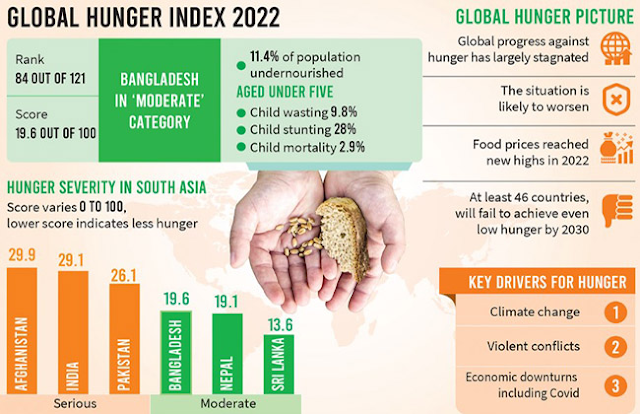
Bangladesh ranked 84th, out of 121 assessed countries on the 2022 Global Hunger Index (GHI). With an overall score of 19.6 (2022), the level of hunger in Bangladesh has been categorised as “moderate”.

On the eve of World Food Day (October 16), the launch of the 2022 GHI amid global crises and the war in Ukraine is putting global food security in peril, and the worst impacts are being felt by the very poorest.

Among South Asia, India, Pakistan, and Afghanistan are among the worst-performing countries in the region.

The GHI that tracks and measures hunger across the world says that malnutrition among children under five years in Bangladesh has slightly improved.

The country has gradually improved its ranking from 33.9 (2000), 31.3 (2007), 26.3 (2014) and 19.6 in 2022.

The report that has used the fifth National Family Health Survey (NFHS-5) and FAO (Food and Agriculture Organisation of the United Nations) Food Security Indicators as its sources for Bangladesh has highlighted that child wasting (low-weight-for-height) rate in Bangladesh, at 9.8 per cent, is satisfactory but still lots of effort needed to touch the target of “Zero Hunger” of Sustainable Development Goals (SDG) by 2030.

Despite Bangladesh being a moderate hungry country, but has fared well in undernourishment, child wasting and child stunting.

There are several reasons for the disruption, Bangladesh and other countries have failed its reach food autarky.

Some 50 nations that rely on Russia and Ukraine for the bulk of their wheat imports — including Bangladesh, Egypt, Iran, and Turkey — have been scrambling to find alternative suppliers, according to the GHI 2022 Report.

Spiralling food prices and global supply chain disruptions precipitated by the Ukraine war, the COVID-19 pandemic, climate change, and regional conflicts have worsened hunger for millions of people, requiring humanitarian and resilience-building responses to be urgently scaled up.

Incidentally, Bangladesh imports wheat from both Ukraine and Russia. Bangladesh’s food import is the lowest among countries having food shortages. Eritrea tops the list of dependencies on the external food supply in Ukraine and Russia.

The report mentions that there is another prime reason for the increase in food grain requirement in Bangladesh because of hosting more than one million Rohingya refugees since 2017.

Bangladesh took efforts in amplifying longstanding structural deficiencies in the global food system, which is inadequate for sustainably ending poverty and hunger as envisaged by the United Nations’ 2030 Agenda.

Within a global food system that has fallen short of sustainably ending poverty and hunger, citizens are finding innovative ways to improve food systems governance at the local level, holding decision-makers accountable for addressing food and nutrition insecurity and hunger.

The good news is the recent trend toward decentralising government functions has given local governments greater autonomy and authority, including over key elements of food systems.

The situation is likely to worsen in the face of the current barrage of overlapping global crises — conflict, climate change, and the economic fallout of the COVID-19 pandemic — all of which are powerful drivers of hunger.

These crises come on top of underlying factors such as poverty, inequality, inadequate governance, poor infrastructure, and low agricultural productivity that contribute to chronic hunger and vulnerability.

Globally and in many countries and regions, current food systems are inadequate for the task of addressing these challenges and ending hunger.

Hunger cannot be eradicated unless global leaders join hands to tackle the structural drivers that cause it: war, climate change, and recession.

First published in The News Times, 15 October 2022

Tuesday, July 06, 2021

Vaccines are the key to sustainability

Without increasing vaccinations, we cannot restore economic stability

SALEEM SAMAD

Print and electronic media, coupled with social media, have unfortunately contributed to creating disinformation and fake news on the ongoing pandemic crisis, medical treatment, and vaccines.

Researchers on media monitoring on fake news argue that media has often fallen prey to misinformation and rumours about coronavirus and vaccines, especially when the newsroom gatekeepers failed to fact-check within the stipulated deadline.

In this tsunami-like pandemic from east to west, north to south in early 2020, the doctors, physicians, and even virologists and epidemiologists -- who were indeed the prime source for newsroom scribes -- initially gave confusing and contradictory sermons coated with medical jargon, which regrettably incited fake news, based on disinformation.

Despite hosts of myths being busted by the World Health Organization (WHO), both the frontline health care doctors and journalists kept their ears, eyes, and minds shut to myth-busters, like the three wise monkeys in folklore.

Sermons like hot water baths, drinking tea or hot water with traditional spices, eating garlic or peppers in food, application of hydroxychloroquine or malarial drugs, vitamin and mineral supplements, administration of antibiotics, exposure to the sun, and hosts of other remedies failed to prevent the deadly infection.

Leading epidemiologist Dr Mushtuq Husain explained that coronavirus is caused by a deadly virus, and is not a bacteria. There are several scientific studies to prove that vaccines do not compromise natural immunity, he also remarked.

Meanwhile, WHO reiterates that everybody should wear masks, especially in crowds indoors, but the United States Centre for Disease Control and Prevention (CDC) says vaccinated people don’t need to wear masks to protect themselves from the virus.

The scientific statement was also validated by John Hopkins University, Oxford University, and Delhi-based CSIR-Institute of Genomics and Integrative Biology, where researchers are spending sleepless nights to conclude that the efficacy and immunity of vaccinated people are protected even from new variants.

Virus experts and epidemiologists also offer mixed advice, but largely agree on one point: Whether or not a fully vaccinated person needs to wear a mask.

Well, mask mandates are intended to protect the unvaccinated -- people who are vaccinated are already well-protected by vaccines, and infection by new variants is still very rare.

It was logically argued that since a person cannot tell who is vaccinated and who is not, the best would be to advise all to wear a mask, which can help stop the spread of the virus by people who are infected, especially those who don’t have any symptoms.

Bangladesh was initially bogged down in the vaccine divide while procuring vaccines. Finally, the government has been able to negotiate with countries and pharmaceutical industries for a reasonable quantity of vaccines.

Despite the emergence of vaccines, the experts have strongly argued that the coronavirus is here to stay for a long period; the world has to embrace the new normal. On the other hand, experts conclude that vaccines are the key to restoring economic stability.

Leading economists in the country advise that accelerating the vaccine’s distribution will be necessary before the economy sees any long-lasting improvement. They strongly disagree that countering the lockdown in a pandemic with a stimulus is the wrong approach to economic recovery.

“We have to get enough vaccinations to enable people to feel comfortable in social settings. That’s the key to getting back to normal; then only would we have a great 2021,” observed top economist Dr Hossain Zillur, who has recently conducted an intensive study on the pandemic and its impact on disadvantaged populations.

First published in the Dhaka Tribune, 6 July 2021

Saleem Samad is an independent journalist, media rights defender, recipient of Ashoka Fellowship and Hellman-Hammett Award. He could be reached at saleemsamad@hotmail.com; Twitter @saleemsamad

Tuesday, January 12, 2021

Madness, mayhem, and manipulation

It is a grim outlook for a new year, but it is not completely hopeless

SALEEM SAMAD

Should the citizens of the global village expect anything in 2021?

Does it not seem that it will be another series of new episodes, like last year, beset by the madness, mayhem, manipulation, and tyranny that dominated 2020.

For most, the future will be knitted from experience gathered from a year of facing the coronavirus pandemic.

While the regimes were busy doing damage control, everything seemed to have gone haywire; they were unable to control the virus outbreak, or the frustrations of the people. The governments, both in developed and developing countries, gradually took charge of the crisis.

The world leaders were left defenseless in the face of government bureaucrats and elected officials who dance to the tune of their corporate overlords and do what they want, when they want, with whomever they want, all at taxpayer expense.

Now that the people have slowly begun to trust scientists, pharmaceutical producers, United Nations bodies, development economists, health care experts and services, and development partners, the governments with advisers and politicians need to get back on the drawing board to redo the plans on how to live with the Covid-19 virus.

In the broad political spectrum, politics and politicians must come forward with sustainable solutions to the new dimensions of global crises, which is impacted by the pandemic.

Such rethinking has surfaced when the nations’ history, politics, and politicians add problems due to attempting quick-fix solutions, which are not sustainable.

Let the politicians and bureaucrats understand that people will not digest any kind of hypocrisy, double standards, or delusional belief. Nonetheless, the politicians and bureaucrats initially had hiccups when the pandemic was ravaging the economy. There is also no denying that the government wasted crucial time, funds, and effort to get things back on track.

Citizens of developing countries have tolerated injustice and abuse which befell upon them due to the government machinery such as police harassment and brutality, corruption, criminalization of politics, robberies from infrastructure development projects, forcible occupations and invasions of homes and properties of the weak and the minorities by politically-backed hooligans, state security surveillance, unfair taxation -- and the list grows on and on.

Global citizens have been utterly helpless in the face of government injustice meted out, both at home and abroad. Indeed, the systemic violence being perpetrated by the state and non-state actors demoralises any nation-state, writes John W Whitehead, founder and president of The Rutherford Institute.

Until we can own that truth, until we can forge our path back to a world in which freedom means something again, we are going to be stuck in this wormhole of populist anger, petty politics, and destruction that is pitting us against each other.

First published in the Dhaka Tribune, 12 January 2021

Saleem Samad is an independent journalist, media rights defender, recipient of Ashoka Fellowship and Hellman-Hammett Award. He can be reached at saleemsamad@hotmail.com; Twitter @saleemsamad

Tuesday, December 29, 2020

'Pandemic' word of the year 2020

SALEEM SAMAD

The word ‘pandemic’ has become a part of all our lives now

The task to decide a single word or words in the year 2020, roiled by a public health crisis, an economic downturn, racial injustice, climate disaster, political division, and rampant disinformation -- was a challenge.

For the editors at Dictionary.com, the choice was overwhelmingly focused. From our perspective as documenters of the English language, one word kept running through the profound and manifold ways our lives have been upended -- and our language so rapidly transformed -- in this unprecedented year.

The editors, based on online searches, concluded that the “2020 Word Of The Year” was “pandemic” and defined it as “a disease prevalent throughout an entire country, continent, or the whole world.” The year 2020 was indeed painful. And yet, the loss of life and livelihood caused by Covid-19 pandemic defies definition.

Nearly 80 million confirmed cases, the pandemic has claimed over 1.75 million lives across the globe and is still rising to new peaks with the fresh outbreak dubbed as Covid-20.

No doubt the pandemic has severely dented social and economic life on a historic scale and scope, globally impacting every sector of society -- not to mention its emotional and psychological toll.

All other events for most of 2020, from the protests for racial justice to a heated US presidential election, were shaped by the pandemic. Despite the hardships, the pandemic also inspired the best of humanity: Resilience and resourcefulness in the face of struggle.

Languages evolve and adapt to new realities and circumstances. This deadly coronavirus outbreak has been reflected in our language, notably in the word pandemic itself. As the world was shaken from the pandemic, the searches for the word “pandemic” skyrocketed 13,575% on Dictionary.com compared to 2019.

It appeared to have jumped out of history textbooks, and joined a cluster of other terms that users searched for in massive numbers, whether to learn an unfamiliar word used during a government briefing or to process the swirl of media headlines: Asymptomatic, CDC, coronavirus, furlough, nonessential, quarantine, and sanitizer, to name a few.

"The pandemic, despite causing havoc, agony, and trauma among millions worldwide, surprisingly has united the world of vocabulary into one global village, eagerly waiting for the vaccine and an eventual solution for the pandemic."

As the pandemic upended life in 2020, it also dramatically reshaped our language, requiring a whole new vocabulary for talking about our new reality.

Among all searches, the volume for pandemic sustained the highest levels on-site over the course of 2020, averaging a 1000% increase, month over month, relative to previous years. Because of its ubiquity as the defining context of 2020, it remained in the top 10% of all lookups for much of the year.

Glossary and vocabulary researchers, based on a prediction by epidemiologists to virologists agree that the pandemic defined in 2020 will dominate the years to come. It is a consequential word for a consequential year.

In the spring, the pandemic introduced a host of new and newly prominent words that, normally, only public health professionals knew and used.

Expanding the glossary for daily life included: Air bubble; antibody tests; antigen test; antimalarial drugs; asymptomatic; conspiracy theory; contact tracing; corona-cure; Covid-dedicated hospitals; Covid-19; Covidiot; debunk fake news; diagnostic tests; disinformation; distance learning; endemic; epidemic; epidemiologist; face masks; fake health remedies; fake health tips; flatten the curve; frontliner; hand sanitizer; handwashing; health facilities; healthcare; herd immunity; hydroxychloroquine; infodemic; isolation; lockdown; mutation; N95; novel coronavirus; PCR test; PPE; public health; quaranteam; quarantine; second wave; social distancing; strain; superspreader; take-out; vaccine; ventilator; virologist; virtual court; webinar; work remotely; Zoom; so on and so forth.

The resilience and resourcefulness people confronted the pandemic with also manifested itself in tremendous linguistic creativity. Throughout 2020, the editorial teams of various dictionaries have been tracking a growing body of so-called “corona coinages” that have given expression -- and have offered some relief from tragedy, some connection in isolation -- to the lived experience of a surreal year.

First published in the Dhaka Tribune on 29 December 2020

Saleem Samad is an independent journalist, media rights defender, recipient of Ashoka Fellowship and Hellman-Hammett Award. He could be reached at saleemsamad@hotmail.com; Twitter @saleemsamad

Tuesday, December 08, 2020

Austerity, economic recovery, and the debt trap


SALEEM SAMAD

Why developing nations such as Bangladesh must be especially wary of how they seek to recover from the Covid-19 fallout

Development economists and civil society organizations (CSOs) argue that austerity measures adopted by the governments of third-world countries are not a solution during the coronavirus crisis.

They raise questions about austerity, gradually imposed after the Covid-19 crisis due to the massive debt contract. Immediate suspension of debt payments and better still, cancellation of debt, must take priority.

Instead, they advise governments to opt for economic recovery. The economic recovery will only be possible from “debt relief” and “debt justice.”

Bangladesh and other developing countries have given special attention in the wake of the coronavirus crisis and engaged in servicing external debts to international financial institutions.

The governments are deliberately diverting funds from education, human development, and infrastructure development sectors, whereas the health and safety net programs are implemented under a shoe-string budget.

According to the United Nations Conference on Trade and Development (UNCTAD), the pandemic has pushed another 32 million people in poor countries into abject poverty.

Another report by the International Finance Institute highlights the $272 trillion global debt, a new high, in the third quarter of 2020 and warns us about the “attack of the debt tsunami.”

There are issues in which countries while seeking assistance from international financial institutions, are often imposed conditionalities that have not necessarily been negotiated with borrower states. These conditionalities are even seen in the context of the Covid-19 pandemic.

The government deliberately does not involve the citizens to participate in consultations, discussions, or negotiations. Such conditionalities increase the country's chances of falling into a “debt-trap.”

Ultimately, it is the people that have to foot the debt repayment after authorities impose additional taxes and levies to recover from the vicious cycle of debt.

According to standards of international law, international financial institutions should be held responsible for complicity in the imposition of economic reforms that violate human rights, which is well documented.

Governments and major multilateral institutions like the World Bank, the IMF, and regional development banks have used repayment of public debt to generalize policies that have damaged public health systems.

This has meant job cuts in the health sector, job instability, reduced numbers of hospital beds, closing down neighbourhood health services, increased medical costs both for care and medicines, under-investment in infrastructure and equipment, and privatization of various sections of the health sector along with public under-investment in research and development for treatment, which is to the advantage of big private pharmaceutical groups and companies.

Even before the Covid-19 pandemic broke out, these policies had already led to an enormous loss of human lives, and all around the world, health personnel were organizing protests.

Neither the World Bank nor the IMF have cancelled any debts since the beginning of the coronavirus pandemic.

Although they have made endless calculated declarations to give the impression that they are taking very strong measures. This is completely false.

Worse still, since March 2020, the IMF has extended the loan agreements that entail continuing with the structural measures enumerated above. As for the World Bank, since March 2020 it has received more in debt repayments from developing countries than it has paid out to finance either donations or loans.

Eminent development economist, Dr Atiur Rahman states that “We want to fight the coronavirus and, beyond that, improve the health and living conditions of populations, [for which] emergency measures must be taken.”

Immediate suspension of debt payments and cancellation of debt must take priority, suggests former Bangladesh Bank’s governor Dr Rahman.

The austerity measures do not contribute to economic recovery, but instead have negative consequences in terms of economic growth, debt ratios, and equality, and routinely result in a series of negative human rights impacts.

First published in the Dhaka Tribune, 8 December 2020

Saleem Samad is an independent journalist, media rights defender, recipient of Ashoka Fellowship and Hellman-Hammett Award. He can be reached at saleemsamad@hotmail.com; Twitter @saleemsamad

Tuesday, November 24, 2020

The depths of debt


SALEEM SAMAD

Developing countries such as Bangladesh are struggling to balance fighting Covid-19 and keep up with their growing public debt

The global leaders have realized that the coronavirus crisis has jolted the world from a slumber, to understand that the crisis has unveiled the spectre of a larger global crisis.

The health care crisis and its cascading economic consequences are predicted to further plunge many countries in the developing world into an unprecedented crisis, further pushing millions of people into poverty and starvation.

These conditions shine a strong light on the continuing debt problem that stands in the way of people’s survival -- the fight against inequality, the realization of their human rights, sovereignty and the self-determination of people, economic, gender, and ecological justice, and the pursuit of a dignified life.

Hundreds of international, regional, and civil society organizations (CSOs) including Action Aid, CADTM International, Oxfam, Third World Network, joined by 120 Bangladesh NGOs led by Coast Trust, are demanding to suspend the realization of debt instalments for all public debts of developing countries combating the Covid-19 pandemic so that the ongoing coronavirus crisis is not aggravated.

They call upon world leaders, national governments, and financial institutions both public and private, to take urgent action in compliance with their obligations and responsibilities, and commit to unconditional cancellation of public external debt payments.

The CSOs demanded the suspension of all instalments of public debt for at least the financial year 2020-2021 so that countries can develop the capacity to combat the pandemic and overcome the impact of this disaster on its citizens’ health, food, and economic vulnerabilities.

An international statement issued during Global Week (October 10-17) of action for debt cancellation sought the decisive and full solution to the debt problem as part of the profound transformation of economic and financial systems that the present crises so urgently demand.

Meanwhile, the CSO network appealed to the World Bank, International Monetary Fund (IMF), Asian Development Bank (ADB), Asian Infrastructure Investment Bank (AIIB), and other bilateral, regional, and multilateral development financiers of Bangladesh.

Bangladesh’s economy is severely under stress due to the additional burden of pandemic management, while the country has a budget deficit of $17.65 billion in the current financial year.

The CSOs in Bangladesh are trying to urgently bring to global attention that the government of Bangladesh for the current financial year is being forced to allocate $6.20bn for servicing external debts to international financial institutions.

They are urging the multilateral, regional, and bilateral financial institutions to strictly follow the suggestions made by the World Bank and IMF and suspend the servicing of the public debts for 2020, so that the government can use its resources to fund initiatives to help the people in overcoming the Covid-19 challenge.

On the other hand, the G-20 governments announced the Debt Service Suspension Initiative (DSSI) -- not a cancelation but merely an eight-month delay of up to $12bn worth of payments for public debts.

Much of this debt is illegitimate, the CSO network argues. The international creditors lend irresponsibly and unfairly, driven by predatory lending. The money is used to finance harmful projects and policies, failing to comply with legal and democratic requirements, is saddled with onerous and unjust terms, and incurred by private corporations but assumed by governments or incurred through public guarantees of private profits.

The conditional loans, including cuts in public services and social protection, and severe austerity programs, have also caused as great if not greater harm than debt servicing, especially on women and girls, indigenous people, and the most impoverished and vulnerable people and communities.

CSOs argue that the demand is much more than “debt relief,” but also for “debt justice.”

First published in the Dhaka Tribune on 24 November 2020

Saleem Samad is an independent journalist, media rights defender, and recipient of Ashoka Fellowship and Hellman-Hammett Award. He can be reached at saleemsamad@hotmail.com; Twitter @saleemsamad


Tuesday, November 17, 2020

Feeding the children in coronavirus pandemic

Children School Meal Policy/Photo: Latif Hossain


SALEEM SAMAD

The coronavirus pandemic severely dents free meal programme to help mitigate hunger and malnutrition amongst the most vulnerable school children

In 240 government and BRAC-run educational institutions for children in Trishal, Mymensingh, thousands of school students enjoyed attending classes as the authorities provided a free midday meal.

The cooked food ingredients include rice, lentils, and mixed vegetables -- in total 178 grams which costs Tk10.50. The school students’ nutritional intake of calories was 545 kcal and protein 11.46 gm. The hot cooked meal is culture-specific and nutrition-rich. Dietary diversity is ensured through a change in the recipe to maintain appetite.

The midday meal in rural and urban schools mitigates short-term hunger -- for most students, it was the only full meal.

A study by key civil servants in Bangladesh known as MATT (Managing at Top Team) showed that almost 60% of children go to school hungry. 

In the third year, the school attendance in urban areas in BRAC-operated midday meal projects increased from 55% (2011) to 81% (2013), and in rural areas, attendance increased from 64% (2011) to 92% (2013).

Basanta Kumar, Kar chief of Global Alliance for Improved Nutrition (GAIN) in Bangladesh pushed the idea of a midday meal in schools with the Bangladesh government in 2011 after Prime Minister Sheikh Hasina’s political pledge in Vision 2021 articulated a strong priority on primary school education and nutrition to ensure food security.

However, the Covid-19 crisis has contributed to a child rights crisis. For children, the costs of the pandemic were immediate.

In Bangladesh, like most developing countries, accessibility and affordability of food and nutrition become challenging, while keeping staple food distribution and local food markets is an uphill task for the governments amidst a lack of accountability and weak transparency.

The brunt of the suffering when it comes to access to adequate nutrition with depleting income sources falls on the children, adolescents, and women.

According to the Primary Education Census (2011), there are 20 million primary school-age children, of which 18.4 million children are enrolled in primary schools.

Various studies show that quality education in primary school is hindered by a high dropout rate caused by hunger and malnutrition and widespread micronutrient deficiencies.

The provision of nutritious food improves the cognitive and physical development of children, remarks Basanta. An estimated 20.9% have sub-clinical Vitamin-A deficiency, 19.1% are anaemic, and 40% are iodine deficient.

To ensure the sustainability of the free-midday meal in schools in Trishal, local government representatives, school committees, and participation of mothers of the students have ensured accountability of free mid-day meals in schools.

Unfortunately, after the departure of Basanta, the fruitful negotiations with development partners and international multilateral donors have become weak.

The pioneering program initiated by GAIN with development partners BRAC and Banchte Shekha emerged as a “game-changer.” Recently the government renewed commitment to replicate and scale up the school feeding model nation-wide in primary schools.

“It is critical to ensure food diversity and adequate nutrition, including key micronutrients and fortified staples,” Basanta said.

On Universal Children’s Day which is on November 20, the United Nations claims a definite impact has been found in investing in children. In response to the global nutrition crisis, school feeding programs can be adapted and scaled up to reach the most vulnerable children.

First published in the Dhaka Tribune on 17 November 2020

Saleem Samad is an independent journalist, media rights defender, recipient of Ashoka Fellowship and Hellman-Hammett Award. He can be reached at saleemsamad@hotmail.com. Twitter @saleemsamad

Monday, July 20, 2020

Will a vaccine save the economy?

covid-19 vaccine

SALEEM SAMAD
Development Economist Dr Atiur Rahman sharing his mind said that once the availability of the coronavirus vaccine becomes a reality, the world economy will recuperate and Bangladesh will also make a dramatic turn-around.
However, a challenge remains of generating new employment and regenerating the labour market. The challenge could be bridled with a long and short term economic preparation, by an energetic team of planners and social managers selected.
The government has to develop a recovery plan of action to generate jobs and employment in both formal and non-formal sectors, says Atiur Rahman, a former governor of Bangladesh Bank.
Atiur says the expectation from the discovery and availability of the coronavirus vaccine has increased exponentially.
Meanwhile, over 100 influential global leaders have joined Nobel laureate Muhammad Yunus after he launched an international campaign to make the Covid-19 vaccine a global common good.
The campaign on behalf of Nobel laureates and organizations of Nobel laureates, civil society leaders, and world moral leaders urged all the global leaders, international organizations, and governments to adopt legal measures and declare Covid-19 vaccine as a part of the global domain.
What the founder of the “bank for the poor” meant was that the vaccine should be available at a cheaper price for the developing countries, but not for the West only.
As the Covid-19 pandemic continues to wreak havoc across mother earth, there is an explosion of research activities and clinical trials to find cures and vaccines, says Prof Yunus.
The platform urged the World Health Organization (WHO) to design a World Action Plan on the Covid-19 vaccine and appealed to set up an international committee responsible for monitoring the vaccine research.
The research for a vaccine is a long process. The estimated time for the development of a Covid-19 vaccine is about 18 months or so.
Prof Yunus’s campaign has received pro-active responses from more than 25 Nobel laureates, scores of former presidents, former PMs, creative artists, social justice activists, business leaders, leaders of international organizations, academics, and hosts of political and faith leaders from all the continents.
Obviously, private sector research laboratories engaged in the development of vaccines will be expecting a return on their investments. The research results should be in the public domain, making it available to any pharmaceuticals that pledge to produce vaccines under strict international regulatory supervision.
Prof Yunus believes that if the vaccines are free from patent rights, the price will be affordable in the third world. Most of the developing countries’ hospitals are overwhelmed providing health care to coronavirus patients on their shoe-string budget.
The pandemic exposes the strengths and weaknesses of health care systems in different countries, as well as the obstacles and inequalities of access to health care.
Therefore, the campaign understands the cash-strapped developing countries will not be able to buy the vaccine in bulk. The global leaders demand that the availability of vaccines is a right and there must be free universal access to the vaccine for all.
Governments, foundations, international financial organizations like the WB, and the regional development banks have been urged to develop a strategy on how to make the vaccine available free of cost to inhabitants from all walks of life, be they from urban or rural areas, men or women, or living in rich or poor countries.
The campaign underpins the moral responsibility of the global leaders to develop an unambiguous procedure to determine what would be a fair level of this return in exchange for putting the vaccine in the public domain.

First published in the Dhaka Tribune, 20 July 2020

Saleem Samad is an independent journalist, media rights defender, and recipient of Ashoka Fellowship and Hellman-Hammett Award. He can be reached at saleemsamad@hotmail.com

Monday, July 13, 2020

Are extremists exploiting the pandemic?

Social Media Photo: Bigstock
SALEEM SAMAD
Conspiracy theories and disinformation are spreading at an alarming rate
When Sara Khan, lead commissioner for an independent Commission for Countering Extremism (CCE) in a flagship report “Challenging Hateful Extremism” talked of how effective existing British laws are in dealing with hateful extremist activity -- policy-makers and government officials in Britain were dumbfounded.
The report, launched on June 10, observes that the far right to the far left and Islamist groups have fully exploited the global coronavirus crisis to promote dangerous conspiracy theories and disinformation, mostly online.
A private study has been posted by the United Kingdom government’s official website, which says CCE advises the government on new policies to deal with extremism, including the need for any new powers.
The non-governmental organization, CCE, supports society to fight all forms of extremism and has closely worked with the British Police Department.
The extremists joined in separate social media space, joined by #CovIdiots across all spectrums. From far right and far left, all are agog in 5G conspiracy theories on platforms such as Telegram, a multi-platform messaging service platform.
Conspiracy theories need just the right ingredients to take off within a population, and the Covid-19 pandemic has been a breeding ground for them.
The independent commission has pulled together several other pieces of research to draw a broader canvas of the extremist threat during the pandemic. A narrative spread like wildfire on social media that the wireless network 5G technology fuelled the coronavirus pandemic.
The conspiracy theory on the Covid-19 outbreak believes that the virus pandemic is part of a strategy conceived by global elites - such as Bill Gates - to roll-out coronavirus vaccines with tracking chips that would later be activated by 5G, the technology used by mobile technology networks.
Such mindless #CovIdiots in Bangladesh are equally active in social media. They are active in posting conspiracy theories in attempts to inject into the novice minds of young and old, rich and poor that coronavirus is a Western conspiracy by Christians and Jews responsible for funding research in Wuhan labs.
Well, wearing masks, using sanitizers, washing hands, and testing for coronavirus are selling points of multinational companies and their accomplices in the country.
What about those millions who are infected, hospitalized, and dying from coronavirus? The #CovIdiots mysteriously remain silent and dish out stereotypical responses to such pressing issues.
The study further emphasized that hateful extremists have used divisive, xenophobic, and racist narratives to sow division and undermine the social fabric of Britain.
Unless the British government urgently invests in counter-extremism measures, extremists will seek to capitalize on the socio-economic impacts of Covid-19 to cause further long-term instability, fear, and division in Britain.
For a democratic government, in the United Kingdom, the impact of extremist propaganda and disinformation shouldn’t be undermined. These conspiracy theories are harmful, dangerous, and are used by extremists to cause division and breed hate, reiterated Sara Khan.
Now a social media strategy needs to be developed to challenge dangerous conspiracy theories based on the harm they cause. This will enable practitioners on social media platforms to better challenge harmful conspiracy theories before they escalate.
Bangladesh shouldn’t miss the opportunity to join the global effort to classify dangerous conspiracy theories. 
A fresh counter-extremism strategy must include an assessment of how extremism manifests locally, the harm it causes, the scale of support for extremist narratives, and how best to pre-empt extremist activity.
The assessment should also include the people most vulnerable to extremist narratives, to deliver vital interventions to engage and support these guiltless people. 

First published in the Dhaka Tribune, 13 July 2020

Saleem Samad is an independent journalist, media rights defender, and recipient of Ashoka Fellowship and Hellman-Hammett Award. He can be reached at saleemsamad@hotmail.com. Twitter @saleemsamad

Friday, July 10, 2020

Deep-rooted issues hamper Bangladesh’s recovery

Even as the number of COVID-19 cases continues to rise, healthcare workers in Bangladesh struggle to get their hands on good quality personal protection gears. The tendency to cover up irregularities and mismanagement has led to a prevailing culture of corruption.
SALEEM SAMAD
Recently, Bangladesh crossed the grim milestone of 1,62,000 confirmed coronavirus cases. With a population of 160 million, the developing economy has been grappling with formidable challenges that have only been exacerbated by the outbreak of COVID-19.
Transparency International Bangladesh (TIB), a civil society organisation dedicated to fighting against corruption, has squarely blamed the government’s poor coordination for the current crisis.
The rot within
Data shows that 26 percent of the frontline healthcare workers in Bangladesh, including doctors, nurses, and hospital staff, did not receive personal protection gears, even as the number of COVID-19 cases has been on the rise. Also, the protection materials supplied to government hospitals were deemed to be of inferior quality.
At least six doctors who brought up the issue via Facebook posts were suspended or transferred to non-COVID hospitals as punishment for speaking out. Eventually, at the intervention of Prime Minister Sheikh Hasina, the Anti-Corruption Bureau and anti-crime forces were shaken from their siesta. They raided dozens of places – including government warehouses – to find fake protective materials and stolen medical products.
“If the government wants to tackle this crisis, the right to get and publish accurate information must not be diminished,” said Dr. Iftekharuzzaman, executive director of TIB. The tendency to cover up irregularities and mismanagement through restrictions on disclosure of information encourages corruption.
Stitch in time
In the wake of the coronavirus outbreak, TIB analysed seven indicators of governance, including rule of law, responsiveness, capacity and effectiveness, coordination and participation, accountability, transparency, and control of corruption. “The government failed to make adequate preparations even after getting three months’ time,” noted Dr. Iftekharuzzaman.
“The impacts of the COVID-19 pandemic have been largely ignored in the budget allocation for the health sector,” remarked Dr. Fahmida Khatun, executive director of the think tank Centre for Policy Dialogue (CPD). “The outbreak is a lesson for us, which has made it clear how much strength we have to tackle the crisis,” she said.
The Daily Star, an independent newspaper, in an editorial recently wrote: From the onset of the pandemic, citizens have been confused and frustrated about the government’s lack of vision and direction in addressing the health and socio-economic implications of COVID-19 holistically. The newspaper came heavily on the government’s casual handling of the risk of spread at the initial stages, declaring general holidays and non-binding lockdown.
The arbitrary policy decision at every stage, the editorial observed, have left ordinary citizens as well as experts in bewilderment as to what the government is thinking and what it wants to achieve in the near and far future.
Prof Abul Kalam Azad, Director General of Directorate General of Health Services (DGHS) drew flak from ruling party leaders when he recently said, “COVID-19 situation in Bangladesh will not go away in two or three months, rather it is likely to stay for two to three years.”

First published in the Health Analytics. 10 July 2020

Saleem Samad, is an independent journalist, and health fact-checker, recipient of Ashoka Fellowship and Hellman-Hammett Award. He could be reached at ; Twitter @saleemsamad

Tuesday, June 16, 2020

Pandemic has exposed deep-seated weaknesses in Bangladesh

Photo: Reuters
SALEEM SAMAD
A senior staff member along with many others of a grocery chain outlet in Dhaka were hailed as “corona warriors” by a leading English newspaper. The daily did not hesitate to describe that “our humanity, empathy, and responsibility is being tested by the coronavirus pandemic.”
Shila Aktar, a customer relationship officer at a grocery outlet had a fever, but other signs of coronavirus were absent. With fever, she went from one government hospital to another -- over four consecutive days.
She tried day and night to access the dedicated helpline. Also, she desperately tried online registration with no luck.
On the third day, she had an outrageous experience at a government-dedicated Mughda Hospital for Covid-19 patients. The Ansar Battalion sold Tk20 tickets at the exorbitant price of Tk2,000 to 3,000 in connivance with the hospital staff.
Hearing her ordeal, a journalist wrote an angry post on Facebook. Promptly, the lawmaker Saber Hossain Chowdhury responded pro-actively. The following day, the guards were removed and an additional booth to collect 150 additional samples a day was opened adjacent to the hospital.
On the fifth day, despite feeling weak, she stood in a queue from 6am in a make-shift booth in Bashabo, in the city. Finally, her sample was taken.
The issue did not end there. Now the waiting period began to get her virus test report. After four days she received a heartbreaking message online and also phone SMS that she was positive. 
“Dear Shila Aktar, your test for coronavirus is positive. Please stay at home. Be positive.”
The test for the coronavirus is a nightmare for millions in the country. Well, the government and private resources have been inadequate, coupled with widespread corruption in medical supplies and a lack of transparency in health care management.
As the crisis in Wuhan enlarged last winter, the “learned” heath minister Zahid Malek assured the nation that the country is fully prepared to overcome the pandemic.
When the virus finally struck on March 7, there were only a few ventilators in the country. The country had few virus testing labs, and no dedicated hospitals for infected patients when the first virus was detected in early March.
Despite media warnings, based on input from infectious disease experts, the airport authorities and immigration departments were lax in checking the entry of thousands of people, and also didn’t follow the quarantine protocols.
Well, the government never used the word “lockdown” or “curfew” and the police and civil administration all over the country failed to keep the people at home, maintain social distancing, wear masks, or practise basic hygiene.
The worst-case scenario was that the doctors, nurses, and health care staff often did not have enough PPE, including gloves and masks and safety materials.
Some state hospital senior doctors who have taken to social media to criticize the poor quality of medical supplies were punished. Even those who complained of poor living facilities in designated hotels were also punished.
Caught in a catch-22 situation, between lives and livelihoods, after 66 days, the government partially opened offices, factories (including export industries), shops, public transport, domestic flights, and restaurants. Several media reports say all the establishments flouted health guidelines with impunity.
Prime Minister Sheikh Hasina has been rated among the top 10 women leaders for the commendable job in coronavirus management by the prestigious Forbes magazine. She recently wrote in the British newspaper, The Guardian, that Bangladesh is unlikely to be the only country struggling with health, economic, and climate emergencies this year.
Most governments have proved dangerously unprepared for the crisis, which has exposed deep-seated weaknesses in public-health and social-security systems in rich and poor countries alike.

First published in the Dhaka Tribune, 16 June 2020

Saleem Samad is an independent journalist, media rights defender, recipient of Ashoka Fellowship and Hellman-Hammett Award. He could be reached at saleemsamad@hotmail.com. Twitter @saleemsamad

Saturday, June 13, 2020

Healthcare, humanity, and hospitals

Testing for coronavirus has been a nightmare for millions in Bangladesh, coupled with widespread corruption in medical supplies and poor transparency in healthcare management
SALEEM SAMAD
A senior staff of a grocery chain outlet in capital Dhaka, along with many others, was hailed as “Corona Warriors” by the Business Standard published from Bangladesh. The paper was emphatic in celebrating the role of these “heroes” at a time when “our humanity, empathy, and responsibility is being tested by the coronavirus pandemic.”
Testing for coronavirus has been a nightmare for millions in the country. The government and private resources are inadequate, coupled with widespread corruption in medical supplies and poor transparency in healthcare management.

Desperate times
Shila Aktar, a Customer Relationship Supervisor at Agora grocery outlet, had fever and weakness, but other signs of coronavirus were absent. She went from one government hospital to another. On the fifth day, she decided to stand in a queue at another make-shift booth in the city. Finally, her sample was taken.
Shila had desperately tried all helplines – announced as public health messages on public and private televisions, FM radios, newspapers, SMS, as well as embedded ringtones on mobile phones. At last, she took to Facebook to share the suffering of hundreds of people who had to wait in long queues for several hours at the state hospitals to get themselves tested.
She recounted her terrible experience at the government-dedicated Mughda Hospital for COVID-19 patients, not far from her home. The Ansar Battalion guards sold Taka (BDT) 20 tickets at an exorbitant price of Taka 2,000 to 3,000 in connivance with hospital staff union leaders. Her angry Facebook post brought the matter to the attention of a local lawmaker, Saber Hossain Chowdhury. The following day, para-police guards were removed and additional booths were opened adjacent to the hospital to collect further 150 samples a day.
Then began the waiting period to get her virus test report. After four days, she received a heartbreaking message online and also via phone SMS: “Dear Shila Aktar, your test of coronavirus is positive. Please stay at home. Be positive.”
Shila was unknowingly wandering for more than nine days infected by the contagious virus.

Leadership lessons
Bangladesh Prime Minister Sheikh Hasina has been rated among the top 10 women leaders for their commendable responsibility in coronavirus management by the prestigious Forbes magazine. Despite working with goddess Durga’s ten hands, she was in a dilemma as to what should be her nation’s priority: lives or livelihood?
As the crisis in Wuhan grew, the ‘learned’ heath minister Zahid Malek assured the nation that the country is fully prepared for any eventualities to overcome the pandemic. Thousands of panicked migrants returned home from epicentres; they were checked with ancient thermal scanners and hand-held thermometers, which broke down in weeks.
Despite media warnings, based on inputs from infectious disease experts, the airport authorities and immigration department were lax in checking the entry of thousands of people, who didn’t follow the quarantine procedures.
When Bangladesh’s first virus infection was detected on 7th March, there were only a few ventilators, a couple of virus testing labs, and no dedicated hospitals for infected patients. While the government never officially announced a ‘lockdown’ or ‘curfew’, the police and civil administration in the country failed to keep the people safe at home or ensure that they maintained social distancing, wore masks, and practised hygiene.
The most worrisome part was that the doctors, nurses, and healthcare staff did not have enough Personal Protective Equipment (PPE) kits. The suppliers had no fear of delivering low-quality and even fake materials. Scores of doctors and nurses were infected and were either placed in-home quarantine, isolation centres, or hospitals. Nearly half a dozen doctors succumbed to the deadly virus.
Some state hospital senior doctors who took to social media to criticise the poor quality of medical supplies were punished. Even those who complained of poor living facilities in designated quarantine hotels were punished.
When Cyclone Amphan from the Indian Ocean struck southwest of Bangladesh in May, people were afraid to move to the shelters as they were not built with social distancing in mind.
Caught in a catch-22 situation, between lives and livelihoods, the government has partially opened offices, factories (including export industries), shops, public transport, domestic flights, and restaurants. For now, the fate of parks, cinema halls, convention centres, religious and cultural festivals is on hold.
Regular products that were once sold on the streets have vanished. Now we have hawkers selling hand gloves, sanitizers, face shields, PPE gowns, and goggles to eager customers, who are unaware of the quality of these products.

First published in the Health Analysis Asia, 12 June 2020

Saleem Samad is an independent journalist, health fact-checker in Bangladesh. Recipient of Ashoka Fellowship and Hellman-Hammett Award. He could be reached at saleemsamad@hotmail.com; Twitter: @saleemsamad

Tuesday, June 09, 2020

Of Racism and Whitening Cream Culture

SALEEM SAMAD
A complex over darker complexion
An Indian actor got called out for protesting racism while endorsing whitening creams in TVCs (television commercials). Instead of echoing her protest, hundreds of voices on social media blasted the glamour actor for “shameless” and “pseudo-liberal” jibes against racism in the United States when they advertise whitening creams to be bold and beautiful.
The global outcry after the first-degree murder of African-American George Floyd in the street of Minnesota in the US has once again raised eyebrows among policy-makers, social scientists, and civil rights defenders.
Social and political tensions that have long been simmering just beneath the surface of the global economic order have begun to boil over, as evidenced most vividly by the protests in the US over the death of a black person, by four police officers in Minneapolis.
Ignoring coronavirus health safety advice, from London to Auckland, Toronto to Berlin, and Copenhagen to Madrid, demonstrators gathered in thousands to express solidarity with the #BlackLivesMatter protests against police brutality in America.
The fault-line has been ignored by politicians of both camps of Democrats and Republicans.
In the lockdown during the virus outbreak, in mid-March, more than 40 million workers have filed unemployment claims in the US, and more and more families are pushed to the brink of poverty.
American civil rights activists often cry wolf, arguing violence breeds violence, and repression breeds retaliation. The cautionary messages of rights defenders usually fell into deaf ears of politicians and society leaders.
Life seems to be simplified in black and white colour code. Profiling a person having black or white hearts, so are bank loans or utility bills defaulters blacklisted. It is expected the priests and Muslim clerics are in white, while the executioners in prison wear black.
Deposed Zimbabwean President Robert Mugabe’s speeches were laced with satire and a sense of humour which made him a controversial statesman. He once said: “Racism will never end if people still use black to symbolize bad luck and white for peace.”
There is no reason for the white supremacist to admire the dictator Mugabe but his quotes from speeches will be remembered when he says: “Racism will never end if people still wear white clothes to weddings and black clothes to funerals.”
In a country where a government, politicians, national institutions, and state policy surreptitiously incite racism to settle scores in a plea to crack down on opposition and dissidents, such state policies further marginalize minorities for their belief, faith, ethnicity, race, language, and culture. Social scientists warn that where there is racism, the parameters of repression and inequality in society remain visible.
The social construction of racism is built in our hearts and minds. Unknowingly, millions developed a perception that evil is black and angels are draped in white. Unfortunately, such a colour-coded concept is in children’s storybooks and school textbooks.
Indian actor Abhay Deol criticized his glitz colleagues in the Bollywood industry, saying that “woke Indian celebrities” have been speaking out on #BlackLivesMatter but failing to speak up on similar instances within the country.
The tradition in South Asia is for young women eligible for marriage to apply turmeric on their face and hands, an ancient tradition enabling her skin to glow when seated at the ceremony -- or use whitening creams to be fair and beautiful.
Whereas, in the west, women love to have their skin tanned in the summer, bathing in sunshine.
The day when the demand for skin whitening cream sale plummets, only then can a nation be redefined to be non-racist.
It’s high time to admit the vanity of a false distinction.

First published in the Dhaka Tribune, 9 June 2020

Saleem Samad is an independent journalist, media rights defender, recipient of Ashoka Fellowship and Hellman-Hammett Award. He could be reached at saleemsamad@hotmail.com. Twitter @saleemsamad

Tuesday, June 02, 2020

Sino-India ‘war-cry’ at the roof of the world


Indian PM Narendra Modi and Chinese President Xi Jinping Photo/REUTERS
SALEEM SAMAD
No bullets were fired! So far, Chinese and Indian troops exchanged brickbats and hurled bullies.
Normally, India and Pakistan skirmishes trade thunderous artillery fire and weapons drawn on each other -- often inflicting civilian casualties.
Presently, both China and India claim transgression of the Line of Actual Control (LAC) over Galwan Valley in Ladakh. The valley was once a flashpoint in the 1962 Sino-India war.
An earlier Sino-India border dispute in 2017 or Doklam stand-off refers to the faceoff between the Indian Armed Forces and the Chinese People’s Liberation Army (PLA) over the construction of a road in Doklam near a tri-junction border area, known as Donglang, or Donglang Caochang (meaning Donglang pasture or grazing field), in Chinese.
After a month of the stand-off, both India and China withdrew their troops from the Doklam theatre.
As the Galwan valley stand-off continues, China is increasingly taking a more belligerent position. Of the flashpoints, three were in Ladakh in the Kashmir region, while another is at Nuka La Pass, which connects India’s north-eastern state of Sikkim with China’s Tibet.
The question is: Why are the two Asian giants hurtling down the path of war at the Himalayan frontiers?
When the military of the two countries are in a face-off, Xi Jinping tells PLA to “prepare for war” to thwart the coronavirus impact on national security.
The winter in Galwan Valley is brutal. Even during clear weather at any time of the year, border patrol at 15,000 feet above sea level is treacherous.
There are several theories to why this border tension exists when the world is trying to control the coronavirus that came from China.
First, China allegedly changed its claims over the Galwan Valley thrice. Now, Beijing says that the entire Galwan Valley belongs to China.
“India in recent days has illegally constructed defense facilities across the border into Chinese territory in the Galwan Valley region, leaving Chinese border defense troops no other option but making necessary moves in response, and mounting the risk of escalating stand-offs and conflicts between the two sides,” blames China’s official newspaper the Global Times.
Second, China is annoyed after the Indian authority’s plan for a huge economic zone in the northern state of Uttar Pradesh, offering attractive packages to shift manufacturing plants from China, when companies are worried about the second wave of Covid-19 sweeping the country.
The media report in Indian newspapers has visibly irritated the bigwigs of the Chinese Communist Party, with the strategic ambition of India to replace China’s role in the global industrial chain only expanding. Thus, the Global Times editorial has expressed its rage against the “Make in India” campaign to become the world’s next destination for brand factories.
Third, Narendra Modi’s administration last year revoked the autonomous status of the part of Kashmir under its control. Indian-administered Kashmir is the only Muslim-majority region in India and has continued to be claimed by China’s staunch ally, Pakistan.
While India and Pakistan have fought wars over Kashmir, China has always stood beside Pakistan and supported Kashmir nationals’ right to self-determination.
The fourth sore point between China and India is Tibet, a region that China says is its rightful territory. Tibet’s spiritual leader, the Dalai Lama, and the so-called Tibetan government in exile, have its headquarters in Himachal, India.
Fifth, ignoring the Sino-India relations, Narendra Modi nominated two BJP lawmakers to 'attend' swearing-in of Taiwan virtual celebration of president Tsai Ing-wen swearing-in ceremony.
Meanwhile, China is in no mood for dialogue. Beijing is blaming India, and China’s newspaper the Global Times has been publishing aggressive and anti-India rhetoric. It claims that India has “illegally constructed defense facilities across the border into Chinese territory.”
“Not since 1975 has a bullet been fired across the shared border. As a result, the theory that Sino-Indian clashes are flashes in the pan and unlikely to lead to more extensive fighting has become a widely held consensus,” Professors Sumit Ganguly and Manjeet S Pardesi wrote in the Foreign Policy.

First published in the Dhaka Tribune, 1 June 2020

Saleem Samad is an independent journalist, media rights defender, and recipient of Ashoka Fellowship and Hellman-Hammett Award. His twitter is @saleemsamad and can be reached at saleemsamad@hotmail.com