Buy.com Monthly Coupon
Showing posts with label warcrimes. Show all posts

Wednesday, March 27, 2024

Why the world is silent about persecution in Balochistan?


SALEEM SAMAD

At the onset of the Holy Ramadan month, Muslims all over the world were busy with fasting rituals, and the global protest against the occupation of Balochistan on 27 March 1948 was not heard across the globe.

Balochistan, for 76 years has endured institutionalised persecution and atrocities of Baloch ethnic minorities.

The Baloch people have been living in pain and agony under Pakistan’s occupation. The exiled Baloch has taken to social media @Twitter (now X) to remind that Balochistan was forcibly annexed by Pakistan against the will of the people.

Not much has been written and published in the international press. Not enough voice has been raised at any international forum regarding appalling human rights abuses, missing persons, enforced disappearances, extra-judicial deaths, crimes against humanity and genocide committed by state actors – Pakistan security forces.

Before the 1947 partition of India and Pakistan, Balochistan consisted of four princely states under the British Raj – Kalat, Lasbela, Kharan and Makran, which is known as Balochistan. Two of these provinces, Lasbela and Kharan, were fiduciary states placed under Khan of Kalat’s rule by the British, as was Makran which was a district of Kalat.

The rulers of Kalat State first were under the subject of Mughal emperor Akbar in Delhi and after 1839 to the British.

Only three months before the creation of Pakistan (in August 1947), Muhammed Ali Jinnah, and the first Governor-General of Pakistan had negotiated the freedom of Balochistan under Kalat State from the British.

The series of meetings were held between the Viceroy, the British Crown’s representative based in New Delhi, Jinnah and the Khan of Kalat regarding the future relationship with Kalat State and Pakistan.

The parleys ensued in a communiqué, popularly a Standstill Agreement on 11 August 1947, which stated that: The Government of Pakistan recognised Kalat as an independent sovereign state in treaty relations with the British Government with a status different from that of Indian States.

The ruling Muslim League elites of Pakistan led by Jinnah had a change of heart and unilaterally decided to merge Balochistan with the Pakistan Union on 27 March 1948. The hashtag #27MarchBlackDay is viral on social media.

A Baloch journalist Malik Siraj Akbar remarked, “The Black Day in Balochistan is a reminder of the struggle for freedom and justice that continues to this day.”

For decades, exasperated Baloch people have been ferociously protesting the forcible conversion of the Baloch population into a minority in their homeland.

Armed militants of the fiercest Marri and Bugti tribes, waged armed struggles and politically challenged the forcible inclusion of the resource-rich province into Pakistan in March 1948.

Pakistan army forcibly occupied the Balochistan capital Quetta, raided the Amar Palace of Mir Sir Ahmad Yar Khan Ahmedzai, Khan of Kalat, who was also the President of the Council of Rulers for the Balochistan States Union and was forced to sign a document of accession to Pakistan.

In 1958, Pakistan military officer Tikka Khan brutally suppressed the first nationalist movement by the Baloch people and the military commander was dubbed the “Butcher of Balochistan”.

After 23 years, the hawkish Lt. Gen. Tikka Khan was rechristened as “Butcher of Bengal” for his role in the genocide in the 1971 Bangladesh liberation war.

The province is vastly rich in natural resources, including oil, gas, copper, and gold. Despite huge deposits of mineral wealth, Balochistan is one of the poorest regions of Pakistan and also the largest province of Pakistan.

“Balochistan is a rich land with poor people because the state has never invested in its development,” stated Naela Quadri Baloch, an outspoken human rights defender and a senior member of the Balochistan government in exile.

Today the resources are plundered by the Pakistan junta in collaboration with China, in the name game of the mega debt-trap Belt and Road Initiative (BRI), which was fiercely resisted by the armed Baloch nationalists.

Amnesty International in a report stated that despite several pledges to resolve the country’s crisis of ‘disappearances’, Pakistan’s new civilian government has not yet provided information about hundreds of cases of people believed to be held in secret prisons in undisclosed locations by the military establishment.

International political think tanks say that there is no global support for the Baloch movement for freedom because an independent Balochistan would result in more violence and destabilisation.

First published in the Northeast News, Guwahati, India

Saleem Samad is an award-winning independent journalist, media rights defender, recipient of the Ashoka Fellowship and Hellman-Hammett Award. He could be reached at <saleemsamad@hotmail.com>; Twitter @saleemsamad

Friday, September 01, 2023

No Justice for Victims Under Nepal’s Maoist Prime Minister


SALEEM SAMAD

Nepal’s decade-long Maoist insurgency ended 16 years ago, but war crimes victims are still seeking justice. The government, headed by the same party leader that carried out the insurgency, has largely refused to prosecute alleged war criminals. If the international community does not change its tack, this situation will doubtlessly continue.

Once popularly known as the Himalayan Kingdom, Nepal transformed by fits and starts from a Hindu nation-state to a secular, democratic state through the 20th and early 21st centuries. From 1996 to 2006, the Communist Party of Nepal (Maoist Centre), or CPN (MC), waged a bloody insurgency against the royal government. The civil war took some 17,800 lives. In 2008, Nepal finally abolished thousand-year-old monarchy and the official Hindu kingdom, introducing secularism and a fragile democracy, for better or worse.

The current Nepal Prime Minister Pushpa Kamal Dahal, aka Prachanda, began his third non-consecutive term in December 2022. He was and is the leader of the CPN (MC) since its founding. He has recently refuted allegations that his party recruited and used child combatants during the insurgency and the years of the peace process. Dahal made the claim in an apologetic response to a petition filed at the supreme court in Kathmandu. The petition claimed that child combatants were used during the Maoist insurgency. Dahal pointed to the documents of the peace process, insisting that the term “child soldiers” was not used.

By documents, he meant the Comprehensive Peace Accord, the Agreement on Monitoring of the Management of Arms and Armies, the Interim Constitution, the 2015 constitution and other authentic documents, where “child soldiers” had indeed not been mentioned.

Nearly three decades after the Maoists launched their armed struggle on 13 February 1996, Nepal is still haunted after 27 years of conflict and violence.

Of the 17,800 Nepalis, including civilians and armed forces, who were killed during the conflict, Dahal admitted to being responsible for only (if that word can even be used) 5,000 of the deaths.

Decades later, victims still seek justice

Dahal has left many wondering what it was all for, writes Sonia Awale in Nepali Times. When heinous crimes against humanity including summary executions, torture, disappearances and war rape by both sides go unaddressed and unpunished, it creates a sense of impunity for unpunished war crimes, she wrote.

Families of the victims worry that with the Maoists now in the governing coalition with their erstwhile nemesis, the Nepali Congress, justice may never be served.

Suman Adhikari’s father was brutally killed by the Maoist foot soldiers. He was a popular school teacher at Panini Sanskrit Secondary School in Duradanda in Lamjung district. His crime? Refusing to contribute a quarter of his salary to the so-called people’s war fund.

Adhikari and his family members petitioned the independent Nepal Human Rights Commission (NHRC) but have little hope in justice for the murder. They pled with the Commission of Investigation on Enforced Disappeared Persons and the Truth and Reconciliation Commission. The members of these latter two commissions were selected on the governing party’s recommendation.

Adhikari believes that both of the commissions are more interested in letting war criminals off the hook than in providing justice and protecting the perpetrators. He is worried by reports “that they want a blanket amnesty for all war crimes by both sides in the conflict,” he lamented.

In another case, nearly 3000 child soldiers were disqualified for integration into the Nepal Army by the United Nations Missions in Nepal (UNMIN) during the verification process in 2007. After being blocked by UNMIN, several of the child soldiers demanded adequate compensation and also demanded punishment for Dahal and his second-in-command, Baburam Bhattarai. The aggrieved young persons claimed that the Maoist leaders committed war crimes using children in the armed conflict.

These thousands of victims are still waiting for justice 17 years after the signing of the historic Comprehensive Peace Agreement. What they need is an investigation through a tribunal, like the trials in Rwanda, Sierra Leone and Yugoslavia. The government’s unresponsiveness has lost it the victims’ trust.

On October 15, 2020, the NHRC published a major report evaluating government responses to its recommendations over the last two decades. The commission said that, out of 286 individuals whom it said should face legal action, only 30 had been held accountable. The list of those identified includes 16 civil servants, 98 policemen, 85 Nepal Army personnel and 65 Maoists.

Of a total of 1,195 recommendations made by the commission over the last 20 years, the government failed to act on half, and only 163 recommendations were fully implemented.

A mentality of violence lives on

The Maoist insurgency has profoundly shaped Nepali political psychology. The Maoist rebels still believe in the ideology of violent revolution to bring about what they term “people’s government.” Poor governance, corruption, government apathy towards integrated socio-economic development and, most importantly, political instability have contributed to the continuing growth of Maoism, says researcher Smruti S. Pattanaik, writing for Strategic Analysis Journal.

Former insurgents continue to address political rallies and blatantly boast that they killed 5,000 people. People like Adhikari and the former child soldiers are being ignored while those responsible for conflict-era crimes are walking openly in broad daylight.

Dahal’s decision to declare February 13 as a national holiday marking the start of the “people’s war” in 1996 “sparked outrage in Nepal’s cybersphere and brought conflict survivors out into the streets,” according to Nepali Times. Glorification of the violence continues to come from the highest levels of government.

Meanwhile, Dahal has claimed that he will complete the transitional justice process. In a statement on November 20, 2021 English op-ed in The Kathmandu Post, he termed Nepal’s peace process a successful “home-grown model” that avoided heavy-handed Western intervention.

We must not ignore Nepal or expect the government to police itself of its own volition. I will conclude with the words of an editorial from Nepali Times:

The international community, which was once so vociferous on transitional justice, has suddenly gone quiet.

Nepal’s conflict ended without a victor or vanquished. The former enemies are now the state. Neither they, nor the police, nor Nepal Army generals or former guerrilla commanders, want to rake up wartime atrocities. They have colluded to set up a Truth and Reconciliation Commission as well as a Commission on Enforced Disappearances, both of which can offer amnesty to those found guilty. If something is not done, the victims of brutality may be waiting forever.

[Anton Schauble edited this piece.]

First published in Fair Observer, United States, 01 SEPTEMBER 2023

Saleem Samad is an award-winning independent columnist and media rights defender based in Bangladesh. He became an Ashoka Fellow in 1991, and won the Hellman-Hammett Award in 2005. He could be reached at <saleemsamad@hotmail.com>; Twitter @saleemsamad


Wednesday, June 14, 2023

Is US encouraging rise of Bangladesh’s Islamist party to counter Sheikh Hasina?


SALEEM SAMAD

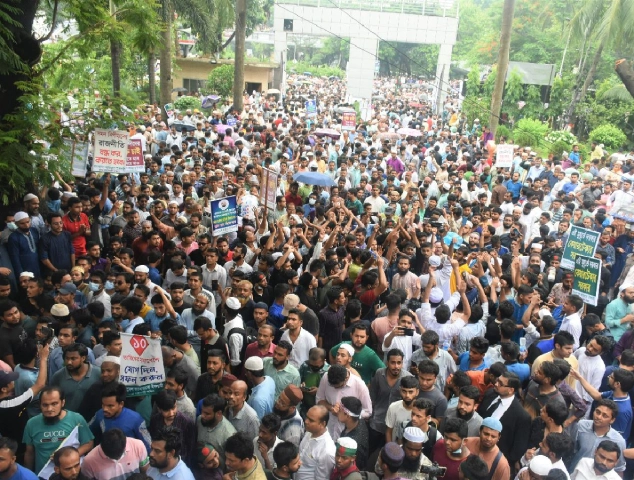
The next parliament elections are around the corner, expected in January 2024. The hardline Islamist political party Jamaat-e-Islami (JeI) after 10 years of hiatus held its first rally in Dhaka, on June 10.

The three-hour-long event was held amid a huge deployment of riot police in armed gear and hundreds of armed officers in plain clothes, at the auditorium in the heart of the capital. Thousands of its members, who were unable to find space in the hall, spilt over in the compound and also occupied half of the streets. There was no law and order situation.

In a sudden move, the capital Dhaka’s police chief permitted on certain conditions, which raised eyebrows of the journalists, political observers, civil society and left-leaning parties.

Home Minister Asaduzzaman Khan on Sunday said that Awami League’s policy regarding Jamaat-e-Islami has not “changed our position.”

Several political observers argue that the threat of the United States visa policy has given extra mileage in obtaining permission. The US visa policy for Bangladesh says it would clamp down restrictions on officials, governing party leaders and the opposition in defence of democracy. This includes those responsible for voter intimidation, vote rigging, denial of free speech or freedom of assembly, and violence that seeks to undermine free and fair elections.

Moving away from tough repressive measures against the opposition, the district civil officials and police administration in holding elections of the local government or by-elections to the parliament are extra cautious in violating compliance stated by the US State Department on May 3.

Thus, the Islamist party got the desired “verbal permission” on the eve of their rally, after the police cancelled an event of a youth wing of another political party at the same venue.

The JeI rally has brought together the party leaders and members on a three-point demand which includes: elections under a caretaker government; release of their leaders and members in prison; control of the prices of essential grocery items.

JeI leaders claimed that in 14 years of Awami League era, nearly 1.5 lakh legal harassment cases are on their heads, and nearly 14,000 leaders and members are languishing in prisons, including their national ameer (chief) Dr Shafiqur Rahman, nayeb-e-ameer (vice-president) ANM Shamsul Islam and secretary general Mia Golam Porwar.

In their list of demands are to open the JeI’s party offices across the country, and permission for political assembly, which they pointed out that has been guaranteed by the Constitution – the Constitution which they do not recognise.

The JeI leaders have offered dialogue with the government on developing a framework for an interim government to hold free, fair, inclusive and credible elections and also ensure a level-playing field for all political parties.

The Islamist calls JeI a political party, but a majority of the people in Bangladesh are aware of the organisation’s antecedent – their demonic role during the brutal war of independence.

Fearing streets violence, the police headquarters ceased permission for JeI from February 2013 after the arrests of the party’s key leaders including their national ameer Matiur Rahman Nizami, secretary general Ali Ahsan Mohammad Mujahid, assistant secretary general Abdul Quader Molla and assistant secretary general ATM Azharul Islam indicted for war crimes in 1971.

In the 2008 election, Sheikh Hasina led Awami League had returned to power after a landslide victory. Her electoral promise to the nation was the trial of those responsible for war crimes and crimes against humanity committed in 1971 must face the music of justice.

Bangladesh’s International (War) Crimes Tribunal awarded capital punishments to scores of JeI, other Muslim parties and Islamist leaders. The tribunal considering an elderly person gave sentences for imprisonment until death to Ghulam Azam, former JeI chief in 1971, for recruitment, aiding and abetting with the marauding Pakistan military.

The Islamic evangelist leader Delwar Hossain Sayeedi, a key figure with JeI and his Muslim militia were held responsible for the deaths and rape of hundreds of Hindu community and pro-independence compatriots in southern Bangladesh in 1971, says Barrister Tapash Kanti Baul, a prosecutor in the tribunal.

In the first year of Bangladesh’s independence, Bangabandhu Sheikh Mujibur Rahman, the liberation war hero passed the world’s second secular Constitution after the Muslim majoritarian Turkey.

The Constitution had a blanket ban on religious political parties. The dreaded Jamaat-e-Islami party by default was struck off.

The newly born country has gone through the pains and agony of the bloody liberation war when Pakistan forces committed wanton war crimes and rape as a weapon of war. Their henchmen of the radicalised Muslim party, JeI in the name of Islam had committed genocide and extra-judicial killings of hundreds of intellectuals by a secret death squad Al Badr.

In a landmark judgement the Bangladesh High Court on August 1, 2013, deregistered the Islamist party, Jamaat-e-Islami, thereby banning it from participating in future elections.

The court found several contradictions between the principles of the JeI party’s manifesto (available on their website and printed documents) with the Bangladesh Constitution.

The JeI wishes to establish an Islamic Republic [of Bangladesh] instead of a secular country for which it sacrificed in blood in 1971. The Quran & Sunnah will override the state Constitution; implement the strictest Islamic Sharia laws and protect the Hindus and other religious minorities in an Islamic country.

The petitioner of the public interest litigation for the deletion of JeI’s registration with the Bangladesh Election Commission (EC) in the High Court, Maulana Ziaul Hasan, fails to understand how the EC will act JeI’s plans to participate in the elections after being deregistered.

Hasan, who is also the president of Bangladesh Sommilito Islami Jote (United Islamic Alliance), a like-minded platform against political Islam and an outspoken secularist is obviously worried about the rise of Islamism.

JeI documents claim their founder was controversial Islamic leader Syed Abul A’la Maududi, founder of Jamaat-e-Islami in Pakistan. He is responsible to instigate the worst racial riots in 1953 after the partition, which killed 200 Ahmadiyya Muslims after Maududi’s disciples heard his ‘Fatwa’ which mandates the Sunni Muslims in Pakistan to kill the heretics and infidels.

Barrister Tania Amir, a leading human rights lawyer argued in the court on behalf of the PIL against JeI registration that, “The Jamaat in principle does not recognise the powers of the Republic which belongs to the people, nor does it accept the undisputed power of the people’s representatives to make laws. The party discriminates against people based on religion and, therefore, should have its registration cancelled long ago.”

In December 2018, as the general election was approaching, the Bangladesh Election Commission scrapped its registration in accordance with the higher court’s verdict. Thus, JeI was rocking in troubled waters, as they were not eligible to participate in the elections and the party was in jeopardy.

The JeI members hurriedly negotiated with their all-weather ally, the rightist Bangladesh Nationalist Party (BNP) to be able to contest more than 20 seats, and they drowned.

For the last 12 years, the rhetoric of several top echelons of Awami League and senior Ministers reiterated their party’s position to make a law to ban Jamaat-e-Islami which ruthlessly opposed the independence of Bangladesh in being complicit to war crimes committed by Pakistan’s occupation military forces.

The policymakers did not hesitate to say that banning JeI is a matter of time. Now it seems those were empty promises.

The change of heart is understood by political analyst Sohrab Hasan. JeI has recently broken away from the BNP alliance. JeI is deemed an alternative to the government if BNP boycotts the upcoming elections, he wrote in the largest circulated newspaper Prothom Alo.

It seems that the same senior Ministers made a U-Turn on their rhetoric against JeI. As Dr Hasan Mahmud, Minister for Information and Broadcasting and also Joint General Secretary of Awami League said on Sunday that Jamaat-e-Islami was not banned. “Any political party can hold rallies. As long as it is not prohibited, they have the right to hold rallies,” he explained.

While Law Minister Anisul Huq said on Sunday that Jamaat-e-Islami should “not be termed guilty until the party is convicted.”

The judges have given their opinion that JeI should be banned based on sufficient evidence that came in the verdicts delivered by the war crimes tribunal.

The Saturday event has given a message that JeI is not weak and was able to brainwash thousands more youths in radical Islamic ideology.

After the war crimes tribunal indicted the key leadership of JeI, the party was demoralised but survived in a turbulent political climate.

After the tragic assassination of Sheikh Mujib in a military putsch in mid-August 1975, the regime of General Ziaur Rahman (later president) in May 1976 abrogated Clause 38 of the Constitution which bars the formation of a religious party.

Overnight the dreaded JeI resurfaced from the dead and began politicking, but of the tainted history of their engagement against the people of the country, they strategically changed its name to Islamic Democratic League.

The JeI bagged six seats in the 1979 parliament under a military dictator General Rahman. Surprisingly, the six JeI’s elected in the constituencies were all bordering the India-Bangladesh.

Fortunately, the people understood and rejected the Islamist party, which could be understood from the subsequent elections. JeI on average received nearly 4 per cent vote, said political scientist Dr Imtiaz Ahmed.

In the 1991 election after the departure of another military junta of General HM Ershad, JeI was elected in 18 seats, which was crucial for Khaleda Zia to form a coalition government. Despite a clear win, Awami League had to be seated on the opposition bench in the parliament as the party failed to muster a majority to form a government.

Awami League’s influential general secretary Obaidul Quader, hours after the event said the opposition BNP is behind Jamaat-e-Islami’s rally to conspire against the democratic process and jeopardise the forthcoming elections.

Indeed it’s rare in the world’s political history that a party which opposed the independence of a country had remained resilient and defiantly returned to politics, despite key leaders of the JeI leaders being handed down maximum punishment by the war crimes by the war crimes tribunal.

First published in the India Narrative, New Delhi, India on 14 June 2023

(Saleem Samad is an award-winning independent journalist based in Bangladesh. Views expressed are personal. Twitter: @saleemsamad)

Sunday, May 28, 2023

Imran Khan’s ‘Vandana’ For Bangabandhu Sheikh Mujib


SALEEM SAMAD

For more than a decade there was a simmering debate spearheaded by the netizens, academicians, journalists, researchers, social justice activists and civil society in Pakistan on war crimes, genocide and rape as a weapon of war by marauding Pakistan military during the brutal birth of Bangladesh in 1971.
Long before the cricketer-turned-politician Imran Khan became Prime Minister of the Islamic Republic of Pakistan at a talk show in Urdu anchored by celebrated anti-establishment journalist Hamid Mir, admitted that “some” atrocities had been committed in Bangladesh in 1971.
He also said that it was time to reconcile with Bangladesh what happened in 1971, and Pakistan should seek an apology for the war crimes.
Obviously, this news appeared in major dailies and argued on private TV channels during prime time talk-shows in Bangladesh.
Bangladesh’s relationship with Pakistan during Nawaz Sharif was all-time low after Sheikh Hasina in 2010 when she decided to put the war crimes suspects to face the music of justice.
Islamabad scolded Bangladesh envoy in Pakistan each time when the war crimes tribunal in Dhaka handed down maximum punishment for the Islamist leaders of Jamaat-e-Islami (JeI).
The key henchmen of the Pakistan military were indicted for crimes against humanity, especially kidnapping, torture and deaths of hundreds of intellectuals by a dreaded death squad, Al-Badr recruited by JeI.
Hasina was angry with Islamabad’s statement condemning the so-called “sham” trial targeting Muslim leaders.
Well, Turkey joined Pakistan in the vilification campaign against the trial of the accused for war crimes and crimes against humanity.
She decided to withdraw the diplomats from Islamabad and shut down the Bangladesh mission in Pakistan. Her government for several years refused to give accreditation to Pakistan’s nominated High Commissioner to Dhaka.
However, the Indian Prime Minister Narendra Modi, and Saudi Arabia and the United States in a similar diplomatic tone advised Hasina to not a harsh diplomatic decision.
Hasina backed out, understanding that the move would jeopardize South Asian regional cooperation and the war against terror campaign.
Her government continued to deny visas to Pakistan nationals from the Bangladesh missions in Islamabad and Karachi.
Well, during Khan’s tenure as head of government, he did not take any effort to thaw relations with Bangladesh, not to speak of seeking an apology for war crimes.
Hours after the much-dramatized arrest of former Prime Minister Imran Khan allegedly for corruption, the country rocked with violent street protests on May 9.
Angry protesters of the opposition Pakistan Tehreek-e-Insaf (PTI) seem to have a grudge against the military establishment.
Many are beginning to wonder if the military hawks can remain the hegemon that guides the nation, while the COAS General Asim Munir warns Khan and his cohorts from fresh attacks on military facilities.
Exasperated by the violent protests, Pakistan’s Prime Minister Shehbaz Sharif at a civil-military huddle a few days ago decided to observe May 9 as a ‘black day’ and remarked that “Such scenes were not witnessed since the fall of Dhaka during 1971.”
Sharif was referring to the surrender of Pakistan’s 96,000 troops and civilians in Dhaka under the joint command of the Indian army and Bangladesh Mukti Bahini on December 16, 1971 – labelled as the “darkest day” in the history of Pakistan.
Veteran political historian Mohiuddin Ahmad says if Pakistan believes that December 16 is the “darkest day” then they should also consider seeking a public apology for war crimes committed during the liberation war of Bangladesh.
Thousands of netizens in Pakistan and PTI cohorts poured onto social media and began to compare the 70-year-old Imran Khan ‘Vandana’ with Bangabandhu [Friend of Bangladesh] Sheikh Mujibur Rahman, an architect of independent Bangladesh.
Once a blue-eyed boy of the Pakistan military establishment, Khan blamed the top military hawks in Rawalpindi GHQ for orchestrating against him to eliminate him from politics in axis with the United States, and dubbed himself as ‘Mujibur 2.0’.
The Bangladesh media and social media did not feel comfortable comparing Imran Khan with founding father Sheikh Mujib. The media with scornful eyes rebuked the Pakistani netizens for comparing a man mountain with a Lilliput.
Dr Imtiaz Ahmed, a professor at Dhaka University is a leading political scientist who reacted to Khan’s comparison with the Father of Nation. He has demeaned Sheikh Mujib, who is adored by millions of people. Bangabandhu has never been smeared by allegations of corruption and hobnobbing with the military establishment to scale the ladder to power.

An Indian micro-blogger @Pavan_JaiHind reverberates with other netizens: History is repeating itself. Victims are [the] same, Pakistani people. [The] perpetrator is [the] same, Pakistan Army. Crimes are [the] same, Rape & Murders. [The] only leader of 1971 Sheikh Mujibur Rahman is replaced by Imran Khan in 2023.

Mehedi Hasan Shuvo @MHShuvo12053 on May 9 satires from Bangladesh: Remember these two things: 1. Every country has its own military; 2. Pakistan’s military has its own country.

The netizen in another tweet: Sheikh Mujibur Rahman whom you [have] known as a traitor, now see what your [Pakistan] army does to your own men.

“Everyone knows Mujibur Rahman and his party won the general elections in 1970. Instead of handing over power, a clever politician set Awami League and the army on a collision course,” said Khan.

A Pakistani micro-blogger Sohail @mosohail03 on May 10 tweets: Sheikh Mujibur Rahman told the military, “You can kill me, but you can’t suppress the people of Bangladesh. Sheikh Mujibur Rahman, the whole nation apologizes to you.”

In 1971, when Pakistan’s army battalion arrested Sheikh Mujibur Rahman, the “Father of the Nation” of Bangladesh, he was treated very badly. At that time, the Pakistan Army Chief (dictator) Yahya Khan was backed by a political puppet named Zulfikar Ali Bhutto #ImranKhanArrest

@OsintTV on May 11 tweets from Pakistan: History repeating itself…It was Sheikh Mujibur Rahman then now Imran Khani. Pakistan Army is [the] same.

“A shrewd politician (Zulfikar Ali Bhutto), in his greed for power, set the armed forces against the then largest party (Bangladesh’s Awami League), which had won elections, causing the dismemberment of the country,” lamented PTI chief during a road march in Gujranwala in last November, reports Dawn.
Khan was ousted as prime minister in April 2022 in a parliamentary no-confidence vote, reminded that Pakistan had split into two after Awami League with a legitimate political mandate was denied its right to rule. “Those who are behind all this don’t know what happened in East Pakistan.”
Despite all the deadly political drama, Imran is Pakistan’s most popular leader according to opinion polls.
The comparison of Imran Khan with Bangabandhu and the May 9 violent protests with the 1971 liberation, demonstrates appalling knowledge of the political history of the 1970 post-elections, the bloody liberation war in 1971 and culminating in the humiliating defeat of occupation troops of Pakistan.

First published in The News Times, 28 May 2023

Saleem Samad is an award-winning independent journalist, media rights defender, recipient of Ashoka Fellowship and Hellman-Hammett Award. He could be reached at <saleemsamad@hotmail.com>; Twitter @saleemsamad


Wednesday, March 09, 2022

Why Did Pakistan Crackdown In Bangladesh, Balochistan In March?


SALEEM SAMAD

It may be coincidental that the Islamic Republic of Pakistan has a weakness for the month of March!

The Islamic nation-state possibly felt the month of March was a ‘holy’ month or lucky month for the ruthless crackdown in Balochistan and after 23 years sadistically repeated it in Bangladesh.

Maybe the fortune-tellers to the military hawks in Rawalpindi decide their evil actions on the particular month of March. Whatever the motive, the evil axis occurred in March.

The regime in Rawalpindi launched fierce genocidal ‘Operation Searchlight’ in Bangladesh on the night of 25 March 1971.

In the nine months to freedom, 3 million martyrs were victims of genocide, and more than 400,000 women were raped as a weapon of war. Possibly the world’s largest war refugee was created in living history. More than 10 million war refugees took shelter in neighbouring India.

The Pakistan junta did not realise they will experience a humiliating defeat in December 1971. After the Second World War, another formal surrender occurred when 93,000 Pakistan troops signed the instrument of surrender at Dhaka on 16 December 1971.

Before the crackdown in Bangladesh in March 1971, Pakistan’s invasion of the largest princely states Balochistan on 27 March 1948 killed several thousand innocent Baloch. Their struggle for independence still rages in the rugged terrain of Balochistan.

However, the Pakistan official narratives claim that the State of Kalat acceded to Pakistan on 27 March after Mohammad Ali Jinnah sent a confidential letter to ‘Khan of Kalat’.

Jinnah was legal adviser to ‘Khan of Kalat’ and with his full knowledge, the Pakistan military attacked and invaded Quetta, the capital of Balochistan.

Well, history says differently. Balochistan became an independent country on 4 August 1947, much ahead of the independence of Pakistan on 14 August 1947.

The declaration of independence of Balochistan was announced on 11 August 1947, three days before Pakistan was created. Unfortunately, the independence of Balochistan was short-lived and lasted for 252 days.

Before the partition of India and Pakistan, Balochistan consisted of four princely states of Kalat, Lasbela, Kharan and Makran under the British Raj. Two of these provinces, Lasbela and Kharan, were ‘fiduciary states’ placed under Khan of Kalat’s rule by the British, as was Makran which was a district of Kalat.

In the notorious month of March, many political events occurred. On 23 March 1956, the road to military rule was paved when General Iskander Mirza was sworn in as the first President of Pakistan.

On 25 March 1969, in a bloodless coup d’état Pakistan Army chief General Yahya Khan took over power from General Ayub Khan, a dictator of a decade and proclaim Martial Law and dissolved the assemblies.

Pakistan first tried to trick the leaders of Balochistan into joining the renegade part of India in the name of ‘Muslim’, but when both Houses of Balochistan unanimously refused to annexe with Pakistan angered the hierarchy, then based in Karachi.

After the bloody independence of Bangladesh, the Pakistan troops were still Prisoners of War (POWs) in India, the Prime Minister Zulfiqar Ali Bhutto to rejuvenate the demoralised Pakistan troops, gave responsibilities to “Butcher of Bengal” General Tikka Khan, then army chief to crack down on Baloch separatists and dissidents.

Subsequently, the military operation against separatists commenced in Balochistan in 1973 and the armed nationalist movement was brutally suppressed. The fiercest Baloch people have been struggling against Pakistan’s occupation and fought in 1948, 1958, 1962 and 1974.

What is more frustrating for Pakistan is that it failed to defeat the Baloch liberation struggle despite killing thousands of Baloch nationalists. More than 20,000 were victims of enforced disappearances and “dumping”. Those captured were brutally tortured and bullet-ridden bodies of thousands of Baloch political prisoners are found on the roadside.

The brutal torture of state forces includes gouging the eyes of the victims, cutting their tongues, noses, amputating their limbs, drilling holes in their bodies and many other inhuman and brutal mediums of torture. Pakistan junta is still paying an enormous price for the crackdown in Balochistan.

First published in The News Times, 9 March 2022

Saleem Samad, is an independent journalist, media rights defender, recipient of Ashoka Fellowship and Hellman-Hammett Award. He could be reached at <saleemsamad@hotmail.com>; Twitter @saleemsamad