Buy.com Monthly Coupon
Showing posts with label Islamist party. Show all posts

Saturday, November 04, 2023

Will the Islamists pose a challenge to the Awami League in Bangladesh?

SALEEM SAMAD

The wind of election fever is sweeping Bangladesh as the national election is coming closer. The Islamist parties, including the lesser-known Islamists are gearing up for the elections expected in early January 2024.

The Islamist parties are formally and informally holding parleys to form an electorate alliance. The question arises, whether the alliance will be a challenge for the incumbent Awami League or the opposition Bangladesh Nationalist Party (BNP).

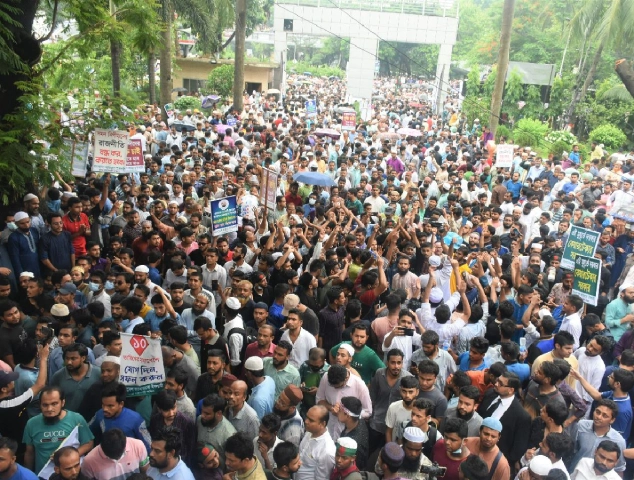
After a long time, Bangladesh’s capital Dhaka witnessed a largely attended crowd at a rally organised by Islami Andolon (Movement) Bangladesh on Friday (November 3), a weekly holiday for the noon Jumma prayer.

The rally was held at Shurwardy Uddyan, where 96,000 Pakistan military signed a historic surrender and a surrender ceremony was held on December 16, 1971.

It is the same placed where Bangabandhu Sheikh Mujibur Rahman made a historic speech on March 7, 1971, which inspired the people to rise against the Pakistan military junta, leading to an independent Bangladesh.

The vast green expanse was the country’s only race course, a legacy of the British Raj, is presently a site in remembrance of the liberation war, and the sacrifices of the martyrs.

The Islami Andolon has asked the governing Awami League to relinquish power within seven days.

What has amazed many political observers is that the Islamist party has expressed solidarity with the ongoing BNP anti-government movement for a caretaker government and asked Prime Minister Sheikh Hasina to step down.

The founder of Islami Andolon, Syed Mohammad Rezaul Karim said if the government fails to comply with the demands to quit by November 10, they will discuss with members of the opposition alliance and announce the next course of the movement.

The demands include a national government with members from the parties in the anti-government campaign and urged the President of the country to take measures to avoid further escalation of the violence unleashed during the series of countrywide shutdowns and blockades of road, train and river communication.

They also asked to release all BNP leaders arrested during the wake of the movement in a week.

The Islamist leader Karim warned that the people will not accept sham elections held in 2014 and 2018.

The Islamic preacher spelt out an ultimatum and threatened to launch a tougher movement with all the political parties to hold an election under a national government if their demand is not met by the date.

He warned that they will not be allowed to hold sham elections held in 2014 and 2018 polls. “The government is referring to the constitution saying that it is not possible to go beyond it. Who made the constitution? Awami League? This constitution is also illegal like the Awami League–led government,” he remarked.

He told a cheering crowd of tens of thousands that they would fight in collaboration with all political groups and get Sheikh Hasina off the throne.

On the other hand, the governing Awami League and the opposition Bangladesh Nationalist Party (BNP) are vigorously working backstage to get Islami Andolon as an electoral ally. Obviously, it will energise the enthusiasm of the impressive vote bank ahead of the upcoming general elections in early January 2024.

Surely, Karim, popularly known as “Charmonair Pir” has become a factor in politics. And it led the two major parties to make one request to Islami Andolon to join their electoral coalition, instead of going alone.

Notwithstanding, starting their political career from Barishal in March 1987, the party emerged as the fourth most popular political party in the last general election, writes The Daily Star.

The Islamist party categorically told the BNP delegation last February that they have strong reservations about the caretaker system as has been marked by bitter experience which ushered in the infamous 1/11 military-backed caretaker government.

Instead, they proposed a national government comprising members from major political parties to hold the national elections, which did not catch the winds from BNP leadership visiting Islami Andolon headquarters in Barishal.

The governing party is actively engaged in expanding the political base of an electoral alliance with leftist and Islamist parties too.

A government party delegation held parleys with Islami Andolon and proposed to its fold to defeat the opposition BNP.

The ruling party explained to Islamist leaders that joining the alliance would broaden their hope of winning in several constituencies with a vote bank of like-minded parties in the pro-government alliance if BNP decides to participate in the election.

Several Awami League leaders, however, denied holding dialogue or have proposed the Islamist party to join the broad electoral alliance.

The Islamic Andolon contested 299 seats out of 300 constituencies in the national polls held in 2018. Well, the highest by a single party, whereas the Awami League contested in 262 seats, the BNP in 258 and the Jatiya Party in 45 seats.

The Islamic Andolon individually participated in national elections for the first time in 2008. In the last 2018 election, the Islamist party contested 299 seats and got 12.55 lakh votes, which was 1.52 per cent of the vote, according to The Daily Star.

Bangladesh Election Commission has delisted the registration of the Islamist party Jamaat-e-Islami (JeI) and has no locus standi in the electioneering. However, 22 candidates of JeI have contested the 2018 election with the BNP election symbol ‘sheaf of paddy’. All the JeI candidates lost the election.

Since the BNP announced agitations on 28 October, the JeI has also announced a similar agitation programme.

The Qawmi Madrasa–based non-political Islamist organisation, Hefajat-e-Islam are in catch-22 whether to support the government party and release central leaders languishing in prison or challenge Awami League in the upcoming elections.

Several central leaders of Hefajat-e-Islam, are also leaders of smaller Islamist parties and will certainly surface during the electioneering.

On the sideline, lesser-known Islamist parties are gearing up to participate in the elections and plan to merge as a “third force”.

An alliance of Islamist parties has launched the Liberal Islamic Alliance comprising six Islamic and like-minded political parties formed on  1 September.

The six Islamic parties, newly registered with the Election Commission, are Bangladesh Supreme Party led by Syed Saifuddin Ahmed Maizbhandari, Bangladesh Islami Oikya Jote led by Misbahur Rahman Chowdhury, Krishak Sramik Party led by Farhanaz Haque, Aashiqeen-e-Awlia Oikya Parishad led by Alam Noori Sureshwari, Bangladesh Janodal and National Awami Party (NAP Bhashani).

The Supreme Party Chairman Syed Saifuddin Ahmed Maizbhandari said that preparations are afoot to contest in all 300 constituencies, indeed a challenge to other Islamist parties and alliances.

Some of the Islamist parties have reportedly said, that they will decide to participate or boycott after the election date is formally announced by the election commission.

Presently, 44 political parties, including 14 Islamist parties, are registered with the Election Commission, which is obligatory for participation in national and local government elections.

What will happen, if BNP suddenly decides to join the election at the eleventh hour? The Islamist parties will surely join the grand alliance of the government with an impressive vote bank, concludes Partha Pratim Bhattacharjee, political reporter with The Daily Star.

First published in the Northeast News, 4 November 2023

Saleem Samad is an award-winning independent journalist based in Bangladesh. A media rights defender with the Reporters Without Borders (@RSF_inter). Recipient of Ashoka Fellowship and Hellman-Hammett Award. He could be reached at saleemsamad@hotmail.com; Twitter: @saleemsamad

Wednesday, June 14, 2023

Is US encouraging rise of Bangladesh’s Islamist party to counter Sheikh Hasina?


SALEEM SAMAD

The next parliament elections are around the corner, expected in January 2024. The hardline Islamist political party Jamaat-e-Islami (JeI) after 10 years of hiatus held its first rally in Dhaka, on June 10.

The three-hour-long event was held amid a huge deployment of riot police in armed gear and hundreds of armed officers in plain clothes, at the auditorium in the heart of the capital. Thousands of its members, who were unable to find space in the hall, spilt over in the compound and also occupied half of the streets. There was no law and order situation.

In a sudden move, the capital Dhaka’s police chief permitted on certain conditions, which raised eyebrows of the journalists, political observers, civil society and left-leaning parties.

Home Minister Asaduzzaman Khan on Sunday said that Awami League’s policy regarding Jamaat-e-Islami has not “changed our position.”

Several political observers argue that the threat of the United States visa policy has given extra mileage in obtaining permission. The US visa policy for Bangladesh says it would clamp down restrictions on officials, governing party leaders and the opposition in defence of democracy. This includes those responsible for voter intimidation, vote rigging, denial of free speech or freedom of assembly, and violence that seeks to undermine free and fair elections.

Moving away from tough repressive measures against the opposition, the district civil officials and police administration in holding elections of the local government or by-elections to the parliament are extra cautious in violating compliance stated by the US State Department on May 3.

Thus, the Islamist party got the desired “verbal permission” on the eve of their rally, after the police cancelled an event of a youth wing of another political party at the same venue.

The JeI rally has brought together the party leaders and members on a three-point demand which includes: elections under a caretaker government; release of their leaders and members in prison; control of the prices of essential grocery items.

JeI leaders claimed that in 14 years of Awami League era, nearly 1.5 lakh legal harassment cases are on their heads, and nearly 14,000 leaders and members are languishing in prisons, including their national ameer (chief) Dr Shafiqur Rahman, nayeb-e-ameer (vice-president) ANM Shamsul Islam and secretary general Mia Golam Porwar.

In their list of demands are to open the JeI’s party offices across the country, and permission for political assembly, which they pointed out that has been guaranteed by the Constitution – the Constitution which they do not recognise.

The JeI leaders have offered dialogue with the government on developing a framework for an interim government to hold free, fair, inclusive and credible elections and also ensure a level-playing field for all political parties.

The Islamist calls JeI a political party, but a majority of the people in Bangladesh are aware of the organisation’s antecedent – their demonic role during the brutal war of independence.

Fearing streets violence, the police headquarters ceased permission for JeI from February 2013 after the arrests of the party’s key leaders including their national ameer Matiur Rahman Nizami, secretary general Ali Ahsan Mohammad Mujahid, assistant secretary general Abdul Quader Molla and assistant secretary general ATM Azharul Islam indicted for war crimes in 1971.

In the 2008 election, Sheikh Hasina led Awami League had returned to power after a landslide victory. Her electoral promise to the nation was the trial of those responsible for war crimes and crimes against humanity committed in 1971 must face the music of justice.

Bangladesh’s International (War) Crimes Tribunal awarded capital punishments to scores of JeI, other Muslim parties and Islamist leaders. The tribunal considering an elderly person gave sentences for imprisonment until death to Ghulam Azam, former JeI chief in 1971, for recruitment, aiding and abetting with the marauding Pakistan military.

The Islamic evangelist leader Delwar Hossain Sayeedi, a key figure with JeI and his Muslim militia were held responsible for the deaths and rape of hundreds of Hindu community and pro-independence compatriots in southern Bangladesh in 1971, says Barrister Tapash Kanti Baul, a prosecutor in the tribunal.

In the first year of Bangladesh’s independence, Bangabandhu Sheikh Mujibur Rahman, the liberation war hero passed the world’s second secular Constitution after the Muslim majoritarian Turkey.

The Constitution had a blanket ban on religious political parties. The dreaded Jamaat-e-Islami party by default was struck off.

The newly born country has gone through the pains and agony of the bloody liberation war when Pakistan forces committed wanton war crimes and rape as a weapon of war. Their henchmen of the radicalised Muslim party, JeI in the name of Islam had committed genocide and extra-judicial killings of hundreds of intellectuals by a secret death squad Al Badr.

In a landmark judgement the Bangladesh High Court on August 1, 2013, deregistered the Islamist party, Jamaat-e-Islami, thereby banning it from participating in future elections.

The court found several contradictions between the principles of the JeI party’s manifesto (available on their website and printed documents) with the Bangladesh Constitution.

The JeI wishes to establish an Islamic Republic [of Bangladesh] instead of a secular country for which it sacrificed in blood in 1971. The Quran & Sunnah will override the state Constitution; implement the strictest Islamic Sharia laws and protect the Hindus and other religious minorities in an Islamic country.

The petitioner of the public interest litigation for the deletion of JeI’s registration with the Bangladesh Election Commission (EC) in the High Court, Maulana Ziaul Hasan, fails to understand how the EC will act JeI’s plans to participate in the elections after being deregistered.

Hasan, who is also the president of Bangladesh Sommilito Islami Jote (United Islamic Alliance), a like-minded platform against political Islam and an outspoken secularist is obviously worried about the rise of Islamism.

JeI documents claim their founder was controversial Islamic leader Syed Abul A’la Maududi, founder of Jamaat-e-Islami in Pakistan. He is responsible to instigate the worst racial riots in 1953 after the partition, which killed 200 Ahmadiyya Muslims after Maududi’s disciples heard his ‘Fatwa’ which mandates the Sunni Muslims in Pakistan to kill the heretics and infidels.

Barrister Tania Amir, a leading human rights lawyer argued in the court on behalf of the PIL against JeI registration that, “The Jamaat in principle does not recognise the powers of the Republic which belongs to the people, nor does it accept the undisputed power of the people’s representatives to make laws. The party discriminates against people based on religion and, therefore, should have its registration cancelled long ago.”

In December 2018, as the general election was approaching, the Bangladesh Election Commission scrapped its registration in accordance with the higher court’s verdict. Thus, JeI was rocking in troubled waters, as they were not eligible to participate in the elections and the party was in jeopardy.

The JeI members hurriedly negotiated with their all-weather ally, the rightist Bangladesh Nationalist Party (BNP) to be able to contest more than 20 seats, and they drowned.

For the last 12 years, the rhetoric of several top echelons of Awami League and senior Ministers reiterated their party’s position to make a law to ban Jamaat-e-Islami which ruthlessly opposed the independence of Bangladesh in being complicit to war crimes committed by Pakistan’s occupation military forces.

The policymakers did not hesitate to say that banning JeI is a matter of time. Now it seems those were empty promises.

The change of heart is understood by political analyst Sohrab Hasan. JeI has recently broken away from the BNP alliance. JeI is deemed an alternative to the government if BNP boycotts the upcoming elections, he wrote in the largest circulated newspaper Prothom Alo.

It seems that the same senior Ministers made a U-Turn on their rhetoric against JeI. As Dr Hasan Mahmud, Minister for Information and Broadcasting and also Joint General Secretary of Awami League said on Sunday that Jamaat-e-Islami was not banned. “Any political party can hold rallies. As long as it is not prohibited, they have the right to hold rallies,” he explained.

While Law Minister Anisul Huq said on Sunday that Jamaat-e-Islami should “not be termed guilty until the party is convicted.”

The judges have given their opinion that JeI should be banned based on sufficient evidence that came in the verdicts delivered by the war crimes tribunal.

The Saturday event has given a message that JeI is not weak and was able to brainwash thousands more youths in radical Islamic ideology.

After the war crimes tribunal indicted the key leadership of JeI, the party was demoralised but survived in a turbulent political climate.

After the tragic assassination of Sheikh Mujib in a military putsch in mid-August 1975, the regime of General Ziaur Rahman (later president) in May 1976 abrogated Clause 38 of the Constitution which bars the formation of a religious party.

Overnight the dreaded JeI resurfaced from the dead and began politicking, but of the tainted history of their engagement against the people of the country, they strategically changed its name to Islamic Democratic League.

The JeI bagged six seats in the 1979 parliament under a military dictator General Rahman. Surprisingly, the six JeI’s elected in the constituencies were all bordering the India-Bangladesh.

Fortunately, the people understood and rejected the Islamist party, which could be understood from the subsequent elections. JeI on average received nearly 4 per cent vote, said political scientist Dr Imtiaz Ahmed.

In the 1991 election after the departure of another military junta of General HM Ershad, JeI was elected in 18 seats, which was crucial for Khaleda Zia to form a coalition government. Despite a clear win, Awami League had to be seated on the opposition bench in the parliament as the party failed to muster a majority to form a government.

Awami League’s influential general secretary Obaidul Quader, hours after the event said the opposition BNP is behind Jamaat-e-Islami’s rally to conspire against the democratic process and jeopardise the forthcoming elections.

Indeed it’s rare in the world’s political history that a party which opposed the independence of a country had remained resilient and defiantly returned to politics, despite key leaders of the JeI leaders being handed down maximum punishment by the war crimes by the war crimes tribunal.

First published in the India Narrative, New Delhi, India on 14 June 2023

(Saleem Samad is an award-winning independent journalist based in Bangladesh. Views expressed are personal. Twitter: @saleemsamad)