|
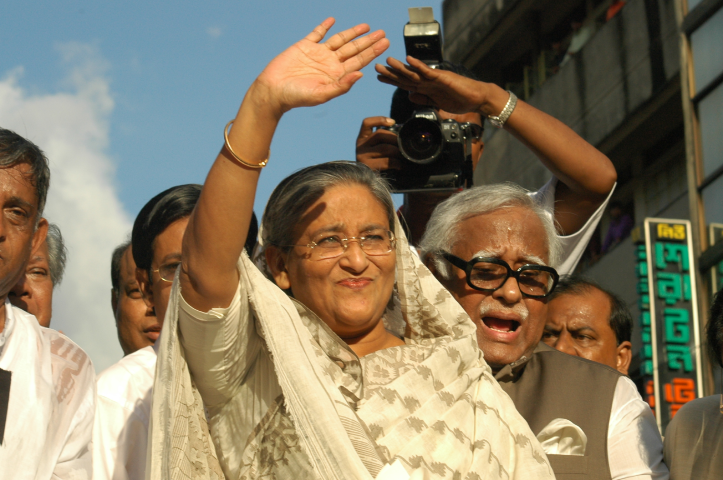
Bangladesh Prime Minister Sheikh Hasina hours before the assassination attempt in 2004 (Photo: Anisur Rahman, The Daily Star)
SALEEM SAMAD
As dusk fell 19 years ago on 21 August 2004, I received a desperate phone call from a foreign diplomat (his identity cannot be disclosed). His frenzied voice was very urgent and said his Ambassador urgently wants to know the status of Sheikh Hasina.
Sheikh Hasina was president of the largest political party Awami League. The party was founded by her assassinated father Bangabandhu Sheikh Mujibur Rahman, an independence hero.
Hasina was an opposition leader of the Awami League and was intermittently boycotting the parliament sessions to protest the stubbornness of the ruling rightist Bangladesh Nationalist Party (BNP) and its ally the Islamist party Jamaat-e-Islami in refusing the opposition to adequate participation in the parliamentary debate. She was at loggerheads with the ruling BNP and the Islamists protesting country-wide mass arrests and attacks on her party members and supporters – selectively the Hindus were targeted.
Why, what is the news of Sheikh Hasina, I asked the diplomat. He said that several hand bombs were lobbed at the rally. Several senior Awami League leaders were wounded or dead, and hundreds more were grievously injured at the rally in front of the party headquarters at Bangabandhu Avenue, in the city centre.
Requesting to call back at the soonest, the diplomat asked again to confirm her status, whether she is safe and where she is now. I could not digest the heartbreaking news.
The diplomat thought as I was working with an influential English daily The Bangladesh Observer, I would be able to respond to his frantic queries.
The call came 20 minutes after the brutal attack on the opposition, which had an objective to eliminate Sheikh Hasina and cripple the party’s leadership by killing the senior leaders. Obviously, the opposition will be paralysed and immobilised. Indeed, a picture-perfect plan!
It was an evil dream of the so-called Hawa Bhaban, the de facto political power outside the Prime Minister’s Office (PMO). It was an independent office in the posh Banani area by Prime Minister Khaleda Zia’s eldest son, an obtrusive politician Tarique Rahman (presently a fugitive in exile in London, United Kingdom).
I called several press photographers, including Pavel Rahman of the Associated Press (AP), Rafiqur Rahman of Reuters Photo, Shambunath Nandi of the Bangladesh Observer, and others. Unfortunately, none of them responded to my anxious phone calls.
Out of the blue one of my colleagues with the Bangladesh Observer called me. He was safely positioned at the Dhaka Stadium which was across the street from the scene of occurrence. He witnessed the carnage and panicked supporters and members of the party fleeing the spot.
I quickly asked him about the status of Hasina. He could not give any information on the fate of Hasina.
Still not getting information about Hasina, I called a long-time source, a Field Officer of National Security Intelligence (NSI). He covers Awami League. After several calls on his mobile phone, finally he responded in a relaxed mood, as if nothing has happened.
I asked whether he has any information about Hasina’s status. Promptly he responded that the rally has ended more than an hour ago and Hasina must have left the place.
My second curious question was where was he (security intelligence agent)? He replied that he was at a music store at Topkhana Road (not far from the venue of the bomb attack) and was listening to Bengalees’ favourite ‘Rabindra Sangeet’ songs with a headphone. The third question was, did you not listen to other Field Officers about what happened at Bangabandhu Avenue over his walkie-talkie? He said softly, his walkie-talkie was switched off.
I retold what I heard from the diplomat. He laughed upon hearing my query.
I repeatedly requested him to switch on his walkie-talkie. Once he switched on the two-way radio, I could hear garbled voices from his radio. Before I could request him to call me back on any news of Hasina, he hung up and did not respond to my calls throughout the night.
Three hours after the incident, still no news of the fate of Hasina. My colleague called me back and confirmed that Hasina has reached her private residence ‘Suda Sadan’ in Dhanmondi.
On the following day, I was walking to the place of occurrence from the National Press Club not far from Bangabandhu Avenue. I met the NSI officer (his name has been suppressed for security reasons) walking towards the Secretariat Building, where most of the Government Ministries are housed.
While walking and talking, I asked him why he had abandoned his position in the rally and instead decided to listen to music with a headphone? He replied that his superior officer had asked all the Field Officers to leave the venue once Hasina arrives at Bangabandhu Avenue. So, he moved away as nothing else was expected, he switched off the radio.
By the way, who was his superior? He did not hesitate to indicate that it was none other than the Director-General of NSI, Major General Rezaqul Haider Chowdhury (a rogue officer presently languishing in prison pending appeal verdict of the infamous ‘10-truck arms’ hauled in Chattagram, which was destined for India’s northeast separatist the United Liberation Front for Assam – ULFA).
To my surprise, he voluntarily gave me additional information that the NSI chief was at Holy Family Hospital at Eskaton instead of Combined Military Hospital (CMH) on a dreadful evening. “Now you understand who is responsible for the incident,” the NSI officer quipped and walked away, requesting not to be quoted.
Describing the incident, lawmaker Saber Hossain Chowdhury said the driver of the vehicle and her bodyguards (former military officers) intelligently outwitted the assassins and bombers and saved Hasina from the wrath.
The customized bullet-proof vehicle Mercedes Benz was shot several times. The snipers continued to target the shocked Hasina seated in the front passenger seat to accomplish their killing mission. The windshield, window, and door on her side bore marks of hails of bullets.
The assassins had deployed sharpshooters in strategic locations on rooftops in the area. On an ominous day, the duties of armed police were deliberately not positioned on the rooftops.
As soon as the vehicle managed to manoeuvre out of the August carnage site, the nervous Special Branch officer onboard the vehicle sought clearance over his walkie-talkie for a secured route. An unknown officer in the control room barked at him to wait for the police escort vehicle but Hasina’s bodyguards refused to listen to the advice of the police control room.
The vehicle zigzagged through the Dhaka University campus and reached home safely in 15 minutes. In fact, Sheikh Hasina cheated a near-death of the full-proof assassination plot.
War decorated Mukti Bahini officer retired Major General Syed Muhammad Ibrahim visited the spot the following day confirmed finding military-grade bullets and unexploded Arges Type HG 84 hand grenade. He also said that weapons used for shooting and lobbed hand grenades can only be used by trained personnel.
The top-secret plot to assassinate Hasina and reduce the party into a skeleton was backed by the state. The conspiracy was prepared with full knowledge of the state security agency NSI. The assassination was masterminded by the prime minister’s delinquent son Tareque Rahman.
The higher court upheld the death penalty for Tareque, former NSI chief General Chowdhury and the dreaded Harkat-ul-Jihad-al Islami Bangladesh (HuJI-B) leader Mufti Abdul Hannan for the botched assassination of Hasina and deaths of 24 persons and grievously wounded 300 others.
First published in India Narrative, 17 August 2023, New Delhi, India
(Saleem Samad is an award-winning independent journalist based in Bangladesh. Views expressed are personal. Twitter: @saleemsamad)