Buy.com Monthly Coupon

Thursday, May 27, 2021

Arabs have failed the Palestinians

Smoke and flames rise from a tower building as it is destroyed by Israeli air strikes amid a flare-up of Israeli-Palestinian violence, in Gaza City May 12, 2021 Reuters

SALEEM SAMAD

The 11-day fierce fire-fight between the militants of Hamas and the Islamic Jihad with Israel caused at least 243 people, including more than 100 women and children, to be killed in Gaza.

The Israeli military says more than 4,300 homemade Qassam rockets --   a simple, steel artillery rocket developed and deployed by the military arm of Hamas -- were fired towards its territory by Palestinian militants.

Since the rockets were pressed into conflict with Israel in 2001, the improvised rocketry technology is not capable of being fired to target military sites, and is "indiscriminate when used against targets in population centres."

Nevertheless, the improvised rockets rained down deep into central Israel and crashed into former capital Tel Aviv. Israel’s state-of-the-art air defense system “Iron Dome” however managed to intercept 90% of the rockets from Gaza.

On the 12th day, Egypt brokered a ceasefire which was also backed by US President Joe Biden. The fragile ceasefire apparently seems to have halted the skirmish for a while. No surprise that both sides have claimed victory.

In a virtual conference held several days after the airstrikes caused havoc in Gaza, the 57-nation Organisation of Islamic Conference (OIC) was outraged, when hundreds of women and children were victims of collateral damage over the conflict in Gaza.

Only Saudi Arabia condemned Israel for “flagrant violations” in Gaza, calling on the global community to act urgently to put an end to Israel’s attacks on Gaza.

Surprisingly, most Arab countries except Kuwait, Iran, and Turkey did not rebuke Israel harshly for the recent conflict that started in East Jerusalem during the Muslim holy month of Ramadan, which spread to Gaza as a result of Israeli assaults on worshippers in the Al-Aqsa Mosque compound and coupled with the eviction of Palestinians from the Sheikh Jarrah neighbourhood.

The Muslim countries are divided in a thick and thin line of a partisan realignment of a global superpower. Despite being the “guardians of Islam” and “protector of Muslims,” Arab monarchies have demonstrated that they care only to counter Iran.

Joe Biden, however, reiterated that the Israel and Palestine crisis lies in a two-state solution, nothing more and nothing less to create a sovereign Palestine State.

The radicalized Islamist party Hamas had landslide wins in 2005 and 2006 elections in Gaza, which resulted in a crucial split of the Palestinian National Authority (PNA), established as a consequence of the 1993–1995 Oslo Accords.

The Palestine Authority, dominated by the Fatah party, was founded by Yasser Arafat and is governed from Ramallah in the West Bank. The PNA is recognized internationally as the sole representative of the State of Palestine but does not recognize the Hamas authority which rules Gaza.

The trouble began when Fatah lost the elections to Hamas in Gaza. Subsequent Palestinian rocket attacks on Israel and Israeli airstrikes on Gaza, and the joint Egyptian-Israeli blockade of Gaza, have exacerbated the conflict.

As part of its 2005 disengagement plan, Egypt retained control of the border, and border crossings were supervised by European monitors, while Israel retained exclusive control over Gaza's airspace and territorial waters, and continued to patrol and monitor the external land perimeter of Gaza.

According to Human Rights Watch and Amnesty International, Israel remains an occupying power under international law. The United Nations has stated that under resolutions of both the General Assembly and the Security Council, it regards Gaza to be part of the "Occupied Palestinian Territories."

The international community is outraged at indiscriminate attacks on civilians and civilian structures that do not differentiate between civilians and military targets -- and that is tantamount to a crime against humanity under international law.

First published in Dhaka Tribune, 27 May 2021

Saleem Samad is an independent journalist, media rights defender, recipient of Ashoka Fellow (USA) and Hellman-Hammett Award. Email saleemsamad@hotmail.com; Twitter @saleemsamad

Tuesday, May 18, 2021

Why the idea of a unified struggle with Pakistan’s exiled political leaders failed in 1971

SALEEM SAMAD

In December 1971, when the Mukti Bahini guerrillas and the Indian army captured large chunks of occupied Bangladesh, the government-in-exile in Kolkata and Indian Prime Minister Indira Gandhi were having sleepless nights.

At the fag-end of the Liberation War, a senior leader -- Abdus Samad Azad -- took charge of the ministry of foreign affairs from Khondaker Mostaq Ahmad.

In London on December 16, 1971, the Bangladesh foreign minister organized a top-secret meeting of exiled political leaders from Sindh, Balochistan, and Khyber Pakhtunkhwa (formerly North-West Frontier Province -- NWFP) in Pakistan. Azad was not sure what the outcome of the secret meeting would be. The Pakistani leaders were living in exile to escape the wrath of the military junta in the Rawalpindi military headquarters.

The victims were mostly politicians of ethnic sub-nationalities from the minority provinces in Pakistan, and progressive left intellectuals who dared to raise their voices in favour of handing over power to the Awami League, the unconditional release of Sheikh Mujibur Rahman, the safe return of refugees from India, and the withdrawal of troops from the eastern front.

Tajuddin Ahmed, prime minister of the provisional government, in conjunction with South Block in New Delhi envisaged opening a crucial dialogue with Pakistan’s exiled political leaders in London. Among the attendees was Khan Abdul Wali Khan (leader of the socialist National Awami Party of the NWFP, an iconic Pashtun leader, and an able son of “Frontier Gandhi” Khan Abdul Ghaffar Khan).

All of the progressive leaders of Pakistan were fortunately close allies of Sheikh Mujib and had lent him their political support, which raised alarm bells among military hawks in Rawalpindi.

The agenda of the meeting was sensitive. The leaders expressed their solidarity with the creation of independent Bangladesh and were worried about the safety of Sheikh Mujib. Azad did not hesitate to spell out the exiled government’s plan. He carefully laid down whether there was any possibility to forge a joint front for armed rebellion among the ethnic sub-national people in Pakistan to break away from Pakistan and become sovereign independent nation-states, as Bangladesh had showcased.

The Bangladesh leader in his submission said the Indian army had reached the gates of Lahore and it was an opportune moment to strike. He said confidently that Bangladesh would provide logistics from friendly countries to wage armed struggles and extend political, diplomatic, and military support for a unified movement.

The ethnic leaders at the Charing Cross meeting could not believe that Bangladesh leadership would offer such a radical proposal. They doubted whether Bangladesh could provide political and military support to the ethnic armed struggles already happening in Balochistan and NWFP.

The curious leaders asked Azad about India’s mindset to back the movements of the Sindhi, Baloch, and Pashtuns. Azad quickly assured them that India’s political support could be mustered, citing India’s help for Bangladesh’s Liberation Movement. He said the Awami League leadership was willing to talk to New Delhi to secure India’s support, on the condition that the leaders would have to commit to democracy, secularism, and pluralism, and reject Mohammad Ali Jinnah’s two-nation theory.

However, the exiled leaders Nawab Akbar Khan Bugti, Khan Abdul Wali Khan, and Khair Baksh Marri said the proposal was too little, too late. While the meeting was in progress, news broke in the British media that 93,000 Pakistan troops and civilian officers had unconditionally surrendered in Dhaka.

Several historians conclude that it was obvious the dialogue failed because the secret plan was made in haste with a poor vision and no timeline.

First published in the Dhaka Tribune 18 May 2021

Saleem Samad is an independent journalist, media rights defender, recipient of Ashoka Fellowship and Hellman-Hammett Award. He could be reached at saleemsamad@hotmail.com; Twitter @saleemsamad

Tuesday, May 11, 2021

Securing Bangabandhu’s return

Bangabandhu Sheikh  Mujibur Rahman with Indian diplomat Sashanka S Banerjee onboard special flight from London to Dhaka via New Delhi

SALEEM SAMAD

A few days after the Pakistan forces’ humiliating defeat in the Eastern War Theatre and the surrender of occupation troops at Dhaka on December 16, 1971, Bangladesh’s government-in-exile, as well as the Indian Prime Minister Indira Gandhi, were left worried about Bangabandhu Sheikh Mujibur Rahman languishing in Mianwali Jail in Pakistan.

Pakistan’s would-be president, Zulfiqar Ali Bhutto, who was in New York attending heated UN Security Council meetings, had to air dash to Rawalpindi after he was informed by General Yahya Khan that he had resigned from his office as president of Pakistan and military commander.

Bhutto had been appointed the chief martial law administrator of Pakistan.

Indira Gandhi received a top-secret message that the Rawalpindi flight carrying Bhutto was scheduled for a stopover at Heathrow Airport in London. The Indian PM hurriedly called a meeting of the war cabinet in New Delhi at her South Block office to discuss Bhutto’s journey home. She wanted a reliable point-person who would be present for Bhutto’s arrival at Heathrow, so she could get an intelligence feed.

India desperately wanted to learn what Bhutto was thinking -- whether he would release Rahman and let him return home, or carry out the Pakistan military court’s verdict of death.

The meeting was attended by Durga Prasad Dhar, head of policy planning in the Ministry of External Affairs; Ram Nath Kao, chief of RAW; PN Haksar, the prime minister’s principal secretary; and TN Kaul, the foreign secretary. 

A plan was drawn, with no guarantee of acquiring the vital intelligence of the fate of Sheikh Mujib. Incidentally, a highest ranked Pakistan bureaucrat, Muzaffar Hussain, former chief secretary of the government of East Pakistan and posted in Dhaka, had become a prisoner of war (POW) along with 93,000 military, other combatants, civil officers, and families.

Hussain was staying as a VIP guest at the official residence of DP Dhar. On the other hand, his wife, Laila Hussain, was visiting London when the war broke out in December and remained stranded. Both husband (in Delhi) and wife (in London) were communicating with each other through diplomatic channels. 

Fortunately, Sashanka S Banerjee, an Indian diplomat in the Indian mission in London, had befriended Laila Hussain. Indira knew that Laila and Bhutto had been good friends. Thus, the South Block decided to play a one-off diplomatic “summit” at the VIP lounge, the Alcock and Brown Suite, at Heathrow airport. Banerjee persuaded Laila to meet Bhutto at the airport lounge and ask him if he could help in getting her husband released from Delhi.

The two friends, Laila and Bhutto, met at Heathrow airport. The meet and greet turned out to be a historic diplomatic thriller. Bhutto responded to Laila’s emotional appeal for help in getting her husband released from Indian custody. He pulled her aside and whispered to Laila a very sensitive, top-secret message for the Indian prime minister, writes Banerjee in his memoir.

“Laila, I know what you want. I can imagine you are [carrying a request] from Mrs Indira Gandhi. Do please pass a message to her, that after I take charge of office back home, I will shortly thereafter release Mujibur Rahman, allowing him to return home. What I want in return, I will let Mrs Indira Gandhi know through another channel. You may now go.”

The Indian High Commission in London urgently shot out a priority message to the South Block, based on Laila’s encounter with Bhutto. Indira Gandhi was excited that Bhutto had sent out a positive message. 

Meanwhile, within hours, a diplomatic message came from Islamabad confirming the authenticity of Laila’s report.

Bangladesh leaders received a secret message from the South Block regarding the release of Sheikh Mujib -- the architect of Bangladesh’s independence would first land in London and then fly from there to Dhaka via Delhi. 

Bhutto dared to over-rule the death sentence handed out by a military court in Rawalpindi and released Mujib on January 8, 1972. On January 10, 1972, Mujib returned as a hero to a war-ravaged homeland -- but an independent Bangladesh.

First published in the Dhaka Tribune, 11 May 2021

Saleem Samad is an independent journalist, media rights defender, and recipient of Ashoka Fellowship and Hellman-Hammett Award. He could be reached at saleemsamad@hotmail.com; Twitter @saleemsamad

Tuesday, May 04, 2021

How Indira Gandhi’s principal secretary PN Haksar had aided the liberation effort in 1971

SALEEM SAMAD

The genocidal campaign “Operation Searchlight” raged in occupied Bangladesh. The marauding Pakistan Army began to feel the pinch in their boots when they battled the Mukti Bahini resistance in several regions bordering India.

On the other hand, the beleaguered Awami League leaders who took sanctuary in India spent restless nights planning the pros and cons of diplomatic protocols to announce the “government-in-exile” in Kolkata and its strategies to augment the military role of the Mukti Bahini in the Liberation War.

A career bureaucrat and diplomat, Parmeshwar Narayan Haksar -- principal secretary to Indian Prime Minister Indira Gandhi -- had already gotten the ball rolling on Bangladesh on March 2, 1971.

Prof Amartya Sen (who won Nobel Prize 27 years later) phoned PN Haksar and introduced his two friends Prof Rehman Sobhan and Dr Anisur Rahman, who were sheltered in his house. Veteran economist and academician Prof Rehman Sobhan and Dr Anisur Rahman were the first people who had escaped from Dhaka to meet Haksar in Delhi.

On the evening of April 2, Sobhan and Rahman were taken to Haksar’s residence. 

Haksar was fully briefed by the duo regarding the dream of independent Bangladesh. The logical approach to the Bangladesh struggle helped Haksar debrief Indira Gandhi.

In fact, from that evening, India’s secret role in the Bangladesh Liberation War began its journey. Haksar played a pivotal role throughout 1971, orchestrating and managing India’s response to the crisis in Bangladesh.

Sobhan himself has written that Haksar’s reactions suggested that the encounter he had with them “was [Haksar’s] first such exposure to these events of the genocidal crackdown on the Awami League, the nationalists, and the Hindus by the Pakistani army and the launch of Operation Searchlight.”

Haksar was also introduced to Tajuddin Ahmad, general secretary of Awami League, and Barrister Amirul Islam when they called on Indira Gandhi. 

On principle, the Indian prime minister agreed with the Bangladesh government-in-exile, to provide shelter for the millions of refugees who had poured into India, and also to provide military help to the Mukti Bahini.

A fortnight later, on April 17, Sobhan wrote that Tajuddin Ahmad was sworn in as the prime minister of an independent Bangladesh “at a mango grove near Kushtia…which is now known as Mujibnagar.” Tajuddin, this time as the prime minister of the exiled government, again had parleys with Indira on the night of May 6.

Haksar had urged Indira to be firm and say that India’s response to what was happening in Bangladesh should not become a subject of public debate as “such a debate would defeat the purpose of giving such comfort as we can to democratic forces in Pakistan as a whole.”

Delhi planned that the main characteristics of the war would be guerrilla tactics, with the objective of continuously keeping the Pakistan army off their balance and gradually bleeding them.

Finally, the Pakistan military surrendered in Dhaka on December 16, 1971 after a humiliating defeat in the eastern war theatre.

First published in the Dhaka Tribune on 4 May 2021

Saleem Samad is an independent journalist, media rights defender, recipient of Ashoka Fellowship and Hellman-Hammett Award. He could be reached at saleemsamad@hotmail.com; Twitter @saleemsamad

https://www.dhakatribune.com/opinion/op-ed/2021/05/04/op-ed-an-ally-for-bangladesh

Tuesday, April 27, 2021

Mujibnagar: An oath in secrecy

Syed Zakir Hossain/Dhaka Tribune
SALEEM SAMAD

At Kolkata Press Club on April 16, 1971, two nondescript Bangladesh officials kept journalists waiting for hours. Finally, the officials arrived in the evening and expressed an apology for being late.

Abdul Mannan, an MNA (later the first home minister of Bangladesh in 1972) remained silent, while Barrister Rahmat Ali, without waiting for an introduction, told the crowded journalists that they are requested, including the foreign press representatives, to return to the press club for an important announcement the following morning.

The following morning, Kolkata Press Club was overcrowded with local and foreign journalists accompanied by a battery of camerapersons and press photographers.

Ali announced: “Gentlemen, on behalf of the government of Bangladesh, I invite you to our country,” which jolted the journalists as the Liberation War history was unfolding.

The rally of cars carrying journalists did not know where they were going, whom they would meet, and what they would witness. Everybody was worried about what kind of dispatch they would send to their newsroom. When the vehicles stopped at a mango orchard in Meherpur, inside Bangladesh, the Kolkata journalists quickly dubbed the place as Mujibnagar.

Of course, India and the entire world was taken by surprise that Bangladesh formally announced the “Proclamation of Bangladesh Independence” and the formation of a government-in-exile to coordinate the Liberation War.

What surprised many, was that among the Kolkata media circle, none leaked the story of the secret endeavour of the Mujibnagar episode. The thoughtful journalists maintained secrecy to avoid the enemies being alerted from a single line published in an Indian newspaper.

Journalist Sukharanjan Sengupta saw a vehicle with a diplomatic number plate entering the porch on March 22. 

The curious journalist rushed towards the office of Chief Secretary Nirmal Sengupta and waited for the person to come out.

The person was nobody else but the deputy high commissioner posted in Dhaka during the crucial period. Time was ticking for Bangabandhu Sheikh Mujibur Rahman as New Delhi was impatiently waiting to see what emerges from the negotiation in Dhaka.

Fortunately, the journalist knew the diplomat and quickly asked whether the negotiation to resolve the political crisis will go in the favour of Sheikh Mujib or will there be a bloodbath.

The diplomat was in a rush. He frowned and said the second one and was then escorted to the Kolkata airport and to New Delhi to hold a confidential debriefing on the Bangladesh crisis with Indian Prime Minister Indira Gandhi.

On March 23, the Republic Day of Pakistan, the “Joy Bangla” flag was fluttered all over the country, except for the military cantonments and a few government offices in Dhaka.

On March 25, Bangabandhu was still negotiating with the advisors of Pakistan’s military leader General Yahya Khan to avoid a bloodbath in the streets. 

However, near midnight on March 25, the Pakistan army launched the genocidal campaign “Operation Searchlight,” leaving Bangladesh no choice but to go to war.

First published in the Dhaka Tribune, 27 April 2021

Saleem Samad is an independent journalist, media rights defender, and recipient of Ashoka Fellowship and Hellman-Hammett Award. He could be reached at saleemsamad@hotmail.com; Twitter @saleemsamad

Tuesday, April 20, 2021

Declare Mujibnagar Day on April 17 as Republic Day of Bangladesh

Photo: SYED ZAKIR HOSSAIN

SALEEM SAMAD

On the 50th birth anniversary of Bangladesh, the nation was perhaps expecting that the government would declare April 17 as the country’s Republic Day. This is the day when the cabinet of the government-in-exile took an oath of office and accepted the challenge to lead the War of Liberation to achieve independence.

The venue was discreetly decided at Baidyanathtala, Meherpur in eastern Bangladesh (less than a kilometre from the Indian border). The site was secured by the Indian Border Security Force (BSF) and mounted anti-aircraft artillery to thwart any air attacks by marauding Pakistan fighter jets.

A day earlier, the Ansar saw hundreds of BSF soldiers and vehicles pour in and secure the area. The following morning, April 17, the leaders of government-in-exile, Indian officials, scores of journalists, international photographers, and TV camera persons also arrived with senior BSF officers accompanied by hundreds of additional troops.

At 11 am the ceremony began with recitation from the Qur’an and playing of the national anthem. The oath-taking ceremony was conducted by Abdul Mannan, MNA, and the proclamation of independence was read out by Professor Mohammad Yusuf Ali.

The assignment of portfolios was assigned among the ministers on April 18. The incumbents of the government were: Sheikh Mujibur Rahman (interned in Pakistan jail), president of Bangladesh. Syed Nazrul Islam (Vice President and also Acting President), Tajuddin Ahmad (Prime Minister), Khondaker Mostaq Ahmad (Foreign Affairs and Law Minister), Muhammad Mansur Ali (Finance Minister), AHM Qamaruzzaman (Home, Relief and Rehabilitation Minister), and Muhammad Ataul Gani Osmani (Commander-in-Chief of the Bangladesh Forces or Mukti Bahini). The guard of honour was given to Syed Nazrul Islam, the acting president of Mujibnagar.

The government-in-exile had an elaborate structure of administrative departments, agencies, and activities. Even though elaborate agencies were established, the government’s main work remained coordinating the Liberation War and boosting popular support in occupied Bangladesh.

Soon the government-in-exile operated from 8 Theatre Road, Kolkata. Tajuddin Ahmad supervised the military operations of the Mukti Bahini, held coordinating meetings with officials of Indira Gandhi, the Eastern Command of the Indian Army, the foreign dignitaries, the international NGOs in aid of the 10 million war refugees, and of course, smoothing the inner-conflicts within the hierarchy.

The Shadhin Bangla Betar Kendra broadcast was a moral inspiration for the millions of people who were either languishing in refugee camps across the borders of Bangladesh or living in hellish conditions in occupied Bangladesh.

The production of documentary films, postage stamps, propaganda posters, regular press briefing in Kolkata, definitely made a dent in telling the world of the genocide in Bangladesh and the war crimes committed by the marauding Pakistan troops.

Tajuddin Ahmad was an intimate colleague and a trusted comrade of Bangabandhu Sheikh Mujibur Rahman and enjoyed the recognition and full support of the Indian leadership -- which was an important resource that lent authority to his position, writes acclaimed economist Rehman Sobhan in his book Untranquil Recollections.

Well, the government-in-exile earned credibility and gave an alternative dichotomy to General Yayha Khan’s military regime in Rawalpindi.

Nonetheless, most historians interpret that the able stewardship of the Mujibnagar government, which was a symbolic icon of the nationalist struggle, had essentially lifted the morale of the revolution.

First published in the Dhaka Tribune, 20 April 2021

Saleem Samad is an independent journalist, media rights defender, and recipient of Ashoka Fellowship and Hellman-Hammett Award. He could be reached at <saleemsamad@hotmail.com> Twitter @saleemsamad

Tuesday, April 13, 2021

Remembering the forgotten reports of the Hamoodur Rahman Commission

SALEEM SAMAD

Judge Hamoodur Rahman, along with two Pakistan High Court judges, worked tediously for five years and was able to submit the final reports on the Pakistan military’s failure since they launched the notorious “Operation Searchlight.” 

However, the report lies buried, with little or no accountability; the report never saw the light of day and was kept as highly classified documents in fear of backlash. 

The Hamoodur Rahman Commission (also known as the War Enquiry Commission), assessed Pakistan’s military involvement from 1947 to 1971. The commission was set up on December 26, 1971. 

When the Mukti Bahini and the Indian army threw their full might, the occupation forces had to negotiate an instrument of surrender on December 16, 1971. The surrender at Dhaka, according to war historians, was the largest surrender of the military after the historic surrender of Germany, Italy, and Japan, which brought an end to WWII.

The Commission interviewed 213 persons of interest that included former president Yahya Khan, politician Nurul Amin, Abdul Hamid Khan (Chief of Army), Abdul Rahim Khan (Chief of Air Force), Muzaffar Hassan (Chief of Navy), Zulfikar Ali Bhutto, senior commanders, activists, journalists, and various political leaders.

The Commission also interviewed Gen Tikka Khan, Gen AAK Niazi, and Gen Rao Farman Ali who were responsible for the horrific war crimes in Bangladesh.

In 1974, the Commission again resumed its work and interviewed 300 freed POWs and recorded 73 more bureaucrats’ testimonies that served on government assignments in East Pakistan (now Bangladesh).

The report recognized the atrocities and systematic massacre at Dhaka University which led to recommendations of holding public trials for civilian bureaucrats and court-martials for the senior officers. It is theorized that the first report is very critical of the Pakistan military’s interference in politics and misconduct of politicians in the country’s political atmosphere.

The military headquarters in Rawalpindi and Bhutto himself maintained that the first report should be classified to “save [the military’s] honour”. The report was marked Top Secret because Bhutto told Indian journalist Salil Tripathi in 1976 that he was concerned that it would demoralize the military and might trigger unrest.

Both the first and the supplementary report lashed out at the Pakistan Army for “senseless and wanton arson, killings in the countryside, killing of intellectuals and professionals and burying them in mass graves, killing of officers of East Pakistan Army and soldiers on the pretense of quelling their rebellion, killing East Pakistani civilian officers, businessmen and industrialists, raping a large number of East Pakistani women as a deliberate act of revenge, retaliation and torture, and deliberate killing of members of the Hindu minority.”

The report also did not hesitate to accuse military dictator General Yahya Khan of being a womanizer, debaucher, and an alcoholic. He was forced to step down after Pakistan’s defeat in December 1971.

Rahman asked Bhutto for the feedback and status of the report. Bhutto remained silent for a while and replied that the report was missing. It was either lost, or stolen, and was nowhere to be found, he remarked.

Justice Rahman also asked the Chief of Army Staff General Zia-ul-Haq on the fate of the report who also commented that the original report was nowhere to be found, and nobody knew where the report went missing -- either at the Army GHQ or the National Archives of Pakistan.

In the 1990s, curiosity over the report grew when a Pakistan daily newspaper leaked the classified report which was lying at the army HQ in Rawalpindi. 

The trials of Gul Hassan, Abdul Rahim Khan, and Muzaffar Hassan were held in the light of the Hamoodur Rahman Commission’s recommendations. 

In December 2000, 29 years after the report was compiled, the War Report was finally declassified by Pakistan’s military dictator Pervez Musharraf. Subsequently, Bangladesh officially requested a copy of the report through diplomatic channels.

First published in the Dhaka Tribune on 13 April 2021

Saleem Samad is an independent journalist, media rights defender, and recipient of Ashoka Fellowship and Hellman-Hammett Award. He could be reached at saleemsamad@hotmail.com; Twitter @saleemsamad

Tuesday, April 06, 2021

Understanding Arab world’s response to Bangladesh Liberation War

Liberation war guerrillas with Bangladesh flag - Photo: Anwar Hossain Foundation

SALEEM SAMAD

The conspicuous silence of the Arab world in 1971 shouldn’t be interpreted as mysterious, as the Muslim countries blatantly supported Pakistan’s occupation of Bangladesh.

The heavily censored media of the Arabs failed to speak out on the crimes against humanity, war refugees, and the persecution of people who dreamed of an independent homeland.

Overtly, China, the United States, and the rest of the Arab countries joined Pakistan without understanding what conspired after the crackdown of “Operation Searchlight,” a genocidal campaign to neutralize the self-determination of its Eastern province (now Bangladesh).

The Arabs were carried away by the conspiracy theory that a Hindu nation, India, had hatched plans to bifurcate the world’s largest Muslim nation -- Pakistan, and eventually colonize East Pakistan.

Well, the culture, language, tradition, heritage, physical features, and even the weather of the four provinces of Pakistan were starkly different from East Bengal.

The only bond between the five provinces (including East Bengal) of Pakistan was laid on the thin rope of Islam. Fresh jargons of “Islam is in danger” were repeatedly heard since the weak “Unity Government” was overthrown in a bloodless military coup d’état in 1958.

Mohammad Redowanul Karim, a researcher on Islamic history and culture writes: “Consequently, an independent Bangladesh was inevitable. After starting the Liberation War of Bangladesh in 1971, the myth that Islam was a stronger binding force than cultural heritage [was] refuted.”

The Liberation War and independence of Bangladesh shattered the much talked about “Two-Nation Theory” articulated by the founder of Pakistan, Muhammad Ali Jinnah.

The doctrine rationalized the division of India politically into two independent nations -- India and Pakistan -- in the 1940s on the eve of the winding up of the British rule in India.

The Arab leaders were convinced that Pakistan’s military operations, besides flushing out “miscreants” and anti-Islamic terrorists, are also exterminating “kafirs” (or kufrs) from the “Muslim holy land.”

Therefore, it’s obvious that Pakistan, under the state obligation, had to exercise excessive force to restore law and order -- blaming the political crisis on Sheikh Mujibur Rahman, his Awami League, and millions of his sympathizers in the eastern province.

The Arabs were also convinced that to restore a political crisis, the military had to come down heavily. Most importantly, India had to be given a “befitting reply” for “interfering into internal affairs of Pakistan,” as repeated by Radio Pakistan.

The Arab leaders unwittingly provided moral, spiritual, political, and diplomatic support to Pakistan, despite knowing the marauding army was committing genocide and ethnic cleansing of religious minorities. 

In absence of elective democracy and free press in the 1970s, the Arab governments under kingdoms or autocratic regimes swallowed the narrative of their all-weather friend Pakistan.

The two alliances, the Arab League and the Organization of Islamic Cooperation (OIC), instead of cautioning Pakistan, had extended moral and political support to strengthen “Islamic nationalism,” which provided the base for united Pakistan which was in the spirit of “Muslim Ummah,” while the Pakistan military committed war crimes in Bangladesh.

The discourse of the liberation war which transformed East Pakistan into Bangladesh was not understood by the Middle East leaders and Arab organizations.

Obviously, during the Cold War, the Arabs were left out by the superpowers. From Algeria to Egypt, Saudi Arabia, Turkey, Iran, and Pakistan embraced the Western hegemony of America as their trusted ally.

Bangladesh, while licking the scars of the Liberation War, did not hesitate to connect with the Arab nations and establish diplomatic relations with them, thus, opening a strategic inroad to the Arabs.

Sheikh Mujib’s statesmanship dented the wall created by Pakistan and penetrated deep into the heartland of the Middle East. In July 1972, Iraq was the first Arab country to recognize Bangladesh as an independent state, and gradually all countries accepted the existence of the newly independent country.

First published in the Dhaka Tribune, 6 April 2021

Saleem Samad, is an independent journalist, media rights defender, and recipient of Ashoka Fellowship and Hellman-Hammett Award. He can be reached at saleemsamad@hotmail.com; Twitter @saleemsamad


Wednesday, March 31, 2021

Narendra Modi came, he saw, but he did not conquer

Narendra Modi speaks on the occasion of Bangladesh's 50th Independence Day - FOCUS BANGLA

The expectations of the common people in Bangladesh were left unfulfilled

SALEEM SAMAD

Fifty years ago, in 1971, India added colours of victories and feathers on Bangladesh’s hat.

Indian Prime Minister Narendra Modi recently came, saw, but couldn’t conquer the hearts and minds of the people of Bangladesh. His Bangladesh visit was to mark the 50th anniversary of Bangladesh’s nationhood, despite the coronavirus pandemic.

Possibly, Modi couldn’t fulfil the expectations of the “aam janata” of the country.

The agitation spearheaded by the left alliance and its student group protested Modi’s visit. Quickly, the Islamist groups voiced their protests, followed by the rightist parties.

The Islamists blamed India for the persecution of the Muslims in India, especially in Kashmir.

None was surprised as to why the Islamists, right and left elements, failed also to mention the Uighur Muslims facing ethnic cleansing in China, the crimes against humanity in Balochistan under Pakistan occupation, and the humanitarian crisis in Yemen caused by the proxy war by Saudi Arabia and the United Arab Emirates against Iran.

Nothing to deny about the fact that the two South Asian neighbours, Bangladesh and India, share a common history, and linguistic and cultural heritage. The two neighbours’ strategic locations complement each other and offer an opportunity to further develop economic ties.

Nevertheless, the brutal birth of Bangladesh shattered the so-called myth of the contentious “two-nation theory,” a dream of the founder of Pakistan, Mohammad Ali Jinnah, in less than 25 years.

East Bengal, a Muslim majority region, decided to be wedded into weird bondage with a country separated by nearly 2,026 kilometres. But elites and military rulers of Pakistan frowned at the fish-and-rice-eating Bangalis as second-class citizens.

After nine months of birth pangs, the country was liberated from the yoke of the marauding Pakistan troops.

India is the world’s largest democracy, but it was not economically stable in the 70s, and had to bear the burden of providing shelter, food, and health care to more than 10 million refugees.

As the war unfolded in the eastern theatre, India embraced new enemies, including China, the United States, and the Arab countries, as she stood shoulder to shoulder with Bangladesh.

The good offices of Indian civil administration, diplomacy, and armed forces played a pro-active role in creating a nation.

The military and diplomacy of the countries mentioned above tilted towards Pakistan, which further encouraged their evil plans to commit genocide, with the intent towards ethnic cleansing of Bangalis as a nation.

The military hawks in Rawalpindi GHQ deliberately targeted Hindus after declaring them as Kufrs or Kafirs -- enemies of Islam.

To augment military aid to the Liberation War, to muster support from the Soviet Union and Eastern Europe, India signed the historic Indo-Soviet Treaty of Peace, Friendship, and Cooperation on August 9, 1971.

The Indo-Soviet treaty had a direct impact on the decisive battle, which expedited Bangladesh independence and brought about the surrender of occupation Pakistan forces in mid-December 1971.

Indira’s efforts in September to win the hearts of the West and international bodies in favour of the Bangladesh cause had indeed melted the ice.

Months after the war, a joint communiqué surprised many that the two countries (Bangladesh and India) had agreed to pull out the victorious Indian army. Never in military history has a victorious army withdrawn so quickly.

It was hailed as the first diplomatic success by the independent hero Sheikh Mujibur Rahman, popularly known as Bangabandhu.

Yet another request by Sheikh Mujib to shift the 93,000 prisoners of war (POW) of Pakistan armed forces and civilians to India was also agreed upon.

For a justifiable relationship of the newly emerged nation, a controversial Bangladesh-India Treaty of Friendship, Cooperation, and Peace for 25 years was signed between visiting Indian Prime Minister Indira Gandhi and her counterpart Sheikh Mujibur Rahman on March 19, 1972. The treaty, however, was bitterly criticized by the opposition, stating it as a treaty of the hegemony of India.

Well, the relations between the two neighbours were on rough seas. The border killings of Bangladesh nationals by the Indian Border Security Force (BSF), water-sharing of the Teesta rivers, and tilted trade imbalance remained major bottlenecks to the improvement of the relationship.

Besides issues of shared interests between two counties, Modi offered prayers at two temples in Satkhira and Gopalganj, which evoked curiosity in both Bangladesh and India.

His visits to Hindu temples is likely to pay dividends to influence elections in West Bengal. Meanwhile, violence raged in Brahmanbaria for the third consecutive day, leaving 12 dead, including in Chittagong and Narayanganj.

First published in the Dhaka Tribune, 31 March 2021

Saleem Samad, is an independent journalist, media rights defender, and recipient of Ashoka Fellowship and Hellman-Hammett Award. He can be reached at saleemsamad@hotmail.com. Twitter @saleemsamad


Tuesday, March 23, 2021

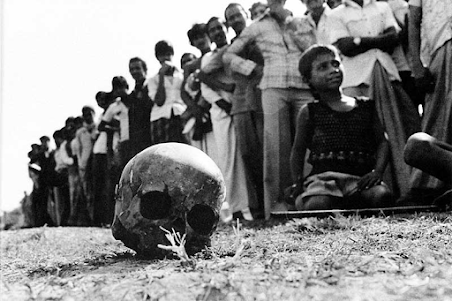
Pakistan: Getting away with genocide

Anwar Hossain's photo of skull in 1971-Photo: Anwar Hossain

How the 195 Pakistani officers escaped prosecution for their war crimes

SALEEM SAMAD

Many believed that another Nuremberg trial would commence once Bangladesh accused 195 Pakistan military officers of war crimes and other related crimes.

Pakistan’s Attorney General, fearing for the officers, filed a petition, “Trial of Pakistani Prisoners of War” (Pakistan versus India) on May 11, 1973, seeking the intervention of the International Court of Justice (ICJ), in the Hague, Netherlands.

Pakistan instituted proceedings against India concerning the 195 POWs; according to Pakistan, India proposed to hand over to Bangladesh, who was suspected of acts of genocide and war crimes.

Pakistan’s application was filed in ICJ, instituting proceedings against India in respect of a “dispute concerning charges of genocide against 195 Pakistani nationals, prisoners of war, or civilian internees in Indian custody.”

India stated that there was no legal basis for the court’s jurisdiction in the matter and that Pakistan’s application was without legal effect. Pakistan hurriedly informed the court that negotiations had taken place, and requested to discontinue the application in July 1973. Accordingly, the case was removed from the list in December 1973.

On July 2, 1972 -- eight months after the POWs issue, Pakistan’s President Zulfikar Ali Bhutto and Indian Prime Minister Indira Gandhi signed the historic Simla Agreement. The crucial negotiation was held following the brutal birth of Bangladesh in 1971 and nearly 93,000 Pakistani forces and civilians were taken as POWs. The deal enabled India to agree to release all the POWs.

Earlier on Sheikh Mujib’s requests in March 1972 and for their safety and well-being, the POWs were transported to India. India treated the war prisoners in accordance with the Geneva Convention, 1925, but used this issue as a tool to coerce Pakistan into recognizing the sovereignty of Bangladesh after three countries reached a compromise in 1974.

Bangladesh was processing formalities to bring charges against the 195 prisoners for war crimes in their special courts established in Dhaka. To punish the 195 war criminals, Bangladesh enacted the International Crimes (Tribunals) Act (ICT Act 1973), to authorize the investigation and prosecution of the persons responsible for genocide, crimes against humanity, war crimes, and other crimes under international law committed in 1971.

Once Mujib announced that Bangladesh would put the war crimes suspects on the docks, the military hawks in Rawalpindi interned almost all the Bangla-speaking officers and soldiers in the army, navy, air force, border guards, police, and civil bureaucrats as POWs.

Bhutto also announced that several officers and civil bureaucrats would be tried for sedition and other crimes according to the Pakistan Army Act of 1952. This news alarmed Mujib who immediately sought help from friendly countries to exert diplomatic pressure on Pakistan.

Thus, both Bangladesh and India succumbed to the political blackmail of Pakistan. The three countries signed a historic “Bangladesh-India-Pakistan: Agreement of Prisoners of War and Civilian Internees” on April 9, 1974.

Dr Kamal Hossain, then Foreign Minister of Bangladesh, stated in the agreement: “The excesses and manifold crimes committed by those prisoners of war constituted, according to the relevant provisions of the UN General Assembly resolutions and international law, war crimes, crimes against humanity, and genocide, and that there was universal consensus that the persons charged with such crimes as the 195 Pakistani prisoners of war should be held to account and subjected to the due process of law.”

The negotiators of the Tripartite Agreement failed to have included a guarantee clause of the military trial of the war crimes suspects. Therefore, the 195 returned safely to Pakistan without being produced in any tribunal in Bangladesh nor were they charged under the Pakistan Military Act.

First published in the Dhaka Tribune, 23 March 2021

Saleem Samad is an independent journalist, media rights defender, and recipient of Ashoka Fellowship and Hellman-Hammett Award. He can be reached at saleemsamad@hotmail.com; Twitter @saleemsamad

Wednesday, March 17, 2021

Bangabandhu in Mianwali Jail

Bangabandhu was arrested and then was taken to West Pakistan shortly 
before the start of Operation Search Light on 25 March, 1971. File Photo

SALEEM SAMAD

Mohanlal Bhaskar alias Mohammed Aslam's undercover identity was blown by a double agent. He was caught and imprisoned in Pakistan from 1967 to 1974.

He and dozens of fellow Indian spies were swapped with Pakistani spies soon after the ice-breaking Simla Accord signed by Pakistani Prime Minister Zulfikar Ali Bhutto and Indian Prime Minister Indira Gandhi in July 1972.

Bhaskar's mission was to gather intelligence on Pakistan's nuclear programme. He witnessed the India-Pakistan war in December 1971 from his cell in Mianwali jail as history unfolded when Bangabandhu Sheikh Mujibur Rahman was brought there and had his grave dug, at least four times, and then quickly refilled.

Possibly the book, 'An Indian Spy in Pakistan', written by Mohanlal Bhaskar in Hindi and translated by Jai Ratan, is the only eyewitness narrative on Bangladesh's independence leader Bangabandhu Sheikh Mujibur Rahman which unfolded in Mianwali Jail.

He exhaustively writes two separate chapters. One on 'Turmoil in Bangladesh' and another on 'Sheikh Mujib in Mianwali Jail'.

"According to the news that had reached us, Sheikh Mujib was supposed to be in the Lyallpur Jail. The winter had just started. A helicopter landed one night in our jail compound. We couldn't see who had got down from it, for our cells were locked at that time. In the morning we [learned] that Sheikh Mujibur Rahman had been brought to Mianwali […] the Lyallpur Jail."

It is presumed Mujib was brought to Mianwali Jail in early September 1971, according to Bhaskar. Sadly, the Indian spy, for reasons unknown, did not mention any date behind the events he has mentioned.

As soon as Sheikh Mujib's arrival was confirmed by prisoners, some soldiers of the East Bengal Regiment planned to dig a tunnel in the jail to smuggle him away from there, according to Bhaskar.

The attempt proved abortive as Mujib was lodged in the female ward of Mianwali Jail. The female inmates had hurriedly been shifted to another barracks.

The Indian prisoners were also shifted to barrack number 10 and the female ward was right behind their barracks.

Unfortunately, neither the Bangalee soldiers nor the Indian spies could have a glimpse of the stalwart politician. He was kept under heavy military guard.

Well, a Bangalee cook had been deployed to cook Mujib's preferred menu – fish and rice.

The following morning, when news of the Sheikh's arrival spread in the jail the Pathan prisoners climbed up the roof of the jail barracks and shouted expletives at the Sheikh. 

Armed guards quickly climbed onto the roof of the female ward and fired six rounds in the air, which terrified the Pathans. 

The Jail Superintendent on a routine round of the barracks informed the prisoners that Mujibur Rahman had been brought to Mianwali Jail to be hanged.

This news triggered sadness among the Indian and Bengal Regiment prisoners but caused a ripple of happiness among Pakistani prisoners and they cried 'Ya Ali!'.

Bhaskar recalls that, unfortunately, he could not meet the "great hero, known as the Lion of Bengal who had awakened the hungry and oppressed people of East Bengal...".

Whenever the Indian prisoners went to collect food rations, they met Mujib's cook but could not have a word with him as he was escorted by military guards.His cook was very devoted to him.

The ration clerk would ask the cook, "How's he faring?" The defiant cook would reply that Sheikh Shaheb was in fine health and with a sound mind and would keep fighting for the rights of the Bangalees till his last breath.

One day, the deputy superintendent called the eight Indian prisoners languishing in condemned cells.

He notes: "We were marched out and halted in front of the female ward where Sheikh Mujib was imprisoned. We were not told what was required of us nor did we care to find out. We were happy in the thought that we may yet be able to have a fleeting glimpse of the Sheikh. But to our chagrin, even the wooden gate leading to his barred cell had been closed."

The senior jail officer ordered them to dig an eight feet long, four feet wide and four feet deep trench and specified the exact spot where the trench was to be dug.

"We immediately guessed that Sheikh Mujib was scheduled to be hanged that night and we were digging a grave to bury his dead body. Short of asking a question which we were reluctant to do, we had no way of confirming our suspicion," he writes.

The grave was ready by nine and the prisoners returned to their cells. They waited with bated breath for the ominous news of Mujib's execution. "Our ears were all along attuned to the "house of death' but nothing happened throughout the night; everything was so quiet and still."

Bhaskar realised that the decision to hang Bangabandhu had been deferred. In the morning when the cells were unlocked, they heard some people saying that Sheikh Mujib was still alive.

There were also rumours that poison had been injected into his body, putting him to eternal sleep, after which he had been buried in the grave dug the previous evening.

In the morning when the Indian prisoners went to the ration godown for collecting their quota, they saw Sheikh Mujib's cook waiting there to get milk, tea and sugar for his morning tea.

It was indeed a relief for them, for "it meant that he was still alive."

They heard a rumour that on the night scheduled for the Sheikh's execution Zulfikar Ali Bhutto had sought an audience with President Yahya Khan and had advised him not to execute him. 

He [Bhutto] impressed upon the President that if he [Mujib] was executed the Bangalees in East Pakistan (now Bangladesh) would not sit idle. The Pakistani forces stationed in East Pakistan right from the highest officer down to a soldier would become the target of the wrath of the Bangalee guerrillas. Yahya Khan on second thought decided to halt Mujib's execution.

The next day, the prisoners were again called out and asked to fill in the trench dug the previous day. "But our happiness was short-lived."

Fifteen days later, they were again called out and asked to dig a similar trench. Again, Sheikh Mujib was not hanged. This process was repeated three times and every time his hanging was deferred.

For the fourth time, Sheikh Mujib was saved from walking to the gallows. In this manner, Sheikh Mujib stayed for four months in the Mianwali Jail.

Finally, Zulfikar Ali Bhutto in early January released Bangabandhu, who was to return in triumph to Bangladesh.

Even now, the days of Sheikh Mujib in Mianwali Jail remains a nightmare. Time and again they [the Pakistan authorities] would prepare the noose for his neck and dig a grave. But he did not die at the hands of his enemies.

Regrettably, he died at the hands of his "own people whom he called his children." Nobody could believe that the same people for whom he had made such huge sacrifices and suffered imprisonment and political harassment would assassinate him," laments Bhaskar.

First published in The Business Standard, 17 March 2021

Saleem Samad is an independent journalist, media rights defender, recipient of Ashoka Fellowship and Hellman-Hammett Award. He can be reached at <saleemsamad@hotmail.com>; Twitter @saleemsamad

Tuesday, March 16, 2021

Indo-Soviet Treaty turning point for Bangladesh independence

Assessing the impact of the Indo-Soviet treaty of 1971 on Bangladesh’s independence

SALEEM SAMAD

As Bangladesh celebrates its 50th anniversary on March 26th, the historic Indo-Soviet Treaty of Peace, Friendship and Cooperation signed on August 9, 1971, had a direct impact on the decisive battle in the eastern war theatre.

The treaty expedited the Bangladesh War of Independence and brought about the surrender of 93,000 Pakistan forces on December 16, 1971.

In the annals of diplomacy, the Indo-Soviet Treaty on Peace, Friendship and Cooperation was a unique document that not only epitomized the special relationship between India and former Soviet Union, but also acted as a guarantor of regional peace.

The treaty was a significant deviation from India’s previous position of non-alignment in the Cold War and the prelude to the Bangladesh war, and it was a key development in a situation of increasing China-American ties and American pressure.

The Indo-Soviet treaty was later adopted as the India-Bangladesh Treaty of Friendship and Cooperation in 1972.

As the struggle for independence in Bangladesh gathered momentum in 1971, months after holding general elections in Pakistan, and the US hegemony attempted to subvert it, the treaty restrained the evil design of Pakistan and its allies.

Following the first-ever free, fair, and credible elections in Pakistan in 1970, Pakistan’s head of state, General Yahya Khan, was utterly dissatisfied with the large victory of the Awami League, led by Sheikh Mujibur Rahman.

The marauding Pakistan military unleashed a reign of terror under “Operation Searchlight” at midnight on March 25, committing genocide with the intent to cleanse the land of Bangali and Hindu populations, who were deemed as enemies of Pakistan and Islam.

Pakistan’s General Yahya Khan had said that “if India made any attempt to seize any part of East Pakistan, he would declare war and Pakistan would not be alone.”

Well, Kissinger’s surprise visit to Beijing in July 1971 was indeed a morale boost for Pakistan. On the other hand, it was frustrating for India as it felt diplomatically humbled and strategically isolated.

India could see the US-China-Pakistan axis as an emerging threat to regional geopolitical interests. China committed unqualified support to its “all-weather” friend Pakistan against India to stop interference in the domestic affairs of Pakistan.

During the parley between Kissinger and China’s Prime Minister Zhou Enlai, Beijing indicated that if war breaks out between India and Pakistan over Bangladesh, China would make military intervention against India on behalf of Islamabad.

The US sympathized with Pakistan for obvious reasons. The US believed a victory for India would be considered as an expansion of Soviet hegemony in South Asia. In this backdrop, Delhi and Moscow moved closer to ink the historic treaty to neutralize the emerging Washington-Beijing–Islamabad axis and defend their vital geopolitical interests.

In an editorial, Pravda, a leading Soviet national daily, underlined the significance of the treaty, saying the treaty had effectively “restrained” Pakistan and its allies from embarking on a course of “military adventurism” in the sub-continent and would continue to act as a “deterrent” against such hegemonic goals. The treaty also signalled a clear warning to China’s hegemonistic ambitions in the continent.

Following the rising struggle for independence in erstwhile East Pakistan and the influx of millions of refugees from there to India, the possibility of war between New Delhi and Islamabad was looming large in Asia.

First published in the Dhaka Tribune, 16 March 2021

Saleem Samad is an independent journalist, media rights defender, and recipient of Ashoka Fellow (USA) and Hellman-Hammett Award. Email saleemsamad@hotmail.com; Twitter @saleemsamad

Tuesday, March 09, 2021

Born for the flag

Photo: MAHMUD HOSSAION OPU

The story of Salam Sikder and his loyalty to the Bangladesh flag

SALEEM SAMAD

Liberation War veteran Salam Sikder, born in a poor peasant family, left home in early 1971. He told his wife that henceforth, she must take care of their two children.

When filmmaker Kawsar Chowdhury met him in 1997 at Gollamari in Khulna, his eyes were glowing with pride, instilled with the glory of the Liberation War. He was in his early thirties when he joined the Mukti Bahini guerrillas. He and his combatants operated stealthily for months in Khulna and Bagerhat region under Sector 9, commanded by Major Jalil.

The ragtag foot soldiers survived on bare food ration but were defiant against marauding forces. Their objective was one -- to liberate the motherland from the brutal occupation of Pakistan. Salam did not remember how many hit and run operations they conducted in Dacope, Batiaghata, Gollamari, Rampal, and adjoining areas.

On December 16, 1971, heads held high, Salam along with a small unit of foot soldiers, marched into war-ravaged Khulna city. Several dead bodies were strewn all over the city. The flow of the Gollamari canal, a tributary of river Moyur, was blocked by countless corpses in the waterway.

On December 16, in a simple ceremony, the flag of independent Bangladesh was hoisted at a small field on the back of the Gollamari canal. Quickly a flag-stand made of a bamboo pole was erected. A flag was tied to a rope. Who would take the privilege to hoist the flag?

Commander Kamruzzaman Tuku asked Salam Sikder to hoist the flag. He began to cry and said that he was not the right choice when there were other valiant guerrilla fighters.

Finally, all hands joined to raise the flag. It was also decided to build a martyr’s memorial at the same site. The Mukti Bahini commander and others decided that the caretaker would be Salam Sikder and he would hoist the flag at dawn and lower at dusk.

The story does not end here. Till the last day of his life, he raised the flag and lowered it, as demanded by the commander.

He took the honorary job seriously. He lived in a dilapidated thatched house adjacent to the martyr’s memorial. Not a single day, till 1997, had Salam taken a day off. When he did visit neighbours and relatives, he quickly returned before evening to lower the flag.

He never requested his family members to wash the flag. The flag was washed with care as if he was bathing an infant. He lamented that his son often asked why he had spent his entire life for a flag and never took care of the family. He explained that when he left their mother with two sons, he could have been killed in the battlefront.

He appealed to them to seek blessings from the Almighty that their father was alive and said: “I have been born for the flag and I will die for the flag.”

The award-winning Liberation War documentary filmmaker Kawsar Chowdhury in 2004 visited the martyr’s memorial and also met the warrior in fragile health. A brain stroke left him physically challenged and with memory loss.

The following year, the loyal flag caretaker Salam Sikder died -- unfortunately unrecognized for his contribution. 

First published in the Dhaka Tribune, 9 March 2021

Saleem Samad is an independent journalist, media rights defender, recipient of Ashoka Fellowship and Hellman-Hammett Award. He can be reached at saleemsamad@hotmail.com; Twitter @saleemsamad

Friday, March 05, 2021

Cybersecurity law to end harassment?

SALEEM SAMAD

The week-long street protests and pro-government intellectuals, academics, rights activists, and defenders of media rights continued to ventilate their anger over the death of writer Mushtaq Ahmed and simultaneously demands to repeal the controversial Digital Security Act (DSA), the government in damage-control mode has hinted to repair the draconian law.

Law Minister Anisul Huq has said that the government is taking measures so that no one can be arrested or sued under the DSA before the investigation, he told BBC Bangla radio.

The DSA came to the forefront after the death of writer Ahmed, who was detained under the draconian law and died in Kashimpur High-Security Jail in Gazipur last week.

The Minister assured that they trying to reach a conclusion where no one can be arrested before investigation.

Admitting the misuse of law, the minister assured that they [government] are taking measures to bring an end to it.

For the first time in the country, there is a repressive cybersecurity law that only protects the government, politicians, and bureaucrats, but not the citizens.

If the controversial DSA could provide security to the citizens, the government must come forward and state who are those citizens benefitted from the draconian law.

The government cannot deny that the law arbitrarily targets critics, netizens, and journalists.

Not surprised that the law has never slammed charges against ‘waz-mongers (Islamic evangelists)’ and seems to have given immunity under the repressive law.

When the Mullah ‘wazi’ makes hate speech against the Ekushey book fair, Ekushey February, elective democracy, gender quality, Independence Day, liberation war sculptures, liberation war, national anthem, national constitution, national flag, Pahela Baishak, pluralism, school textbooks, secularism, Victory Day, women leadership, women’s empowerment, anger the people who suffered and contributed to the liberation.

They dared to challenge the elected government, demand to garbage the state constitution and instead override with Holy Quran and Sunnah as guiding principle of the nation-state, and to declare the nation an Islamic Republic, which was born from a bloody war on the principles of democracy, secularism and pluralism.

Such hate-speech challenges the sacrifice made by the people of Bangladesh – the three million martyrs, more than 400,000 women victims of rape, and 10 million war refugees.

The district administration nor the local police chief monitor the Waz-Mehfils, which gives them an upper hand to deliver hate-speech among tens and thousands of disciples. The audience enlarges when the sermons are uploaded to Youtube and Facebook, which are owned by infidels.

Despite hate-speech by the Mullahs are widely available on social media, but they are never punished. They are not slammed under cybersecurity laws.

Should the government be afraid of the Mullahs? The wazi’s overtly opposed secularism, pluralism, democracy, and are threats to national unity.

The mango-people understand that like the writer Ahmed, who dared to criticise the government’s pandemic management is a soft target for legal harassment.

More than 2,000 people have been booked under the undemocratic law since 2018, including folk singers, children, doctors, netizens, and not the least but the last are the journalists.

The law gives a wide range of authority to a junior police officer to barge into a newspaper or a media office. They can confiscate digital devices, like computers/laptops, WiFi routers, external hard disks, and mobile phones without any warrant.

The accused persons are blamed for tarnishing the image of the nation or have attempted to ‘destabilise’ the state.

Such lambasting accusations against the critics, writers, netizens, and journalists are sweeping statements. At the end of the day, the police investigators do not have any evidence, nor could they list any eyewitness to the alleged cybercrime.

On the other hand, the cybercrime tribunal is ill-equipped and does not have digital equipment, nor any trained personnel to determine what the accused has committed through social media.

The police investigators also do not have the skill and experience to understand what digital offence has been committed.

As the law allows, the detained accused should be kept in prison until a competent court grants bail, or held in custody to stand trial at the cybercrime tribunal.

Meanwhile, civil society and rights groups have reiterated to scrap the controversial cybersecurity law, which shrinks the space for freedom of expression, free speech, press freedom, and right to critique.

First published in the Dhaka Courier, 5 March 2021

Saleem Samad, is an independent journalist, media rights defender, recipient of Ashoka Fellowship and Hellman-Hammett Award. He could be reached at <saleemsamad@hotmail.com>; Twitter @saleemsamad

Tuesday, March 02, 2021

For whom the bell tolls

What purpose does the Digital Security Act truly serve?

SALEEM SAMAD

Most loyal citizens should agree with Bangladesh Information Minister Hasan Mahmud that the Digital Security Act (DSA) provides security to the people from digital harassment.

He scoffed off critics that the DSA has been misused. His comments came against the backdrop of nationwide street protests which turned violent, demanding repeal of the repressive DSA.

The protests sparked from the death of a progressive writer Mushtaq Ahmed, who died in prison due to alleged negligence by jail authorities. He was languishing in prison for nine months and denied bail six times.

Hours after the death of the writer Ahmed, who was incarcerated in a case filed under the cybersecurity law, activist Ruhul Amin was sued under the controversial law after his angry statement was posted on Facebook.

“If such writings sent Mushtaq to jail and then to death, depriving him of bail six times, then arrest me too,” read the loud Facebook post.

Plainclothes detectives picked him up from Khulna city. A senior official of the Detective Branch at Khulna Metropolitan Police said Ruhul was sued under the DSA for his threats to “destabilize” the state, creating social unrest, and over other reasons.

An appropriate statement by a responsible police officer, that a youth leader Ruhul has somehow acquired the capacity to “destabilize” the government and country alone or with a handful of youths. 

Sounds like a sequence from a Bollywood movie.

In the first place, the police officer should be reprimanded for undermining the stability of the present government of Prime Minister Sheikh Hasina. Her state stands on the pillars of democracy, pluralism, and of course, strengthened by a strong political party, the Awami League.

Although the country’s constitution promised to protect freedom of expression and freedom of the press, unfortunately, a repressive cybersecurity law was appended in the parliament as legislation at the end of 2018.

Nearly 2000 cases have been filed under the DSA since its enactment on October 8, 2018, according to data from the Bangladesh government’s Cyber Crime Tribunal.

More than 800 cases were filed in the first nine months of 2020 alone, with many of the country’s most prominent editors and senior journalists being increasingly targeted.

At least 247 journalists have been targeted in 2020 by law enforcement agencies, non-state actors, and of course, individuals acting on behalf of the government.

Last year, during the lockdown, the authorities randomly misused DSA to silence critics, doctors, netizens, and journalists who were critiquing the government’s management of the pandemic.

The use of the DSA has been so outlandish that even folk singers, minors, writers, and cartoonists were not spared from being detained.

Mysteriously, the law has not cast shadows upon Islamist groups -- one of the key groups that have been spreading disinformation on Covid-19 and also spewing hate speech.

The waz-mongers (Islamic evangelists) in waz-mahfils have dared to speak against Ekushey book fair, Ekushey February, elective democracy, gender equality, the Liberation War, the national anthem, national flag, Pahela Baishakh, pluralism, secularism, women leadership, women’s empowerment, and the list goes on and on.

Dr Syeda Aireen Jaman, secretary-general of PEN International Bangladesh said that the law has been discriminately used against critics and journalists, while the mullahs who are a threat to secularism and pluralism are deliberately left out.

Several eminent citizens, intellectuals, and civil society leaders stated that there is no doubt that the anti-democratic DSA has been born outside the elective democracy and politics to inject a “culture of fear” among the citizens.

Dr Mizanur Rahman, of Dhaka University, stated that the responsibility of the death of Ahmed rests upon the state, as he died in judicial custody, pending trial of the DSA.

He also said that the draconian law impedes freedom of expression and encourages self-censorship and contradicts the principles of democracy, pluralism, and press freedom.

First published in the Dhaka Tribune, 2 March 2021

Saleem Samad is an independent journalist, media rights defender, recipient of Ashoka Fellowship and Hellman-Hammett Award. He can be reached at saleemsamad@hotmail.com; Twitter @saleemsamad