Buy.com Monthly Coupon

Saturday, September 10, 2022

Sheikh Hasina’s “Jamdani” diplomacy

Bangladesh Prime Minister Sheikh Hasina with her counterpart Indian PM Narendra Modi at Hyderabad House, New Delhi

SALEEM SAMAD
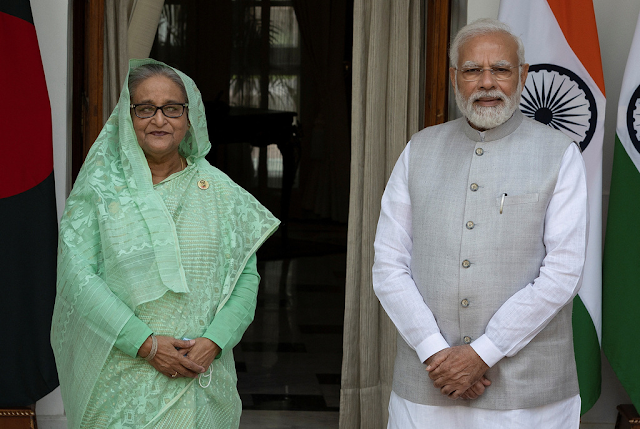
After last week’s official visit of Bangladesh Prime Minister Sheikh Hasina to New Delhi the officials of both sides described the visit as having further strengthened relations between the two neighbouring countries, despite there being several political hiccups according to political observers.

Well, the prime ministers of Bangladesh and India have met 12 times since 2015. Each parley held has added feathers to the hats, except the recent one.

The most significant achievement was the long-standing border demarcation which was finally resolved, pending as it had been since the partition in 1947. The beleaguered citizens of the enclaves were rehabilitated, resettled, and compensated.

Road and railroad connectivity have appreciably improved and are expected to progress further. The transit through Bangladesh to the northeast Indian states is in function.

However, several crucial issues were not discussed or any consensus reached regarding them, which include river water sharing, climate change, border killings, Rohingya refugees, lopsided trade gap, energy and other pending issues.

Meanwhile, the head of German state media Deutsche Welle (DW) Bangla service Khaled Muhiuddin, not an apologetic political analyst, describes the trip as an “election campaign” for Sheikh Hasina’s upcoming national election scheduled at end of 2023.

None of the bilateral agreements – the Memorandum of Understanding (MoU) signed in Delhi comply with the state visit protocol, said the Bangladesh-born broadcaster in DW.

Bangladesh and India share 54 international rivers including the Ganges and the Brahmaputra being major rivers. The legendary rivers are linked to the livelihood of people belonging to both countries.

Presently the two countries have water-sharing agreements with only two – the Ganges in 1996 and the Feni River in 2019. The Ganges water treaty was hailed as historic.

India and Bangladesh last week inked an interim water sharing agreement for the third river Kushiyara (flowing from Assam hills) after 25 years.

Hasina at Hyderabad House in Delhi expressed her dissatisfaction over the pressing Teesta water sharing that has been hanging in balance for over a decade due to opposition from West Bengal Chief Minister Mamata Banerjee.

Banerjee argues that the water level in the Teesta has drastically reduced over the years and therefore there is very little water for West Bengal to offer to Bangladesh.

She (Banerjee) instead was pressing for an alternative proposal to link other rivers to augment the water flow in Teesta during the dry season, but Bangladesh turned down the proposal.

Earlier, an arrangement was made in 1983 that gave 39 per cent of water to India and 36 per cent to Bangladesh. The two sides agreed on another interim arrangement in 2011 that would give India 42.5 per cent and Bangladesh 37.5 per cent of the water from the Teesta for 15 years.

Banerjee deliberately poured cold water over the deal, which angered Hasina. New Delhi is equally feeling discomfited about Banerjee’s closing rooms for holding dialogue with hydrology and river-morphology experts from India and Bangladesh.

Joint River Commission (JRC) member K M Anwar Hossain said Pakistan and north-west India are being irrigated by water from the Indus river basin and most of the water canals were in Indian territory. Whereas, the two arch enemies struck the Indus basin water sharing agreement in 1950 when tensions between the two countries were at their peak.

The Hasina-Modi talks failed to reach a meaningful point on two major security concerns of Bangladesh: repatriation of Rohingya refugees and border killings, writes Shamsuddoza Sajen, an analyst in the independent newspaper The Daily Star.

The article states that when the Director-General of the Indian Border Security Force (BSF) justified the border killings by Indian border guards during a meeting in Bangladesh on July 21, 2022, had described that all Bangladeshis killed on the border were “criminals”, the Bangladesh counterpart Border Guards Bangladesh (BFB) conspicuously remained silent.

Bangladesh and India share a 4,096 kilometre border, despite India raised barbed wire fences. There are several porous points in otherwise strict border management by both sides.

Intermittent deaths along the Bangladesh–India border occur around the year. The shoot and kill policy of BSF of people illegally crossing into India from Bangladesh, cross border crimes including gun running, drug trade and cattle smuggling.

To prevent smuggling and illegal migration from Bangladesh, BSF exercises its controversial “Shoot-on-Sight” policy, which empowers border guards to shoot any person with or without cause. A large portion of the victim is cattle traders and farmers with agricultural lands near the border.

Rights organisation Odhikar’s report indicates that between 2000 and 2021 at least 1,253 were killed and another 1,156 were wounded in BSF firing.

Earlier, according to several MoUs and related treaties signed between India and Bangladesh, if citizens of the two countries illegally cross the border, it would be considered trespassing. As per law, those suspects would be handed over to the civilian authority.

From January to September 2022, six Bangladesh nationals were killed, four injured and seven abducted allegedly by Indian border guards, according to Ain o Salish Kendra (ASK), a legal aid and human rights organisation.

However, it has been observed that India has been violating treaties, shooting at anyone seen near the border or anyone trying to cross the border, which is a clear violation of international law and human rights, says Odhikar.

Hasina, nevertheless, was assured in Delhi that the border killings will be reduced and the border chiefs of both sides have agreed to stop the killings, which is embarrassing for both Dhaka and Delhi.

Critics, dissidents, opposition and media in Bangladesh are frustrated with the slow progress of signing water-sharing agreements for more than 50 rivers. Hasina’s government came under fire by media and opposition for failing to get a “single drop” of water for Teesta.

What Bangladesh received and what Bangladesh offered to India is surely important. In between parleys and visits outside her hotel, Hasina has been able to draw the attention of the Indian media, Indian top officials and the business community to her century-old traditional handloom ‘Jamdani’ saree she wore during her four-day visit. Some media dubbed her clad in a gorgeous saree as “Jamdani diplomacy”.

First published in the International Affairs Review, 10 September 2022

Saleem Samad, is a Dhaka-based independent journalist, a media rights defender, recipient of Ashoka Fellowship and Hellman-Hammett Award. He could be reached at <saleemsamad@hotmail.com>; Twitter @saleemsamad

Sunday, September 04, 2022

Why Islamic World Is Silent On The Persecution Of Uyghur Muslims?

SALEEM SAMAD

The United Nations (UN) Office of the High Commissioner for Human Rights (OHCHR) softly blames “China may have committed crimes against humanity in Xinjiang (former Turkestan province).

The human rights office releases a long-awaited report last week to expose China’s treatment of ethnic Uyghur Muslims and says ‘serious human rights violations have been committed in Xinjiang, home of 10 million Uyghurs.

Well, the bigwigs of the Chinese Communist Party in the capital Beijing calls the report ‘completely illegal and void’. China has forcefully denied any maltreatment in Xinjiang and issued a 131-page (nearly three times the length) in response to the 48-page UN report in which decried the findings as “based on the disinformation and lies fabricated by anti-China forces.”

Outgoing UN human rights chief Michelle Bachelet, who is former President of Chile says, China’s “arbitrary and discriminatory detention” of Uyghurs and other Muslims in its Xinjiang in the north-western region of China “may constitute crimes against humanity”.

The report came four years after the UN Committee on the Elimination of Racial Discrimination (UNCERD) revealed that more than one million Uyghurs were being held in visible network of detention centres across Xinjiang.

Widespread persecution, discrimination and forcible confinement have occurred in Xinjiang. Besides Uyghurs, other ethnic Hui (Chinese Muslims), Kazakhs, Uzbeks, Tajiks, Tatars, Tahurs and Russians are also locked up in internment centres, while the world remains quiet.

In the internment camps, they face appalling human rights abuses from forced labour, coerced sterilisation, and the destruction of their culture and religious identity. It’s indeed a humanitarian crisis!

Throughout persecution since 2017, the international organisations within the UN have done little or less regarding the allegations of human rights abuses in China.

The Islamic world including the influential Organisation of Islamic Cooperation (OIC) and powerful countries like Saudi Arabia, Turkey, Iran, and Pakistan remains conspicuously silent.

Except for European nations, Britain, Canada, the United States and Australia, the apologetic Muslim countries instead of rebuking the Chinese for the crime against humanity are the main beneficiaries of the Road and Belt Initiative (BRI) mega projects to keep them in good humour.

The Islamic countries and Muslim-majority nations deliberately do not wish to embarrass China for their appalling human rights abuse.

Apologetic media, international organisations and Muslim countries explain that it’s a “domestic issue”, their “internal affairs” and are “combating terrorism”.

Nevertheless, China extends its “golden heart” to the Muslim countries – also to the hard-line Islamic countries like Iran, Pakistan and Arab states.

In fact, all Muslim countries have a similar problem with their human rights record in compliance with the UN Charter of Universal Declaration of Human Rights.

In the 1971 blood war of liberation in Bangladesh, no Muslim country, Muslim leader or any Muslim aid agency helped the plight, agony and sufferings of the 10 million refugees. They either supported the marauding Pakistan military junta. Nor did they raise their hand while the military committed war crimes, genocide and rape as a weapon of war.

Similarly, the same Muslim community did not urge international bodies to protest the genocide and ethnic cleansing of Muslims in Bosnia-Herzegovina by warlord General Radovan Karadzic under the command of Serbian leader Slobodan Milosevic.

After the military intervention of NATO, the civil war ceased. International Court of Justice indicts 161 individuals, including the warlords for crimes against humanity. No jubilation in any city in a Muslim country. No statement by Muslim leaders appreciating the initiative of The Hague verdict.

Leaked official documents in Chinese reveal for the first time the systematic use by the ruling Chinese Communist Party to justify the indefinite detention on trivial grounds of millions of citizens in heavily fortified internment centres across the province.

The leak exposes what appears to be a detailed and far-reaching system of state surveillance in Xinjiang, run by the provincial local government enables to target the Uyghurs, apparently Chinese citizens to the peaceful practice of their culture or religion.

Chinese official records, verified by a team of experts commissioned by rights groups and international media, show people are transported to detention facilities for simply “wearing a veil”, growing “a long beard” or performing “Muslim prayer”.

The Chinese government admits to locking up several million Uyghurs in “vocational education and training centres”, a mass “deradicalisation programme” targeting “potential extremists”.

Thousands of siblings, parents and kith and kin were victims of arbitrary detention after their relatives living in exile slammed Chinese authorities for human rights abuse and persecution of their loved ones.

Interestingly, Xinjiang’s capital Urumqi, formerly known as Dihua, has the world’s best-sophisticated surveillance system. Each person is under the authority’s radar 24/7 with a hi-tech CCTV network with audio equipment to spy on what they discuss on the street corners and hangouts.

The OHCHR said that “serious human rights violations have been committed” in Xinjiang in the context of the government’s application of “counter-terrorism and counter-‘extremism’ strategies”.

“There are credible indications of violations of reproductive rights through the coercive enforcement of family planning policies since 2017,” the OHCHR report said.

The punitive actions by the Chinese against the Uyghur “may constitute international crimes, in particular, crimes against humanity”.

The report recommended the Chinese government take prompt steps to release all those detained in training centres, prisons or detention facilities.

It is expected that the international community must take action or be ‘wilfully complicit’.

Several exiled Uyghur leaders, however, lamented that the report was the “bare minimum” which could be expected from the international community.

“The report will do little for the people (Uyghur),” a survivor of the internment camps in exile observed.

First published in The News Times, 3 September 2022

Saleem Samad, is an independent journalist, media rights defender, recipient of Ashoka Fellowship and Hellman-Hammett Award. He could be reached at <saleemsamad@hotmail.com>; Twitter @saleemsamad

Thursday, August 25, 2022

Balochistan Atrocities From Worse, Worst To Worsen


Photo (collected from open source): Nawab Akbar Shahbaz Bugti

SALEEM SAMAD

Nawab Akbar Shahbaz Bugti, a legendary hero of Balochistan independence was martyred on 26 August 2006. His martyrdom will be observed in silence by Baloch nationalists announced all over the world.

Thousands of recruits of the Baloch Liberation Army (BLA) and other revolutionaries are fighting to liberate Balochistan from the occupation of Pakistan.

Nawab Bugti, a defiant Baloch nationalist leader was brutally murdered by the Pakistan Army on the orders of Pakistan’s President General Pervez Musharraf.

In a fierce battle with the fighters, Bugti’s fortified cave in Bhamboor hills fell after the military helicopter gunship fired air-to-surface missiles into the cave killing him and his brother, grandson, and others in the August raid.

After the downfall of General Musharraf, an arrest warrant was issued when he was accused by an anti-terrorism court. Later he was acquitted by a Pakistan court in Bugti’s assassination conspiracy for insufficient evidence.

His death sparked a countrywide anti-Pakistan protest by Baloch students and youths. Police had to quell the violent ethnic riots in different cities and towns.

Nawab Bugti, born in 1927, chieftain of the rebellious Bugti tribe was the tallest Baloch leader who was the Federal Minister, Governor, and Chief Minister of Balochistan.

The nationalists from Marri and Bugti tribes – the ferocious tribes are engaged in armed insurrection. The ongoing Baloch insurgency politically challenged the forcible inclusion of the resource-rich province into Pakistan in March 1948.

Before the 1947 partition of India and Pakistan, Balochistan consisted of four princely states under the British Raj – Kalat, Lasbela, Kharan and Makran, which is known as Balochistan. Two of these provinces, Lasbela and Kharan, were fiduciary states placed under Khan of Kalat’s rule by the British, as was Makran which was a district of Kalat.

The rulers of Kalat State first were subjected to Mughal emperor Akbar in Delhi and after 1839 to the British.

Only three months before the creation of Pakistan (in August 1947), Muhammed Ali Jinnah, the first Governor-General of Pakistan had negotiated the freedom of Balochistan under Kalat State from the British colonialist.

A series of meetings were held between the Viceroy, the British Crown’s representative based in New Delhi, Jinnah and the Khan of Kalat regarding the future relationship with Kalat State and Pakistan.

The parleys ensued in a communiqué, popularly a Standstill Agreement on August 11, 1947, which stated that: The Government of Pakistan recognises Kalat as an independent sovereign state in treaty relations with the British Government with a status different from that of Indian States.

The ruling Muslim League elites of Pakistan led by Jinnah had a change of heart and unilaterally decided to merge Balochistan with Pakistan Union on March 26, 1948.

In a violent raid, the Pakistan army occupied Balochistan’s capital Quetta and forcibly entered the Amar Palace of Mir Sir Ahmad Yar Khan Ahmedzai, Khan of Kalat, who was also the President of the Council of Rulers for the Balochistan States Union and intimidated him to sign a document of accession to Pakistan.

Balochistan is populated by ethnic Baloch, as well as Pakhtuns or Pashtuns. This largest province is the least populated region and possesses abundant natural resources in Pakistan.

For decades, disgruntled Balochi nationalists are protesting forcibly converting the Baloch population into a minority in their homeland.

In the post-Bugti era, the restive Balochistan has experienced appalling human rights abuse and untold atrocities.

Anyone who speaks up, protests or writes about the persecution by security forces in Balochistan, the next day a dead body would be dumped in a village or township to warn of the dire consequences to challenge the state.

The journalists who have published critical pieces on Balochistan faced harsh backlash from the state security apparatus.

Scores of tweets are posted every day by family members of the victims of enforced disappearances. Families, relatives and well-wishers often appear in street protests demanding the return of their loved ones. Thousands of suspects supporting or sympathisers of armed insurrection were victims of enforced disappearances.

Most of the victims of enforced disappearances never returned to their families. The dead bodies which were either returned or dumped by security forces bear the brutality, the victims have endured.

In 1970 when Bangabandhu Sheikh Mujibur Rahman was on a whirlwind tour for the election campaign in Karachi, Lahore, Peshawar, and Quetta – he was given tumultuous welcome, said Zahirul Islam Khan Panna.

When the crisis in Bangladesh was brewing at the end of 1970, the fieriest Baloch leader Nawab Bugti expressed solidarity with Bangabandhu Sheikh Mujibur Rahman’s Six-Point programme.

Z I Khan Panna, a leading human rights lawyer was a law student at Karachi University. He was hand-picked by Bangabandhu to be his fixer for the election campaign in Pakistan.

Panna met Nawab Bugti in Karachi in June 1970 and handed over an English copy of the Six-Point program, as desired by Shiekh Mujib.

Bugti was indeed a great admirer of Mujib and told his Baloch nationalist leaders that the Six-Point was a Bible to resolve the longstanding deprivation and political neglect of Balochistan.

Sher Mohammad Bugti, spokesperson of Baloch Republican Party – BRP spoke on WhatsApp from Geneva where he and BRP’s key leaders are living in exile lamented that the “Balochistan atrocity is worst than Bangladesh” in 1971 perpetrated by marauding Pakistan military.

Baloch nationalists are fighting on two fronts, he said. One is Pakistan and the second is China. The Chinese Communist Party is singing the tune of Pakistan on the Baloch crisis of their existence on the mega Belt and Road Initiative (BRI) and Gwadar Port, which is located in Balochistan.

Brahamdagh Bugti, leader of the Baloch Republican Party living in exile in Switzerland, and grandson of slain nationalist leader Nawab Akbar Bugti, says that Chinese economic projects in Balochistan were aimed at “colonising” the province, and must be resisted.

Brahamdagh Bugti, who is wanted by Pakistan rejected the possibility of holding any political negotiations with the government in Islamabad and suggested an internationally supervised referendum on the Balochistan crisis to bury the crisis once and for all.

First published in The News Times, 25 August 2022

Saleem Samad, is an independent journalist, media rights defender, recipient of the Ashoka Fellowship and Hellman-Hammett Award. He could be reached at <saleemsamad@hotmail.com>; Twitter @saleemsamad

Sunday, July 31, 2022

When The Police Became Music ‘Vigilantes’

SALEEM SAMAD

I did not know when the police were given responsibility for ensuring singers sing to the proper tune of the song, especially ‘Rabindra Sangeet’ (Tagore Songs).

Tomorrow, they will haul singers singing ‘Nazrul Geeti’ or band (or pop) music for not strictly following the music grammar.

Remember, the police arrested folk singers and send them to prison for singing folk songs, which they said had hurt the feeling of the Muslims.

During the coronavirus pandemic in 2020, two Baul (mystic) singers—Rita Dewan and Shariat Sarker were arrested separately under the repressive Digital Security Act, for allegedly “hurting the religious sentiments of Muslims.”

Social media is flooded with protests and satire posts by academics, journalists, social justice advocates, human rights defenders and of course the netizens.

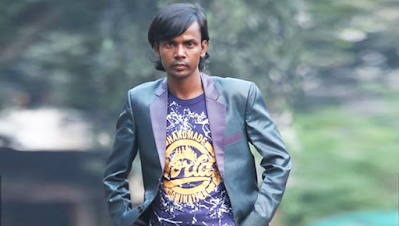
Police recently harassed a nondescript Youtuber and video-blogger Hero Alom, who was born and lives in Bograand was summoned to the office of the Detective Police.

He was not charged after he signed an apology on a piece of paper stating that he will never sing Tagore Songs in distorted tune and proper pronunciation. It is understood that some aggrieved persons had complained against Alom to the police. Is it a crime to sing inappropriately?

How do the law enforcement officers understand Hero Alom’ssongs on the YouTube channel were distorted? Are they certified by a musical institute or themselves graduates from a music college or an institute – likeChhayanaut, Bangladesh Academy of Fine Arts (BAFA), Government Music College or any recognised music institutions in the country?

If they are not certified music experts, have they consulted with a music connoisseur or teacher of RabindraSangeet? Unfortunately, they have not!

The nation has not forgotten that songs and poetry penned by Rabindranath Tagore were banned from broadcast by the Dhaka station of Radio Pakistan in 1967 during the military junta of General Ayub Khan.

Tagore is considered taboo in Pakistan since the partition in 1947. Finally, all works of Tagore were officially banned in government media (Radio Pakistan, PTV, government-owned newspapers) by the orders of powerful information and broadcasting ministerKhwajaShahabuddin and vetted by East Pakistan governor Monem Khan in 1967.

One reason is that he is an Indian. Secondly, he was dubbed as a Hindu – which fortunately he was not. His family practised Brahmmo – believing in One God, singing the Upanishad’s ‘ekeshwar’ and distanced themselves from idolatry. His father, Debendranath Tagore, adopted the Brahmofaith and does away with the rituals of Sanatan Dharma (faith).

Rabindranath Tagore is a poet of Bengal, India, and the world. Songs of Nobel laureate Rabindranath are national anthems in India, Bangladesh and Sri Lanka and of course,in the minds and hearts of the Bangalee diaspora (from both sides of Bengal) living abroad.

The Islamists in Bangladesh for decades have been demanding of the government to trash the national anthem written by Tagore, who is dubbed a Hindu and an Indian.

Scores of Mullahs in Waz-Mehfil(Islamic rallies) uploaded videos on YouTubethreatening to forcibly change the national anthem, which they explain compromises the culture, language and spirit of majoritarian Sunni Muslims.

Well, the Islamist has not only called to get rid of the national anthem but also dared to speak nonsense against the national flag, and state constitution. They debunkedPahelaBaishak (Bangla New Year), Ekushey February (International Mother’s Language Day) and the rich cultural heritage of Bengal.

They taunt at independence war which created Bangladesh, after a humiliating surrender of marauding Pakistan military at Dhaka on 16th December 1971. They challenge the figures of 3 million victims of genocide and said Muslim soldiers cannot kill Muslims.

In the Waz, they speak foul regarding women’s education, women’s empowerment and women in leadership.

Islamist hate-speech does attack Hindus, Christians, Buddhists and Adivasis. They warn them that the land they are born among the majoritarian Muslims. Even, they provoke the government to ban Ahmadiyya – whom they say are not Muslims.

This does not end here!

The Islamists coerced the authorities to change the school textbooks in Bangladesh. The authority deleted several pieces of literature and poetry written by Hindu litterateurs. Even the sketches in the textbooks have been replaced by girls and women in headcovers and men wearing ‘Tupi’ (cap). The boys in half-pants or shorts have been replaced with pyjama and panjabi.

Well, to conclude the police and civil administration have turned a blind eye to the Waz-Mefils spitting hate-speech against the state authority, the spirit of the liberation war, and the religious and ethnic minorities.

Not to be surprised, none of the Islamic evangelists has been prosecuted under the controversial Digital Security Act, nor faced music of justice.

Is it not true that the draconian cyber law is only used against critics of the government, opposition, journalists, netizens, cultural activists and human rights defenders and not the Islamist hate-speech mongers?

First published in The News Times, 30 July 2022

Saleem Samad, is an independent journalist, media rights defender, recipient of Ashoka Fellowship and Hellman-Hammett Award. He can be reached at: saleemsamad@hotmail.com; Twitter @saleemsamad


Wednesday, July 06, 2022

Farhad Mazhar’s Knowledge of Padma River

SALEEM SAMAD

Padma Bridge possibly received the highest media attention, as well as millions of citizens, mostly proletariat and working class were enthusiasts of the landmark communication in this century. Of course zeal of the leaders, members and sympathisers of the Awami League fervour was at a different height.

The bridge’s pre and post-inauguration obviously received media hype and the issue was a priority on the prime-time talk shows, special newspaper columns and of course the first-page stories and photo features.

In one such talkshow hosted by a New York-based exiled journalist, Kanak Sarwar, the show sought the feelings and reactions about Padma Bridge from an acclaimed poet, writer and philosopher Farhad Mazhar. Well, I heard the entire discussion and understand the discussion fairly well.

Farhad Mazhar is a trained pharmacist and played a crucial role in the establishment of Gonoshasthaya Pharmaceuticals Ltd. We often met him (Farhad) in Savar while researching with Nadira Majumder writing for Shaptahik Robbar on ‘drug imperialism’ which resulted in the announcement of a landmark drug policy in 1982.

Farhad has huge followers and fans for his outspoken philosophical debate on society, religion and politics. His poetry books are best-sellers in the Ekushey Book Fair.

He advocates Sufism and ‘Naya Krishi’ or the organic agriculture movement. His love and hate for the present regime are very well understood. In his recent interview with BBC Bangla radio, he could not defend many of his deeds, actions and statements in the last decade.

In the BBC Bangla video interview, he failed to satisfy the audience regarding his undaunted commitment to the Sunni Islamist group Hefazat-e-Islam Bangladesh (Defenders of Islam), a staunch advocate for Sharia Laws.

Among the hosts of tainted speakers (including leaders from BNP and other reactionary elements in the society), he also joined the bandwagon of Hefazat-e-Islam Bangladesh’s showdown in Motijheel in 2013. He was shown live on private TV Channels from Motijheel Shapla Square expressing his alliance with the Islamist movement.

The downtown Motijheel, a financial district in the capital Dhaka was blocked for two days. The Islamist and rightist elements had plans to cripple the financial activities and force the secular government of Sheikh Hasina to bow down.

The show of political strength ended in chaos and fiasco after riot police with armoured personal carriers(APC) and volleys of stun grenades in a pre-dawn operation literally scared the Mullahs.

Farhad defends the shut-down of the Dhaka metropolis by tens of thousands of Islamists and argues that the shadowy outfit is a “democratic” organisation.

His feminist wife Farida Akter, in an article in a popular Bangla daily, defended the misogynist Hefazat’s opposition to the women’s empowerment goals.

Many were shocked to read Farida’s illogical argument against the proposed Women’s Development Policy, 2011. She continues to oppose the policy singing to the tune of Islamists and says the policy is influenced by multinationals, corporates and a donor-driven women’s development policy.

Unfortunately, despite the nation having a woman-headed government, it has failed to implement the women’s policy for fear of Islamist antagonism.

Meanwhile, the learned Farhad Mazhar has told Kanak Sarwar’s audience that the newly build Padma Bridge was in fact the third bridge over the mighty river the Padma.

The first was Hardinge Railway Bridge (1912) and the second was Lalon Shah Road Bridge (May 2004) connecting Pakshey, Pabna and Bherapara, Kushtia, he said.

He lost in a myriad of hydrological data on the location and position of Padma River and mixed it up with the lower Ganges (Ganga in Bangla) river.

In fact, hydrological experts had determined that the Padma River is 120 km in length and begins from Goalondo to Chandpur. While the Ganges basin originates in north India from the Himalayan Mountains. It reaches the Farakka Barrage and continues on the bank of Chapai Nawabganj and flows through Hardinge Bridge and Lalon Shah Bridge.

The Ganges merged with the yawning Jamuna River at the confluence of Goalundo (once a vibrant railway and steamer ghat). From here Padma River begins its journey ending the flow of the Jamuna River.

Thus Padma Bridge is the first and until now the only longest road and rail communication bridge, beside Bangabandhu Bridge (also popularly known as Jamuna Bridge).

The all-knowing poet and philosopher have interpreted the river under Hardinge and Lalon Shah bridges as Padma River based on a myth.

The myth says that the Ganges River becomes the Padma River from Chapai Nawabganj bordering India and Bangladesh, which has been challenged by hydrological experts and river morphologists.

To continue with the debate, the massive irrigation project is Ganges-Kobadak Irrigation Project (or GK Project). The project is not a ‘Padma-Kobadak Project’. The largest surface irrigation system serves the southwestern region of Bangladesh – covering Kushtia, Chuadanga, Magura and Jhenaidah districts.

Similarly, the Ganges Barrage Project was proposed to hold back rainwater during the monsoon season because of the periodic drying up of the Ganges River in Bangladesh due to the withdrawal of the flow at Farakka Barrage. However, the Ganges Barrage Project was formally cancelled in 2017.

Hope these few pieces of information will enlighten Farhad Mazhar’s knowledge of the location and geo-position of the Padma River and also adopt the scientific knowledge of hydrologists and river morphologists and shun the myths from his mind and heart.

First published in The News Times, Dhaka, 5 July 2022

Saleem Samad, is an independent journalist, media rights defender, recipient of Ashoka Fellowship and Hellman-Hammett Award. He could be reached at <saleemsamad@hotmail.com>; Twitter @saleemsamad
Tuesday, April 05, 2022

‘Game changer’ Imran Khan is not out yet!

SALEEM SAMAD

Pakistan’s cricket star-turned-politician Imran Khan did not hesitate to admit that the “establishment” (the Pakistan military) gave him three options.

The first option was to face a no-confidence vote in parliament. The second one was to dissolve parliament and hold snap elections and the third one was to resign as prime minister and forget about patronage of the military.

Khan’s party Pakistan Tehreek-e-Insaf (PTI) swept into power in 2018, albeit with the blessings of the military, pulling strings to ensure that PTI has 121 seats in the assembly, thus making it a minority government.

The military denied the claims of giving Khan three options and backing him in the election, but he successfully dodged the ouster by following one of the three pieces of advice after consulting his cronies and advisers.

Pakistan’s former celebrity cricketer Wasim Akram wrote on Twitter: “The Game Changer #ImranKhan #Skipper #NotOutYet #Surprise”.

The tweet of the former captain and international sports commentator has earned 72.3K likes and 10.2K Retweets in a day.

What Akram and other supporters of Khan have not mentioned is that Khan remained loyal to “His Master’s Voice” – the military bigwigs who continued to interfere in foreign policy, civil administration and political affairs.

For nearly half of the 75 years of Pakistan’s birth, the country was ruled by the military which caused immense harm to the national economy, and sustainable development goals, blocking the capacity building of democratic institutions and freedom of expression.

As a result, the news organisations that were critical of the PTI government fell prey to Inter-Services Intelligence, the military’s spy agency. The dreaded agency has long been accused of enforced disappearances, extrajudicial killings and torture of journalists in custody, especially in restive Balochistan and Waziristan of Khyber Pakhtunkhwa.

Several prominent journalists were killed. Journalists critical of the military establishment were forced to go into exile. The owners of several private news organisations were stopped by the ISI from employing these journalists.

The opposition moved to oust Khan accusing him of failing to revive the economy and crackdown on corruption. Now he is blamed for “burning down democratic order” as the minority government dissolved parliament to avoid the vote of no-confidence that he claims is backed by the United States because he visited Moscow on the day Russia launched the invasion of Ukraine.

After the chaos in parliament before its dissolution, Pakistan’s independent newspaper Dawn in an editorial wrote: “The nation is stunned. Ahead of the vote of no-confidence, the prime minister had repeatedly hinted that he had a ‘trump card’ up his sleeve. There were indications all along that something might be amiss: even as political pundits and the media confidently predicted Mr Imran Khan’s defeat in the vote of no-confidence, he seemed unperturbed. No one could have guessed that his last ploy would involve having the democratic order burnt down by a democratically empowered party.”

Maleeha Lodhi, a Pakistani diplomat and political scientist wrote in the Dawn: “The Imran Khan government’s denouement raises the question of how he ended up facing a vote of no-confidence. Although that parliamentary process was subverted and a constitutional crisis ensued it will still mark an end to his rule. Few governments in Pakistan’s recent history began their term with Khan’s advantages. He had unqualified support from the military, widespread public goodwill, control of Punjab, a divided and demoralised opposition and a popular yearning for change.”

The country’s political landscape has recently been abuzz with political activity as parties and individuals changed alliances and the PTI and the opposition were seen trading barbs and allegations alongside intensifying efforts to ensure their success in the no-confidence contest.

Zaigham Khan, a leading political analyst told Al Jazeera: “[The dissolution is] a blatant violation of the constitution and can lead to a very serious crisis.” If the apex court of Pakistan orders the speaker to go ahead with the no-confidence motion, the dissolution of parliament will become invalid, the analyst said.

Former prime minister Muhammad Khan Junejo appealed to the Supreme Court in 1988 after the assembly had been dissolved by former president General Zia-ul-Haq, who had taken power in a military coup years earlier.

The court agreed his government had been dissolved unconstitutionally but ruled that since elections had been announced anyway it was best to move on.

The fate of Khan’s political future now rests upon the Supreme Court’s decision. Although opposition leaders seemed confident to win a vote of no-confidence against Khan, chances are weak to get a proactive verdict. It’s highly unlikely the Supreme Court will overrule the decision to hold the vote at all.

First published in the news portal bdnews24, 5 April 2022

Saleem Samad is an independent journalist, defender of media rights, and the recipient of Ashoka Fellowship and Hellman-Hammett Award


Monday, April 04, 2022

Time’s Up For Imran Khan

SALEEM SAMAD

When Imran Khan was in the opposition, he told journalist Hamid Mir on a live talkshow on Pakistan’s popular channel Geo TV that Pakistan should seek an apology for war crimes during the bloody war of independence of Bangladesh in 1971.

Since he came to power backed by military hawks in Rawalpindi GHQ on 18 August 2018 he never bothered to warm the relationship with Bangladesh despite several hiccups.

Bangladesh was blasted several times in the Pakistan parliament. When a war criminal was indicted and the war crimes tribunal in Dhaka handed down maximum punishment, the parliament in Islamabadrebuked Bangladesh for eliminating Islamic scholars and leaders and said their only crime was that they were loyal to Pakistan. Islamabad also officially blamed Dhaka for purging opposition, blah, blah, blah!

Bangladesh has hanged several high profile suspects for committing crimes against humanity and mostly belonged to Islamist party Jamaat-e-Islami, Muslim League, Jatiya Party and Bangladesh Nationalist Party (BNP).

Such unwarranted remarks and resolutions angered the government of Prime Minister Sheikh Hasina. Her regime decided to lower the status of diplomatic relationships. Bangladesh High Commission in Islamabad and Karachi suspended issuing visas to Pakistan nationals from travelling to Bangladesh.

Imran Khan did little to thaw the relationship between the two countries and of course forgot the pledge to seek an apology for genocide and war crimes by marauding Pakistan forces in 1971.

Now the flamboyant cricketer turned politician seems to have dug his own grave.  He is facing a vote of no confidence which is expected to force him from office.

His ruling party Pakistan Tehreek-e-Insaf’s (PTI) coalition with minority parties has fallen apart for hundred and one reasons. Most of the PTI lawmakers and regional leaders point their fingers at Khan for the debacle.

Pakistan’s premier independent newspaper the Dawn writes: Out of a total of 342 seats, the opposition parties have managed to cross the magical figure of 172 and enjoy the support of 177 members in the NA [National Assembly], even without nearly over a dozen dissidents of the ruling PTI, who have already publicly declared the withdrawal of their support to the prime minister.

In the days to follow, the country’s political landscape had been abuzz with political activity as parties and individuals changed alliances and the PTI and opposition were seen trading barbs and allegations alongside intensifying efforts to ensure their success in the no-confidence contest.

The opposition includes Pakistan Muslim League (Nawaz), Pakistan Peoples Party, MuttahidaMajlis–e–Amal, MuttahidaQaumi Movement (Pakistan), Balochistan Awami Party (BAP), Balochistan National Party (Mengal), Awami National Party, JamhooriWattan Party and Pakistan Muslim League (Quad) hold the magic number.

Khan told a private TV channel that the country’s ‘establishment’ [the Pakistan military] gave him three options facing the no-confidence motion in parliament. To face the no-confidence motion in parliament, hold fresh elections in the country, or resign from the post of prime minister, to end the ongoing political turmoil.

He blamed the West for hatching a conspiracy against Khan’s government after he visited Moscow just days after the Russian invasion of Ukraine.

Khan when he mentions the west means the United States and blames Washington for leaning his shoulder toward Russia at the crucial juncture of the second phase of the cold war era in Europe.

Pakistan had always been a trusted ally of the United States, during the ‘War on Terror" campaign when US troops invaded Afghanistan and also an all-weather friend of China. Despite the tension, the USA wants Pakistan to play its role in Afghanistan.

Khan said he has credible information that his life is in danger but asserted that he is not afraid and will continue his fight for an independent and democratic Pakistan.

First published in The News Times, 4 April 2022

Saleem Samad, is an independent journalist, media rights defender, recipient of Ashoka Fellowship and Hellman-Hammett Award. He could be reached at <saleemsamad@hotmail.com>; Twitter @saleemsamad
Wednesday, March 09, 2022

Why Did Pakistan Crackdown In Bangladesh, Balochistan In March?


SALEEM SAMAD

It may be coincidental that the Islamic Republic of Pakistan has a weakness for the month of March!

The Islamic nation-state possibly felt the month of March was a ‘holy’ month or lucky month for the ruthless crackdown in Balochistan and after 23 years sadistically repeated it in Bangladesh.

Maybe the fortune-tellers to the military hawks in Rawalpindi decide their evil actions on the particular month of March. Whatever the motive, the evil axis occurred in March.

The regime in Rawalpindi launched fierce genocidal ‘Operation Searchlight’ in Bangladesh on the night of 25 March 1971.

In the nine months to freedom, 3 million martyrs were victims of genocide, and more than 400,000 women were raped as a weapon of war. Possibly the world’s largest war refugee was created in living history. More than 10 million war refugees took shelter in neighbouring India.

The Pakistan junta did not realise they will experience a humiliating defeat in December 1971. After the Second World War, another formal surrender occurred when 93,000 Pakistan troops signed the instrument of surrender at Dhaka on 16 December 1971.

Before the crackdown in Bangladesh in March 1971, Pakistan’s invasion of the largest princely states Balochistan on 27 March 1948 killed several thousand innocent Baloch. Their struggle for independence still rages in the rugged terrain of Balochistan.

However, the Pakistan official narratives claim that the State of Kalat acceded to Pakistan on 27 March after Mohammad Ali Jinnah sent a confidential letter to ‘Khan of Kalat’.

Jinnah was legal adviser to ‘Khan of Kalat’ and with his full knowledge, the Pakistan military attacked and invaded Quetta, the capital of Balochistan.

Well, history says differently. Balochistan became an independent country on 4 August 1947, much ahead of the independence of Pakistan on 14 August 1947.

The declaration of independence of Balochistan was announced on 11 August 1947, three days before Pakistan was created. Unfortunately, the independence of Balochistan was short-lived and lasted for 252 days.

Before the partition of India and Pakistan, Balochistan consisted of four princely states of Kalat, Lasbela, Kharan and Makran under the British Raj. Two of these provinces, Lasbela and Kharan, were ‘fiduciary states’ placed under Khan of Kalat’s rule by the British, as was Makran which was a district of Kalat.

In the notorious month of March, many political events occurred. On 23 March 1956, the road to military rule was paved when General Iskander Mirza was sworn in as the first President of Pakistan.

On 25 March 1969, in a bloodless coup d’état Pakistan Army chief General Yahya Khan took over power from General Ayub Khan, a dictator of a decade and proclaim Martial Law and dissolved the assemblies.

Pakistan first tried to trick the leaders of Balochistan into joining the renegade part of India in the name of ‘Muslim’, but when both Houses of Balochistan unanimously refused to annexe with Pakistan angered the hierarchy, then based in Karachi.

After the bloody independence of Bangladesh, the Pakistan troops were still Prisoners of War (POWs) in India, the Prime Minister Zulfiqar Ali Bhutto to rejuvenate the demoralised Pakistan troops, gave responsibilities to “Butcher of Bengal” General Tikka Khan, then army chief to crack down on Baloch separatists and dissidents.

Subsequently, the military operation against separatists commenced in Balochistan in 1973 and the armed nationalist movement was brutally suppressed. The fiercest Baloch people have been struggling against Pakistan’s occupation and fought in 1948, 1958, 1962 and 1974.

What is more frustrating for Pakistan is that it failed to defeat the Baloch liberation struggle despite killing thousands of Baloch nationalists. More than 20,000 were victims of enforced disappearances and “dumping”. Those captured were brutally tortured and bullet-ridden bodies of thousands of Baloch political prisoners are found on the roadside.

The brutal torture of state forces includes gouging the eyes of the victims, cutting their tongues, noses, amputating their limbs, drilling holes in their bodies and many other inhuman and brutal mediums of torture. Pakistan junta is still paying an enormous price for the crackdown in Balochistan.

First published in The News Times, 9 March 2022

Saleem Samad, is an independent journalist, media rights defender, recipient of Ashoka Fellowship and Hellman-Hammett Award. He could be reached at <saleemsamad@hotmail.com>; Twitter @saleemsamad

Wednesday, December 08, 2021

We won the war, but was Bangladesh liberated?

SALEEM SAMAD, Times of India

“Bottomless basket,” US national security adviser Henry Kissinger called Bangladesh soon after it was formed. Five decades on, Bangladesh has turned that around. But with hate speech growing and tolerance shrinking, are there bigger challenges ahead?

No liberation war in the world was as decisive as that of Bangladesh. The barefoot, half-naked soldiers of the Mukti Bahini had faced off with the Islamic militia of Pakistan and emerged victorious. A triumphant Sheikh Mujibur Rahman, the leader of the East Pakistan Awami League who led the resistance for an independent East Bengal, was released from prison in January 1972. When he took over the reins of the country, he had a huge task ahead of him. Corruption was raging, a famine was sweeping the nation and the ravages of over a decade of struggle had rent the people apart.

He got to work but his compatriots betrayed him. He was assassinated in a military putsch on 15 August 1975 – when India was celebrating its Independence Day. Fifty years on, the secular ethos he died defending is under threat.

What we fought for

India and Pakistan were partitioned once, in 1947. But Bangladesh was partitioned thrice — 1905, 1947 and 1971. The contentious theory of the origins of Bangladesh is that it goes back to 1905, when the British Viceroy of India Lord Curzon partitioned Bengal. Indian nationalists and the intellectuals of Bengal vehemently opposed it. The seeds of Bengali nationalism had been sown.

When the two-nation theory was floated, the name for the new homeland for Muslims, Pakistan, was suggested by a young Britain-educated lawyer Choudhary Rahmat Ali in 1933. P for Punjab, A for Afghan province (now Khyber-Pakhtunkhwa), K for Kashmir, I for Indus, S for Singh, and ‘stan’ for Balochistan. East Bengal found no mention. It angered the revolutionaries of Bengal.

In 1940, fiery Bengal politician AK Fazlul Huq proposed the Lahore Resolution on behalf of the All India Muslim League — it called for independent states of Muslims in India — and nationalists began imagining an independent East Bengal.

By the 1960s, it had turned into a movement. Bangabandhu (friend of Bangladesh) Mujib, incarcerated on and off, was sent off to jail again in 1968 in the infamous ‘Agartala Conspiracy’ case. Anger spilled onto the streets and spread to the rest of Pakistan, with violent student protests against Pakistan’s military junta in 1969. The anti-government agitation ousted the decade-long military dictatorship of General Ayub Khan. 

Mujib won a landslide victory in the first ever general elections in December 1970. He was poised to be the head of the government of Pakistan. Three months later, opposition leaders from the provinces of Punjab, Sindh, Balochistan and the North West Frontier Province (now Khyber Pakhtunkhwa) pledged allegiance to Mujib’s Six-Point Political Agenda, which sought regional autonomy for the provinces in Pakistan.

Between Mujib winning and this agenda being accepted by political leaders, General Khadim Hussain Raja, commander of the Eastern Command, planned Operation Blitz. It would mean suspension of all political activities and a return to military rule. The armed forces of Pakistan would be allowed to move against “defiant political leaders” and take them into “protective custody”. But Lieutenant General Yaqub Khan, who was chief of general staff of the Eastern Command, and Admiral Syed Mohammad Ahsan, who was governor of East Pakistan, scuttled the plan. Not for long, though.

The frustrated General Yahya Khan, president of Pakistan, ousted both Khan and Ahsan. Later, General Raja was also shown the door. 

Why the Mukti Bahini was formed 

Weeks before the genocidal campaign of March 25, 1971, codenamed Operation Searchlight, most officers and soldiers of the East Bengal Regiment and border guards East Pakistan Rifles revolted. The rebel officers and soldiers along with hundreds of border guard troops and policemen crossed into India, with fire cover from the Indian Border Security Force shielding them The rebel officers held a crucial meeting on April 12 at Teliapara in Sylhet — the Mukti Bahini (Bangladesh Liberation Force) was formed under the command of Colonel (later General) MAG Osmany. The Mukti Bahini decided it would go the guerrilla way, on the lines of what Vietnam rebels did, instead of conventional war. Thousands of students, youths and farmers, including women, joined the Mukti Bahini.

Where is Bangladesh now?

At the helm now is his daughter, Sheikh Hasina, who took over in 2009 after the country had seen three decades of autocratic regimes. The economy took off. She opened up the country to foreign investment from India, Japan, South Korea, the US, Turkey and European countries. Soon, Bangladesh became the second largest exporter of readymade garments. Pharmaceutical products are its other big export, to more than 70 countries, and frozen fish and food to Europe, North America, the Middle East and Australasia.

Bangladesh made big strides in meeting Sustainable Development Goals. Hasina has been elected Prime Minister thrice, holding office for 12 years. Her decision to take in more than a million Rohingya refugees who had fled Myanmar was appreciated globally.

But the human rights record at home has been controversial. Sectarian violence against Hindus in mid-October cast a shadow on the secular credentials of the country. Rights groups claim no perpetrator of sectarian violence against religious minorities, desecration of temples, arson and plunder faced criminal proceedings.

Before the 2018 general elections, the authorities ignored human rights groups, civil society and journalists’ bodies to enact the Digital Security Act, which was believed to throttle freedom of expression.

In three years since then, 1,516 cases have been filed under the law against 142 journalists, 35 teachers, 194 politicians and 67 students. None against Islamic evangelists who peddle hate speech online against women’s empowerment and elective democracy, and want a theocratic state. Nor against those uploading videos on YouTube demanding that the country’s flag be changed to a crescent and the national anthem be scrapped because a Hindu poet (Nobel laureate Rabindranath Tagore) wrote it. “It is a retreat from the commitments of 1971,” said acclaimed social scientist Prof Rehman Sobhan.

The authorities are yet to complete a non-controversial registration of liberation war veterans. Successive regimes failed to prepare a genuine list of veterans. Let’s not discuss the total number of genocide victims — researchers claim the number could be higher than 3 million. Tens of thousands of infants and elderly people died of cholera and diarrhoeal disease in refugee camps. Bangladesh has had seven governments since Mujib’s. Not one took up the issues of 1971 seriously.

Political historian Mohiuddin Ahmad quoted a Liberation War poster: “Banglar Hindu, Banglar Christian, Banglar Buddhist, Banglar Musalman, Amra shobai Bangalee (Bengali Hindus, Christians, Buddhists, Muslims — we are all Bengalis).” He added, “If I knew Islamism would triumph over secularism, pluralism and tolerance, I would not have joined Mukti Bahini to liberate the country.”

First published in TIMESOFINDIA.COM, 8 December 2021

The writer is an independent journalist and columnist based in Bangladesh

Saturday, November 20, 2021

Chasing an uproar in Bangladesh

Rioters incinerates ISKON temple at Chowmuhani, Noakhali

SALEEM SAMAD

“To resume regular puja (prayer) for the devotees will take time, as mobsters have desecrated the temples. Only a few priests have the knowledge and wisdom to purify the holy sites.”
An outraged devotee Arun Kanti Saha with the venerated Ram Takur Ashram in Chowmuhani, Noakhali told a post-violence joint civil administration, police and ruling Awami League meeting.
When the Noakhali police chief urged upon the leaders of temple management committees and Hindi leaders, Saha declined to open up the temples for regular prayers for devotees.
The priest and committee members denied removing the debris and restoring the vandalised temples. The temple’s committee was not eager to purify the sacred places which were made unholy by armed hooligans who entered wearing sandals, shoes and deliberately spitting inside the prayer halls for their hate and anger against the Hindus.
Tons of debris of broken glass, smashed furniture, cooking utensils and of course, the vandalised deities have been kept as it is for the visiting civil society teams to witness the rage and fury of the violence.
The district civil and police administrations were desperate to return to normalcy in the towns and devotees are back to regular Puja.
It began after a Facebook post of a photo of a Quran (Holy Scripture of Islam) found on the lap (or feet) of the Hanuman deity at temporary Nanua Digirpar Durga Puja mandap (pavilion for public rituals) on Ashtami (eighth day), 13 October.
Hours later, thousands of Islamic vigilantes and bigots took to the streets in Cumilla, east of the capital Dhaka. The mobsters armed with metal bars, machetes, batons, bamboo sticks and construction hammers were hurled abuses against the Hindu religion and community – addressing them as ‘malayun’ (traitors).
Well, the Sunni Muslim’s faint interpretation of the Quran describes the Hindus [Quran names only Christians, Jews and Pagans] as Kafir’s (who has rejected the tenets of Islam).
Likewise, the Jews and Christens are also bracketed as enemies of Islam.
Middle-aged Achintya Das Tito, is secretary of the Cumilla Mahanagar (metropolitan) Puja Committee was woken up from slumber in the early morning by an officer of a police station.
He rushed to the Nanua Digirpar Puja site and was debriefed on the recovery of a copy of the Quran from the mandap. For safekeeping, the police officer kept the divine book under his armpit.
Moments later the copy of the Quran found at Hanuman deity’s lap or feet and photos of the holy book under the armpit of the officer became viral on Facebook, describing that the Hindus have committed blasphemy and insulted the sentiment of the Muslims. Muslims were urged to protest and punish the Hindus.
After five days the perpetrator was arrested for posting on Facebook. Within a few hours, hundreds of frenzy mobsters ransacked the mandap, smashed the Durga and Hanuman deities. The vigilantes paraded the streets and attacked several temples and business centres owned by Hindus for several hours while the police and administrator remained mute bystanders. Often scores of Islamic evangelists in ‘Waz-Mehfil’ spewed hatred against the Hindus, not to speak of disparagement the Christians, Buddhists and Ahmadiyya Muslims [like in Pakistan, the Mullahs term the sect as a heretic].
Also in the line of fire were the millions of liberal Muslims who remain defenders of secularism, pluralism, freedom of expression, religious freedom and gender equality are bracketed as ‘Murtad’ (apostate). The hate-mongers have millions of followers on their YouTube channels and term the Hindus as enemies of Islam.
Maulana Abdul Awal Khan Chowdhury, National Amir of Ahmadiyya Jamaat, Bangladesh argues that blasphemy was not practised during Prophet Muhammad’s tenure. The Quran prohibits hatred against other religions, faith or ethnicity, Chowdhury said. But Sunni Muslims cite the controversial Sharia law that has sanctioned action against the infidel. Videos by Islamic evangelists vomiting unlimited hate speech were never prosecuted and the channels in YouTube were not blocked by telecom watchdog.
Hardly were they charged under the repressive Digital Security Act, 2018, when thousands of netizens (social media citizens), journalists, opposition and critics were slammed with the draconian cybercrime law and many are languishing in prison.
On 30 October 2016, after a Facebook post attributed to an illiterate Hindu fisherman, hundreds of religious zealots launched a coordinated attack on six villages inhabited by Hindus in Nasirnagar, Brahmanbaria. Several  Hindus were often arrested for fake Facebook posts and hurting the feelings of Muslims. Fake posts on social media are often engineered by Islamic bigots backed by masterminds who have a political colour of the ruling party launch sectarian violence.
The phenomenon of the majoritarian Sunni Muslim is to dominate the society, religious minorities and Adivasis (ethnic communities). Besides the Muslims, 12.73 million of the population are Hindus (8.5%), the rest are Buddhists, Christians and ethnic communities.
The Hindus are visible minorities in cities and towns in Bangladesh. In the villages, they are mainly artisans, fisherfolk and traders. The zealot’s soft targets are the temples, Hindu neighbourhoods and their businesses in commercial districts and markets. The onus of the security and welfare of the minorities obviously rests upon the majoritarian. The Muslims take a large slice of the state and politics. Thus, the state governed by the ruling party will have to shield the minorities and provide protection, security and safety.
Several human rights and citizen’s groups, after visiting the recent spate of racial violence in Cumilla, Noakhali, Chandpur, Bhola and Dinajpur, concluded that it was a failure of civil administration, police, political parties (including opposition) and civil society to protect the Hindus.
But Prof Robaet Ferdous of Dhaka University, an outspoken defender of religious freedom after touring the strife-torn areas, differs. “It’s not only the local administration, police and ruling party’s failure to protect the Hindus, but I see the collapse of the society during a national crisis, which contradicts the legacy of the glorious liberation war in 1971 which promised to establish secularism, pluralism and freedom of expression in Bangladesh.” On its 50th independence anniversary Bangladesh transgressed from the pledge, he lamented.
Sangita Ghosh, a filmmaker and defender of secularism said the scars from the wounds of racial hatred will not heal unless the perpetrators are brought to justice. Unfortunately, in 20 years none of the perpetrators was prosecuted for hate crime. The victims never received adequate compensation for breaking their hearts and trusts, she bemoaned.
The sectarian violence has caused a global uproar, including in the international media and has dented the image of Bangladesh. This, rather sadly, comes at a time when the country has made significant strides in economic development, women’s empowerment and gained an international appreciation for achievements in SDG Goals.

First published in the International Affairs Review, 20 November 2021

Saleem Samad is an independent journalist and columnist based in Bangladesh. A media rights defender, recipient of Ashoka Fellowship and Hellman-Hammett Award. He could be reached at saleemsamad@hotmail.com; Twitter: @saleemsamad

Tuesday, November 09, 2021

China ‘belting’ Pakistan on the road to debt trap

Gwadar Port in Pakistan occupied Balochistan
SALEEM SAMAD

The political debacle of the ambitious Gwadar International Port built by the Chinese is yet to be fully operational in Pakistan. It was found that the challenge was unbearable and that the threat perception has increased in the Balochistan province.

The security threat posed by Baloch separatists and armed nationalists demanding the independence of Balochistan has caused a ripple of fear for the future of the Gwadar Port and its connectivity with Central Asia.

Recently, “all-weather friends” China and Pakistan signed a precursor deal to develop the Karachi coastline at the cost of $3.5 billion -- what is being called another debt trap. China’s shift from Gwadar to Karachi has prompted Pakistan’s prime minister Imran Khan to dub the “jackpot” project “a revolution” in his Tweet to develop Karachi’s coast.

China puts strategy over investment and ignores profits. The Chinese Communist Party’s leadership has shifted from high-risk lending to hedging its bets. China’s President Xi Jinping’s Belt and Road Initiative (BRI) project seems to have hit a speed bump after reaching Gwadar. In fact, BRI is losing steam. Malaysia has cancelled projects worth $11.58bn. Similarly, Kazakhstan shook their head to say no to a $1.5bn investment, followed by Bolivia, which has turned down projects worth $1bn.

Some countries admit that they have fallen into a debt trap and the mega infrastructure is being colonized, like the $306.7m Hambantota International Port in Sri Lanka built by China in November 2010.

In 2016, a 70% stake of the port was leased to China Merchants Port Holdings Company Limited (CM Port) for 99 years for $1.12bn. The lease has recently been questioned by Sri Lankan President Gotabaya Rajapaksa, who now wants the port back.

Nearly 35% of the projects are struggling with corruption and protests, while several other countries are contemplating quitting BRI debt trap projects. Many countries where China has offered ambitious BRI proposals could not contemplate where and when they were going to fall into a debt trap. Pakistan is one of them. They know where the trap is. The Sunni Muslim majority nation knows they are falling into China’s debt trap. Despite the debt trap, a strong pro-Chinese lobby promotes Chinese megaprojects, while the politicians have to swallow the Chinese red pills.

The $62bn Gwadar project envisages linking with the persecuted Uyghur Muslims in East Turkistan (now Xinjiang Province) of China, and is being built through disputed territory in Gilgit-Baltistan, Pakistan-administered Kashmir, and Balochistan. Balochistan was once an independent country, before Pakistan’s independence in 1947 and its forcible occupation in March 1948.

Recently, China is extremely concerned about the safety and security of its personnel engaged in construction in China-Pakistan Economic Corridor (CPEC) projects, including the Karakoram Highway linking with Gwadar.

Gwadar has been leased to China for 43 years and the prospect of the Chinese navy converting the port as a strategic base will invite greater security issues, as China has a grand plan to expand its maritime presence in the Arabian Sea and the Gulf of Oman --  a major global oil trade route.

The United States and its allies in the Gulf reckon China’s hegemony in the Gulf will be a security concern. America thinks the presence of the Chinese navy will provide military backup to Iran’s naval patrol in the Persian Gulf, from yet another Chinese-built Chabahar port in Iran, not far from Gwadar.

First published in the Dhaka Tribune, 9 November 2021

Saleem Samad, is an independent journalist, media rights defender, and recipient of the Ashoka Fellowship and Hellman-Hammett Award. He can be reached at <saleemsamad@hotmail.com>; Twitter @saleemsamad

Tuesday, November 02, 2021

Too little, too late to protect Hindus in sectarian violence

Slain Dilip Das left behind his wife Rupa Das, daughter Priya Das and son Partha Das - Photo: Saleem Samad

SALEEM SAMAD

Law enforcement’s lack of response during the Cumilla riots lead to greater escalation

Dilip Das, 62, was a commercial washerman for the Sadar Hospital and other clinics in Cumilla. For nearly 30 years, he laundered hospital bed sheets and linens.

When pedestrians rushed Dilip to the emergency department of the hospital, he was not attended to. His family shifted him to the 250-bed government hospital, where again he was left unattended. For six hours, he did not get medical care in Cumilla hospitals. His condition deteriorated as his forehead wound was bleeding.

Dilip’s wife Rupa Das did not expect to hear the tragic news in her life. The sky had fallen on her head. She was not aware that rioters had gone berserk in the city.

At Dhaka Medical College Hospital, the surgeons and physicians struggled for eight days to treat the patient who had gone into a coma from a fatal brain haemorrhage. His daughter Priya Rani Das, 25, said the brain surgeons had twice operated upon him in Dhaka.

She also said that he was struck with full force with a metal bar by Islamic vigilantes, which badly fractured his forehead skull, and he sank into a coma. She dashed from her house at Thana Road, accompanied by Ruma Das, sister of Dilip.

The armed vigilantes had taken positions in the streets and the intersection became dangerous for Hindus to venture out. She and Ruma were desperate to reach the hospital.

The vigilantes, mostly teenagers with machetes, bamboo sticks, and metal bars, threatened them to cut them into pieces. They yelled at her -- how dare they desecrate the Holy Quran?

Ruma told the youths, “You can kill us, but we need to go to the hospital for the emergency treatment of my elder brother.” Rupa had no clue about what had happened at Nanua Dighirpar Puja mandap in the morning when all hell had been let loose in Cumilla.

On that ominous day, Dilip went to Rajeshwari temple in Manoharpur to clean the premises as a volunteer. He told his wife not to cook for him as he would have prasad (religious offering of food) at the temple. At noon, he was walking towards Darogabari Mazar, a tomb of a Sufi saint, to clean the premises. He was caught in the violence near the temple. The vigilantes caught him and, with a metal bar, fractured his skull.

The residents of the city had not experienced such rage in 50 years, since the genocidal campaign by marauding the Pakistan military in March 1971.

While Dilip was fighting for his life in the hospital at Dhaka, the neighbours offered milad and dua mehfil (prayers) in at least two mosques and several Muslim homes for his early recovery. The neighbours mourned his death.

He was adored by thousands for his volunteerism at temples, mosques, and the shrines of Sufi saints. He had respect for all religions, but had given his life to the brutalities of Islamic vigilantes with political clout.

When the mobs and mobsters roamed the towns in Cumilla and Chowmuhani, Noakhali for several hours, the police were squarely blamed for the slow response.

Scores of survivors, Durga Puja committee members, and priests of temples claimed to have called the civil administration, police stations, 999 emergency police helpline, and even ruling Awami League leaders, but unfortunately, nobody responded.

Members of the Human Rights Alliance Bangladesh, Research and Empowerment Organization (REO), and Nipironer Birudhey Shahbag, a sister organization of Gonojagaron Mancho, visited the place and met Achintya Das Tito, secretary of the Cumilla Mahanagar (city) Puja Committee. He was an eyewitness to the desecration of the Nanua Dighirpar Puja. He had frantically called the police chief, the police station, civil administration, and Awami League leaders for help to stop the mayhem.

Their conspicuous silence was questioned by the media, civil society, rights groups, and Hindu leaders.

Interestingly, at one end of the large pond, a stone’s throw away was the home of Cumilla City Mayor Monirul Haque Sakku and, on the other corner, lived ruling party MP AQM Bahauddin Bahar. None came forward for decisive action.

“The desired help never came. It came only then when everything was lost to sectarian violence,” he lamented.

First published in the Dhaka Tribune, 2 November 2021

Saleem Samad is an independent journalist, media rights defender, recipient of Ashoka Fellowship and Hellman-Hammett Award. He could be reached at <saleemsamad@hotmail.com>; Twitter @saleemsamad