Buy.com Monthly Coupon
Showing posts with label New Delhi. Show all posts

Thursday, January 09, 2025

India Irks Bangladesh for Extension of Visa to Sheikh Hasina

SALEEM SAMAD

India seems to have deliberately extended the visa of Sheikh Hasina, to a former democratically elected autocratic prime minister to stay comfy at a two-room safe house in a military base at Delhi.

A reputed Delhi-based Hindustan Times writes that extending the visa for another six months is unprecedented. This has annoyed the five-month-old Interim Government of Nobel laureate Prof Muhammad Yunus.

The news was another dent amid growing tension between the two countries after the fall of Hasina in early August last year. She fled to India after a bloody student uprising. India seems uncomfortable providing asylum and its relationship with neighboring countries has turned from sweet to sour.

Officials close to the Chief Advisor’s (Yunus) office said they did not expect but were not surprised that Delhi offered Hasina to live in exile, amid a call for her extradition.

Dhaka has officially asked Delhi through diplomatic channels to extradite Hasina to face the music of justice for committing crimes against humanity. She has been accused of ordering law enforcement to shoot and kill unarmed students and protesters during the bloody Monsoon Revolution last year July-August.

The gesture confirms that India is unwilling to extradite Hasina. Indian media is harping that she is unlikely to get a fair trial if she stands on the dock for crimes of putting to deaths of hundreds of protesters.

An official, who requested to remain anonymous, as the person is not authorized to speak to journalists, said the latest decision to extend the visa gives a strong message.

The message was loud and clear that India does not wish to normalize the bilateral relations with its neighbor, which has a shared history of and common heritage originating from the Bengal (West Bengal became an Indian state and East Bengal became Bangladesh) region, linguistic and cultural ties, passion for music, literature and the arts.

The half a century of trade, commerce, regional infrastructure development, transit, and people-to-people contacts will fall flat. The gesture confirms that India is unwilling to extradite Hasina.

Unfortunately, India could not reconcile the fact that Hasina is no longer at the helm of Bangladesh's affairs. Political observers here argue that South Block in New Delhi foolishly kept all its eggs in Hasina's basket. Such actions contradict ancient India’s visionary strategist Chanakya’s wisdom on war and peace with the neighboring states.

Political stalwarts among the ruling Bharatiya Janata Party (BJP) do not believe that Hasina is a ‘spent fuel’ and cannot be replenished or recharged to lead the new population of 51 million Gen-Z in a country of 174 million.

Thousands of Gen-Z, students from college and university students in the capital and countryside sparked the revolt which forced the Awami League despots from power to crumble.

The opposition Bangladesh Nationalist Party (BNP), despite several attempts to unseat Hasina through violent anti-government movements in the last 15 years, miserably failed. They could not dent the invincible Hasina regime.

Delhi failed to acknowledge the Monsoon Revolution which killed more than a thousand students and protesters in police firing and armed vigilantes recruited from Awami League’s student and youth organizations which clashed with students on the educational campuses.

Political historian Mohiuddin Ahmad said he has a feeling if Hasina is brought back from India, the country will plunge into chaos and the distraught Interim Government will be overwhelmed.

Thousands of students and protesters would march the streets of the capital and elsewhere demanding Hasina to be punished immediately. Many journalists covering politics echoed with Ahmad that the presence of Hasina in the safest custody would turn into political pressure for the Yunus administration.

India despite being the largest functional democratic nation, accepted Hasina’s flawed elections in 2014, 2018 and 2024 sans the participation of the mainstream opposition.

Delhi was conspicuously silent when appalling human rights violations were being committed, including extra-judicial deaths, enforced disappearances and confinement of political opposition, critics and dissidents in secret prisons by security agencies.

With credible investigations, the Human Rights Watch and Amnesty International have exposed the dark era of Hasina’s regime. It was picked up by international media, including several independent Indian media. The political language of India did not change.

The media was another soft sector and was throttled by draconian cybercrime laws. Many journalists were arrested and tortured which was reported by Reporters Without Borders (RSF), Committee to Protect Journalists (CPJ), and the International Federation of Journalists (IFJ).

Hasina’s government refused to probe into the allegations of enforced disappearance, secret prisons and extra-judicial deaths after several requests by the United Nations, European Union and other Western countries.

The former government instead blamed the BNP and Islamist party Jamaat-e-Islami for orchestrating the propaganda to tarnish the image of her regime. All through her tyrannical rule, India never raised questions nor was Hasina given any advice to act as a benevolent dictator.

Earlier, Prof Yunus urged India to ensure that Hasina remains quiet and not give sermons through social media which is being amplified by her loyalists living in the West. First ever India-Bangladesh Foreign Secretary-level meeting was held at Dhaka, which is believed to have melted some ice.

Prof Yunus and Indian Prime Minister Narendra Modi will likely meet in November on the sidelines of the BIMSTEC (Bay of Bengal Initiative for Multi-Sectoral Technical and Economic Cooperation) summit in Thailand.

BIMSTEC is India's brainchild to avoid SAARC (South Asian Association for Regional Cooperation) and bypass Pakistan for regional cooperation.

Until Yunus meets Modi at the end of the year nothing tangible could be achieved from the biggest neighbor India on bilateral relations and regional cooperation.

First published in the Stratheia Policy Journal, Islamabad, Pakistan, 09 January 2025

Saleem Samad is an award-winning independent journalist based in Bangladesh. A media rights defender with the Reporters Without Borders (@RSF_inter). Recipient of Ashoka Fellowship and Hellman-Hammett Award. He could be reached at saleemsamad@hotmail.com; Twitter (X): @saleemsamad


Thursday, October 17, 2024

How will Delhi react to Sheikh Hasina’s arrest warrant?

SALEEM SAMAD 

The International Crimes Tribunal (ICT) in Bangladesh has issued a warrant of arrest against the Iron Lady Sheikh Hasina to surrender by November 18.

Her autocratic regime collapsed on August 5 after a 36-day-long countrywide student-led bloody Monsoon Revolution, which killed more than 700 students and protesters.

The cases against Hasina have held her responsible for the deaths of hundreds of students and protesters in the anti-government street demonstration, which turned violent.

When she announced that the doors of Gonobhaban, the official residence of the Prime Minister were open for the student leaders, it was too late and too little.

Instead of negotiating with the student protesters, she ordered the police to shoot, kill and detain protesters. More than 10,000 protesters were bundled in prison vans and taken to magistrate courts accused of terrorism.

The ICT was established in Hasina’s tenure for the trial of those who have committed crimes against humanity during the brutal birth of Bangladesh in the 1971 liberation war.

The majority of the indicted persons were Islamist political leaders, a few police and local village elites. It was believed that political Islam would come to an end after the trial.

Hasina has been squarely blamed for indulging political leaders, party henchmen, and civil and police administration into kleptocracy. All the Prime Minister’s men were involved in money laundering, siphoning money from banks, buying properties in foreign countries, stashing money in off-shore banks and procuring second-country resident permits and dual citizenship after depositing millions of dollars in various countries.

After the ICT has issued a warrant of arrest, it is time to observe how Delhi’s South Block will react to the pressing issue.

International media has already made screaming news of the arrest warrant against Hasina and others. She is presently living in a safe house on the fringes of New Delhi, the capital of India.

She fled Bangladesh on August 5 by a Bangladesh Air Force transport aircraft from Kurmitola Air Force base in Dhaka.

On her arrival, Ajit Doval, the National Security Adviser to the Indian government, met her at the Hindan Air Force Base at Ghaziabad, not far from New Delhi.

No senior officials of Indian Prime Minister Narendra Modi’s administration have met her at the safe house since she arrived more than two months ago.

Her Red Passport, a diplomatic travel document and her Deshi Green Passport, have been revoked by the Interim Government. The United States and several countries in Europe and the United Kingdom have refused her entry.

Meanwhile, even after 73 days, more than two months Hasina’s eldest son Sajeeb Wazed Joy, living in Washington DC, USA, and her daughter Saima Wazed Putul have been unable to meet her.

Saima, who is working in Delhi as Saima Wazed, has been serving as the South East Asian Regional Director for the World Health Organisation (WHO) since November 2023 and lamented in her Twitter (X) that she has not been able to hug her and wrote a strange message that she is too busy in her workplace, series of planning meetings, meeting delegations and visit to several countries.

A high-profile Indian journalist who was with Ajit Doval’s outfit National Security Council, who is privy to the issue and does not wish to be named, said Delhi South Block has unofficially explored possibilities with a few countries for her stay in a third country.

Hasina is literally stranded in India and has nowhere to go. Delhi bigwigs are in dilemma about what should be their next step after India’s friendly countries did not respond to requests.

Well, it is too early for the Indian government to react as they will have to wait and see what is likely to happen after the deadline for appearance at the ICT expires.

Delhi will have to further wait for the verdict against the cases against Hasina to be delivered by the ICT. It is not likely before another year or more, as defence lawyers will appeal to the higher court against the verdict, which will take several additional months.

First published in the Northeast News, Guwahati, India, 17 October 2024

Saleem Samad is an award-winning independent journalist based in Bangladesh. A media rights defender with the Reporters Without Borders (@RSF_inter). Recipient of Ashoka Fellowship and Hellman-Hammett Award. He could be reached at saleemsamad@hotmail.com; Twitter (X): @saleemsamad
Saturday, September 10, 2022

Sheikh Hasina’s “Jamdani” diplomacy

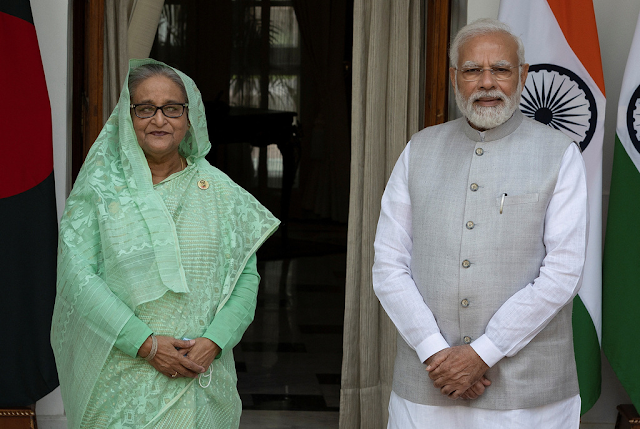
Bangladesh Prime Minister Sheikh Hasina with her counterpart Indian PM Narendra Modi at Hyderabad House, New Delhi

SALEEM SAMAD

After last week’s official visit of Bangladesh Prime Minister Sheikh Hasina to New Delhi the officials of both sides described the visit as having further strengthened relations between the two neighbouring countries, despite there being several political hiccups according to political observers.

Well, the prime ministers of Bangladesh and India have met 12 times since 2015. Each parley held has added feathers to the hats, except the recent one.

The most significant achievement was the long-standing border demarcation which was finally resolved, pending as it had been since the partition in 1947. The beleaguered citizens of the enclaves were rehabilitated, resettled, and compensated.

Road and railroad connectivity have appreciably improved and are expected to progress further. The transit through Bangladesh to the northeast Indian states is in function.

However, several crucial issues were not discussed or any consensus reached regarding them, which include river water sharing, climate change, border killings, Rohingya refugees, lopsided trade gap, energy and other pending issues.

Meanwhile, the head of German state media Deutsche Welle (DW) Bangla service Khaled Muhiuddin, not an apologetic political analyst, describes the trip as an “election campaign” for Sheikh Hasina’s upcoming national election scheduled at end of 2023.

None of the bilateral agreements – the Memorandum of Understanding (MoU) signed in Delhi comply with the state visit protocol, said the Bangladesh-born broadcaster in DW.

Bangladesh and India share 54 international rivers including the Ganges and the Brahmaputra being major rivers. The legendary rivers are linked to the livelihood of people belonging to both countries.

Presently the two countries have water-sharing agreements with only two – the Ganges in 1996 and the Feni River in 2019. The Ganges water treaty was hailed as historic.

India and Bangladesh last week inked an interim water sharing agreement for the third river Kushiyara (flowing from Assam hills) after 25 years.

Hasina at Hyderabad House in Delhi expressed her dissatisfaction over the pressing Teesta water sharing that has been hanging in balance for over a decade due to opposition from West Bengal Chief Minister Mamata Banerjee.

Banerjee argues that the water level in the Teesta has drastically reduced over the years and therefore there is very little water for West Bengal to offer to Bangladesh.

She (Banerjee) instead was pressing for an alternative proposal to link other rivers to augment the water flow in Teesta during the dry season, but Bangladesh turned down the proposal.

Earlier, an arrangement was made in 1983 that gave 39 per cent of water to India and 36 per cent to Bangladesh. The two sides agreed on another interim arrangement in 2011 that would give India 42.5 per cent and Bangladesh 37.5 per cent of the water from the Teesta for 15 years.

Banerjee deliberately poured cold water over the deal, which angered Hasina. New Delhi is equally feeling discomfited about Banerjee’s closing rooms for holding dialogue with hydrology and river-morphology experts from India and Bangladesh.

Joint River Commission (JRC) member K M Anwar Hossain said Pakistan and north-west India are being irrigated by water from the Indus river basin and most of the water canals were in Indian territory. Whereas, the two arch enemies struck the Indus basin water sharing agreement in 1950 when tensions between the two countries were at their peak.

The Hasina-Modi talks failed to reach a meaningful point on two major security concerns of Bangladesh: repatriation of Rohingya refugees and border killings, writes Shamsuddoza Sajen, an analyst in the independent newspaper The Daily Star.

The article states that when the Director-General of the Indian Border Security Force (BSF) justified the border killings by Indian border guards during a meeting in Bangladesh on July 21, 2022, had described that all Bangladeshis killed on the border were “criminals”, the Bangladesh counterpart Border Guards Bangladesh (BFB) conspicuously remained silent.

Bangladesh and India share a 4,096 kilometre border, despite India raised barbed wire fences. There are several porous points in otherwise strict border management by both sides.

Intermittent deaths along the Bangladesh–India border occur around the year. The shoot and kill policy of BSF of people illegally crossing into India from Bangladesh, cross border crimes including gun running, drug trade and cattle smuggling.

To prevent smuggling and illegal migration from Bangladesh, BSF exercises its controversial “Shoot-on-Sight” policy, which empowers border guards to shoot any person with or without cause. A large portion of the victim is cattle traders and farmers with agricultural lands near the border.

Rights organisation Odhikar’s report indicates that between 2000 and 2021 at least 1,253 were killed and another 1,156 were wounded in BSF firing.

Earlier, according to several MoUs and related treaties signed between India and Bangladesh, if citizens of the two countries illegally cross the border, it would be considered trespassing. As per law, those suspects would be handed over to the civilian authority.

From January to September 2022, six Bangladesh nationals were killed, four injured and seven abducted allegedly by Indian border guards, according to Ain o Salish Kendra (ASK), a legal aid and human rights organisation.

However, it has been observed that India has been violating treaties, shooting at anyone seen near the border or anyone trying to cross the border, which is a clear violation of international law and human rights, says Odhikar.

Hasina, nevertheless, was assured in Delhi that the border killings will be reduced and the border chiefs of both sides have agreed to stop the killings, which is embarrassing for both Dhaka and Delhi.

Critics, dissidents, opposition and media in Bangladesh are frustrated with the slow progress of signing water-sharing agreements for more than 50 rivers. Hasina’s government came under fire by media and opposition for failing to get a “single drop” of water for Teesta.

What Bangladesh received and what Bangladesh offered to India is surely important. In between parleys and visits outside her hotel, Hasina has been able to draw the attention of the Indian media, Indian top officials and the business community to her century-old traditional handloom ‘Jamdani’ saree she wore during her four-day visit. Some media dubbed her clad in a gorgeous saree as “Jamdani diplomacy”.

First published in the International Affairs Review, 10 September 2022

Saleem Samad, is a Dhaka-based independent journalist, a media rights defender, recipient of Ashoka Fellowship and Hellman-Hammett Award. He could be reached at <saleemsamad@hotmail.com>; Twitter @saleemsamad

Monday, August 24, 2020

Pakistan’s desperate attempt to come closer to Bangladesh

WEB_ Prime-Minister-Sheikh-Hasina-Imran-Khan
File photo: Bangladeshi Prime Minister Sheikh Hasina (left), and her counterpart Pakistan's Prime Minister Imran Khan

SALEEM SAMAD

"Bilateral synergy between Bangladesh and Pakistan remains a work in progress"

For most journalists, columnists, and academicians in Pakistan, when they write or speak on Bangladesh affairs, it could be understood that they are bashing India and trying to appease Bangladesh by stating or using the term “brotherly Muslim” country.

The Bangladesh Ministry of Foreign Affairs has stated about the delinquent Indian press in undermining the relations of the two neighbours. The government could have warned equally about the Pakistan media writing provocative articles and commentaries that Bangladesh has realized after almost 50 years that India is no friend of Bangladesh, and is instead tilting towards China.

A Pakistani columnist Inam Ul Haque in The Express Tribune has written: “Taking a leaf from post-war European history would do well for both brotherly Muslim countries.”

Bangladesh, even after almost half-a-century, has not forgotten the marauding Pakistan Army launched a “jihad war” against the people. 

Thus, the broadcast of Radio Pakistan aptly said that the people of Bangladesh are “kafirs” and “gaddhars” (traitors) and have joined hands with their arch enemy, the Hindu-India.

Pakistan must backtrack their statement of officially declaring the people of Bangladesh as “kafirs” and traitors which gave them the moral legitimacy to commit genocide and rape as a weapon of war.

An estimated 10 million refugees fled Bangladesh and trekked into neighbouring states of India. They fled when their villages and towns were raided. Their relatives and neighbours were slaughtered by the Pakistan Army and their Islamic henchmen.

The plunders and arson of villages and bazaars and desecrating places of worship, and the genocide by Islamist militia -- these narratives are documented in the history of the Liberation War.

The Pakistan media put up stories on the first page regarding Pakistan Prime Minister Imran Khan’s telephone tete-a-tete with his Bangladesh counterpart Sheikh Hasina.

Both Bangladesh and Pakistan’s official statements did not mention that Imran Khan wanted to convince Bangladesh to support Pakistan on the Kashmir issue. PM Hasina in three words silenced Khan when she stated that Kashmir is “India’s internal affair.” Full stop.

What Pakistan media will not publish was that Bangladesh reiterated that Pakistan should provide a public apology to the war crimes committed during the Liberation War.

Barrister Tania Amir says that Bangladesh should muster support from friendly countries to hold Islamabad responsible for flouting the historic 1974 Tripartite Agreement signed in New Delhi which released 93,000 prisoners of war (POW).

In Clause 13 of the agreement jointly signed by the foreign ministers of Bangladesh, India, and Pakistan regarding the governments for reconciliation, peace, and friendship in the sub-continent, “the 195 Pakistani prisoners of war should be held to account and subjected to the due process of law.”

However, the Pakistan minister of defense and foreign affairs in the agreement said that “his government condemned and deeply regretted any crimes that may have been committed.”

Former Foreign Minister Dr Kamal Hossain, a signatory of the agreement in Clause 13, stated that the manifold crimes committed by POWs constituted, according to the relevant provisions of the UN General Assembly Resolutions and International Law, war crimes, crimes against humanity, and genocide, and that there was universal consensus that persons charged with such crimes as the 195 Pakistani POWs should be held to account and subject to the due process of law.

The Tripartite Agreement stated that the 195 listed as war criminals will face court-martial under the Manual of Pakistan Military Laws (MPML), 1957.

In the home front, during a live discussion over a TV channel on the relationship between India and Bangladesh and the recent developments in regards to Pakistan, Foreign Minister Abdul Momen said the recent tensions between India and China were impacting ties with Bangladesh of both the nations, and he asserted that both India and China were its “neighbours” and that both the nations always had a big heart for Bangladesh.

Pakistan and Bangladesh need to realize that bilateral synergy can bring tremendous good to their people, wrote columnist Inam Ul Haque in The Express Tribune. Political observers merely scoffed at such wild ideas. 

First published in the Dhaka Tribune on 24 August 2020

Saleem Samad is an independent journalist, media rights defender, and recipient of Ashoka Fellowship and Hellman-Hammett Award. He can be reached at saleemsamad@hotmail.com.  Twitter @saleemsamad

Tuesday, March 03, 2020

Sheikh Hasina deserves thanks for neutralise conflict in Assam

How Bangladesh helped Assam
SALEEM SAMAD
Early this year, New Delhi decided to withdraw the Indian Army from Assam, the neighbouring state in the northeast of India.
The conducting of a conflict assessment in the wake of a reduction in militancy in the region was the primary reason for the withdrawal of troops from Assam.
The top brasses in Indian defense were in the view that as the situation was improving in Assam, the state police should deal with it with the help of the Central Paramilitary Forces, according to The Assam Tribune.
Nearly two decades ago, the Indian army was deployed for counter-insurgency operations in Assam, in November 1990.
The dreaded militant groups National Democratic Front of Boroland (NDFB), United Liberation Front of Asom (ULFA), and other separatist armed groups were at the behest of Pakistan spy agency ISI, with their cohorts in Dhaka.
Bangladeshi territory was used by the militant leaders of ULFA, NDFB, and other insurgent groups in Tripura, Nagaland, Mizoram, and Manipur for their separatist movement.
The second-generation separatist leaders got renewed impetus in their illegal activities during the regime of Begum Khaleda Zia from 1991-1996 and again in 2001-2006. Pakistan was literally fighting a proxy war in the northeast through ISI covert operations in Dhaka.
The so-called headquarters of ULFA, NDFB, and others were dismantled, the leaders were pushed back from Bangladesh, months after Sheikh Hasina took oath in 2009. Since then, the entire gamut of militancy was physically immobilized in Bangladesh.
Thus, the cross-border terror came to a halt. The militant outfit’s bank accounts and other businesses were frozen by Bangladesh authorities. Several rogue elements in the Bangladesh government who were involved with aiding and abetting the militancy were punished and others reprimanded.
Recently, the NDFB(S) signed suspension of operations -- the ULFA remains the only major militant outfit active and the situation does not warrant deployment of the army all over the state -- the defense brass concludes.
On November 29, the Global Terrorism Index 2019 noted that Bangladesh had been the most successful South Asian country in countering terrorism. S Binodkumar Singh, Research Associate of Institute for Conflict Management in New Delhi wrote: “Bangladesh had the largest improvement of any country in South Asia.”
Most of the militant leaders pushed back are presently active in negotiation for sustainable peace in the region. After being evicted from Bangladesh, the camps of the separatists moved to Myanmar. Myanmar military caused havoc on their camps recently.
The casualty from two decades of conflicts in northeast India has significantly reduced after Bangladesh had been able to neutralize the militancy and keep cross-border terror in check.
According to data from the Institute for Conflict Management, in 2000 the civilian casualty was 267, security forces 37, and extremists killed 223; while in 2019 civilian deaths dropped to one, security forces casualty to zero, and only two militants were killed.
The total deaths in 20 years comes to: 2,208 civilians, 340 security forces, and the number of separatists killed was 2,331 in 2,562 incidents of conflicts. The tripartite agreement was signed between NDFB President B Saoraigwra, the Assam government’s Ashutosh Agnihotri, and Union Home Joint Secretary (North-East) Satyendra Garg in New Delhi on January 17.
Bangladesh security forces were on high alert, and last June a team from the Bangladesh army and RAB, in a joint operation, recovered 12,000 weapons, including rocket launchers and machine guns, from the Satchari National Park.
Earlier in the year 2004, in a sensational recovery, 10 truckloads of arms and ammunition -- apparently smuggled in by ULFA’s military commander Paresh Barua from China -- were seized by the Bangladesh Army near Chittagong port.
The fugitive Paresh Barua, once a popular Assamese soccer player, was handed the death sentence by a Bangladesh court after he stood convicted in the 10-truck arms smuggling case.
Last November, a three-member pro-talk ULFA delegation -- Chairman Arabinda Rajkhowa, General Secretary Anup Chetia, and Foreign Secretary Sasadhar Choudhury - attended a formal discussion with interlocutor AB Mathur, a former special secretary of the Research and Analysis Wing (RAW) at an undisclosed location in New Delhi.

First published in the Dhaka Tribune on 2 March 2020

Saleem Samad is an independent journalist, media rights defender, and is a recipient of the Ashoka Fellow and Hellman-Hammett Award. He can be followed on Twitter @saleemsamad

Tuesday, March 21, 2017

Defense pact between Bangladesh & India in front row, while Teesta water-sharing takes backstage

SALEEM SAMAD

India eyes a comprehensive defence pact with Bangladesh, while Teesta water-sharing is off the radar during the official visit of Prime Minister Sheikh Hasina to India's capital New Delhi in early April.

Bangladesh is nervous on the outcome of the India visit, which is expected to further take the bilateral relations to new heights, said a top official of the Ministry of Foreign Ministry on Monday. She is also slated to visit Ajmer to pay homage to Sufi Saint Khwaja Moinuddin Chishti.

Political hype on the crucial issue of twice postponed the Teesta water-sharing treaty has caused much embarrassment to the government and ruling political allies. For Hasina, inking another sensitive military pact will not be easy to keep afloat in rough weathers, observes former Bangladesh envoy to Delhi Ambassador Liaquat Ali Chowdhury.

The anti-Indian political lobby, both ruling Awami League's arch rivals Bangladesh Nationalist Party (BNP) and Jamaat-e-Islami, is likely to make noise to the government's getting closer to India, "but Hasina is not afraid of the wolves", said Chowdhury.

Since Hasina returned to power in 2009, she walked extra miles in addressing India's concerns over north-east India's insurgency and connectivity. Nevertheless, India understands that a military pact with Bangladesh  would be beneficial for the two neighbors.

If the pact comes through, India will offer highest ever credit line for defence cooperation with other friendly counties. Delhi is also willing to commit up to 500 million USD in line of credit for military cooperation with Dhaka, writes Jayanth Jacob in Hindustan Times.

Earlier, India had not given line of credit for defence hardware purchases, a source told The Asian Age. On the other hand, the crucial parleys on the outlines of the defence pact is going on, which comprises training, sale of military hardware and military to military cooperation.

Hindustan Times confirms that the "discussions for a defence pact is progressing and yet to reach a final shape". Unfortunately, Delhi is unable to keep pace with Hasina in reciprocating her political desires from her largest neighbor.

The much-awaited Teesta water-sharing deal and two neighbors to share 54 rivers remains a far-cry. Negotiations on Teesta were on for the past 18 years, Chowdhury noted. Indian Prime Minister Narendra Modi opined for water sharing of all 54 rivers during his maiden visit to Bangladesh two years ago.

The good offices of an elderly politician and President of India Pranab Mukerjee in Delhi are trying to break the ice to resolve the Teesta water sharing issue at a parley between Sheikh Hasina and West Bengal Chief Minister Mamata Banerjee has been planned.

Bangladesh is confident that she will not return home with empty hands, said a Foreign Office official. The draft agreement prepared by Delhi in 2011 was not signed due to opposition from Mamata, the two sides agreed to share the river's water 50:50, the same as the 1996 Ganges (Padma) water-sharing pact.

First published in The Asian Age, March 21, 2017

Saleem Samad, is an Ashoka Fellow (USA), an award-winning investigative journalist based in Bangladesh. He is Special Correspondent, The Asian Age
Twitter @saleemsamad