Buy.com Monthly Coupon
Showing posts with label Indo-Bangladesh relations. Show all posts

Wednesday, March 26, 2025

India shies over Yunus-Modi talks

SALEEM SAMAD

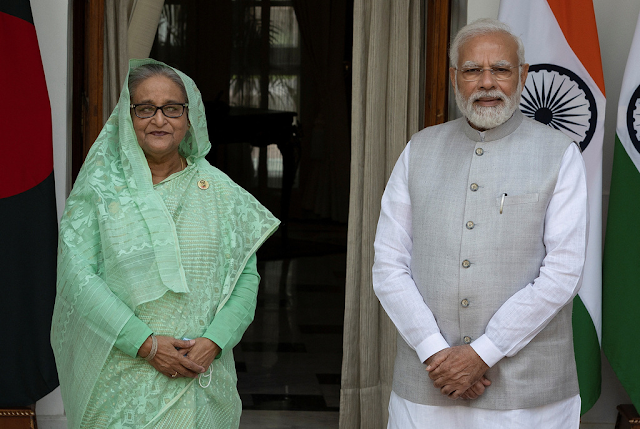
India has not declined a meeting with Nobel laureate Prof Muhammad Yunus, Chief adviser of Bangladesh Interim Government and Indian Prime Minister Narendra Modi.

South Block in New Delhi did not respond to a request for Yunus-Modi state-level bilateral meeting in New Delhi. Through diplomatic channels Yunus administration requested for a bilateral visit in December 2024.

Nor did Delhi respond to a meeting on the sidelines of BIMSTEC (Bay of Bengal Initiative for Multi-Sectoral Technical and Economic Cooperation) on 3-4 April in Bangkok, Thailand.

Indian External Affairs Minister Subrahmanyam Jaishankar remained non-committal, saying “Bangladesh’s request for a meeting between its interim government’s Chief Advisor Muhammad Yunus and Prime Minister Narendra Modi at the upcoming BIMSTEC Summit is under consideration.”

BIMSTEC is a regional organization of seven countries (Bangladesh, Bhutan, India, Myanmar, Nepal, Sri Lanka, and Thailand) focused on promoting economic and technical cooperation in the Bay of Bengal region, with its secretariat located in Dhaka, Bangladesh.

The platform dropped Pakistan and Maldives giving a flimsy excuse that the countries do not share the Bay of Bengal. Whereas, Nepal and Bhutan do not have shores with the Bay of Bengal but are said to be beneficiaries of the sea.

Meanwhile, the independent Indian newspaper The Hindu reported on 25 March that Yunus wanted to visit India before China, but did not receive a positive response, quoting Press Secretary Shafiqul Alam to Prof Yunus’s administration.

Yunus seeks bilateral ties with India before visiting China, pitching Bangladesh as a business-friendly destination, writes Kallol Bhattacherjee in the Hindu.

Bangladesh is still waiting for a response from India for a meeting between Yunus and Modi on the sidelines of the BIMSTEC summit.

Chief Adviser of the interim government of Bangladesh desired to travel to India before visiting China but Dhaka’s request for the visit did not elicit a “positive” Indian response, said Alam.

Yunus is the second leader from South Asia to be hosted in China in four months. Nepal’s Prime Minister K. P. Sharma Oli travelled to China in December 2024 on an official visit.

Like the formal request to extradite ousted Prime Minister Sheikh Hasina in December last year, the meeting between the two heads of government, Delhi remains absolutely silent. Indian government remains conspicuously tight lipped over the possible bilateral meeting.

Sources in the Bangladesh Ministry of Foreign Affairs who is privy to the exchange of diplomatic messages said there could be multiple reasons, why India continues to be silent over the requests from Bangladesh.

First, India-Bangladesh ties should not be ‘regime-specific’, says Bangladesh Foreign Affairs Adviser Mohmmad Touhid Hossain. Second, India is officially not prepared to make any commitment to the extradition of Hasina.

Third, how will Modi respond to Yunus when he asks him when India will extradite her to stand trial for crimes against humanity responsible for the deaths of over 1400 students and protesters?

The United Nations High Commission for Human Rights, in their 114-page investigation report, says “The brutal response was a calculated and well-coordinated strategy by the former Government [of Awami League] to hold onto power in the face of mass opposition,” UN Human Rights (OHCHR), Chief Volker Türk, said.

“There are reasonable grounds to believe hundreds of extrajudicial killings, extensive arbitrary arrests and detentions, and torture, were carried out with the knowledge, coordination and direction of the political leadership and senior security officials as part of a strategy to suppress the protests.”

The UN fact-finding mission report directly blames Hasina for ordering law enforcement agencies to shoot at protesters with live bullets to neutralize the anti-government street uprising.

Indian media has raised storms on news broadcasts and talk shows that India cannot invite a “stooge” of the United States and China, an unelected leader, etcetera, etcetera. Most importantly, he does not represent the people of Bangladesh which was the first reason for India not responding to Bangladesh’s request for an official meeting.

Bilateral political history of Bangladesh says it differently. At least three military dictators made official visits to Delhi. Like General Ziaur Rahman (1977-1981), General Hussain Muhammad Ershad (1982-1990) and Lt. Gen Moeen U Ahmed (2006-2008), despite not having the people’s mandate.

Indian ruling and opposition parties never objected to the bilateral meetings with three military dictators. The Indian media was not vociferous against their official visits.

The Indian media, also joined by the Indian ruling party Bharatiya Janata Party (BJP), failed to reconcile with the forcible departure of their all-weather friend Sheikh Hasina, who has taken refuge on the outskirts of Delhi. Jaishankar last week told the Consultative Committee on External Affairs in Delhi that India was aware of the mounting discontent against Hasina leading up to the ouster of her government on 5 August 2024, but could not intervene as it lacked the necessary leverage over the former prime minister.

Admitting tensions between Delhi and Dhaka, especially after India granted refuge to Hasina, the Interim Government in Bangladesh has begun engaging with India, Jaishankar told the Indian lawmakers.

Commenting on the influence of “external actors” in Bangladesh, Jaishankar said he viewed China as a regional “competitor” rather than an “adversary”, writes The Hindu.

Indian External Affairs Minister Jaishankar also told the meeting that SAARC (South Asian Association for Regional Cooperation) was inactive because of Pakistan’s approach and thus India is trying to strengthen BIMSTEC.

In the worst-case scenario, Narendra Modi is expected to drop attending BIMSTEC at the last moment and instead send an emissary on his behalf to attend the summit. Thus, the Modi-Yunus sideline meeting will not happen.

First published in the Stratheia Policy Journal, Islamabad, Pakistan on 26 March 2025

Saleem Samad is an award-winning independent journalist based in Bangladesh. A media rights defender with the Reporters Without Borders (@RSF_inter). Recipient of Ashoka Fellowship and Hellman-Hammett Award. He could be reached at saleemsamad@hotmail.com; Twitter (X): @saleemsamad

Thursday, January 09, 2025

India Irks Bangladesh for Extension of Visa to Sheikh Hasina

SALEEM SAMAD

India seems to have deliberately extended the visa of Sheikh Hasina, to a former democratically elected autocratic prime minister to stay comfy at a two-room safe house in a military base at Delhi.

A reputed Delhi-based Hindustan Times writes that extending the visa for another six months is unprecedented. This has annoyed the five-month-old Interim Government of Nobel laureate Prof Muhammad Yunus.

The news was another dent amid growing tension between the two countries after the fall of Hasina in early August last year. She fled to India after a bloody student uprising. India seems uncomfortable providing asylum and its relationship with neighboring countries has turned from sweet to sour.

Officials close to the Chief Advisor’s (Yunus) office said they did not expect but were not surprised that Delhi offered Hasina to live in exile, amid a call for her extradition.

Dhaka has officially asked Delhi through diplomatic channels to extradite Hasina to face the music of justice for committing crimes against humanity. She has been accused of ordering law enforcement to shoot and kill unarmed students and protesters during the bloody Monsoon Revolution last year July-August.

The gesture confirms that India is unwilling to extradite Hasina. Indian media is harping that she is unlikely to get a fair trial if she stands on the dock for crimes of putting to deaths of hundreds of protesters.

An official, who requested to remain anonymous, as the person is not authorized to speak to journalists, said the latest decision to extend the visa gives a strong message.

The message was loud and clear that India does not wish to normalize the bilateral relations with its neighbor, which has a shared history of and common heritage originating from the Bengal (West Bengal became an Indian state and East Bengal became Bangladesh) region, linguistic and cultural ties, passion for music, literature and the arts.

The half a century of trade, commerce, regional infrastructure development, transit, and people-to-people contacts will fall flat. The gesture confirms that India is unwilling to extradite Hasina.

Unfortunately, India could not reconcile the fact that Hasina is no longer at the helm of Bangladesh's affairs. Political observers here argue that South Block in New Delhi foolishly kept all its eggs in Hasina's basket. Such actions contradict ancient India’s visionary strategist Chanakya’s wisdom on war and peace with the neighboring states.

Political stalwarts among the ruling Bharatiya Janata Party (BJP) do not believe that Hasina is a ‘spent fuel’ and cannot be replenished or recharged to lead the new population of 51 million Gen-Z in a country of 174 million.

Thousands of Gen-Z, students from college and university students in the capital and countryside sparked the revolt which forced the Awami League despots from power to crumble.

The opposition Bangladesh Nationalist Party (BNP), despite several attempts to unseat Hasina through violent anti-government movements in the last 15 years, miserably failed. They could not dent the invincible Hasina regime.

Delhi failed to acknowledge the Monsoon Revolution which killed more than a thousand students and protesters in police firing and armed vigilantes recruited from Awami League’s student and youth organizations which clashed with students on the educational campuses.

Political historian Mohiuddin Ahmad said he has a feeling if Hasina is brought back from India, the country will plunge into chaos and the distraught Interim Government will be overwhelmed.

Thousands of students and protesters would march the streets of the capital and elsewhere demanding Hasina to be punished immediately. Many journalists covering politics echoed with Ahmad that the presence of Hasina in the safest custody would turn into political pressure for the Yunus administration.

India despite being the largest functional democratic nation, accepted Hasina’s flawed elections in 2014, 2018 and 2024 sans the participation of the mainstream opposition.

Delhi was conspicuously silent when appalling human rights violations were being committed, including extra-judicial deaths, enforced disappearances and confinement of political opposition, critics and dissidents in secret prisons by security agencies.

With credible investigations, the Human Rights Watch and Amnesty International have exposed the dark era of Hasina’s regime. It was picked up by international media, including several independent Indian media. The political language of India did not change.

The media was another soft sector and was throttled by draconian cybercrime laws. Many journalists were arrested and tortured which was reported by Reporters Without Borders (RSF), Committee to Protect Journalists (CPJ), and the International Federation of Journalists (IFJ).

Hasina’s government refused to probe into the allegations of enforced disappearance, secret prisons and extra-judicial deaths after several requests by the United Nations, European Union and other Western countries.

The former government instead blamed the BNP and Islamist party Jamaat-e-Islami for orchestrating the propaganda to tarnish the image of her regime. All through her tyrannical rule, India never raised questions nor was Hasina given any advice to act as a benevolent dictator.

Earlier, Prof Yunus urged India to ensure that Hasina remains quiet and not give sermons through social media which is being amplified by her loyalists living in the West. First ever India-Bangladesh Foreign Secretary-level meeting was held at Dhaka, which is believed to have melted some ice.

Prof Yunus and Indian Prime Minister Narendra Modi will likely meet in November on the sidelines of the BIMSTEC (Bay of Bengal Initiative for Multi-Sectoral Technical and Economic Cooperation) summit in Thailand.

BIMSTEC is India's brainchild to avoid SAARC (South Asian Association for Regional Cooperation) and bypass Pakistan for regional cooperation.

Until Yunus meets Modi at the end of the year nothing tangible could be achieved from the biggest neighbor India on bilateral relations and regional cooperation.

First published in the Stratheia Policy Journal, Islamabad, Pakistan, 09 January 2025

Saleem Samad is an award-winning independent journalist based in Bangladesh. A media rights defender with the Reporters Without Borders (@RSF_inter). Recipient of Ashoka Fellowship and Hellman-Hammett Award. He could be reached at saleemsamad@hotmail.com; Twitter (X): @saleemsamad


Monday, December 30, 2024

India’s Pessimism Threatens Historic Ties with Bangladesh

SALEEM SAMAD

India’s current political maneuvers, particularly those involving religious factors, are akin to pouring cold water on a relationship that has endured for over half a century. Such actions risk tarnishing the two nations’ deep-rooted historical, cultural, and mutual respect.

It’s crucial to recognize that India and Bangladesh have shared a resilient relationship that has weathered many hiccups over the last fifty years. However, recent political maneuvers in India, particularly those influenced by religious factors, create tensions that could undermine this precious bond.

In India, a wave of negativity has emerged, fueled not only by certain media outlets but also by the ruling Bharatiya Janata Party (BJP), which champions the Hindutva ideology.

The rhetoric challenges the legitimacy of the Interim Government headed by Nobel laureate Prof Muhammad Yunus, who has promised to hold free and fair parliamentary elections in early 2026.

As Prof Yunus stated, “The Bangladesh-India relationship is deep and multifaceted. We can have our differences but that cannot define it.” Delhi is reluctant to engage positively with the new government after Sheikh Hasina’s autocratic regime has fallen and fled to India.

The narrative being propagated suggests that Yunus has strayed from Bangladesh’s secular premises, leaving the door ajar to radicalized Muslims that have unfortunately perpetrated violence against the Hindu community, vandalizing Hindu business establishments and desecrating temples.

The Godi Media, a term used to describe sensationalist and biased Indian print and TV news media, has been instrumental in perpetuating this misinformation.

They have broadcasted/posted several fake videos showing attacks on Hindus and the killing of scores of Hindus, further exacerbating the tensions. The Godi Media described the religious tensions as “genocide” and “ethnic cleansing”, which is far from the accepted definition by academics.

Despite the diligent efforts of fact-checkers in both Bangladesh and India, including the BBC, has debunked these fabrications, the negative portrayal of Bangladesh continues. But that did not stop or even slow down the tirade of stories demonizing Bangladesh.

An investigation by fact-checker Rumor Scanner identified 13 misleading reports published by Indian media between August and December following the collapse of the Awami League government.

According to Rumor Scanner, 49 media outlets, including well-known names such as the Republic Bangla, Hindustan Times, Zee News, Live Mint, Republic TV, India Today, ABP Anand, and Aaj Tak, were implicated in spreading this inaccurate information.

Alarmingly, the analysis further revealed that a staggering 72% of social media accounts based in India are engaged in spreading misleading narratives about Bangladesh.

Editor Mahfuz Anam of the influential English newspaper The Daily Star writes that a powerful section of the Indian media has shifted into the “reprimand” mode, with some even suggesting “punishment.” Much of the social media discourse seems to support this.

The Indian media’s coverage appears to be driven by concern solely for Hindus of Bangladesh, rather than the people of Bangladesh, remarks Anam.

New Delhi’s South Block has weaponized the Hindu atrocities in Bangladesh to hide their diplomatic debacle for putting all eggs in one basket in the hand of their blue-eyed Sheikh Hasina.

It is undeniable that the religious and ethnic communities in Bangladesh were victims of persecution, atrocities, vandalism of business establishments and desecration of religious prayer halls, including Hindu temples, Christian churches, Buddhist pagodas and also Ahmadiyya Muslim mosques.

The sectarian persecution and violence in Bangladesh, it is essential to contextualize these events within the historical legacy of injustice that has plagued the region.

Since Bangladesh’s independence, perpetrators of religiously motivated violence have evaded accountability. There is no denying that such attacks on religious communities are a legacy of perpetrators enjoying impunity.

None of the perpetrators faced the music of justice since 1972 when independence hero Sheikh Mujibur Rahman returned from imprisonment in Pakistan.

This silence in holding aggressors accountable for sectarian violence has perpetuated a cycle of impunity that continues to impact communities today.

Durga Puja is a sacred religious festival of the Hindus of Bengal (historically, Bangladesh was known as East Bengal). It dampened the spirit of the newly independent Bangladesh of millions of Hindus, secularists, advocates of pluralism, and liberal Muslims alike.

Even under the despotic leadership of Sheikh Hasina, calls for accountability have often gone unheard. Many Hindus in Bangladesh, who have historically supported the Awami League, feel disillusioned by the lack of action taken against those responsible for religious violence.

The perception persists that the ruling party, rather than protecting extremism, has allowed perpetrators to go unpunished. Instead, she blamed Islamist parties and the opposition Bangladesh Nationalist Party (BNP) for the sectarian violence.

Rana Dasgupta, a former General Secretary of the Bangladesh Hindu Christian Buddhist Unity Council, noted the unfortunate reality that some grassroots leaders of the Awami League were found in the company of rioters during incidents of violence.

At a press conference in Chattagram (formerly Chittagong), his organization lamented the political leadership’s failure to safeguard Hindu temples and communities during crucial festivals.

Despite these challenges, it’s vital to recognize the diversity that exists within Bangladesh, where nearly 9% of the population identifies as Hindu, alongside smaller communities of Buddhists, Christians, and others within a predominantly Sunni Muslim landscape.

Each year, civil society groups, human rights advocates, and concerned citizens reflect on how they can uphold secularism and pluralism principles essential for a collective future. According to Ain O Salish Kendra, a Bangladeshi human rights organization, at least 3,600 similar attacks have occurred in Bangladesh between 2013 and 2021.

Such violence had prompted Prof Robaet Ferdous of Dhaka University, an outspoken defender of religious freedom, to say, “It’s not a failure of the local administration, police or the ruling party to protect the Hindus, but I see the collapse of the society during a national crisis, which contradicts the legacy of the glorious liberation war in 1971 which promised to establish secularism, pluralism, and freedom of expression in Bangladesh.”

According to Rana Dasgupta, “… a culture of impunity has been created in Bangladesh for attacks on Hindus. Those involved in these attacks have never been prosecuted, and as a result, it continues….”

India’s conspicuous silence over the atrocities, persecution, and vandalism against Hindus and other religious communities during the 15 years of Hasina’s era has been ignored.

The South Block, which looks after the Indian foreign policy in New Delhi, probably did not want to embarrass Sheikh Hasina when the sectarian violence was prominently published in mainstream media and human rights groups identified her Awami League, which she inherited from her father, Sheikh Mujib was the prime accused.

India, despite having a functional democracy and pluralism, never advised Hasina to hold an inclusive, free, fair, and credible election. Delhi’s indulgence has encouraged Hasina to grow into a Frankenstein and dare to rig the 2014, 2018, and 2024 elections, angered the West and the core reason for voters’ outrage with her regime.

Reelected for the third consecutive term through holding sham elections, she instead received feathers on her hat and congratulatory messages from Indian Prime Minister Narendra Modi.

The Hefazat-e-Islam, launched in 2010 to “protect Islam”, was spurred particularly by a proposed policy to confer equal inheritance rights to women and women’s empowerment, which is lauded in international media and the United Nations.

During her tenure (2009-2024), she placed the radicalized Islamic organization Hefazat-e-Islam on her lap to defuse their anger against women’s empowerment and women’s rights.

Despite protests from secularists and civil society, her government consciously amended the school textbooks with an Islamic coating. Based on the musical tunes of the Madrassa (Qawmi Islamic schools), the network introduced Islamic culture and tradition into the secular fabric of the society.

She kept the Hefazat in good humor in a bid to shield her authoritarian regime from the dreaded Islamists and jihadists outfits – Jamaat-e-Islami, outlawed Harkatul Jihad al Islam (HuJI), Hizb ut-Tahrir and other fringe outfits.

Bangladesh’s acclaimed political historian Mohiuddin Ahmad said the appeasement of Hasina was never to hurt her counterpart Modi by mentioning that the rights of the Dalits (low caste Hindus), Christians, Muslims and ethnic communities also impact Bangladesh.

Not surprisingly, the South Block’s so-called Look East Policy has placed Bangladesh as a delinquent state like that of Pakistan, said Ahmad. India arbitrarily stopped issuing visas to Bangladesh nationals after Hasina’s fall in early August, citing security reasons.

Bangladesh’s number of tourists and visitors to India was 2.12 million in 2023. The figure has dwindled to less than half and will decline when many Bangladesh multiple visas expire in December.

The non-issuance of visas has caused tension among Bangladesh nationals who regularly visit India for medical purposes. Some go on pilgrimage to Ajmer and other holy sites. A significant percentage of people visit India for business and pleasure.

The visa restrictions have stopped direct buses from Dhaka to Kolkata and Dhaka to Agartala. Direct train services from Dhaka to Kolkata, Dhaka to Siliguri, and Khulna-Kolkata have also reached a screeching halt. Similarly, both Bangladesh and Indian airlines have reduced flights by one-third in the absence of passengers who failed to avail of Indian visas.

Ahmad said people-to-people contact has been severely hampered due to visa restrictions imposed by India to punish the people of Bangladesh. Meanwhile, the Boycott India campaign on social media, which was joined by fringe political parties, melted after Bangladesh planned to import 50,000 tons of rice from India. The Interim Government recently imported eggs, green chilies, onions, and potatoes to stabilize the kitchen market.

On the other hand, India-Bangladesh bilateral trade is lopsided. Bangladesh’s exports are nearly $2 billion, while imports from India as of 2023 stood at $12 billion. This is also a contention with Indian policymakers and Bangladesh’s industrial, manufacturing, and exporters bodies.

As long as India hosts the fugitive Shiekh Hasina, who lives in exile at an official safe house near Delhi, it will be difficult for India-Bangladesh relations to reach a new height.

Unless she is extradited to Bangladesh to face trial for crimes against humanity, the relations will turn from sour to bitter. Fortunately, Bangladesh and India signed an extradition treaty in 2013.

The prestigious Indian Express newspaper argues that “India also has the option of refusing Hasina’s extradition because the accusations against her are not “in good faith in the interests of justice.” However, Delhi’s newspaper realizes the refusal to extradite Hasina may further strain ties between New Delhi and Dhaka.

Well, India has no option left but to take the risk to save Hasina from walking to the gallows for crimes for ordering the law enforcement agencies to shoot and kill hundreds of students and protesters during the July-August Monsoon Revolution, says former Ambassador Humayun Kabir, who served as a diplomat in India and the United States.

He also said Bangladesh should develop a contingency plan if India decides not to deport her. The government will also have to calculate the risk factor of whether Bangladesh can live without the most prominent neighbor’s fraternity, which had helped achieve the bloody birth of Bangladesh in 1971.

First published in the Stratheia Policy Journal, 30 December 2024

Saleem Samad is an award-winning independent journalist based in Bangladesh. A media rights defender with the Reporters Without Borders (@RSF_inter). Recipient of Ashoka Fellowship and Hellman-Hammett Award. He could be reached at saleemsamad@hotmail.com; Twitter (X): @saleemsamad

Wednesday, December 11, 2024

India’s efforts to thaw the frosty ties with Bangladesh will be difficult

Dr Yunus (R), Indian Foreign Secretary Vikram Misri with Bangladesh counterpart Jashim Uddin.
Photo Collected

SALEEM SAMAD

The much-talked-about India-Bangladesh talks held on 9 December, apparently did not melt the desired amount of ice after the fall of the autocratic regime of Sheikh Hasina in early August.

In fact, the Foreign Secretary of India, Vikram Misr offers were too little, too less and too late to warm up the strained relations after Nobel laureate Dr Muhammad Yunus took oath as Chief Adviser of the Interim Government.

The Foreign Office Consultations (FOC) with his Bangladesh counterpart Foreign Secretary Jashim Uddin. The visiting Foreign Secretary highlighted India’s support for a democratic, stable, peaceful, progressive and inclusive Bangladesh.

“To that end, therefore, I have underlined today India’s desire to work closely with the interim government of Bangladesh authorities,” he said.

Vikram Misri said there is no reason why this mutually beneficial relationship should not continue to develop in the interest of our people.

He said they have always seen in the past and will continue to see in the future the relationship as a people-centric and people-oriented relationship—one that has the benefits of all the people as its central motivational force.

The parleys did not make any proactive decisions regarding the visa regime, which was unilaterally stalled by the Indian government after the sudden change of government. There were no tangible discussions on the resumption of the Dhaka-Agartala, Dhaka-Kolkata bus service, Dhaka-Kolkata, Dhaka-Siliguri, and Khulna-Kolkata Maitree trains, which came to a screeching halt.

The non-issuance of visas has also impacted the Dhaka-Delhi, Dhaka-Kolkata, Dhaka-Chennai, and Chattogram-Kolkata flights, which have been reduced to one-fourth after the Indian High Commission visa processing centres, except on special cases stopped after 5 August, the day Hasina fled the country.

Regarding issuing Indian visas to Bangladesh nationals, Environment, Forest and Climate Change Adviser Syeda briefing the media said Misri has assured that steps would be taken to increase the number of Indian visas for Bangladeshi nationals.

After reading out a written press briefing by Misri, he hurriedly walked away without taking any questions from the journalists, including dozens of Indian journalists presently in town.

Walking away from a press briefing means that the speaker either has something to hide or wants to avoid taking questions, which could be embarrassing for Delhi’s South Block.

The press statement issued by the Indian Ministry of External Affairs (MEA) is fully loaded with diplomatic phrases and jargon. It says, Misri reiterated India’s willingness to build a positive and constructive relationship with Bangladesh, based on mutual trust and respect and mutual sensitivity to each other’s concerns and interests.

The Indian Foreign Secretary emphasized that people are the main stakeholders in India-Bangladesh relations, and noted India’s development cooperation and multifaceted engagements with Bangladesh.

The MEA statement mentions that both sides held comprehensive discussions on a wide range of issues covering political and security matters, border management, trade, commerce and connectivity, cooperation in water, power and energy sectors, development cooperation, consular, cultural and people-to-people ties.

The statement does not mention how the people, identified as the main stakeholders in India-Bangladesh relations interaction in the face of India’s blanket ban on visas will continue with people-to-people contact.

Political historian and researcher Mohiuddin Ahmad asked, “How will the so-called people-to-people ties will continue? On WhatsApp or social media?”

Ahmad was keenly following the recent development of India-Bangladesh relations, which have dipped to an all-time low in 53 years of all-weather friendship.He said when Indian media sang to the tune of the ruling Bharatiya Janata Party (BJP) advocating Hindutva, an extremist religious-cultural philosophy had embarked upon anti-Bangladesh rhetoric, challenging the legitimacy of Yunus administration, which was tantamount to downgrading the status of the India-Bangladesh ties.

Misri could not assure Bangladesh officials of the means to stop the anti-Bangladesh campaign of the ruling BJP and the Indian media to stabilise the hard-earned friendship, since the brutal birth of Bangladesh in 1971.

About the propaganda being spread by a section of Indian media against Bangladesh, Adviser Rizwana Hasan told journalists that the Indian foreign secretary claimed that the Indian government is not responsible for the anti-Bangladesh campaign and that Delhi does not subscribe to the disparagement against Bangladesh.

The Indian side also claimed that their government did not own the propaganda, the environment adviser added.

The majority of mainstream media picked up sources from fake news floating on social media without fact-checking. Several fact-checkers in India and Bangladesh have debunked scores of fake news, but Indian media has not stopped.

At least 49 Indian media outlets spread fake reports, according to fact-check outfit Rumour Scanner based in Bangladesh.

They are still playing with the Hindu card, terming the attacks on Hindus in the aftermath of the Iron Lady Hasina fleeing the country.

The Indian political leaders, several organisations and television news channels did not hesitate to coin words of ‘genocide’ and ‘ethnic cleansing’, without understanding the academically accepted definition found in textbooks and also in Encyclopaedia Britannica.

Mohiuddin Ahmad, who is a genocide survivor said how will one classify the ethnicity of the Adivasis? Never knew that Hindus are ethnic, he remarked.

Well, Misri aptly raised the concern of religious minorities and urged for their safety, security and welfare. He also raised some regrettable incidents of attacks on cultural, religious and diplomatic properties.

Misri also paid a courtesy call with Dr Yunus, he stressed reviving the South Asian Association for Regional Cooperation (SAARC), an inter-governmental organisation that promotes economic, social, and cultural development among Afghanistan, Bangladesh, Bhutan, India, Maldives, Nepal, Pakistan, and Sri Lanka.

SAARC was put into cold storage after India, Bangladesh and Nepal declined to attend the 19th Summit scheduled in Islamabad, Pakistan after a border skirmish in Kashmir.

The two officials during their parley, also exchanged views on sub-regional, regional and multilateral issues, and agreed to enhance consultations and cooperation to advance regional integration, including under the BIMSTEC framework. Misri did not mention SAARC, except nodding his head while speaking to Dr Yunus.

Misri will be the second senior-most Indian official to have met Dr Yunus, after the Indian High Commissioner Pranay Verma met the inventor of micro-credit Dr Yunus days after he took oath on 8 August.

After the parley with the Yunus, Rizwana Hasan briefing the journalists said India is eager to clear the cloud formed in the sky over Bangladesh and India relations after the ouster of the Hasina government.

There was no comment regarding, India recognising the Monsoon Revolution, the student uprising which ousted the autocratic Hasina regime.

He concluded that the discussions have allowed both the countries to take stock of the relations, and appreciates the opportunity in holding the meeting to have had a frank, candid and constructive exchange of views with all my interlocutors.

First published in the International Affairs Review, New Delhi, India on 11 December 2024 

Saleem Samad is an award-winning independent journalist based in Bangladesh. A media rights defender with the Reporters Without Borders (@RSF_inter). Recipient of Ashoka Fellowship and Hellman-Hammett Award. Email: <saleemsamad@hotmail.com>; Twitter (X): @saleemsamad

Sunday, January 28, 2024

India is not among the top 10 development partners of Bangladesh

SALEEM SAMAD

When India promptly felicitated Bangladesh for holding a "free and fair" 12th National Elections, the government leaders in Bangladesh were visibly excited.

Indian Prime Minister Narendra Modi congratulated his Bangladesh counterpart Sheikh Hasina on her "victory for a historic fourth consecutive term in the Parliamentary elections" and also said, "We are committed to further strengthen our enduring and people-centric partnership with Bangladesh."

On the eve of the 75th Republic Day of India, a Bangladesh business daily Share Biz in Bangla publishes a damning first-page lead story "India is not among the top 10 development partners of Bangladesh".

The story was published in the byline of a reporter Ismail Ali writes, that since the liberation war of Bangladesh, India is one of the friendly countries in South Asia.

Having the longest international border, the country always stood by its neighbour at various times. Bangladesh's diplomatic and economic relations with India are also very deep.

However, there is a lopsided trade imbalance between the two countries. India is Bangladesh's second-largest source of imports.

It is also worth noting that every year Bangladesh's trade gap with India is widening rather than narrowing. In the Financial Year (FY) 2021-22, for example, Bangladesh imported commodities worth US$14.58 billion from India, while its exports to that country were merely US$1.8 billion.

Every day, thousands of Bangladesh nationals travel to India for medical treatment, been lagging business and pleasure. The two countries have shared the same history, culture and tradition for centuries during the Moghuls and British colonial era.

An estimated US $5 billion annually is remitted to India by documented and undocumented Indian expats working in Bangladesh. Similarly, thousands of economic migrants work in India as menial labourers.

Although India boasts of Bangladesh being a development partner and heightened bilateral relations, which both countries reiterate on all occasions.

The largest country in South Asia is not on the list of top 10 development partners of Bangladesh. India has been lagging in foreign economic assistance to Bangladesh since its independence.

India has provided nominal economic assistance to Bangladesh for 52 years from financial year (FY) 1971-72 to FY 2022-23. This information has emerged in the latest report of the Economic Relations Department (ERD), a government department which negotiates foreign economic assistance.

According to ERD's report, Bangladesh's foreign debt has reached US $92.367 billion in the 52 years since independence. At this time, Bangladesh received US $30.105 billion in various grants.

The total development assistance received is US $122.472 billion. Of this, $7.031 billion came from food aid, $10.908 billion from product aid and $104.533 billion from project aid.

The World Bank has provided the most assistance to Bangladesh among any single international multilateral donor agency, amounting to $28.446 billion. It is 23.23 per cent of the total development cooperation.

The international multilateral donor agency has donated $1.623 billion under this economic assistance. The remaining $26.823 billion was loaned by the World Bank.

Another, multi-lateral donor agency Asian Development Bank (ADB), which is in the second position on this list provided Bangladesh with $22.424 billion in development cooperation.

It is 18.31 per cent of development cooperation and provided only $382 million to Bangladesh. The remaining $22.42 billion was disbursed as loans.

The two international multi-lateral agencies have never provided food aid to Bangladesh. However, the two agencies have given some loans under product support.

Japan is third in assisting Bangladesh. In the last 52 years, the country has given $20.452 billion or 16.70 percent of foreign aid. Of the total aid, Japan has given $3.609 billion in grants and $16.843 billion in loans.

China is in the fourth position. The country has given $8.115 billion or 6.63 percent of aid to Bangladesh. Of the financial assistance, China has donated only $104 million.

Russia ranks fifth in the list of development partners.

The country has given $6.874 billion to Bangladesh in the last 52 years, which is 5.61 per cent of the total aid. Of the country's aid, only $35 million was in grants.

The United Nations and its bodies are in the sixth position among the list of development partners. The UN has given the entire amount of $4.795 billion or 3.92 percent was disbursed as a grant to Bangladesh.

The United States ranks seventh and has provided $3.856 billion or 3.15 percent of foreign aid.

The United Kingdom was followed by the USA and provided economic assistance worth $2.727 billion or 2.23 per cent.

Germany, ranked ninth and tenth respectively in development cooperation.

The country gave Bangladesh $2.251 billion or 1.84 percent and Canada gave $2.214 billion or 1.81 percent.

Apart from this, India has given 2.143 billion dollars or 1.75 percent of development assistance to Bangladesh. And the European Union (EU) has contributed 2.105 billion dollars or 1.72 per cent.

Contributions from other organisations and countries amount to less than two billion dollars. Among them, the Asian Infrastructure Bank (AIIB), UNICEF, Islamic Development Bank (IDB), Netherlands, France, Denmark and Saudi Arabia have development cooperation amounting to more than one billion dollars. The rest have less support than that.

According to ERD data, different countries have provided food aid to Bangladesh at different times. Basically, in the post-independence years, food aid was higher. This support has decreased in recent times.

Over 89 percent of food aid in 52 years was received in grants, amounting to $6.268 billion. The remaining $763 million, or about 11 per cent, was loan assistance.

Food aid has been given to Bangladesh the most by the United Nations and its various organizations, amounting to 2.143 billion dollars. The United States is next in food aid. The country has provided food aid to Bangladesh at various times under USAID, amounting to $1.804 billion.

About 52 percent or $5.651 billion of product assistance came from grants and 48 per cent or $5.257 billion was loans. Japan and the World Bank provided the most product assistance. And 18.186 billion dollars or 17.40 per cent of the project assistance came as grants. The remaining 86.347 billion dollars or 82.60 percent was loan assistance. World Bank, ADB and Japan are the top three lenders.

Finally, on 20 January, Indian External Affairs Minister Dr. S. Jaishankar in a microblogging Twitter (X) wrote: So glad to meet with my new Bangladesh counterpart Dr. Mohammed Hasan Mahmud in Kampala [Uganda at 19th Non-Aligned Movement (NAM) Summit] and further stated that "India-Bangladesh relations are growing from strength to strength."

First published in North East News, Guwahati, India, 28 January 2023

Saleem Samad is an award-winning independent journalist based in Bangladesh. A media rights defender with the Reporters Without Borders (@RSF_inter). Recipient of Ashoka Fellowship and Hellman-Hammett Award. He could be reached at saleemsamad@hotmail.com; Twitter (X): @saleemsamad

Saturday, September 10, 2022

Sheikh Hasina’s “Jamdani” diplomacy

Bangladesh Prime Minister Sheikh Hasina with her counterpart Indian PM Narendra Modi at Hyderabad House, New Delhi

SALEEM SAMAD

After last week’s official visit of Bangladesh Prime Minister Sheikh Hasina to New Delhi the officials of both sides described the visit as having further strengthened relations between the two neighbouring countries, despite there being several political hiccups according to political observers.

Well, the prime ministers of Bangladesh and India have met 12 times since 2015. Each parley held has added feathers to the hats, except the recent one.

The most significant achievement was the long-standing border demarcation which was finally resolved, pending as it had been since the partition in 1947. The beleaguered citizens of the enclaves were rehabilitated, resettled, and compensated.

Road and railroad connectivity have appreciably improved and are expected to progress further. The transit through Bangladesh to the northeast Indian states is in function.

However, several crucial issues were not discussed or any consensus reached regarding them, which include river water sharing, climate change, border killings, Rohingya refugees, lopsided trade gap, energy and other pending issues.

Meanwhile, the head of German state media Deutsche Welle (DW) Bangla service Khaled Muhiuddin, not an apologetic political analyst, describes the trip as an “election campaign” for Sheikh Hasina’s upcoming national election scheduled at end of 2023.

None of the bilateral agreements – the Memorandum of Understanding (MoU) signed in Delhi comply with the state visit protocol, said the Bangladesh-born broadcaster in DW.

Bangladesh and India share 54 international rivers including the Ganges and the Brahmaputra being major rivers. The legendary rivers are linked to the livelihood of people belonging to both countries.

Presently the two countries have water-sharing agreements with only two – the Ganges in 1996 and the Feni River in 2019. The Ganges water treaty was hailed as historic.

India and Bangladesh last week inked an interim water sharing agreement for the third river Kushiyara (flowing from Assam hills) after 25 years.

Hasina at Hyderabad House in Delhi expressed her dissatisfaction over the pressing Teesta water sharing that has been hanging in balance for over a decade due to opposition from West Bengal Chief Minister Mamata Banerjee.

Banerjee argues that the water level in the Teesta has drastically reduced over the years and therefore there is very little water for West Bengal to offer to Bangladesh.

She (Banerjee) instead was pressing for an alternative proposal to link other rivers to augment the water flow in Teesta during the dry season, but Bangladesh turned down the proposal.

Earlier, an arrangement was made in 1983 that gave 39 per cent of water to India and 36 per cent to Bangladesh. The two sides agreed on another interim arrangement in 2011 that would give India 42.5 per cent and Bangladesh 37.5 per cent of the water from the Teesta for 15 years.

Banerjee deliberately poured cold water over the deal, which angered Hasina. New Delhi is equally feeling discomfited about Banerjee’s closing rooms for holding dialogue with hydrology and river-morphology experts from India and Bangladesh.

Joint River Commission (JRC) member K M Anwar Hossain said Pakistan and north-west India are being irrigated by water from the Indus river basin and most of the water canals were in Indian territory. Whereas, the two arch enemies struck the Indus basin water sharing agreement in 1950 when tensions between the two countries were at their peak.

The Hasina-Modi talks failed to reach a meaningful point on two major security concerns of Bangladesh: repatriation of Rohingya refugees and border killings, writes Shamsuddoza Sajen, an analyst in the independent newspaper The Daily Star.

The article states that when the Director-General of the Indian Border Security Force (BSF) justified the border killings by Indian border guards during a meeting in Bangladesh on July 21, 2022, had described that all Bangladeshis killed on the border were “criminals”, the Bangladesh counterpart Border Guards Bangladesh (BFB) conspicuously remained silent.

Bangladesh and India share a 4,096 kilometre border, despite India raised barbed wire fences. There are several porous points in otherwise strict border management by both sides.

Intermittent deaths along the Bangladesh–India border occur around the year. The shoot and kill policy of BSF of people illegally crossing into India from Bangladesh, cross border crimes including gun running, drug trade and cattle smuggling.

To prevent smuggling and illegal migration from Bangladesh, BSF exercises its controversial “Shoot-on-Sight” policy, which empowers border guards to shoot any person with or without cause. A large portion of the victim is cattle traders and farmers with agricultural lands near the border.

Rights organisation Odhikar’s report indicates that between 2000 and 2021 at least 1,253 were killed and another 1,156 were wounded in BSF firing.

Earlier, according to several MoUs and related treaties signed between India and Bangladesh, if citizens of the two countries illegally cross the border, it would be considered trespassing. As per law, those suspects would be handed over to the civilian authority.

From January to September 2022, six Bangladesh nationals were killed, four injured and seven abducted allegedly by Indian border guards, according to Ain o Salish Kendra (ASK), a legal aid and human rights organisation.

However, it has been observed that India has been violating treaties, shooting at anyone seen near the border or anyone trying to cross the border, which is a clear violation of international law and human rights, says Odhikar.

Hasina, nevertheless, was assured in Delhi that the border killings will be reduced and the border chiefs of both sides have agreed to stop the killings, which is embarrassing for both Dhaka and Delhi.

Critics, dissidents, opposition and media in Bangladesh are frustrated with the slow progress of signing water-sharing agreements for more than 50 rivers. Hasina’s government came under fire by media and opposition for failing to get a “single drop” of water for Teesta.

What Bangladesh received and what Bangladesh offered to India is surely important. In between parleys and visits outside her hotel, Hasina has been able to draw the attention of the Indian media, Indian top officials and the business community to her century-old traditional handloom ‘Jamdani’ saree she wore during her four-day visit. Some media dubbed her clad in a gorgeous saree as “Jamdani diplomacy”.

First published in the International Affairs Review, 10 September 2022

Saleem Samad, is a Dhaka-based independent journalist, a media rights defender, recipient of Ashoka Fellowship and Hellman-Hammett Award. He could be reached at <saleemsamad@hotmail.com>; Twitter @saleemsamad

Wednesday, March 31, 2021

Narendra Modi came, he saw, but he did not conquer

Narendra Modi speaks on the occasion of Bangladesh's 50th Independence Day - FOCUS BANGLA

The expectations of the common people in Bangladesh were left unfulfilled

SALEEM SAMAD

Fifty years ago, in 1971, India added colours of victories and feathers on Bangladesh’s hat.

Indian Prime Minister Narendra Modi recently came, saw, but couldn’t conquer the hearts and minds of the people of Bangladesh. His Bangladesh visit was to mark the 50th anniversary of Bangladesh’s nationhood, despite the coronavirus pandemic.

Possibly, Modi couldn’t fulfil the expectations of the “aam janata” of the country.

The agitation spearheaded by the left alliance and its student group protested Modi’s visit. Quickly, the Islamist groups voiced their protests, followed by the rightist parties.

The Islamists blamed India for the persecution of the Muslims in India, especially in Kashmir.

None was surprised as to why the Islamists, right and left elements, failed also to mention the Uighur Muslims facing ethnic cleansing in China, the crimes against humanity in Balochistan under Pakistan occupation, and the humanitarian crisis in Yemen caused by the proxy war by Saudi Arabia and the United Arab Emirates against Iran.

Nothing to deny about the fact that the two South Asian neighbours, Bangladesh and India, share a common history, and linguistic and cultural heritage. The two neighbours’ strategic locations complement each other and offer an opportunity to further develop economic ties.

Nevertheless, the brutal birth of Bangladesh shattered the so-called myth of the contentious “two-nation theory,” a dream of the founder of Pakistan, Mohammad Ali Jinnah, in less than 25 years.

East Bengal, a Muslim majority region, decided to be wedded into weird bondage with a country separated by nearly 2,026 kilometres. But elites and military rulers of Pakistan frowned at the fish-and-rice-eating Bangalis as second-class citizens.

After nine months of birth pangs, the country was liberated from the yoke of the marauding Pakistan troops.

India is the world’s largest democracy, but it was not economically stable in the 70s, and had to bear the burden of providing shelter, food, and health care to more than 10 million refugees.

As the war unfolded in the eastern theatre, India embraced new enemies, including China, the United States, and the Arab countries, as she stood shoulder to shoulder with Bangladesh.

The good offices of Indian civil administration, diplomacy, and armed forces played a pro-active role in creating a nation.

The military and diplomacy of the countries mentioned above tilted towards Pakistan, which further encouraged their evil plans to commit genocide, with the intent towards ethnic cleansing of Bangalis as a nation.

The military hawks in Rawalpindi GHQ deliberately targeted Hindus after declaring them as Kufrs or Kafirs -- enemies of Islam.

To augment military aid to the Liberation War, to muster support from the Soviet Union and Eastern Europe, India signed the historic Indo-Soviet Treaty of Peace, Friendship, and Cooperation on August 9, 1971.

The Indo-Soviet treaty had a direct impact on the decisive battle, which expedited Bangladesh independence and brought about the surrender of occupation Pakistan forces in mid-December 1971.

Indira’s efforts in September to win the hearts of the West and international bodies in favour of the Bangladesh cause had indeed melted the ice.

Months after the war, a joint communiqué surprised many that the two countries (Bangladesh and India) had agreed to pull out the victorious Indian army. Never in military history has a victorious army withdrawn so quickly.

It was hailed as the first diplomatic success by the independent hero Sheikh Mujibur Rahman, popularly known as Bangabandhu.

Yet another request by Sheikh Mujib to shift the 93,000 prisoners of war (POW) of Pakistan armed forces and civilians to India was also agreed upon.

For a justifiable relationship of the newly emerged nation, a controversial Bangladesh-India Treaty of Friendship, Cooperation, and Peace for 25 years was signed between visiting Indian Prime Minister Indira Gandhi and her counterpart Sheikh Mujibur Rahman on March 19, 1972. The treaty, however, was bitterly criticized by the opposition, stating it as a treaty of the hegemony of India.

Well, the relations between the two neighbours were on rough seas. The border killings of Bangladesh nationals by the Indian Border Security Force (BSF), water-sharing of the Teesta rivers, and tilted trade imbalance remained major bottlenecks to the improvement of the relationship.

Besides issues of shared interests between two counties, Modi offered prayers at two temples in Satkhira and Gopalganj, which evoked curiosity in both Bangladesh and India.

His visits to Hindu temples is likely to pay dividends to influence elections in West Bengal. Meanwhile, violence raged in Brahmanbaria for the third consecutive day, leaving 12 dead, including in Chittagong and Narayanganj.

First published in the Dhaka Tribune, 31 March 2021

Saleem Samad, is an independent journalist, media rights defender, and recipient of Ashoka Fellowship and Hellman-Hammett Award. He can be reached at saleemsamad@hotmail.com. Twitter @saleemsamad


Thursday, May 08, 2014

New government at the Centre disturbing improved relations with Bangladesh would lose credibility internationally

SUBIR BAUMIK

Whoever forms the next government in Delhi will have to face a host of serious foreign policy issues. Repairing frosty relations with the US without surrendering to Washington and carrying forward improving relations with China, simultaneously, would be the biggest foreign policy challenge for the new government. But the immediacy of settling the line on Bangladesh cannot be underestimated. 

Former MEA secretary (east) Rajiv Sikri has observed that Bangladesh is India's most important neighbour — more important than Pakistan in many ways. India's military intervention in 1971 to create this new nation was motivated by her concern for its own insurgency-ravaged northeast. 

A friendly Bangladesh was seen as the best guarantee for the security of India's east and northeast — a region afflicted by underdevelopment and prone to ethnic separatism, which was fuelled by strong support from both Pakistan and China. 

Indira, Mujib's Legacy 
Indira Gandhi's wisdom was carried forward by Manmohan Singh when he sought to carry bilateral relations with Dhaka to a new high. With Sheikh Mujibur Rahman's daughter Sheikh Hasina in power and willing to deliver on India's security and connectivity concerns, Manmohan's 2010 Dhaka visit set the stage for a huge breakthrough. 

But Mamata Banerjee's fierce opposition scuttled the Teesta water-sharing treaty and made it difficult, if not impossible, to implement the land boundary agreement signed during Singh's visit. The security situation in India's troubled northeast is better than ever before after Bangladesh's crackdown on northeast Indian rebel groups based there. 

A Chittagong court has awarded death sentences against two former ministers, two former intelligence chiefs and Ulfa military wing supremo Paresh Barua in a 2004 arms smuggling case, underscoring the importance of a friendly regime in Dhaka for India's security. 

Delhi-Friendly Dhaka 
That the two ministers belonged to the BNP-Jamaat alliance and the arms were being smuggled with the connivance of senior functionaries of Khaleda Zia's government stands in stark contrast to the crackdown on the rebel groups after Hasina took charge. But a change of regime in Dhaka could make a lot of difference. 

It is payback time for Delhi and the next government would have to find ways to carry forward the Teesta water-sharing deal and implement the land boundary agreement. BJP hardliners like Subramaniam Swamy have gone to the absurd extent of demanding Bangladesh land for settling illegal migrants from there. 

The party will have to distance itself from such positions. Narendra Modi will have to refrain from talking about sending all Muslims in Bengal back to Bangladesh. If he takes his Rajdharma seriously, there is no way Modi can reverse Manmohan's Bangladesh policy. 

If India fails to push the Teesta and land boundary agreements, no other country would take India seriously or come forward to resolve contentious issues. The BNP is already stepping up the heat on the Teesta issue. 

On April 22-23, it organised a Long March to the Teesta barrage at Nilphamari in northern Bangladesh, blaming the Awami government for failing to clinch a deal with India. A low waterline in the Teesta is an emotive issue with farmers in northern Bangladesh. The BNP wants to corner the Awami League on this, after failing to dislodge it through an agitation leading to a poll boycott. 

Tripping Over Hard Line 
Hasina is understandably worried. A coalition of regional parties with Mamata Banerjee as an important player is her worst-case scenario because the Bengal chief minister would do all to block the Teesta and land boundary agreement. 

With Congress looking on its way out and the Left not as influential as before, her only hope is a BJP government that does not pander to its hardliners like Swamy or Assam unit chief Sarbananda Sonowal, and implements India's sovereign commitments. Failure to do that would not only undermine India's credibility but also adversely affect its most trusted ally in the region. 

In 2001, the BJP decided not to put its eggs in one basket and A B Vajpayee's national security adviser Brajesh Mishra rushed to congratulate Khaleda Zia on taking over as Prime Minister, even as Hindus were suffering one of the worst recent pogroms inflicted by BNP-Jamaat hardliners. 

If Vajpayee got Kargil for Lahore, he was rewarded by heightened Bangladesh support for northeastern insurgents, a point the 2004 Chittagong arms case drives home. 

Modi or any other BJP prime minister should not repeat that mistake because there is nothing to suggest the BNP-Jamaat combine would address India's security and connectivity concerns like Hasina has. 

It is easy to argue Indian policy should not be regime-specific but what can Delhi do if some regimes warm up to it while others remain perpetually hostile. Bangladesh should be the first priority for the next government in Delhi.


The article was first published in The Economic Times, 8 May 2014


Subir Baumik is a writer, a veteran journalist, is now senior editor with Dhaka-based bdnews24.com

Wednesday, August 07, 2013

Bangladesh 'most trusted' by Indians

SUBIR BHAUMIK

Guess the country Indians trust the most - surely not where they prefer to travel for higher education or health care or with whom they trade most.

A recent survey on foreign policy issues indicates most Indians trust neighbour Bangladesh the most. And not unexpectedly, Pakistan the least.

The CNN-IBN-The Hindu Election Tracker Survey, conducted by the Centre for the Study of Developing Societies, has revealed that while 37 per cent of India's voters feel that relations with neighbours have improved under Prime Minister Manmohan Singh's UPA coalition government, only 19 per cent disagreed with the proposition.

When asked which countries should India either trust a 'great deal' or 'somewhat', 48 per cent chose Bangladesh while 46 percent picked Russia.

This is somewhat surprising considering that leading Indian parties like the biggest Opposition BJP have run a persistent campaign about illegal migration from Bangladesh and previous governments in that country have been accused of sheltering insurgents and religious radicals who attacked targets in India.

Even now the BJP and some regional parties like Asom Gana Parishad and Trinamool Congress are opposing a bill to be placed in the Parliament by the UPA government to formalise the land boundary agreement with Bangladesh.

Not to speak of the anti-Bangladesh tirade that often surfaces in Assam and other northeastern states on the issue of illegal migration and leads to considerable violence against settlers of East Bengali origin.

India's former ambassador in Bangladesh Deb Mukherjee feels this has much to do what the Hasina government has done for India in the last five years.

"I think this has much to do with the way Bangladesh has addressed India's security concerns very comprehensively in the last five years. Unlike during previous regimes, when insurgents from northeast India found sanctuary in Bangladesh," Mukherjee told the Hindu.

He said public attitudes are often shaped by recent memory rather than by history, which may explain why so many Indians feel Bangladesh can be trusted.

Mukherjee also felt many Indians may be suffering from a 'sense of guilt '.

"I am speculating that this could also be a result of a sense of guilt because India has not delivered what India should have delivered on and reciprocated, be it on Teesta waters or the land boundary agreement," Mukherjee said.

There is also a growing recognition that Bangladesh has performed well on social indicators and even its economy is doing rather well.

While India's rupee has fallen from 47-48 to 59-60 for a dollar, Bangladesh's Taka has appreciated from 84 to a dollar to 77 a dollar in a year's time.

For the first time in its independent history, Bangladesh has a current account surplus of $2.57 billion , while India's current account is woefully in the red.

And against all expectations, Bangladesh is on course to achieve its 2015 UN millennium goals in poverty alleviation two years before time within 2013.

In their recent book, An Uncertain Glory, economists Amartya Sen and Jean Dreze have noted that India has a lot to learn from Bangladesh in human development index.

Bangladesh is ahead of India and other South Asian countries in most of the criterion used to judge the human development index.

Former Secretary (East) in India's ministry of external affairs Rajiv Sikri has publicly called Bangladesh "India's most important neighbour' during a recent conference in Kolkata.

Russia ranks a close second among partners India should have trust in, according to the survey.

Anuradha Chenoy, professor at the School of International Studies at the Jawaharlal Nehru University (JNU) and a Russia expert, recounted that this trust had 'wavered' after the collapse of the Soviet Union.

"Sections of the middle class, and the strategic elite, begun having aspirations that they should only go with the US. But after ten years of the strategic partnership with US, and its attitudes on a range of issues, there is a renewed faith in old partners, in Russia, and in the South-South framework."

This, she added, did not mean a reversal to 'Cold War politics', but an 'independent foreign policy'.

54 per cent of the respondents said India should have 'no trust at all' in Pakistan, while only 14 per cent said there should be a 'great deal' or some trust in the country.

These findings come soon after a poll done by the Australia-India Institute and the Low Institute for International Policy, which said that 94 percent of Indians see Pakistan as a threat, while 78 per cent see it as a major threat.

But their study also showed that 89 percent believe that ordinary people in both countries want peace. So there's an window of opportunity to use -- people-to-people contact may help.

China draws mixed response in CNN-IBN-The Hindu Election Tracker Survey, in a reflection of the relationship of competition and co-operation New Delhi shares with Beijing. 33 per cent of the respondents felt India should have trust in China, while 31 per cent believed there should be 'no trust at all' in Beijing.

That should mean there is a window of opportunity to improve relations with China , specially if India reacts positively to Li Keqiang's 'handshake across the Himalayas' and work on specific proposals like developing the BCIM (Bangladesh-China-India-Myanmar) economic corridor .

"This indicates that while there are sections pandering to jingoism about China, there's equal or more people in India who believe the two Asian giants can develop a great future relationship.

This could also be the result of the growing disillusionment with US, a strategic partner of India but with whom relations have plummeted on a host of controversial issues.

First appeared in IBN-CNN blog, July 29, 2013