Buy.com Monthly Coupon
Showing posts with label Mukti Bahini. Show all posts

Sunday, February 05, 2023

Shahbag Square Thunderous Slogan ‘Joy Bangla'

SALEEM SAMAD

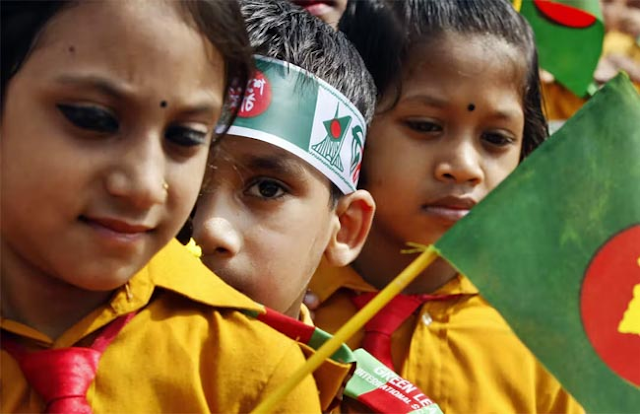
On 5 February 2013, suddenly Shahbagh intersection become lively as thousands of angry and frustrated young people thronged the place to demand maximum punishment of war criminals indicted for war crimes and a crime against humanity during the brutal birth of Bangladesh.

On the tenth anniversary of Gono Jagaron Moncho, remembered for the revival of the war cry of Bangladeshi nationalism ‘Joy Bangla’ was significant. Tens of thousands of young people from all walks of life have turned up to protest the life sentences handed out to Islamists.

The platform for trial and punishment of Bangladesh-born henchmen of occupation Pakistan armed forces imbibed millions of young people despite they were born after the liberation war. They did not forget what the war criminals have committed to their motherland.

Popular belief suggests that Bangladesh is a conservative Sunni Muslim majority. The melee of thousands of young women at the square belies this. The women are there, with children in tow, on their lap or shoulder way past midnight.

The deafening roar of the youths at Shahbag Square, the epicentre of protest in Dhaka, is awe-inspiring. Mainly because over one lakh youth chanted “Joy Bangla” (Long Live Bangladesh) throughout the day and night.

Joy Bangla was the war cry of the Mukti Bahini (Bangladesh Liberation Forces) during the 1971 bloody liberation war.

The Joy Bangla slogan became taboo after the assassination of independence hero Sheikh Mujibur Rahman in 1975.

“Today I walk in the streets shouting the slogan without fear, prejudice or being bashful,” Shamsuddin Ahmed, journalist and writer tells me. “I haven’t heard that slogan in over 40 years since the country was liberated.”

The revival of the war cry of Bangladeshi nationalism is significant. Young people from all walks of life have turned out in their thousands to protest the life sentences handed out to an Islamist war criminal by the Bangladesh International Crimes Tribunal.

If the tribunal persists, Bangladesh could become the world’s first Muslim nation to bury political Islam once and for all. It is a devil which needs to be contained. And here’s why they were at Shahbag.

The struggle against the Islamic Republic of Pakistan was sparked off in its erstwhile eastern province in March 1971. Nine months later, the new nation of Bangladesh emerged, after a bloody gruesome war for millions of Muslims, Hindus, Christians and Buddhists and Adivasis alike.

Pakistan’s marauding army with their local henchmen committed genocide, crime against humanity and forced abductions for nine months of the independence war, nearly 4.5 lakh women were victims of rape as a weapon of war, and intellectuals were murdered and abducted.

Bangladesh war historian Prof. Muntasir Mamoon claims genocide of three million people. These were people whose only crime was to believe in the independence of Bangladesh. The marauding Pakistan forces and their henchmen were blamed for the genocide.

The peasants and students fought the elite Pakistan military forces and their auxiliary forces, largely recruited from among the Bangalee Muslim population in the country.

Their spirits were not dampened and we have demanded the trial of these henchmen, collaborators of war crimes. For forty years our voice was not heard. But most underestimated the new generation.

Their thunderous cry is not just audible over Shahbag Square. It echoes over social media, Twitter and Facebook. It is an angry voice demanding justice.

In the Arab Spring, the protests were anti-government. The Arab protester’s objective was to achieve democracy, freedom and justice. In Bangladesh, the scenario is dramatically different.

The protester’s quest is to seek justice for crimes committed in 1971, when Bangladesh, formerly the Eastern province of Pakistan, attained its independence. The crowd listens patiently to the chorus, poetry recitation and brief speeches for hours. Thousands chant slogans repeatedly.

Today Gono Jagaron Moncho which bonded millions of youngsters is a history, despite the controversy and myths around the movement. Forty-two years after its difficult birth, Bangladesh witnessed a rebirth in Shahbag Square.

First published in The News Times, February 5, 2023

Saleem Samad, is an award winning independent journalist, media rights defender, recipient of Ashoka Fellowship and Hellman-Hammett Award. He could be reached at <saleemsamad@hotmail.com>; Twitter @saleemsamad

Wednesday, March 09, 2022

Why Did Pakistan Crackdown In Bangladesh, Balochistan In March?


SALEEM SAMAD

It may be coincidental that the Islamic Republic of Pakistan has a weakness for the month of March!

The Islamic nation-state possibly felt the month of March was a ‘holy’ month or lucky month for the ruthless crackdown in Balochistan and after 23 years sadistically repeated it in Bangladesh.

Maybe the fortune-tellers to the military hawks in Rawalpindi decide their evil actions on the particular month of March. Whatever the motive, the evil axis occurred in March.

The regime in Rawalpindi launched fierce genocidal ‘Operation Searchlight’ in Bangladesh on the night of 25 March 1971.

In the nine months to freedom, 3 million martyrs were victims of genocide, and more than 400,000 women were raped as a weapon of war. Possibly the world’s largest war refugee was created in living history. More than 10 million war refugees took shelter in neighbouring India.

The Pakistan junta did not realise they will experience a humiliating defeat in December 1971. After the Second World War, another formal surrender occurred when 93,000 Pakistan troops signed the instrument of surrender at Dhaka on 16 December 1971.

Before the crackdown in Bangladesh in March 1971, Pakistan’s invasion of the largest princely states Balochistan on 27 March 1948 killed several thousand innocent Baloch. Their struggle for independence still rages in the rugged terrain of Balochistan.

However, the Pakistan official narratives claim that the State of Kalat acceded to Pakistan on 27 March after Mohammad Ali Jinnah sent a confidential letter to ‘Khan of Kalat’.

Jinnah was legal adviser to ‘Khan of Kalat’ and with his full knowledge, the Pakistan military attacked and invaded Quetta, the capital of Balochistan.

Well, history says differently. Balochistan became an independent country on 4 August 1947, much ahead of the independence of Pakistan on 14 August 1947.

The declaration of independence of Balochistan was announced on 11 August 1947, three days before Pakistan was created. Unfortunately, the independence of Balochistan was short-lived and lasted for 252 days.

Before the partition of India and Pakistan, Balochistan consisted of four princely states of Kalat, Lasbela, Kharan and Makran under the British Raj. Two of these provinces, Lasbela and Kharan, were ‘fiduciary states’ placed under Khan of Kalat’s rule by the British, as was Makran which was a district of Kalat.

In the notorious month of March, many political events occurred. On 23 March 1956, the road to military rule was paved when General Iskander Mirza was sworn in as the first President of Pakistan.

On 25 March 1969, in a bloodless coup d’état Pakistan Army chief General Yahya Khan took over power from General Ayub Khan, a dictator of a decade and proclaim Martial Law and dissolved the assemblies.

Pakistan first tried to trick the leaders of Balochistan into joining the renegade part of India in the name of ‘Muslim’, but when both Houses of Balochistan unanimously refused to annexe with Pakistan angered the hierarchy, then based in Karachi.

After the bloody independence of Bangladesh, the Pakistan troops were still Prisoners of War (POWs) in India, the Prime Minister Zulfiqar Ali Bhutto to rejuvenate the demoralised Pakistan troops, gave responsibilities to “Butcher of Bengal” General Tikka Khan, then army chief to crack down on Baloch separatists and dissidents.

Subsequently, the military operation against separatists commenced in Balochistan in 1973 and the armed nationalist movement was brutally suppressed. The fiercest Baloch people have been struggling against Pakistan’s occupation and fought in 1948, 1958, 1962 and 1974.

What is more frustrating for Pakistan is that it failed to defeat the Baloch liberation struggle despite killing thousands of Baloch nationalists. More than 20,000 were victims of enforced disappearances and “dumping”. Those captured were brutally tortured and bullet-ridden bodies of thousands of Baloch political prisoners are found on the roadside.

The brutal torture of state forces includes gouging the eyes of the victims, cutting their tongues, noses, amputating their limbs, drilling holes in their bodies and many other inhuman and brutal mediums of torture. Pakistan junta is still paying an enormous price for the crackdown in Balochistan.

First published in The News Times, 9 March 2022

Saleem Samad, is an independent journalist, media rights defender, recipient of Ashoka Fellowship and Hellman-Hammett Award. He could be reached at <saleemsamad@hotmail.com>; Twitter @saleemsamad
Wednesday, December 08, 2021

We won the war, but was Bangladesh liberated?

SALEEM SAMAD, Times of India

“Bottomless basket,” US national security adviser Henry Kissinger called Bangladesh soon after it was formed. Five decades on, Bangladesh has turned that around. But with hate speech growing and tolerance shrinking, are there bigger challenges ahead?

No liberation war in the world was as decisive as that of Bangladesh. The barefoot, half-naked soldiers of the Mukti Bahini had faced off with the Islamic militia of Pakistan and emerged victorious. A triumphant Sheikh Mujibur Rahman, the leader of the East Pakistan Awami League who led the resistance for an independent East Bengal, was released from prison in January 1972. When he took over the reins of the country, he had a huge task ahead of him. Corruption was raging, a famine was sweeping the nation and the ravages of over a decade of struggle had rent the people apart.

He got to work but his compatriots betrayed him. He was assassinated in a military putsch on 15 August 1975 – when India was celebrating its Independence Day. Fifty years on, the secular ethos he died defending is under threat.

What we fought for

India and Pakistan were partitioned once, in 1947. But Bangladesh was partitioned thrice — 1905, 1947 and 1971. The contentious theory of the origins of Bangladesh is that it goes back to 1905, when the British Viceroy of India Lord Curzon partitioned Bengal. Indian nationalists and the intellectuals of Bengal vehemently opposed it. The seeds of Bengali nationalism had been sown.

When the two-nation theory was floated, the name for the new homeland for Muslims, Pakistan, was suggested by a young Britain-educated lawyer Choudhary Rahmat Ali in 1933. P for Punjab, A for Afghan province (now Khyber-Pakhtunkhwa), K for Kashmir, I for Indus, S for Singh, and ‘stan’ for Balochistan. East Bengal found no mention. It angered the revolutionaries of Bengal.

In 1940, fiery Bengal politician AK Fazlul Huq proposed the Lahore Resolution on behalf of the All India Muslim League — it called for independent states of Muslims in India — and nationalists began imagining an independent East Bengal.

By the 1960s, it had turned into a movement. Bangabandhu (friend of Bangladesh) Mujib, incarcerated on and off, was sent off to jail again in 1968 in the infamous ‘Agartala Conspiracy’ case. Anger spilled onto the streets and spread to the rest of Pakistan, with violent student protests against Pakistan’s military junta in 1969. The anti-government agitation ousted the decade-long military dictatorship of General Ayub Khan. 

Mujib won a landslide victory in the first ever general elections in December 1970. He was poised to be the head of the government of Pakistan. Three months later, opposition leaders from the provinces of Punjab, Sindh, Balochistan and the North West Frontier Province (now Khyber Pakhtunkhwa) pledged allegiance to Mujib’s Six-Point Political Agenda, which sought regional autonomy for the provinces in Pakistan.

Between Mujib winning and this agenda being accepted by political leaders, General Khadim Hussain Raja, commander of the Eastern Command, planned Operation Blitz. It would mean suspension of all political activities and a return to military rule. The armed forces of Pakistan would be allowed to move against “defiant political leaders” and take them into “protective custody”. But Lieutenant General Yaqub Khan, who was chief of general staff of the Eastern Command, and Admiral Syed Mohammad Ahsan, who was governor of East Pakistan, scuttled the plan. Not for long, though.

The frustrated General Yahya Khan, president of Pakistan, ousted both Khan and Ahsan. Later, General Raja was also shown the door. 

Why the Mukti Bahini was formed 

Weeks before the genocidal campaign of March 25, 1971, codenamed Operation Searchlight, most officers and soldiers of the East Bengal Regiment and border guards East Pakistan Rifles revolted. The rebel officers and soldiers along with hundreds of border guard troops and policemen crossed into India, with fire cover from the Indian Border Security Force shielding them The rebel officers held a crucial meeting on April 12 at Teliapara in Sylhet — the Mukti Bahini (Bangladesh Liberation Force) was formed under the command of Colonel (later General) MAG Osmany. The Mukti Bahini decided it would go the guerrilla way, on the lines of what Vietnam rebels did, instead of conventional war. Thousands of students, youths and farmers, including women, joined the Mukti Bahini.

Where is Bangladesh now?

At the helm now is his daughter, Sheikh Hasina, who took over in 2009 after the country had seen three decades of autocratic regimes. The economy took off. She opened up the country to foreign investment from India, Japan, South Korea, the US, Turkey and European countries. Soon, Bangladesh became the second largest exporter of readymade garments. Pharmaceutical products are its other big export, to more than 70 countries, and frozen fish and food to Europe, North America, the Middle East and Australasia.

Bangladesh made big strides in meeting Sustainable Development Goals. Hasina has been elected Prime Minister thrice, holding office for 12 years. Her decision to take in more than a million Rohingya refugees who had fled Myanmar was appreciated globally.

But the human rights record at home has been controversial. Sectarian violence against Hindus in mid-October cast a shadow on the secular credentials of the country. Rights groups claim no perpetrator of sectarian violence against religious minorities, desecration of temples, arson and plunder faced criminal proceedings.

Before the 2018 general elections, the authorities ignored human rights groups, civil society and journalists’ bodies to enact the Digital Security Act, which was believed to throttle freedom of expression.

In three years since then, 1,516 cases have been filed under the law against 142 journalists, 35 teachers, 194 politicians and 67 students. None against Islamic evangelists who peddle hate speech online against women’s empowerment and elective democracy, and want a theocratic state. Nor against those uploading videos on YouTube demanding that the country’s flag be changed to a crescent and the national anthem be scrapped because a Hindu poet (Nobel laureate Rabindranath Tagore) wrote it. “It is a retreat from the commitments of 1971,” said acclaimed social scientist Prof Rehman Sobhan.

The authorities are yet to complete a non-controversial registration of liberation war veterans. Successive regimes failed to prepare a genuine list of veterans. Let’s not discuss the total number of genocide victims — researchers claim the number could be higher than 3 million. Tens of thousands of infants and elderly people died of cholera and diarrhoeal disease in refugee camps. Bangladesh has had seven governments since Mujib’s. Not one took up the issues of 1971 seriously.

Political historian Mohiuddin Ahmad quoted a Liberation War poster: “Banglar Hindu, Banglar Christian, Banglar Buddhist, Banglar Musalman, Amra shobai Bangalee (Bengali Hindus, Christians, Buddhists, Muslims — we are all Bengalis).” He added, “If I knew Islamism would triumph over secularism, pluralism and tolerance, I would not have joined Mukti Bahini to liberate the country.”

First published in TIMESOFINDIA.COM, 8 December 2021

The writer is an independent journalist and columnist based in Bangladesh

Tuesday, June 01, 2021

The last 10 days of East Pakistan

COURTESY OF ANWAR HOSSAIN FOUNDATION

SALEEM SAMAD

On March 15, 1971, Yahya Khan arrived in Dhaka amid growing political unrest and no light at the end of the tunnel. His mission was to halt the “civil disobedience movement” called by Awami League leader Bangabandhu Sheikh Mujibur Rahman.

Rawalpindi GHQ insisted that Yayha Khan needed to make a final bid to ensure Pakistan’s integrity after meeting Sheikh Mujib. The following day, Sheikh Mujib met Yahya Khan at Bailey Road. 

Mistrust and suspicion between Mujib and Yahya had heightened to such an extreme level that their first meeting had to take place in the bathroom of the Presidential Suite. The Awami League leader refused to hold parleys in the President’s House drawing-room on suspicion that it could be bugged, writes Ian Talbot, author of Pakistan: A Modern History.

In an hour-long parley, President Yahya wanted to justify the cancellation of the maiden National Assembly session on March 1, 1971, whilst Sheikh Mujib remained defiant on his demand to withdraw the martial law.

Meanwhile, the non-cooperation movement coupled with street agitation continued.

Yayha was dragging his feet on the withdrawal of the martial law promulgation. He argued that if martial law was abrogated, there would be a “constitutional vacuum.” Mujib quickly said that he would request his advisers to sit with the president’s advisers to work out a formula that would resolve the so-called “constitutional vacuum.”

On Mujib’s advice, Dr Kamal Hossain met the president’s principal staff officer Gen SGM Peerzada and argued that under no circumstances did the postponement of the national assembly session, scheduled to be held in Dhaka, have any justification.

On March 17, Mujib-Yahya’s closed door parley resumed again. As usual, neither the Hawks in Rawalpindi nor the Awami League’s party office issued any media statement. Thus the media was publishing speculative news in Dhaka and Karachi.

Meanwhile, the Awami League rejected the formation of a 5-member probe body to determine why the army was called into action and the reasons behind the killing of agitating people during the shutdown.

Instead, the Awami League formed an alternative 3-member enquiry committee consisting of Captain Mansur Ali, Khondaker Mostaq Ahmad, and Abidur Reza.

On March 19, a third round of parley between Mujib-Yahya was held and it was decided that there would be another meeting the following day. Representatives from both sides had a separate meeting to formulate the basis of discussion for the impending meeting to break the political impasse. Failing to negotiate, President Yahya and Sheikh Mujib were at a standstill along with their advisors on March 20 for two hours. In fact, it was to be their last meeting. Yahya Khan was shrewdly leading towards an inclusive meeting to prove that the dialogue had entered a dead end.

On the call of Maulana Abdul Hamid Khan Bhashani to observe “Swadhin Purba Bangla Dibash” on the Republic Day of Pakistan on March 23 -- except the government buildings and military garrisons –– all over the country, the independent Bangladesh flag was hoisted.

While the dialogue was in progress, the Rawalpindi Hawks secretly prepared its infamous genocidal plan -- “Operation Searchlight” -- which was launched at midnight on March 25. Hours later, Sheikh Mujib was detained and flown to Karachi.

First Published in the Dhaka Tribune, 1 June 2021

Saleem Samad is an independent journalist, media rights defender, recipient of Ashoka Fellowship and Hellman-Hammett Award. He can be reached at <saleemsamad@hotmail.com>; Twitter @saleemsamad

Tuesday, May 04, 2021

How Indira Gandhi’s principal secretary PN Haksar had aided the liberation effort in 1971

SALEEM SAMAD

The genocidal campaign “Operation Searchlight” raged in occupied Bangladesh. The marauding Pakistan Army began to feel the pinch in their boots when they battled the Mukti Bahini resistance in several regions bordering India.

On the other hand, the beleaguered Awami League leaders who took sanctuary in India spent restless nights planning the pros and cons of diplomatic protocols to announce the “government-in-exile” in Kolkata and its strategies to augment the military role of the Mukti Bahini in the Liberation War.

A career bureaucrat and diplomat, Parmeshwar Narayan Haksar -- principal secretary to Indian Prime Minister Indira Gandhi -- had already gotten the ball rolling on Bangladesh on March 2, 1971.

Prof Amartya Sen (who won Nobel Prize 27 years later) phoned PN Haksar and introduced his two friends Prof Rehman Sobhan and Dr Anisur Rahman, who were sheltered in his house. Veteran economist and academician Prof Rehman Sobhan and Dr Anisur Rahman were the first people who had escaped from Dhaka to meet Haksar in Delhi.

On the evening of April 2, Sobhan and Rahman were taken to Haksar’s residence. 

Haksar was fully briefed by the duo regarding the dream of independent Bangladesh. The logical approach to the Bangladesh struggle helped Haksar debrief Indira Gandhi.

In fact, from that evening, India’s secret role in the Bangladesh Liberation War began its journey. Haksar played a pivotal role throughout 1971, orchestrating and managing India’s response to the crisis in Bangladesh.

Sobhan himself has written that Haksar’s reactions suggested that the encounter he had with them “was [Haksar’s] first such exposure to these events of the genocidal crackdown on the Awami League, the nationalists, and the Hindus by the Pakistani army and the launch of Operation Searchlight.”

Haksar was also introduced to Tajuddin Ahmad, general secretary of Awami League, and Barrister Amirul Islam when they called on Indira Gandhi. 

On principle, the Indian prime minister agreed with the Bangladesh government-in-exile, to provide shelter for the millions of refugees who had poured into India, and also to provide military help to the Mukti Bahini.

A fortnight later, on April 17, Sobhan wrote that Tajuddin Ahmad was sworn in as the prime minister of an independent Bangladesh “at a mango grove near Kushtia…which is now known as Mujibnagar.” Tajuddin, this time as the prime minister of the exiled government, again had parleys with Indira on the night of May 6.

Haksar had urged Indira to be firm and say that India’s response to what was happening in Bangladesh should not become a subject of public debate as “such a debate would defeat the purpose of giving such comfort as we can to democratic forces in Pakistan as a whole.”

Delhi planned that the main characteristics of the war would be guerrilla tactics, with the objective of continuously keeping the Pakistan army off their balance and gradually bleeding them.

Finally, the Pakistan military surrendered in Dhaka on December 16, 1971 after a humiliating defeat in the eastern war theatre.

First published in the Dhaka Tribune on 4 May 2021

Saleem Samad is an independent journalist, media rights defender, recipient of Ashoka Fellowship and Hellman-Hammett Award. He could be reached at saleemsamad@hotmail.com; Twitter @saleemsamad

https://www.dhakatribune.com/opinion/op-ed/2021/05/04/op-ed-an-ally-for-bangladesh

Tuesday, March 09, 2021

Born for the flag

Photo: MAHMUD HOSSAION OPU

The story of Salam Sikder and his loyalty to the Bangladesh flag

SALEEM SAMAD

Liberation War veteran Salam Sikder, born in a poor peasant family, left home in early 1971. He told his wife that henceforth, she must take care of their two children.

When filmmaker Kawsar Chowdhury met him in 1997 at Gollamari in Khulna, his eyes were glowing with pride, instilled with the glory of the Liberation War. He was in his early thirties when he joined the Mukti Bahini guerrillas. He and his combatants operated stealthily for months in Khulna and Bagerhat region under Sector 9, commanded by Major Jalil.

The ragtag foot soldiers survived on bare food ration but were defiant against marauding forces. Their objective was one -- to liberate the motherland from the brutal occupation of Pakistan. Salam did not remember how many hit and run operations they conducted in Dacope, Batiaghata, Gollamari, Rampal, and adjoining areas.

On December 16, 1971, heads held high, Salam along with a small unit of foot soldiers, marched into war-ravaged Khulna city. Several dead bodies were strewn all over the city. The flow of the Gollamari canal, a tributary of river Moyur, was blocked by countless corpses in the waterway.

On December 16, in a simple ceremony, the flag of independent Bangladesh was hoisted at a small field on the back of the Gollamari canal. Quickly a flag-stand made of a bamboo pole was erected. A flag was tied to a rope. Who would take the privilege to hoist the flag?

Commander Kamruzzaman Tuku asked Salam Sikder to hoist the flag. He began to cry and said that he was not the right choice when there were other valiant guerrilla fighters.

Finally, all hands joined to raise the flag. It was also decided to build a martyr’s memorial at the same site. The Mukti Bahini commander and others decided that the caretaker would be Salam Sikder and he would hoist the flag at dawn and lower at dusk.

The story does not end here. Till the last day of his life, he raised the flag and lowered it, as demanded by the commander.

He took the honorary job seriously. He lived in a dilapidated thatched house adjacent to the martyr’s memorial. Not a single day, till 1997, had Salam taken a day off. When he did visit neighbours and relatives, he quickly returned before evening to lower the flag.

He never requested his family members to wash the flag. The flag was washed with care as if he was bathing an infant. He lamented that his son often asked why he had spent his entire life for a flag and never took care of the family. He explained that when he left their mother with two sons, he could have been killed in the battlefront.

He appealed to them to seek blessings from the Almighty that their father was alive and said: “I have been born for the flag and I will die for the flag.”

The award-winning Liberation War documentary filmmaker Kawsar Chowdhury in 2004 visited the martyr’s memorial and also met the warrior in fragile health. A brain stroke left him physically challenged and with memory loss.

The following year, the loyal flag caretaker Salam Sikder died -- unfortunately unrecognized for his contribution. 

First published in the Dhaka Tribune, 9 March 2021

Saleem Samad is an independent journalist, media rights defender, recipient of Ashoka Fellowship and Hellman-Hammett Award. He can be reached at saleemsamad@hotmail.com; Twitter @saleemsamad

Tuesday, December 22, 2020

"How long can Pakistan hold out in the east (Bangladesh)”


SALEEM SAMAD

A conversation between Henry Kissinger and General Westmoreland about the birth of Bangladesh

Three days after a full-scale war between India and Pakistan in the eastern frontier and Bangladesh-India jointly against Pakistan in the eastern theatre, Henry Kissinger asked how long could the Pakistan troops hold in Bangladesh.

The meeting held in Washington DC, in the morning of December 6, 1971, was attended by senior officials of departments of state, defence, joint chief of staffs, CIA, USAID, and others.

US Secretary of State, Henry Kissinger, at the onset of the meeting asked Gen Westmoreland: “What is your military assessment? How long can Pakistan hold out in the east” (Bangladesh war zone)?

Gen Westmoreland candidly said up to three weeks. Once the Pakistan Army runs out of supplies, all the troops in East Pakistan [Bangladesh] will become hostage. The officials discussed whether there were any possibilities of Pakistan troop's evacuation. Gen Westmoreland responded in negative.

A senior official of the State Department asked Gen Westmoreland that assuming the Indians took over Bangladesh, how did he think it would happen?

Gen Westmoreland replied, “I think their primary thrust will be to cut off the seaport of Chittagong. This will virtually cut off any possibility of resupply. Then they will move to destroy the Pakistan regular forces, in cooperation with the Mukti Bahini. They will then be faced with the major job of restoring some order to the country. I think there will be a revenge massacre — possibly the greatest in the twentieth century.”

Kissinger asked whether the Indians would withdraw their army once the Pakistan forces were disarmed.

Gen Westmoreland replied that he thought they [Indian] would leave three or four divisions to work with the Mukti Bahini, and pull the remainder back to the West.

The officials expected that the Indians would pull out as quickly as they could. Once the Pakistan forces were disarmed, the Indians would have a friendly population. They could afford to move back to the border areas quickly.

Another official predicted that after the Indian Army had been in Bangladesh for two or three weeks, they would be accepted as a “Hindu army of occupation.”

Kissinger asked: “What will India do with Bangladesh? Will they see it as an independent state or have them negotiate with Islamabad?”

An official responded that India had already recognized Bangladesh as an independent country. Kissinger said then that there was no hope for Pakistan to negotiate with Bangladesh. The objective of the Indian Prime Minister Indira Gandhi’s government was to force a surrender of the Pakistani troops in Bangladesh within 10 days.

In a telegram from New Delhi on December 6, US Ambassador Kenneth Barnard Keating reported that Indian Foreign Secretary Triloki Nath Kaul had expressed “disappointment, shock and surprise” that the United States had tabled the resolution it did in the UNSC.

On December 5, the Soviet representative on the United Nations Security Council (UNSC) vetoed an eight-power draft resolution that called for a ceasefire and mutual withdrawal of forces, as well as intensified efforts to create the conditions necessary for the return of refugees to their homes.

The United States sriously wanted to stick with withdrawal and ceasefire, not a surrender of Pakistan troops. Kissinger assured the Pakistan regime that they were doing the best they could do diplomatically.

The resolution, which was tabled by Argentina, Belgium, Burundi, Italy, Japan, Nicaragua, Sierra-Leone, and Somalia, garnered a vote of 11 to 2 with 2 abstentions but was not adopted because of the negative vote of the Soviet Union (USSR). However, the UN Security Council accepted on December 6 that an impasse had been reached in its deliberations on the conflict in South Asia, and referred the issue to the General Assembly.

An estimated 93,000 Pakistan troops and civilians made an unconditional public surrender in Dhaka on December 16, 1971, which is observed as Victory Day each year.

First published in the Dhaka Tribune, 22 December 2020

Saleem Samad, is an independent journalist, media rights defender, recipient of Ashoka Fellowship and Hellman-Hammett Award. He could be reached at <saleemsamad@hotmail.com>; Twitter @saleemsamad

Monday, October 19, 2020

America’s political motives further complicated Bangladesh’s Liberation War

Photo: BIGSTOCK
SALEEM SAMAD

Pakistan’s acceptance of Bangladesh’s independence during the height of the Liberation War in 1971 would have shed more bloodletting in the restive region.

The supposedly brokered ceasefire by China and America would have surely collapsed, as the Mukti Bahini, the East Bengal guerrillas, would not have obeyed the call.

By October, the Pakistani junta had deliberately transferred back to Pakistan the amphibian battle tanks, the newly-installed radar at Dhaka was dismantled, as were the squadron of fighter aircraft, which were brought from China.

For many in Karachi, where the military hardware was unloaded in the port, they understood that it was a matter of weeks. The eastern province was to become an independent country, but it was worried about thousands of soldiers and officers, civil administration, business entrepreneurs, and Pakistan civilians in the eastern province.

Henry Kissinger, the double-edge former US secretary of state, in an interview by Jeffrey Goldberg published in The Atlantic, said talks between America and China would have collapsed if the US had publicly condemned human rights violations and atrocities by the Pakistan army against the people of then East Pakistan.

Months before the violent crackdown Operation Searchlight by the Pakistan military, Pakistan emerged as the interlocutor most acceptable to Beijing and Washington, and exchanges were conducted from Islamabad.

Goldberg’s question was whether the opening to China was worth the sacrifices and deaths experienced in the India-Pakistan Bangladesh crisis, to which Kissinger retorted that Bangladesh demonstrates how this issue has been confused in our public debate. There was never a choice between suffering in Bangladesh and the opening to China.

He did not hesitate to state that Pakistan deployed extreme violence and gross human rights violations when Bangladesh was battling to achieve independence.

“The US diplomats witnessing the Bangladesh tragedy were ignorant of the opening to China. Their descriptions were heartfelt and valid, but we could not respond publicly,” he said.

By the time of the Bangladesh crisis in 1971 -- when Pakistan imposed martial law to crush the territory’s bid for independence -- Nixon felt he owed Pakistan’s military dictator, General Yahya Khan, a debt of gratitude for his government’s role in facilitating Kissinger’s secret trip to China, ignoring reports of Pakistan’s military atrocities against Bangladeshi civilians. 

The US actively supported Pakistan, to the extent of violating congressional restrictions on supplying arms to Pakistani troops.

“In November, the Pakistani president agreed with Nixon to grant independence the following March,” Kissinger said.

But the following December, “India, after having made a treaty including military provisions with the Soviet Union, and in order to relieve the strain of refugees, invaded East Pakistan,” he said, adding that the US had to navigate between Soviet pressures, Indian objectives, Chinese suspicions, and Pakistani nationalism.

“By March 1972 -- within less than a year of the commencement of the crisis  -- Bangladesh was independent; the India-Pakistan War ended, and the opening to China completed at a summit in Beijing in February 1972,” said Kissinger.

In his book World Order, Kissinger describes India as “a fulcrum of twenty first century order: An indispensable element, based on its geography, resources, and tradition of sophisticated leadership, in the strategic and ideological evolution of the regions and the concepts of order at whose intersection it stands.”

But in 1971, when Pakistan’s erstwhile eastern wing fought to become Bangladesh, Kissinger made a U-Turn and scorned India as “a Soviet stooge, supported with Soviet arms” over its support for Bangladesh independence.

First published in the Dhaka Tribune on 19 October 2020

Saleem Samad is an independent journalist, media rights defender, and recipient of Ashoka Fellowship and Hellman-Hammett Award. He can be reached at saleemsamad@hotmail.com. Twitter @saleemsamad

Thursday, August 06, 2020

Can Bangladesh shun political Islam?


SALEEM SAMAD

For millions of people in an impoverished Bangladesh, it seems to have ushered a political blessing. The nation which fought a bloody war of independence in 1971 against Pakistan to establish secularism and democracy was obliterated by subsequent military juntas and pro-Islamic governments.

The first constitution has enshrined secularism, democracy, socialism, and nationalism as the key political philosophy of the independence of Bangladesh, which reflects the spirit of the independence war when the eastern province severed from Pakistan in 1971.

After the assassination of the architect of Bangladesh independence Sheikh Mujibur Rahman in a military putsch in 1975, the military-backed government of General Ziaur Rahman, a former Mukti Bahini commander, with a swagger stick doctored the constitution’s guiding principle and scribbled “Bismillah’ir Rahman’ir Rahim (Faith in Allah)” in 1979 to establish legitimacy of his military government.

After Mujib’s daughter Sheikh Hasina, leader of the Awami League swept to power in 2008 pledged to restoration of secularism and the trial of war criminals.

The Supreme Court in its landmark verdict forbids political parties that advocate political Islam. The apex court also asked to reinstate the four key principles in the constitution.

In separate voluminous judgements in July and August of 2010, the apex court pulled down the Fifth Amendment of 1979 and Seventh Amendment of 1986, including provisions that allowed religious-based politics, which was legitimized by tyrannical rules from 15 August 1975 to 9 April 1979 and 24 March 1982, and 10 November 1986 respectively.

The court in a ruling said the Seventh Amendment retroactively legitimized the very acts that successfully engineered the coups by former Chief of Army Staff Lt. Gen. Husain Muhammad Ershad unseated an elected government of President Justice Abdus Sattar in March 1982.

General Ershad in a bid to woo moral support of majoritarian Sunni Muslims had rewritten the constitution which determines “Islam as state religion” of a once secular nation.

The higher court judges noted, “The proclamation of martial law and its regulations and orders and all actions under this law shall remain illegal until Qayamat (the Last Day of Judgment). “The martial law was beyond the mandate of the constitution and will be invalid for eternity,” and said, “a usurper is a usurper.” It is deemed that the judgement squarely blamed both the military leaders have acted as a usurper to grab the state power.

The apex court’s verdict on the Fifth Amendment said, “The perpetrators of such illegalities should also be suitably punished and condemned so that in future no adventurist, no usurper, would dare to defy the people, their constitution, their government, established by them with their consent.”

The court dubs the “extra-constitutional adventurers” as predators of democracy who ushered military regimes.

General Zia was assassinated in a military coup d’état in 1982 and General Ershad was ousted in 1990, after a bloody pro-democracy revolution. He served a prison sentence for corruption but is a key ally coalition of the ruling party and died last year of old age complications.

Excited by hearing the superior court verdict Shahriar Kabir, a secularist, researcher and staunch advocate for the trial of the war criminals said the people’s mandate in the last general election for the restoration of secularism and trial of perpetrators responsible for the crime against humanity in 1971.

“Religious based politics was prohibited after brutal birth of Bangladesh. We have seen youths belonging to Jamaat-e-Islami (JeI) were engaged as henchmen of marauding Pakistan military. They raised Al-Badr, a death squad to kidnap and murder hundreds of intellectuals who could not escape for their safety and security,” he explained.

All the JeI leaders of the secret militia group Al-Badr were handed down maximum punishment for war crimes and crimes against humanity by the International Crimes Tribunal.

The journalist and film-maker Kabir said General Zia, after the assassination of Sheikh Mujib in a bid to gain political support, withdrew the ban on religious politics and allowed Islamic parties to regain grounds.

The Bangladesh Nationalist Party founded by assassinated General Rahman, presently led by his widow, Begum Khaleda Zia appealed the apex court’s first ruling on the Fifth Amendment last January and lost her in a crucial legal battle which was detrimental to her party.

Notwithstanding, Bangladesh is a Sunni Muslim-majority nation, most people practice a moderate version of Sunni Islam. In the long run, the country’s politicians want the country to transform into a secular democracy rather than “Islam as State Religion”.

Pending a verdict from the Appellate Division of the Supreme Court, the Bangladesh Election Commission has struck off the name of Jamaat-e-Islami (JeI) as a political party. Officially the Islamist party was unable to participate in the 2014 and 2018 general election. Unfortunately, the Islamist party failed to satisfy the Election Commission that it is a Bangladesh origin party, upholds the Bangladesh constitution, and expresses solidarity with the independence of Bangladesh.

JeI handbook and various published documents, the party did not accept the state constitution and demanded to override it with Quran and Sharia Law upon 164 million secular and moderate Muslim majority nation. Unfortunately, the party failed to muster moral support of the majority.

Besides, the party didn’t recognise Bangladesh independence. JeI was politically, morally, and physically supported by the marauding Pakistan military.

Regarding banning of Islamic parties, Sheikh Hasina told the Jatiya Sangsad (parliament) said the Islamic parties will not be banned, while “Bismillah’ir Rahman’ir Rahim” and state religion Islam will remain in the constitution.

Social justice activist Kabir is visibly disturbed regarding the delay in banning of religious-based political parties, especially JeI which opposed the independence of Bangladesh.

He said the prime minister’s statement in parliament has confused the nation and contradicts the verdict of the superior court. The Islamic parties would continue to function and overtly campaign against the war crimes trial.

First published in The South Asian Digest on 6 August 2020

Author is an independent journalist, media rights defender in Bangladesh. Recipient of Ashoka Fellowship and Hellman-Hammett Award

Tuesday, May 19, 2020

Pakistan looking to ‘secularize’ terrorism

SALEEM SAMAD
Amid the coronavirus pandemic taking a heavy toll of human lives globally, the General Head Quarters (GHQ) of the dreaded Pakistan army in Rawalpindi is attempting to “secularize terrorism” in restive Kashmir.
Rawalpindi has given birth to another jihadist terror network, The Resistance Front (TRF). The GHQ has developed the expertise in recruiting and abetting Islamic militias to fight and kill innocent people in a bid to establish “Naya Pakistan” of Imran Khan.
From Afghanistan to Bangladesh, Balochistan to Kashmir, Iran to India, the deep state has been engaged to destabilize the region, which the South Asian nations have strongly reacted to in regional forums.
Pakistan’s maiden brutal operation “Raiders in Kashmir” was in autumn 1948. Mohammad Ali Jinnah’s blue-eyed boy Brigadier Akbar Khan, Burma war front veteran, pushed hundreds and thousands of ferocious tribesmen and unleashed a reign of terror in the picturesque valley for 5 days.
Presently the so-called “Azad Kashmir” is also known as Pakistan Occupied Kashmir (POK) and rest of Jammu and Kashmir is Indian Administered Kashmir. 
Thus Kashmir remained in GHQ’s terror map.
Shabir Choudhry, a political activist from POK has written to British Leader of Opposition, Keir Starmer, informing that Pakistan continued to violate the UN Security Council’s resolutions on Kashmir. 
The withdrawal of the Pakistan army never materialized; instead, it infiltrates “jihad warriors” to commit violence and terrorism on the other side of Line of Control (LoC).
Rawalpindi’s skill in creating fright among the people was imported to brutally suppress the nation during the brutal birth of Bangladesh in 1971.
The hawkish General’s terrorism model was developed in the terror lab in POK and was transplanted in the Eastern War Theatre, a delta with the long monsoon season.
The shadowy lobby in Eastern Command of the Pakistan army in Dhaka implemented their sadistic plan to raise several terror groups and also brought in the paramilitary Rangers and Mujahid militias to implant fear-mongering among the local people.
Besides forming the “Shanti Committee” by staunch supporters of Islamic Pakistan with political leaders, the occupation forces also established the infamous razakars and raised 50,000 militias. The paramilitary East Pakistan Civil Armed Force (EPCAF) was attached to border security force East Pakistan Rifles (EPR), while the Al Badr and Al Shams units contributed another 5,000 militia each.
The strengthening of the groups of armed militias was mostly recruited locally to resist the Mukti Bahini’s onslaught and neutralize the dream to achieve independence of the people in towns and villages.
Al Badr was a secret death squad recruited largely from Islami Chhatra Sangha (later rechristened as Islamic Chhatra Shibir), a youth organization of the Islamist party Jamaat-e-Islami.
The secret death squad was responsible for enforced disappearances of nationalist supporters, savage torture, and brutal extrajudicial killings of thousands of intellectuals, teachers, and professionals all over the country.
To come out clear from the grey list of the Financial Action Task Force (FATF) -- the anti-terror financing watchdog -- Rawalpindi not only overnight floated TRF, but also the Joint Kashmir Front, Jammu Kashmir Ghaznavi Force, and other such new groups.
Well, the new terror group TRF has created waves in cyberspace streaming from Rawalpindi since October 2019. 
Pakistan’s spy agency ISI’s pandora’s box was exposed, like a chameleon, to secularize terrorism in Jammu and Kashmir by doing away with Lashkar-e-Tayyiba, Jaish-e-Mohammed, and Hizbul Mujahideen, which had gained notoriety, and merging them into one common non-Islamist label to make it look like an indigenous rebel movement with a modern outlook.
The Pakistani deep state’s idea of “bleeding India through a thousand cuts” is being experimented with for the last several decades, even as Islamabad gets little diplomatic or proxy military success in the Union Territory of Jammu and Kashmir, which has been relatively peaceful ever since the abrogation of Article 370, concluded an Indian conflict researcher Aditya Raj Kaul.

First published in the Dhaka Tribune, 19 May 2020

Saleem Samad is an independent journalist, media rights defender, recipient of Ashoka Fellowship and Hellman-Hammett Award. Twitter @saleemsamad; he can be reached at saleemsamad@hotmail.com

Monday, December 16, 2019

Bangladesh declared war against India on Dec 3

Photo: Courtesy Anwar Hossain Foundation
SALEEM SAMAD
And how a dream became reality
After nearly nine months of a brutal war of independence was coming to an end in early December, the foot soldiers of Mukti Bahini liberated large swathes of occupied Bangladesh backed by the mighty Indian Army, while the ragtag Pakistan soldiers were on the backfoot, converging to the nearest military garrisons.
Pakistan, in desperation, declared “Operation Chengiz Khan” and Pakistan Air Force (PAF) bombers began bombardment of six Indian military bases on December 3, 1971. The strike caused little damage.
The Indian armed forces in anticipation of air-strikes had kept their planes in bunkers.
A day before the Pakistan attack on Indian airfields, Indira Gandhi addressed her last public meeting in Kolkata after visiting the refugee camps in the city. Moments after the air-strikes in India’s western war theatre, few top military brasses briefed Indian Prime Minister Indira Gandhi regarding the PAF attacks on India.
Lieutenant General Sam Manekshaw, chief of the Army Staff of the Indian Army, paused for a moment in silence and advised her (Indira) to delay the declaration of war against Pakistan.
She was told that a surprise was waiting at the eastern theatre. Soon, Indira informed her senior aides that India would not declare war against Pakistan. Instead, Bangladesh would strike Pakistan targets in the east. 
She explained to her aides that the imminent declaration of war would jeopardize the diplomatic efforts mustered around the Bangladesh cause -- the genocide and millions of refugee issues. On the eve of a formal war between India and Pakistan, telephones started to ring at the Mukti Bahini headquarters on December 2. The two-month-old Bangladesh Air Force was entrusted to strike targets deep inside occupied Bangladesh.
Earlier on September 28, 1971, Bangladesh Air Force was formed with three fighter pilots defected from PAF and six civil pilots from Pakistan International Airlines (PIA), and another 60 strong ground technical crew also from PAF.
The formation of the Bangladesh Air Force, dubbed “Kilo Flight,” began its journey with three vintage aircraft on October 8, 1971.
Indian civilian authorities and the Indian Air Force gave one American-made stubborn DC-3 Dakota (donated by the Maharaja of Jodhpur), one Canadian-built DHC-3 Otter plane, and one French Alouette III helicopter for the newborn “Kilo Flight.”
The pilots and ground crew gathered for a special mission on September 28 at Dimapur in Nagaland, where they took advantage of the lack of night-fighting capability of the PAF to launch hit-and-run attacks on sensitive targets inside occupied Bangladesh.
After months of intensive training, the formation was activated for combat.
The first sortie was scheduled to take place on November 28 but was postponed by Indian high commands to December 2, which invited frustration among the “Kilo Flight” crews, eagerly waiting to strike inside Bangladesh. Meanwhile, the three civilian aircraft were renovated, suitable for guerrilla warfare operations.
The Otter boasted seven rockets under each of its wings and could deliver 10 of the 25-pound bombs manually through a makeshift door in the bottom of the plane. The helicopter was rigged to fire 14 rockets from pylons attached to its side and had .303 Browning machine guns installed.
It was fitted with a one-inch (25mm) steel plate welded to its floor for extra strength.
The Dakota was also modified, but for technical reasons, it was used to ferry exiled government officials and supplies only.
The Otter took off from Kailashsahar with a two-member crew -- Flight Lt Shamsul Alam and co-pilot Akram Ahmed -- for a mission against targets in Chittagong, the vital seaport, to disrupt logistics and supplies of Pakistani troops.
The second unit -- a helicopter sortie from Teliamura base in adjoining Tripura state -- was piloted by Flight Lt Sultan Mahmood and Flight Lt Badrul Alam and made a deadly strike at Godnail fuel depot, Narayanganj. The smoke from the flames was seen from the capital Dhaka for days.
Two sorties on crucial targets on December 3 completely demoralized the Pakistan military.
Well, the Indians commenced air-strikes from December 4 in the eastern theatre and, by December 7, the lone airfield at Tejgaon airport was disabled and knocked out of operation.
The 13 days was the shortest war in military history, followed by a historic surrender ceremony, and in fact, the second surrender after WWII.
On December 16 in 1971, a dramatic push led to the fall of Dhaka. The jubilant Mukti Bahini chanting “Joy Bangla” and Indian troops riding battle tanks marched into the capital. Indira Gandhi at Ramlila Grounds in New Delhi. on December 12, 1971. said: “The Bangladesh of their dream has today become a reality.” 

First Published in the Dhaka Tribune 16 December 2019

Saleem Samad, is an independent journalist, media rights defender, also recipient of Ashoka Fellow and Hellman-Hammett Award.

Monday, December 30, 2013

Bangladesh Must Never Forget Those Sacrifices

Photo: Sheikh Hasina has remained constant in her action against the right wing fundamentalists who, aided by the BNP, acting out of electoral compulsions, has encouraged nationwide violence

VIKRAM SOOD

It was on February 5, 2013 that the young in Dhaka came out to Shahbag Square to protest and demand capital punishment for the Butcher of Mirpur, Abdul Quader Mollah, along with others who had been sentenced to life imprisonment, for their war crimes during the Bangladesh Liberation War. The movement had quickly spread to the rest of the country and the Jamaat Islami reaction was immediate and has remained violent. Nevertheless, Sheikh Hasina has remained constant in her action against the right wing fundamentalists who, aided by the BNP, acting out of electoral compulsions and its own convictions, has encouraged nationwide violence.

Shahbag was about closure. It was a war against fundamentalism and was not about revenge. Many of the protestors were young boys and girls born after 1971 who gave the famous slogan ‘Joy Bangla’ a new relevance and a new meaning. It is in Bangladesh that they wish to remember the discrimination in all the 25 years preceding 1971 and the genocide in the nine months that preceded that December 16. It was too soon after independence to find out what happened during those horrible months as the new nation had to be built from the debris and the devastation that the West Pakistanis had left behind. Yet they needed to remember all that to build their future.

The then Karachi-based journalist, Anthony Mascarhenas, was the first in June 1971 to break the news internationally of the genocide in East Pakistan, leading the Pakistan Government to white wash the events in its white paper of August that year. The young nation needed more than anecdotal references.

The Bangladesh Collaborators (Special Tribunals) Order soon after liberation and the 1973 War Crimes Tribunals Act were lost in the assassination of Bangabandhu and some members of his family. It took the Awami League twenty years to regain power in 1996 only to lose it to the right wing BNP supported by the Jamaat-e-Islami, the party that had supported the Pakistan Army and had opposed independence.

Attempts at discovering what happened in 1971 and to record Pakistani atrocities remained haphazard. There was no systematic fact finding and War and Secession — Pakistan, India and the creation of Bangladesh by Richard Sisson and Leo Rose in 1991 was more an account covering the military aspects of the war and did not cover the activites of the Pakistan Army before the war.

Robert Payne’s Massacre has several anecdotal references but his book was published soon after independence as was Mascarenhas’ book The Rape of Bangladesh, so could not give accurate estimates. Susan Brownmiller (Against Our Will) refers to 400000 rapes by the Pakistan Army and its collaborators, of which nearly 80 per cent were Muslim women.
Centuries of Genocide (4th edition in 2013) edited by Samuel Totten and William S Parsons has a chapter — Genocide in Bangladesh by Rounaq Jahan that has detailed graphic descriptions of the killings and depredations. She also says 3 million were killed. Yet Sarmila Bose’s book Dead Reckoning has remained controversial as it sought to find proof for a predetermined finding that the Bengali claim was grossly exaggerated and accepts the Pakistan Army figure of 26,000 Bengalis killed. Bose is dismissive of Bengali claims about the extent of genocide.

It was left to Dr M A Hasan, a medical student in 1971 who had joined the Mukti Bahini resistance movement. He painstakingly researched the events of 1971 through his NGO, The War Crimes Fact Finding Commission established in 1999 produced an accurate report entitled War Crimes, Genocide and the Quest for Justice in 2008. This report should ideally be in research and history libraries given the meticulous details and perhaps not something the average reader would read. Fortunately, Dr Hasan has now published Beyond Denial — The Evidence of a Genocide for the average reader. Hasan’s study says that the figure of 3 million innocent civilians killed is the more likely figure. The book describes in considerable detail some truly blood curdling systematic massacres; only those with strong hearts should read these pages.

Bangladesh needs full closure of this painful aspect of her history and a move away from fundamentalism that threatens it today. Bangladesh has to see the fulfillment of its Shahbag moment. The recent hanging of Mollah, is a process in that closure. But when Pakistan’s National Assembly expressed concern at the hanging of Mollah and Interior Minister Nasir Ali Khan criticised this hanging, this only shows how dangerously delusional Pakistan’s leaders have become. No wonder this prompted Sheikh Hasina to comment that Pakistan had not accepted liberation of Bangladesh.

First published in Mid Day, Mumbai, India, December 30, 2013


Vikram Sood is a Vice President at Observer Research Foundation, Delhi, and a former chief of Research and Analysis Wing

Saturday, December 07, 2013

Bangladesh: Democracy Stumbles

The country is once again in the grip of authoritarianism and political violence, the roots of which run deep.

Photo Ben Hayes: Secularist demand to expedite trial of war criminals at Shahbag Square
NISHA SHARMEEN ALI

The announcement of the schedule for elections to the tenth Jatiya Sangsad (national parliament) on November 25 has stoked an already volatile political situation in Bangladesh. The ready reaction of the Bangladesh Nationalist Party-led opposition alliance to the chief election commissioner’s televised speech to the nation, during which he announced that the general elections will be held on January 5, 2014, came in the form of what was initially a 48-hour countrywide blockade of road, rail and water ways, subsequently extended to 71 hours, beginning from November 26. The blockade ended on November 30, but the BNP commenced another 72 hour countrywide blockade the next day, which was ultimately extended until the evening of December 5. The alliance has called for yet another blockade to begin on Saturday, December 7.

In the meantime, there has been widespread violence and vandalism: vehicles are torched, public and private property destroyed. The death toll as reported on December 4 had reached 40 and scores more have been wounded. Many of the casualties were caused by an explosion of crude bombs and arson attacks on public transport. According to Samanta Lal Sen, the coordinator of the burn and plastic surgery unit at Dhaka Medical College Hospital, the premier public hospital in the country, several of the victims of political violence, admitted with severe burn injuries in the last one month, had died and quite a few are in a critical condition.

The BNP-led alliance has been engaged in street agitation for months now in its demand that Sheikh Hasina resign as prime minister, given that her Awami League government completed its term on October 25. The opposition alliance claims that polls conducted under the government will not be free, fair or transparent. While the two sides continue their finger-pointing over the ongoing political impasse and social disorder, arising out of the failure of the ruling and opposition political alliances to reach a consensus on election-time government, there have reportedly been informal contacts between the feuding camps, supposedly geared towards a dialogue. Still, publicly at least, the two camps have thus far produced only contradictory statements about what the media has dubbed as “clandestine” meetings between the general secretaries of the Awami League and the BNP.

A History of Acrimony
Mutual mistrust, acrimony and recrimination between the two major political parties have come to mark Bangladeshi national politics, especially since the ouster of HM Ershad’s military regime in 1990 and the subsequent restoration of parliamentary democracy in 1991. In any case, intense political unrest has marked almost every election cycle in Bangladesh since the country won independence in 1971. For instance, during the 2001 elections, which the BNP won, approximately 400 people were reportedly killed and more than 17,000 injured, primarily in street clashes between members and supporters of competing political camps. The next election cycle in 2007 also resulted in several deaths and injuries, leading to an extra-constitutional takeover by a military-backed interim government. The elections to the ninth Jatiya Sangsad (national parliament) were eventually held in December 2008, with a 14-party alliance led by the Awami League scoring an electoral landslide victory.

The seeds of the political unrest and uncertainty over the forthcoming general elections were planted in June 2012, when the Awami League-dominated parliament pushed through the Fifteenth Amendment to the constitution, scrapping the provision that parliamentary elections must be held under a non-partisan caretaker government, headed by the chief justice of the Supreme Court. Ironically, in 1996, the Awami League and its opposition allies forced the then BNP-led government, through prolonged street agitation, to incorporate that particular provision in the form of the Thirteenth Amendment. Subsequently, two parliamentary elections, in 1996 and 2001, were held under caretaker governments.

After being elected in 2001, the BNP-led government increased the retirement age for the Supreme Court chief justice, apparently to have a person perceived loyal to it as the head of the caretaker government for the next elections scheduled for 2007. Then the main opposition party, the Awami League refused to accept the former chief justice in question as the chief adviser to the caretaker government and took to the streets. Amidst the consequent political stalemate, marked by sustained violence across the country, scope was created for the military-backed interim government to take over and rule for two years unconstitutionally, after declaring a state of emergency.

Elections or no elections, violence has become a major feature of Bangladesh politics. Numerous political leaders and activists have been killed by rivals or by their own party colleagues. Data from different human rights organizations suggests that the total number of deaths resulting from political violence in 2013 is substantially higher than in recent years, according to a report published in New Age on November 7. Ain O Salish Kendra reported that political violence had claimed the lives of 289 people in the first nine months of the current year while the figure was 84 for the whole of 2012. According to a monthly report by rights organization Odhikar, at least 27 people were killed and 3,433 injured in political violence in October alone.

This political violence may very well have had its origins in the early days of independent Bangladesh. The Awami League, which had presided over the political struggle for the country’s liberation and come to embody the people’s democratic aspirations, proved autocratic in power. In 1975, its head and then president Sheikh Mujibur Rahman introduced BAKSAL, which banned all opposition parties and compelled the country to adopt a one-party system. President Ziaur Rahman, the military general-turned-politician and founder of the BNP, restored the multiparty system in the late 1970s.

Military Intervention
Meanwhile, the path for military intervention in the political process may have been paved during the rule of the post-independence AL government. Notes Professor Amena Mohsin of Dhaka University in her published research paper: “The Mukti Bahini (liberation forces), which formed the nucleus of the Bangladesh army in the immediate aftermath of the liberation war was divided along the regular Bengali forces of the then Pakistan army and those recruited by the Awami League. After the liberation of Bangladesh, Mujib paid little attention for rebuilding the armed forces; this was a cause of major discontent among the army.” The discontent deepened when Mujib created Jatiya Rakkhi Bahini (National Defence Force). Rakkhi Bahini was generally viewed as a parallel institution and a threat to the interests of the army. The army was also apparently fed up with the discrimination, and disenchanted with the AL government’s unchecked rule, which had encouraged unbridled looting, illegal land grabbing and civil disorder. It was also carrying the legacy of the Pakistan army, which had its own track of deep engagement in politics. On August 15, 1975, Mujib was assassinated by a group of Bangladeshi military officers.

General Ziaur Rahman (popularly known as Zia) became president in 1977, following the resignation of the interim government president, Justice Sayem, on the grounds of illness. Many believed this was a Zia ploy to take control of the state with army backing. Although Sayem had promised early elections, Zia kept delaying them. The years of anarchy had left most of Bangladesh’s state institutions in a shambles, with constant threats of military coups amidst strikes and protests. Gaining total power, Zia banned political parties, censored the media, re-imposed martial law and commanded the army to arrest opposition forces. Ironically, Zia himself was assassinated in a military coup in 1981.

The country remained in the grip of military and quasi-military rule from 1975 till 1990, when Ershad’s regime, which had seized power through a military coup in 1982, was overthrown by a popular uprising. For the first time in the political history of Bangladesh, all major political parties joined forces to oust the rule, yet the role of the army in politics had become entrenched. The end of the autocratic regime and the election of the BNP in 1991 did not bring stability in the political arena and the military remained a major factor. Meanwhile, the student wings of the political parties have been encouraged to use arms, and continuous hartals (general strikes) emerged as a common phenomenon. Bangladesh politics became increasingly weaponized and street-centric.

A Hybrid Regime
In 2004, when the BNP was in power, AL president Sheikh Hasina was speaking at a rally in front of the party’s Bangabandhu Avenue office in Dhaka when grenades were hurled, in what was an apparent assassination attempt. Twenty people were killed and 300 injured. Since then, grenades have been found inside Dhaka Central Jail, Dhaka Medical College Hospital and at various cultural hubs. Disorder was rife during BNP’s last stint in power and the state was unable to protect the political rights and civil liberties of its citizens. The situation is unchanged, if not worse, during the Awami League-led government, which is characterized by negligible checks and balances. Not surprisingly, Bangladesh continues to be categorized under “hybrid regimes” in the Democracy Index by The Economist Intelligence Unit, meaning that democratic structures such as elections exist but the state has remained fundamentally authoritarian.

Clearly, the political system of Bangladesh needs a review. Can it transition to a full democracy or will it remain a hybrid regime? It is not easy to build a sturdy democracy. Even in established democratic states, the system can corrode if not nurtured and protected. The Global Corruption Barometer 2012, the largest worldwide survey on public views on corruption, says 50 per cent of Bangladeshis surveyed in 2010 considered the government’s measures effective in curbing corruption. After two years, that had declined to 26 per cent. According to the survey, Bangladeshis see the political parties and the police as the most corrupt institutions, followed by the judiciary, parliament and civil administration. People have reason to lose faith, given the extent of nepotism and graft. This erosion in faith persists with the two major political parties refusing to desert confrontational politics and work towards a transparent, accountable, and participatory democratic system.

Now, as the Awami League continues to evince no interest in accommodating the BNP’s demands by clinging to power beyond its tenure, while the opposition resorts to violent street agitation, there are fears of a repeat of the January 2007 intervention by the army. Were that to occur, Bangladesh would once again be going backwards on the path towards democratization.

First published in The Diplomat, December 06, 2013

Nisha Sharmeen Ali is a Dhaka-based journalist