Buy.com Monthly Coupon
Showing posts with label United Nations. Show all posts

Saturday, September 27, 2025

India is Blowing Hot and Cold with Bangladesh

SALEEM SAMAD

India has multiple reasons for disliking Bangladesh. In the aftermath of the event of the ouster of all-weather friend Sheikh Hasina from power in August 2024. If we look into previous regimes, Delhi developed heightened relations with Sheikh Mujibur Rahman (1972-1975) and her daughter, Sheikh Hasina (1976-2001 and 2009-2024).

Why? The Awami League party was literally “owned” by the Sheikh’s family was tilted to India when their government was in power. The people did not like it, and thousands of critics, dissidents, opposition, and also journalists were severely punished by both the autocratic regimes.

Not only the Awami League, but also the Bangladesh Nationalist Party (BNP) and Jatiya Party. When the military junta of liberation war veteran General Ziaur Rahman (1977-1981) and the other by General Hussain Muhammad Ershad (1982-1990) floated their parties and recruited politicians mostly from the former defunct Muslim League and pro-Maoist parties. Interestingly, the South Block in Delhi had love and hate relations with both the Rahman and Ershad, but both regimes were suspicious and careful of the giant neighbor.

India reciprocated ‘not-so-warm’ diplomatic relations, but each other’s leaders were on reciprocal official state visits to Delhi and Dhaka. Presently, Delhi is not happy with the sudden change of regime in Dhaka. The 36-day Monsoon Revolution street protest by Gen Z forced Prime Minister Sheikh Hasina to quit and flee. She sought political asylum in India.

India has not been able to accept the change in Bangladesh because it “did not like” what the students did during the uprising last year. “We have problems with India right now because they disliked what the students have done,” remarked Nobel laureate Prof Muhammad Yunus, Chief Adviser of the Interim Government.

He was speaking at an event organized by the Asia Society and the Asia Society Policy Institute in New York last week, which was moderated by Dr Kyung-wha Kang, president and CEO of the Asia Society. He said India’s hosting of Hasina has created all sorts of problems in the country and is responsible for the deaths of hundreds of young people, and is not helping bilateral ties between the neighbors.

The United Nations human rights body (OHCHR) claimed that nearly 1,400 people, including students, daily wage earners, vendors, public transport drivers, and children. “This issue creates a lot of tension between India and Bangladesh. Also, lots of fake news is disseminated from the other side [of the border]. This is a very bad thing,” Yunus lamented while attending the UN General Assembly in New York.

He flagged a piece of fake news claiming that the youth who brought about change in Bangladesh are Taliban. “They even said I’m a Taliban too. I don’t have a beard. I just left it at home,” he quipped. Yunus said SAARC (South Asian Association for Regional Cooperation) is supposed to be a bloc of very close family members, and the idea was born in Bangladesh.

“You can invest in Bangladesh. Bangladesh is going to invest in your territory. That’s the whole idea of SAARC,” he said. “All of us benefit from that… This is what we should be doing.” Yunus said SAARC’s idea was to bring all the countries in South Asia (Afghanistan, Bangladesh, Bhutan, India, Maldives, Nepal, Pakistan, and Sri Lanka) together so that young people can get in touch with each other.

The chief adviser said, “Our history allowed us to make that happen, but somehow it didn’t fit into the politics of someone’s country [not naming India], so it had to stop. We feel very sorry for that.” However, Yunus said Dhaka is willing to revitalize SAARC. “We want to make sure that we open it up and bring people [of South Asia] together. That is the only way to solve our issues.”

“I said, why don’t you look at neighbors, like Nepal, Bhutan, and also the seven northeast states of India. In the eastern part of Bangladesh, seven states don’t have any access to the ocean. These are landlocked regions,” he said, hinting at possible fields of economic cooperation. The Indian ‘Godi media’ are saber-rattling when Yunus mentioned that Bangladesh would give access to a new deep-seaport being built by the Japanese in the Bay of Bengal. So did the leaders of the radical Hindutva, ruling Bharatiya Janata Party (BJP), when Yunus spoke of giving access routes to landlocked northeast India states.

The Godi media and BJP stalwarts blamed Yunus for interfering in India and attempting to stir a separatist movement in the landlocked states, which will usher in China’s military presence in the conflict. He also mentioned Nepal and Bhutan. The countries welcomed the proposal, which will facilitate their exports through Bangladesh.

Earlier regional studies suggested that both Bangladesh and Northeast India need to scale up their multi-modal connectivity, which would not only help the region to raise its competitiveness but also narrow long-standing regional development gaps.

The port would immensely benefit economically and create jobs in Northeast Indian states, and Japan proposed a plan for road infrastructure for fast communication to the Bay of Bengal, and also developed backward linkage industries.

Japan has proposed developing an industrial hub in Bangladesh with supply chains to the landlocked northeast states of India, Nepal, and Bhutan beyond by developing a port and connectivity in the region, under the Bay of Bengal Industrial Growth Belt (BIG-B) initiative.

The connectivity will bring synergy in trade facilitation and build express corridors for the transshipment and transit of goods from northeast India to the Bangladesh port in Chattogram.

The former Japanese Prime Minister, Fumio Kishida, Japan’s Free and Open Indo-Pacific (FOIP) Vision, focused particularly on emerging economies and developing countries in the Indo-Pacific region and territories vulnerable to climate change and natural disasters.

It comes after Kishida visited India in March 2023, where he touted the idea of a new industrial hub for the Bay of Bengal and Northeast India that could bolster development in the impoverished region of 300 million people.

After Kishida visited India, Japan approved $1.27 billion to Bangladesh for three infrastructure projects – including an enormous commercial port in the Bay, which will be equivalent to the Port of Colombo in Sri Lanka or the Port of Singapore in terms of water depths, said a JICA (Japan International Cooperation Agency) official in charge of the project.

After the Japanese Prime Minister’s official visit, top Japanese officials visited New Delhi, Guwahati (Assam), Agartala (Tripura), and in Dhaka (Bangladesh). When Japan proposed the port and the economic emancipation of the majoritarian ethnic communities in the Northeast in 2023, the Indians cheered, after Japanese top officials made presentations in the Indian cities.

Japan wants her physical presence in the Bay of Bengal. As prestigious Japanese media Nikkei Asia writes, Bangladesh’s ambitious deep-sea port promises a strategic anchor for Japan and India.

A mega seaport under construction is shaping up to be a strategic linchpin for Japan and India as the QUAD (Quadrilateral Security Dialogue) partners (Australia, India, Japan, and the United States) aim to counter Chinese influence in the South China Sea.

The Red Sun, as Japan is branded, plans to build a Bengal – Northeast India industrial value chain in cooperation with India and Bangladesh to foster growth in the region.

A mega deep-sea port at Matarbari, in southeast Bangladesh waters, is expected to be completed in 2027. The complex will take a major load off of the country’s main Chattogram (formerly Chittagong) port and a trade gateway for northeast India, which would be less than 100 kilometers from the massive port facility.

Whatever the geopolitical strategy, the deep-sea port project has the potential to improve regional trade ties, boost investment, create jobs, and support infrastructural development, spurring economic growth for Bangladesh, Northeast India, Nepal, and Bhutan, as well as the surrounding areas of the Bay of Bengal.

First published in the Stratheia Policy Journal, Islamabad, Pakistan, 27 September 2025

Saleem Samad is an independent journalist based in Bangladesh and a media rights defender with Reporters Without Borders. He is the recipient of the Ashoka Fellowship and the Hellman-Hammett Award. He could be reached at <saleem.samad.1971@gmail.com>; Twitter (X): @saleemsamad

Saturday, March 25, 2023

China has to ensure return of Rohingya to Myanmar


SALEEM SAMAD

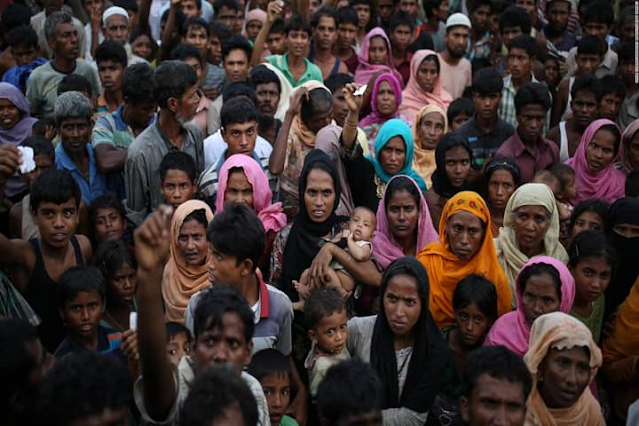
The lights are dim at the end of the tunnel in case of repatriation of Rohingya refugees living in squalid camps in the coastal district of Cox’s Bazar in Bangladesh.

The country hosts nearly 1.2 million Muslim Rohingya people who have fled ethno religious strife in neighbouring Myanmar during a military genocidal campaign, which killed at least 9,000 people in 2017.

The Tatmadaw (Myanmar military) backed campaign that the United Nations labelled a “textbook example of ethnic cleansing” saw hundreds of thousands of Rohingya driven across the border into Bangladesh in September 2017.

More than a million refugees are crammed in tens of thousands of make-shift huts made of bamboo, thin plastic sheets and corrugated tin roofs and the living conditions in the nauseating camps are dangerous. Often, fires blaze through the camps leaving thousands without shelter.

Last week, a 17-member delegation from Myanmar’s immigration and population ministries crossed into Bangladesh in mid-March and interviewed 480 Rohingya in Cox’s Bazar as part of a plan for possible repatriation to their country.

The Myanmar delegation, led by Aung Myo, the social welfare minister for Rakhine State, was selecting members for a pilot ‘family-based repatriation’ project.

The Myanmar delegation’s visit to the camps is believed to be brokered by China and facilitated by the UNHCR.

The Refugee Relief And Repatriation Commissioner (RRRC) in Cox’s Bazar, Mohammed Mizanur Rahman, said the Myanmar junta officials cleared 711 Rohingyas out of 1,140 recommended by Bangladesh. The newborn and newly married couples have been excluded from verification.

When journalists asked when the repatriation is expected to start, Rahman said that the “Myanmar delegation did not have the power to commit to a possible repatriation date.”

Before the visit of the delegation, the Myanmar junta for the first time since the 2017 crackdown, allowed diplomats from Bangladesh, India, China, and five other countries to tour the restive Rakhine State.

It was only then, the officials expressed the military junta’s plan to begin Rohingya repatriation under the pilot project.

Earlier, Bangladesh formally sought cooperation from China to repatriate Rohingya refugees to Myanmar during a visit by Foreign Minister Wang Yi and also China’s State Councillor promised to resolve a political solution to the Rohingya crisis.

China had used its influence in Myanmar to broker a November 2017 agreement to repatriate Rohingyas.

China’s ambassador to Bangladesh Yao Wen hoped that the first batch of displaced Rohingya would be repatriated to Myanmar soon while China continued its role as mediator, the official news agency Bangladesh Sangbad Sangstha reported.

On 17 March 2023, Bangladesh Foreign Minister Dr AK Abdul Momen also urged the Organisation of Islamic Cooperation (OIC) member states to take collective responsibility to ensure a safe and dignified return of the most persecuted Rohingyas to their homeland, Myanmar.

Indeed, OIC backed Gambia to file a genocide case with the International Court of Justice (ICJ). Only Turkey has a visible presence at the Rohingya camps in Cox’s Bazar.

India also launched “Operation Insaniyat” to provide relief assistance in response to the humanitarian crisis faced by a large influx of Rohingya refugees into Bangladesh from Myanmar.

Bangladesh and Myanmar began the negotiation for repatriation, but since 2018 none has returned so far and recent verification of a few hundred potential returnees for a pilot repatriation project remains unclear when they would be going home.

Despite attempts to send them back, the refugees refused, fearing insecurity in Myanmar, which was exacerbated by the military takeover last year.

Amid the situation, the United Nations High Commissioner for Refugees (UNHCR) in a statement on March 19 said they are observing developments of the Myanmar delegation’s visit to Bangladesh to verify a selected number of refugees on a bilateral pilot project on their possible returns.

The UN Refugee organisation reiterated that conditions in Myanmar’s Rakhine State are currently “not conducive to the sustainable return of Rohingya refugees”.

Bangladesh has consistently reaffirmed its commitment to “voluntary and sustainable repatriation” since the onset of the current crisis which echoes UNCHR policy that every refugee has a right to return to their home country based, make an informed choice and no refugee should be forced to repatriate.

China always wanted to impress upon their “feel good” diplomacy, but despite best intentions, it seems the repatriation has entered into a fresh deadlock as both Bangladesh and UNCHR, responsible for the safe return of the displaced Rohingyas are concerned about their safety and security in the Rakhine State.

The Rohingya issue must be addressed by China, a country [Myanmar] over which it has significant influence. Only China can make conclusive negotiations on the safe return of the Rohingyas, writes security analyst Samina Akhter in Modern Diplomacy.

Bangladesh and China have close political and military relations in addition to the fact that China is Bangladesh’s top trading and development partner.

Last week, Bangladesh has inaugurated a naval base in Cox’s Bazar with two conventional diesel-electric powered refurbished Chinese submarines bought for $205 million in 2016 to enhance Bangladesh’s naval capacity, after the demarcation of its maritime boundary with India and Myanmar.

It is equally true, that Myanmar’s military junta, which took power in a coup two years ago, has demonstrated no intention to take back any refugees.

Most importantly, the Rohingya refugee groups based in Bangladesh said for sustainable and dignified repatriation will only be possible when the Myanmar regime recognises the Rohingya as an ethnic community; provide legal citizenship which was stripped in 1982; school education; healthcare services; freedom of movement and livelihood.

Rohingya’s human rights groups believe the face-saving exercise to repatriate refugees happened after the Chinese exerted pressure on the Myanmar military junta to demonstrate a “feel good policy” otherwise face the compliance declared by the International Court of Justice (ICJ). The genocide case is resuming at ICJ on 24 April.

“Taking back a few refugees, even if it is less than one percent of the population, shall allow Myanmar to come up with a counterargument under the very false pretence they are sincere about the return of refugees,” the Arakan Rohingya National Alliance (ARNA) said in a statement.

First published in the India Initiative, New Delhi, India on 25 March 2023

Saleem Samad is an award-winning independent journalist based in Bangladesh

Thursday, March 09, 2023

Why Taliban's Are Afraid Of Purple?

SALEEM SAMAD

The radicalised Taliban after recapturing Afghanistan in August 2021, the regime has promulgated a series of misogynist decrees which targeted women only.

Women are barred from higher education, jobs and business. The Islamic Emirate of Afghanistan issued nearly 20 decrees against women during the last one and a half years inviting global outcry. The

International Women’s Day on 8 March is observed worldwide, but Afghanistan is the world’s most repressive country for women and girls, deprived of their basic rights, said the United Nations.

Despite the dark clouds over Afghanistan, there is two good news on an international day.

First, Afghan broadcaster Tolo News aired an all-female panel in its studio with an audience of women to mark International Women’s Day, a rare broadcast since the Taliban took over the vibrant country, reports BBC.

Second, despite the strict enforcement of protests, the women held a protest in Kabul on International Women’s Day, calling for women’s access to education and work. The protestors called for the removal of blanket restrictions on women in Afghanistan.

Since 1908 International Women’s Day’s thematic colour purple stands for dignity and justice, green for hope, and white for purity. Purple is the colour of women’s empowerment and gender equality, which the Taliban hates to listen to.

Tolo News to mark the auspicious day held a discussion session. The panel of three women and one female moderator with surgical masks covering their faces discussed the topic of the position of women in Islam. Taliban is not prepared to hear a sermon on Islam from a woman.

International media rights defender Reporters Without Borders (RSF) is aghast that the Taliban has continued to erase women journalists from the media landscape in Afghanistan.

In less than two years. Half of the 526 media outlets that existed until the summer of 2021 have had to close and, of the 2,300 women journalists since the Taliban takeover in August 2021, fewer than 200 are still working. Almost all of the women journalists (90%) have had to leave their jobs and some have fled the country, although exactly how many have managed to flee is not known.

Those still working must accept conditions that are becoming more and more draconian if not impossible. The Taliban Ministry for the Promotion of Virtue and Repression of Vice has also imposed a strict dress code. When women journalists are on camera, they must be covered from head to toe and only their eyes may be seen.

The female protestors issued a statement saying the current challenges against women should not be forgotten.

“It is March 8 but women in Afghanistan have no right to celebrate this day. We are the women who are imprisoned in the country. The restrictions are worsened day-by-day,” said Jolia Parsa, a member of Junbish Itlaf Khodjosh Zanan.

The protesters appealed to the international community to pay attention to the situation of women in Afghanistan.

“Today, the gates of gyms, schools, universities and parks have been closed for women,” said a member of Junbish Itlaf Khodjosh Zanan.

The UN Secretary-General António Guterres laments that women and girls “are erased from public life” in Afghanistan.

On the other hand, hopes are dashed as universities reopen after a winter vacation, but it’s another painful reminder to young women of how their world is shrinking.

Due to growing restrictions as well as the country’s severe economic crisis, the International Labour Organisation (ILO) said female employment had fallen 25 per cent last year since mid-2021. It added that more women were turning to self-employed work such as tailoring at home.

The United Nations Mission to Afghanistan called on the Taliban to reverse restrictions on the rights of girls and women, calling them “distressing.”

The Taliban have said the authorities have set up a committee to examine perceived issues to work towards re-opening girls’ schools. But there is no light at the end of the tunnel.

The Islamic Emirate has repeatedly said that they are committed to the rights of women and girls in Afghanistan and that their rights are preserved within strict Islamic Sharia laws.

First published in The News Times, Dhaka, Bangladesh on 9 March 2023

Saleem Samad, is an award-winning independent journalist, media rights defender, recipient of Ashoka Fellowship and Hellman-Hammett Award. He could be reached at <saleemsamad@hotmail.com>; Twitter @saleemsamad

Sunday, February 12, 2023

Is Freedom Of Expression Worsening In Bangladesh?

SALEEM SAMAD

Freedom of expression in Bangladesh has been a constant feature of our nation’s recent political history.

In the recent past, the global media and organisations at the national front, as well as in the international arena are agog on the issue of freedom of expression.

The international bodies including United Nations, foreign embassies, and human rights groups did not hesitate to be outspoken critics of the state of freedom of expression and also the status of press freedom in Bangladesh.

Well, a section of pro-government intellectuals and news organisations promptly blasted the national and international organisations for damaging the image of the country.

The ruling Awami League and the government agencies rebuked the organisations raising the issue of freedom of expression as a conspiracy against the country, which the authorities describe that freedom and democracy are running parallel and media is enjoying wide freedom.

Frankly speaking, they do not have enough information, nor do they understand the parameters of freedom of expression to counter the global outrage over the draconian laws which is shrinking the space for freedom of expression.

When the election is around the corner in January 2024, the government is poised to promulgate yet another law Telecommunication Regulatory Commission Regulation For Digital, Social Media, and OTT Platforms.

Similarly, the government months before the 2018 parliament elections passed the repressive Digital Security Act.

The cyber security law incorporates blasphemy, defamation and secrecy act which contradicts democracy, secularism, and pluralism.

The notorious Digital Security Act (DSA) criminalises the right to freedom of expression, dissent and critiquing the authority in any digital format. The worst victims were journalists, opposition politicians and netizens (social media users).

Politicians and journalists ranked the highest and were neck-to-neck in terms of those accused – at least 287 politicians and 280 journalists.

The draconian law recorded 1,109 cases filed under the DSA, of which around 60 per cent were over Facebook activities. A total of 2,889 individuals were accused, according to a study by the Centre for Governance Studies (CGS).

This study and other activities of CGS invited the state security agencies to haunt Zillur Rahman, executive director of CGS and a volley of criticism by intellectuals and ruling party politicians.

Meanwhile, the members of the global alliance Media Freedom Coalition (MFC) recently participated by envoys of Canada, Denmark, Germany, Netherlands, Norway, Sweden, Switzerland, the United Kingdom, and the United States.

Envoys from member countries of the MFC met early this month in the capital Dhaka to launch the MFC’s Diplomatic Network Initiative for their support of press freedom.

The diplomats discussed the current media landscape, including the censoring of online news portals and recent cases of harassment and intimidation of journalists.

The MFC was established in July 2019 at the Global Conference for Media Freedom and now comprises over 50 member states from six continents that have signed the Global Pledge on Media Freedom.

Last week, the United States Ambassador Peter Haas came down heavily at a discussion on “Online Freedom and Business Investment in Bangladesh” which jolted the upper echelons of the Awami League.

He frankly stated the United States government is concerned about the regulations for digital, social media, and over-the-top platforms the Bangladesh Telecommunications Regulatory Commission and the Ministry of Information have introduced, as well as the draft Data Protection Act.

What worries is that the “Data Protection Act, if passed with strict data localisation requirements, may force some US companies currently operating in Bangladesh to leave the market.”

The online platform regulations “will similarly dissuade companies from investing in their businesses here, if they face criminal liability for user content.”

The law threatens over 2,000 startup companies to be put out of business, and services that Bangladeshis use millions of times every day could become inaccessible.

The worst of worst came, the statement of Irene Khan, Special Rapporteur on the promotion and protection of the right to freedom of opinion and expression was released on 6 February on Telecommunication Regulatory Commission (draft) regulation for digital, social media, and OTT platforms.

Khan categorically said the proposed Data Protection Act is contradictory to Bangladesh’s obligations to the International Covenant on Civil and Political Rights (ICCPR).

Many of the categories of prohibited content in the draft Regulation are vaguely defined. Such broad and vague definitions as “racially or ethnically objectionable”, “offensive, false, or threatening and insulting or humiliating” or “hurts religious values or sentiment” are well beyond the restrictions permitted by international law.

Such clauses will encourage the removal of content by intermediaries as well as self-censorship among users, thereby having a direct chilling effect on freedom of expression, she observed in her report.

She urged the Bangladesh authorities to provide feedback on how the Digital, Social Media, and OTT Platforms Regulation is consistent with the obligations under international human rights law, especially the requirements of the Covenant.

Will the authority respond to the observation of Special Rapporteur Irene Khan? Bangladesh does not have the culture to respond to queries from international bodies.

First published in The News Times, Dhaka, Bangladesh, February 12, 2023

Saleem Samad, is an award winning independent journalist, media rights defender, recipient of Ashoka Fellowship and Hellman-Hammett Award. He could be reached at <saleemsamad@hotmail.com>; Twitter @saleemsamad

Tuesday, January 12, 2021

Madness, mayhem, and manipulation

It is a grim outlook for a new year, but it is not completely hopeless

SALEEM SAMAD

Should the citizens of the global village expect anything in 2021?

Does it not seem that it will be another series of new episodes, like last year, beset by the madness, mayhem, manipulation, and tyranny that dominated 2020.

For most, the future will be knitted from experience gathered from a year of facing the coronavirus pandemic.

While the regimes were busy doing damage control, everything seemed to have gone haywire; they were unable to control the virus outbreak, or the frustrations of the people. The governments, both in developed and developing countries, gradually took charge of the crisis.

The world leaders were left defenseless in the face of government bureaucrats and elected officials who dance to the tune of their corporate overlords and do what they want, when they want, with whomever they want, all at taxpayer expense.

Now that the people have slowly begun to trust scientists, pharmaceutical producers, United Nations bodies, development economists, health care experts and services, and development partners, the governments with advisers and politicians need to get back on the drawing board to redo the plans on how to live with the Covid-19 virus.

In the broad political spectrum, politics and politicians must come forward with sustainable solutions to the new dimensions of global crises, which is impacted by the pandemic.

Such rethinking has surfaced when the nations’ history, politics, and politicians add problems due to attempting quick-fix solutions, which are not sustainable.

Let the politicians and bureaucrats understand that people will not digest any kind of hypocrisy, double standards, or delusional belief. Nonetheless, the politicians and bureaucrats initially had hiccups when the pandemic was ravaging the economy. There is also no denying that the government wasted crucial time, funds, and effort to get things back on track.

Citizens of developing countries have tolerated injustice and abuse which befell upon them due to the government machinery such as police harassment and brutality, corruption, criminalization of politics, robberies from infrastructure development projects, forcible occupations and invasions of homes and properties of the weak and the minorities by politically-backed hooligans, state security surveillance, unfair taxation -- and the list grows on and on.

Global citizens have been utterly helpless in the face of government injustice meted out, both at home and abroad. Indeed, the systemic violence being perpetrated by the state and non-state actors demoralises any nation-state, writes John W Whitehead, founder and president of The Rutherford Institute.

Until we can own that truth, until we can forge our path back to a world in which freedom means something again, we are going to be stuck in this wormhole of populist anger, petty politics, and destruction that is pitting us against each other.

First published in the Dhaka Tribune, 12 January 2021

Saleem Samad is an independent journalist, media rights defender, recipient of Ashoka Fellowship and Hellman-Hammett Award. He can be reached at saleemsamad@hotmail.com; Twitter @saleemsamad

Tuesday, December 22, 2020

"How long can Pakistan hold out in the east (Bangladesh)”


SALEEM SAMAD

A conversation between Henry Kissinger and General Westmoreland about the birth of Bangladesh

Three days after a full-scale war between India and Pakistan in the eastern frontier and Bangladesh-India jointly against Pakistan in the eastern theatre, Henry Kissinger asked how long could the Pakistan troops hold in Bangladesh.

The meeting held in Washington DC, in the morning of December 6, 1971, was attended by senior officials of departments of state, defence, joint chief of staffs, CIA, USAID, and others.

US Secretary of State, Henry Kissinger, at the onset of the meeting asked Gen Westmoreland: “What is your military assessment? How long can Pakistan hold out in the east” (Bangladesh war zone)?

Gen Westmoreland candidly said up to three weeks. Once the Pakistan Army runs out of supplies, all the troops in East Pakistan [Bangladesh] will become hostage. The officials discussed whether there were any possibilities of Pakistan troop's evacuation. Gen Westmoreland responded in negative.

A senior official of the State Department asked Gen Westmoreland that assuming the Indians took over Bangladesh, how did he think it would happen?

Gen Westmoreland replied, “I think their primary thrust will be to cut off the seaport of Chittagong. This will virtually cut off any possibility of resupply. Then they will move to destroy the Pakistan regular forces, in cooperation with the Mukti Bahini. They will then be faced with the major job of restoring some order to the country. I think there will be a revenge massacre — possibly the greatest in the twentieth century.”

Kissinger asked whether the Indians would withdraw their army once the Pakistan forces were disarmed.

Gen Westmoreland replied that he thought they [Indian] would leave three or four divisions to work with the Mukti Bahini, and pull the remainder back to the West.

The officials expected that the Indians would pull out as quickly as they could. Once the Pakistan forces were disarmed, the Indians would have a friendly population. They could afford to move back to the border areas quickly.

Another official predicted that after the Indian Army had been in Bangladesh for two or three weeks, they would be accepted as a “Hindu army of occupation.”

Kissinger asked: “What will India do with Bangladesh? Will they see it as an independent state or have them negotiate with Islamabad?”

An official responded that India had already recognized Bangladesh as an independent country. Kissinger said then that there was no hope for Pakistan to negotiate with Bangladesh. The objective of the Indian Prime Minister Indira Gandhi’s government was to force a surrender of the Pakistani troops in Bangladesh within 10 days.

In a telegram from New Delhi on December 6, US Ambassador Kenneth Barnard Keating reported that Indian Foreign Secretary Triloki Nath Kaul had expressed “disappointment, shock and surprise” that the United States had tabled the resolution it did in the UNSC.

On December 5, the Soviet representative on the United Nations Security Council (UNSC) vetoed an eight-power draft resolution that called for a ceasefire and mutual withdrawal of forces, as well as intensified efforts to create the conditions necessary for the return of refugees to their homes.

The United States sriously wanted to stick with withdrawal and ceasefire, not a surrender of Pakistan troops. Kissinger assured the Pakistan regime that they were doing the best they could do diplomatically.

The resolution, which was tabled by Argentina, Belgium, Burundi, Italy, Japan, Nicaragua, Sierra-Leone, and Somalia, garnered a vote of 11 to 2 with 2 abstentions but was not adopted because of the negative vote of the Soviet Union (USSR). However, the UN Security Council accepted on December 6 that an impasse had been reached in its deliberations on the conflict in South Asia, and referred the issue to the General Assembly.

An estimated 93,000 Pakistan troops and civilians made an unconditional public surrender in Dhaka on December 16, 1971, which is observed as Victory Day each year.

First published in the Dhaka Tribune, 22 December 2020

Saleem Samad, is an independent journalist, media rights defender, recipient of Ashoka Fellowship and Hellman-Hammett Award. He could be reached at <saleemsamad@hotmail.com>; Twitter @saleemsamad

Wednesday, August 12, 2020

Should China apologize to Bangladesh?


SALEEM SAMAD

Chinese wolf-warrior diplomacy was on the lookout for ‘friends’ in South Asia to create political pressure on India. China brought together their all-weather friend Pakistan, new ally Nepal, debt-trap Sri Lanka under its folds, except Bangladesh, Afghanistan, and Bhutan.

China seems desperate to take diplomatic and economic ties with Bangladesh to a new height.

Since 1991 after a democratic government took power the China-Bangladesh relationship was intertwined for the partnership for economic development.

The new pro-Islamist regime of Khaleda Zia reached out to China to shrug off Indian influence which was an extended strategic gain for both countries.

China and Pakistan was the major military hardware supplier to Bangladesh military forces, which was also needed for United Nations Peacekeeping operations. The weighing scale plummeted under the growing influence of the China-Pakistan axis and penetrated deep into politics, bureaucracy, and economic development of the country.

In subsequent years, China emerged as the major economic partner in mega infrastructure development in Bangladesh and the cheering politicians began to beat their chest like King Kong.

Sheikh Hasina, a woman prime minister for successive fourth term has told her government officials that Bangladesh will give second-thought regarding multi-billion dollar development projects with China.

The world media reports have caught the attention of the Bangladesh leaders regarding several third-world countries were caught in debt-trap in South Asia, Africa, and the Pacific Ocean Islands. What happened was the country’s national exchequer failed to repay the huge loan invested in mega projects. China in a bid to salvage the debt-trap government took a 99-years lease of maritime ports and other facilities. End of the story!

Not very long Sheikh Hasina, the daughter of assassinated Bangabandhu Sheikh Mujibur Rahman, the founder of Bangladesh has reassured the Indian journalists that India is an ‘organic’ friend of Bangladesh and have jointly shed blood during the brutal independence in 1971.

She also said that China is a development partner and there is no conflict of interest. In 1971, the marauding Pakistan troops in eastern war theatre in desperate attempted to keep the two wings of Pakistan united. Pakistan troops and their Islamic militia continued to commit genocide and rape as a weapon of war.

Pakistan troops were in a quagmire. In the monsoon rain in floodplain delta coupled with Mukti Bahini guerilla’s hit and run operations gave the soldiers a hard time. Fortunately, Pakistan an ally of the Chinese Communist Party (CCP) received unlimited military supply and political support for the war to suppress the people.

Like the Pakistan media, Chinese media were tight-lipped of the genocide committed by marauding soldiers. China should admit the responsibility for the genocide perpetrated by Pakistan’s military hawks in Bangladesh.

For each victim of genocide, China delivered gifts via the Rawalpindi hawks which were “Made in China” bullets in brass that were pumped into the martyrs who wanted an independent Bangladesh.

China ignored world opinion on the Bangladesh liberation war in 1971. CCP closed their ears not to hear the cries and agonies of 10 million refugees who fled to neighboring India. Many countries in the world do not have 10 million populations!

On the other hand, on request of the Bangladesh government in exile, Maulana Abdul Hamid Khan Bhashani, chairman of the pro-China left-leaning National Awami Party’s appeal to the CCP for political support for Bangladesh went unanswered. Instead, China increased the supply of arms and ammunition.

After independence, China continued to politically and diplomatically harass the newly emerged independent nation.

The architect of Bangladesh’s independence, Sheikh Mujib after three weeks of the historic surrender of 93,000 Pakistan armed forces and para-military forces in Dhaka, had returned from the prison of Pakistan.

He took charge of a war-ravaged nation with a promise to feed the hungry people and task to rehabilitate the millions of refugees slowly trickled back home from camps in India. This phenomenon created a challenge for the new government. By April 1972, one after another, including the United States, Canada, Great Britain, European countries, allies of the Soviet Union, Japan, Australia, and scores of countries recognized the war-torn nation of 75 million. The trouble started when Bangladesh applied for membership to the United Nations in 1972. China spontaneously twice vetoed Bangladesh membership in the United Nations as the country desperately needed international food aid and budget for rehabilitation of the returnees from Indian refugee camps. China deliberately vetoed the application because two United Nations resolutions regarding the repatriation of Pakistani prisoners of war (POWs) and civilians held in India had not yet been implemented. Chinese move was certainly to keep Pakistan in good humor.

To withstand Asian-giant China, Sheikh Mujib to add diplomatic clouts joined the Non-Aligned Movement (NAM), The Commonwealth, and the Organisation of Islamic Conference (OIC), which indeed strengthened Bangladesh foothold in the global arena.

However, Pakistan recognized Bangladesh in 1974 under duress of the leaders of Islamic nations weeks before the OIC conference.

Even after diplomatic recognition by Pakistan, China continued to intimidate the government of Sheikh Mujib.

Overtly the pro-Beijing communist parties in the country received political blessings from CCP. The left parties despite divided into several factions opposed the liberation war, rejected independent Bangladesh, and expressed dissent on the government of Sheikh Mujib, blaming him a stooge of India.

The pro-Chinese extremist groups remained underground and their parties deliberately had prefix “East Pakistan (Purbo Pakistan)” or” East Bengal (Purbo Bangla)”.

Not to anybody’s surprise, the left extremist raised their heads above the ground and made the unconditional suspension of armed struggle during the military junta on the behest of the CCP’s.

Mujib in his book ‘Amar Dekha Nayachin’ (New China As I Saw) had visited China twice. First in 1952 and second in 1957. During his visit, he met both Mao Zedong, Zhou Enlai, and other CCP’s key leaders. He was confident that the Chinese leaders would listen to his request to recognize Bangladesh.

Stubborn Mujib opened diplomatic channels to win the heart of CCP. Pakistan’s veteran envoy to Beijing (1969-1972), Ambassador Khwaja Mohammad Kaiser, a member of Nawab clan in old Dhaka after his tenure in Beijing opted to return home.

Chinese Prime Minister Zhou Enlai confided to Ambassador Kaiser that he understood his difficulties. Well, Kaiser returned to Beijing, as Bangladesh Ambassador in 1984 for two years.

Mujib had also despatched a journalist and poet Faiz Ahmed to China. Faiz had friends in high places among CCP leadership when he was working in Radio Peking (now Beijing) Bangla Service in the 1960s. Faiz was Mujib’s play card game partner in Dhaka prison during 1966-1969. There he heard of Faiz’s relationship with the Chinese political leaders.

He traveled to Beijing via Hong Kong and met the CCP senior leaders. Unfortunately, he returned home with an empty hand. Despite the missions reached a dead end, Mujib did not lose hope.

Finally, China recognized Bangladesh, but not an elected government of Sheikh Mujib, but after his brutal assassination on 15 August 1975. China recognized the regime governed by coup leaders.

China was among the last countries to recognize independent Bangladesh on 31 August 1975.

The ‘dirty dozen’ army officers, mostly liberation war veterans who spearheaded the mutiny remained in power for 84 days. Expect for few fugitives most of the leaders were captured and rewarded the death penalty.

CCP’s anti-people policy during the bloody birth of Bangladesh, overtly providing military aid to Pakistan which augmented genocide with Chinese bullets should apologize. CCP should also apologize for harassing Bangabandhu Sheikh Mujibur Rahman.

First published in The South Asian Digest, Montreal, Canada on 12 August 2020

Author is an independent journalist, media rights defender in Bangladesh. Recipient of Ashoka Fellowship and Hellman-Hammett Award. He could be reached at saleemsamad@hotmail.com; Twitter: @saleemsamad

Monday, February 17, 2020

How likely is Myanmar to make policy changes after the ICJ ruling?

Myanmar’s denial of organized human rights abuses hold little water Photo: REUTERS
SALEEM SAMAD
Does Myanmar have any obligation to take the world court -- the International Court of Justice (ICJ) in The Hague – seriously?
The second question is whether Myanmar’s quasi-military ruler has the political will to implement the landmark judgment of January 23. Myanmar has officially rejected the International Court of Justice’s historic ruling and accused international rights groups of making exaggerated statements about the prevailing situation. It also rejected the UN fact-finding mission’s report on the basis of being “one-sided.”
It is well understood that the ICJ has no legal jurisdiction over Myanmar or any individual nation.
The ICJ ordered Myanmar to implement vital measures to protect its Rohingya population from facing any further atrocities. This ruling has been hailed as an “accomplishment of international justice.” The court further ordered Myanmar to ensure protection from the destruction of any evidence of “possible” genocide.
The ruling means that a global body, for the first time, has officially recognized the threat of abuse against the Rohingya, and ordered Myanmar to protect the community.
The verdict was indeed a significant triumph for the forcefully displaced Rohingya currently in refuge in Bangladesh. This ruling was also hailed by the government of Bangladesh, as the country is host to more than 1 million displaced Rohingya presently languishing in camps.
A lawsuit was brought to the ICJ by the Gambia, an impoverished Muslim state in Africa. The legal process was backed by the 57-nation Organization of Islamic Cooperation (OIC) in November at the highest body -- the United Nations -- for dispute resolution between states.
The OIC accused Myanmar of genocide against the Rohingya, in violation of a 1948 Genocide Convention. The Islamic body, as well as the United Nations, has condemned Myanmar’s refusal to repatriate the Rohingya as citizens of the country. Both bodies have raised concerns over the appalling human rights violations.
The challenges that remain the most significant impediments to the ICJ are that it has no power to execute its decisions and that it is voluntary in nature.
In 1993, the ICJ issued similar measures against Serbia after Bosnia had accused it of genocide. Just two years later, Serb forces killed thousands of Bosnian Muslim men and boys in what has become known as the Srebrenica massacre.
The ruling could not stop a second genocide in Europe after World War II.
Myanmar established an Independent Commission of Enquiry (ICOE) which acknowledges committing war crimes but not genocide during the military campaign.
The Myanmar government, headed by Nobel laureate for Peace Aung San Suu Kyi, has strongly denied organized human rights abuses. The regime systematically said that the military action, which followed militant attacks on Myanmar security forces in August 2017,  was “a legitimate counter-insurgency operation.”
The ICOE inquiry report mentions that nearly 900 people were killed. The commission failed to find assertions of gang-rape, or evidence to presume any intent of genocide. No one was surprised at the discrepancy between Myanmar and the international community over committing genocide.
The head of a UN fact-finding mission in Myanmar warned that there was a serious risk of genocide, and the mission did not hesitate to state in its final report, submitted in September 2019, that Myanmar should be held responsible in international legal forums for alleged genocide against the Rohingya.
Myanmar has questioned the legitimacy of the world court but is obliged under international law to comply with the ICJ ruling to provide regular reports to the ICJ, starting next May, to say what steps it has taken to prevent further abuse against the Rohingya.
It is highly unlikely that Myanmar will make any major policy changes to combat the discrimination against the Rohingya community, or provide support for international justice efforts. The United Nations Security Council (UNSC) has been paralyzed over the Rohingya crisis so far, with China shielding Myanmar from censure, which makes enforcement more difficult.
In this regard, an effective measure could be exerting diplomatic pressure by the international community, which has political and economic clout within the UN Security Council and can bring Myanmar to justice. The Convention against Genocide imposes a duty on states that are signatories to “prevent and to punish” genocide, as seen by Gambia’s ability to bring the case to the ICJ.
Until then, Myanmar will have an excuse to not take any measures for the repatriation, as well as the rehabilitation, of the displaced Rohingya. This difficultly will continue with a possible veto from China.
Whether Myanmar abides by the ICJ rulings remains to be seen. 

First published in Dhaka Tribune, 17 February 2020

Saleem Samad is an independent journalist, media rights defender, and is a recipient of the Ashoka Fellow and Hellman-Hammett Award. He can be followed on Twitter @saleemsamad

Wednesday, November 27, 2019

Facebook helped fuel hate-campaign against Rohingyas

Bangladesh now host over 1.1 million Rohingyas after 700,000 fled Myanmar since August, 2018 when insurgents’ attack triggered a military crackdown, which the UN say constituted to ethnic cleansing. File Photo/Reuters
SALEEM SAMAD
Here is how Facebook which dominates social media has failed the vulnerable communities, especially concerning the hate campaign and fake news against the Rohingyas and so-called illegal Muslim Bangalees in Assam.
The Facebook admin team has miserably failed to delete 93 percent of posts containing speech violating its own “Community Standards” home rules, a study claimed.
The biggest allegation comes from India, describing how Facebook failed to delete hundreds of memes, images, and posts targeting caste, LGBT, and religious minorities.
The posts demonized Rohingya Muslims, the minority group that had been targeted for persecution in Myanmar. The Bangla-speaking Muslims in the neighboring state of Assam, India were also victims of the wrath of ruling party henchmen.
Social media research unit Equality Labs found that 93 percent of the posts reported to Facebook that contained speech violating the organization's own rules remained on the platform.
Facebook has failed to halt the persecution of Rohingyas fleeing Myanmar to Bangladesh. Analysis by BuzzFeed News sheds new light on Facebook's failures on the Rohingya issue.
The United Nations calls Myanmar’s treatment of the Muslim Rohingya minority a genocide and says Facebook has done little to tackle hate speech.
Lawmakers from the Arakan state of Myanmar’s persecuted Rohingya minority regularly posted hateful anti-Rohingya content on Facebook. In some cases, these explicitly called for violence preceding the atrocities since the military campaign of ethnic cleansing began in August 2017.
Posts by members of Rakhine state’s parliament compared Rohingya to dogs, adding that Muslim women were too ugly to rape, falsely stated that Rohingyas torched their own houses for a payout from NGOs and accused Muslims of seeking to become the dominant group in the state by having too many children.
As the Rohingya crisis worsened in Arakan, the analysis showed that Facebook took no action for months and years. The platform finally removed many posts after BuzzFeed News sent links to the concerned person on Facebook.
UN investigators in a damning report also took Facebook to task, describing it as a “useful instrument for those seeking to spread hate,” adding that the company’s response to concerns about its role had been “slow and ineffective.”
In Myanmar, Facebook admitted shortcomings — as elsewhere — after its policies were cited for exacerbating ethnic cleansing, and promised to reform its processes, by hiring more content moderators.
Hate campaign also targeted Bangla-speaking Muslims in the Indian state of Assam which went viral on Facebook, even as the country’s government launched a controversial program to crack down on people immigrating illegally from Bangladesh.
The report, titled “Megaphone for Hate,” released by Avaaz, a nonprofit social media activist network found serious failures of the popular social media platform Facebook.
Comments and posts that called Bangalee Muslims “pigs,” “terrorists,” “dogs,” “rapists,” and “criminals,” — seemingly in violation of Facebook’s standards on hate speech, showed the Avaaz review.
Facebook once prided itself as a largely neutral platform for content. But the company has devalued its status amid calls from the UN and other groups to take greater responsibility for what users post — especially involving calls for violence.
In response to Buzzfeed, a spokesperson for Facebook said: “The company respects and seeks to protect the rights of marginalized communities in India and elsewhere, and pointed to its rules against hate speech.”
Facebook said that it proactively deleted almost all problematic content on its platform before it’s reported, but hate speech is tougher to recognize because of linguistic and cultural context. But many fear it is too little, too late.
Equality Labs also says Facebook’s staff lacks the diversity that would enable it to moderate hate speech targeting minority groups.
Meanwhile, the Facebook founder Mark Zuckerberg has publicly stated he hopes to move toward automating a substantial part of its content management process using artificial intelligence tools, a statement echoed by company officials in interviews with BuzzFeed News.
NGOs and free speech defenders say it’s tough to imagine that intelligent machines will produce the kind of linguistic and cultural understanding it will take to combat these forms of speech.

First published in the Bangla Tribune online on 27 November 2019

Saleem Samad is an independent journalist, media rights defender, also a recipient of Ashoka Fellow (USA) and Hellman-Hammett Award. He can be reached at saleemsamad@hotmail.com

Wednesday, October 09, 2019

ASEAN Plus formula unlikely to resolve Rohingya crisis

Photo: Rohingyas hold placards prior to the arrival of UN secretary-general Antonio Guterres and World Bank president Jim Yong Kim at the Kutupalong refugee camp in Cox’s Bazar, Bangladesh, July 2, 2018. REUTERS
Saleem Samad
Prime Minister Sheikh Hasina tabled a four-point proposal at the United Nations General Assembly (UNGA) to solve the Rohingya crisis.
“The crisis is now lingering into the third year; yet not a single Rohingya could return to Myanmar due to [the] absence of safety and security, freedom of movement and overall conducive environment in the Rakhine State of Myanmar,” Hasina lamented at New York.
Bangladesh Foreign Minister Dr AK Abdul Momen was eager to hold parleys with his counterparts in China and Myanmar, Wang Yi and Kyaw Tint Swe respectively, at the sidelines of the United Nations General Assembly (UNGA) in New York, for safe and voluntary repatriation of Rohingya refugees languishing in sprawling camps in Cox’s Bazar.
Prospects of a diplomatic breakthrough in tripartite talks with China and Myanmar were marred after Myanmar rejected a Chinese proposal to have a group of Rohingya genocide survivors visit the Arakan state to STUDY whether the situation was favorable for repatriation.
Aung Ko, Director General of the Political Affairs Department at Myanmar’s Ministry of Foreign Affairs categorically stated that they “will stick to the bilateral agreement to accept returning refugees after they are assessed.”
Two years ago on August 25, Myanmar security forces began a fresh military campaign of ethnic cleansing that drove an estimated one million Rohingyas to neighbor Bangladesh.
Despite Myanmar’s agreement on the proposal for the repatriation and reintegration of Rohingya survivors, official efforts to implement it ran into hurdles. The Rohingyas' return was stalled several times in a decade.
There is indeed a trust deficiency in engaging with Myanmar, said Dr Momen in an exclusive interview with this journalist. He felt that the confidence and cooperation level should improve significantly to remove misunderstandings and suspicions among the two South Asian neighbors.
Dr Momen explained the present situation to the reporters on the eve of Prime Minister Sheikh Hasina’s visit to India, adding, “India is a good friend of both Bangladesh and Myanmar. It has investments in both countries. But if the Rohingya crisis prolongs, there may be pockets of radicalization.”
Myanmar in a bilateral agreement agreed to issue National Verification Card (NVC) after the return of Rohingyas to Arakan State but Bangladesh demanded that there should not be any restrictions on mobility for the Rohingyas returnees.
An estimated 500,000 Rohingyas who still remained in Arakan State are confined in several hamlets and guarded by Myanmar para-military forces and their freedom of movement is severely restricted.
Bangladesh was not surprised that the proposal for a non-military group of the Association of Southeast Asian Nations – ASEAN, plus the inclusion of China and India to oversee the repatriation of refugees, supervise integration and rehabilitation was rejected by Myanmar.
Myanmar is a member of the ASEAN bloc and has friendly ties with its members including nine states ― Brunei Darussalam, Cambodia, Indonesia, Laos, Malaysia, Philippines, Singapore, Thailand, and Vietnam.
ASEAN countries are willing to cooperate to mitigate the Rohingya crisis. Malaysia, Thailand, and Indonesia are vocal about the genocide survivors and had extended help for the refugees living in Bangladesh.
Bangladesh proposed to Myanmar with a time limit of two years to complete the repatriation in cooperation with ASEAN Plus countries.
This was mooted at the tripartite dialogue in New York after Myanmar refused to agree to a “safe zone” concept similar to the “peace corridor” for two million refugees from war-torn Syria.
The “safe zone” idea for Syrian refugees was proposed by Turkey with the leaders at the UN meeting and backed by Russia and Iran.
Dr Momen reaffirmed that the Myanmar government had a moral responsibility to be proactive in their political commitment to ensure A voluntary, safe, and dignified repartition of Rohingyas languishing in the world's largest refugee camps in Cox's Bazar.

First published in Bangla Tribune online on 09 October 2019

Saleem Samad, is an independent journalist, media rights defender, also a recipient of Ashoka Fellow (USA) and Hellman-Hammett Award. He can be reached at saleemsamad@hotmail.com

Friday, August 30, 2019

Victims of abduction in Bangladesh, Pakistan, Kashmir, Sri Lanka, Nepal & Ugyhur

Women shout slogans during a protest following restrictions after the government scrapped the special constitutional status for Kashmir, in Srinagar August 14, 2019. Photo: REUTERS
SALEEM SAMAD
As the world observes the International Day of the Victims of Enforced Disappearances on Aug 30, another hundred or more people will be abducted silently by state security agencies globally.
Their relatives will hold portraits of disappeared family members and call upon governments to stop such abductions, and seek accountability for the enforced disappearances, killings, and abductions, in Bangladesh, Pakistan, Kashmir, Sri Lanka, Palestine and elsewhere.
Families cry for answers on International Day of the Victims of Enforced Disappearances on August 30, a day declared by the United Nations.
Since its inception in 1980, the UN Working Group on Enforced or Involuntary Disappearances has registered 56,363 cases across 112 countries — but thousands of other cases were simply not reported!
Unfortunately, governments are often reluctant to respond. Besides, security agencies engaged in enforced disappearances, while non-state actors also settle their scores in muddy waters. They enjoy their impunity as they rub shoulders with the mighty in the corridors of power.
The impunity is extended to these forces, often because their crimes against humanity may have had government sanction.
The legal explanation does not, however, convey the horror families endure as they try and grapple with the enforced disappearance of a loved one.
Meenakshi Ganguly, South Asia director of Human Rights Watch says, under international human rights law, an enforced disappearance occurs when a person is taken into custody by government officials or their agents and the state refuses to acknowledge the person’s fate or whereabouts, placing the victim outside the protection of the law.
In South Asia, the recent history of violent conflicts ------ whether the war in Afghanistan; insurgencies in Balochistan, Pakistan or Kashmir, India; the civil war in Sri Lanka and Nepal; or political violence in Bangladesh and the Maldives------ has witnessed serious human rights violations including secret detentions and enforced disappearance, states the New York-based Human Rights Watch.
Bangladesh authorities have traditionally trashed allegations of the disappearances even after the security forces have taken someone away in front of witnesses. Instead, the agencies claim that the ‘disappeared’ are hiding to evade banks loans or are felons dodging arrest.
In Indian administered Kashmir, they use the shocking word ‘half widow,’ for women whose husbands are missing.
In Kashmir, hundreds of unidentified foreign jihadists are buried in unmarked graves, but the government is yet to order forensic tests to determine whether the remains of "disappeared" Kashmiris also lie buried in those graveyards.
In Sri Lanka, families of the tens of thousands of people who disappeared during the three-decade-long bitter ethnic civil war are camped in street corner protests. The war ended in 2009, and these families are still hoping that their loved ones will be found.
In Nepal, a Commission of Investigation on Enforced Disappeared Persons received nearly 3,100 complaints but failed to explain the causes and origin of the scary social phenomenon experienced so widely during the country’s ten-year civil war.
The victims experience egregious form of human rights violation, removed from legal protections, remaining at the mercy of their captors, at severe risk of torture or inhumane treatment, and of extrajudicial killings, says Meenakshi Ganguly.
"The families of missing ones spend the rest of their lives waiting for their loved ones to return home, or at least be told where they are buried. This is a severe form of psychological torture," said Leonce Byimana, a psychologist and Executive Director of TASSC, a US-based Torture Abolition and Survivors Support Coalition.
On this International Day of the Victims of Enforced Disappearances, human rights leaders will be speaking on behalf of missing loved ones---- for the Sindhis in Pakistan, the Kurds in the Middle East, the Tamils in Sri Lanka and Uyghur Muslims in China at the National Press Club in Washington DC.
Sufi Laghari, Executive Director of the Washington DC-based Sindhi Foundation also coordinating the Washington Press Club event, said: "We want people to understand how governments carry out enforced disappearances to silence their dissidents."
Until their whereabouts are determined, families of the disappeared should have access to effective remedies and reparations, including regular updates on the status of the investigations. This cruelty needs to stop.

First published in the Bangla Tribune, 30 August 2019

Saleem Samad, is a journalist, media rights defender, also recipient of Ashoka Fellow (USA) and Hellman-Hammett Award. Twitter @saleemsamad; Email: saleemsamad@hotmail.com

Sunday, July 21, 2019

Who will protect the Rohingya children?

Rohingyas crossing over to Bangladesh after Rohingya insurgent attacks on Myanmar security forces in August 2017 triggered a sweeping military crackdown Mahmud Hossain Opu /Dhaka Tribune
SALEEM SAMAD
They are particularly vulnerable to violence and exploitation.
Bangladesh is often mentioned as a lighthouse of sustainable development -- women’s empowerment, primary education, child immunization, primary health care in remote villages are all achievements in Sustainable Development Goals (SDG).
With each year, the not-so-poor country has added one feather after another in its hat offered by UN development bodies and international development organizations.
Despite the desired achievements, the government believes that more needs to be done. New strategies are developed with the support of international development partners to enable the hard-to-reach population in remote areas, especially in hill districts and haors (wetlands).
Unicef, in its annual report released early July, argues that it encourages the government to monitor child poverty and enact social and economic policies for greater social protection.
The most challenging tasks for Unicef and the government are to ensure education, shelter, basic health care, care for newborn infants and mothers, and child development, especially for the almost million Rohingya refugees who have fled to Bangladesh.
Among the Rohingya refugees, almost 60% are children. They have brought with them stories of unspeakable violence and brutality that had forced them to flee. Rohingya children are caught up in the violence in Myanmar.
Fortunately, Unicef is on the ground, working with the government and international partners, helping to deliver life-saving supplies and services for Rohingya child refugees in Bangladesh. By April 2019, around 910,000 Rohingya had settled in Cox’s Bazar, thus making it the world’s largest refugee camp.
The Rohingya crisis has grievously affected the children. With the support of the Bangladesh government and humanitarian partners, refugees have gained access to some basic services. But they remain highly dependent on short-term aid, and are living in unspeakable conditions, particularly in nauseating camps, where living conditions are difficult and sometimes dangerous -- especially during Bangladesh’s long monsoon and cyclone seasons.
In Myanmar, most Rohingya have no legal identity or citizenship. Inside the country, Rohingya children are hemmed in by violence, forced displacement, and restrictions on freedom of movement.
In Bangladesh, Rohingya children are not being registered at birth. Lacking a legal identity, they are unable to secure refugee status, one of the first tools for protecting children’s rights and safety.
Until the conditions are in place in Myanmar that would allow Rohingya families to return home with basic rights, safety from violence, free movement, health care, and education, they are stuck in Bangladesh.
Meanwhile, children are unable to follow a formal national education curriculum, being deprived of the skills they so desperately need, if they are to develop and thrive in the future.
On the other hand, older children and adolescents in refugee camps who are deprived of opportunities to learn or make a living are at real risk of becoming a “lost generation” -- ready prey to traffickers and those who would exploit them for political or other ends.
Girls and women are at particular risk of sexual and other gender-based violence in this situation, including being forced into early marriage and being left out of school, as parents keep them at home.
A strong commitment to protecting children against violence is clearly reflected in the SDGs. Children uprooted by conflict and disaster continue to face heightened risks of violence, child labour, and exploitation.
To achieve international goals -- and protect millions of children around the world -- it is imperative to speed up the pace of progress. Indeed, a sense of urgency is required if the child protection targets in the SDGs are to be reached by the 2030 deadline.

First published in the Dhaka Tribune, 21 July 2019

Saleem Samad, is an independent journalist, media rights defender, recipient of Ashoka Fellow (USA) and Hellman-Hammett Award. Twitter @saleemsamad, Email