Buy.com Monthly Coupon
Showing posts with label UNHCR. Show all posts

Saturday, March 25, 2023

China has to ensure return of Rohingya to Myanmar


SALEEM SAMAD

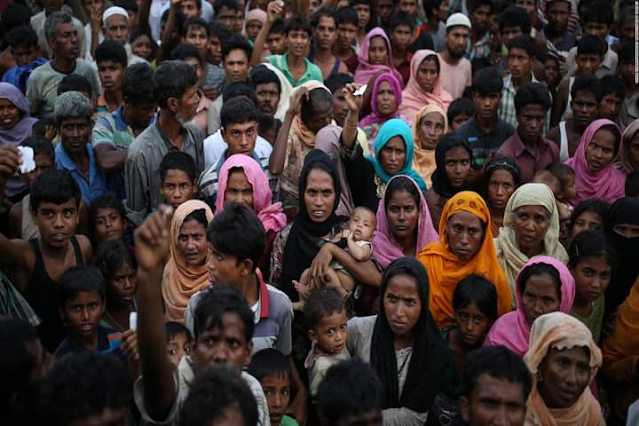
The lights are dim at the end of the tunnel in case of repatriation of Rohingya refugees living in squalid camps in the coastal district of Cox’s Bazar in Bangladesh.

The country hosts nearly 1.2 million Muslim Rohingya people who have fled ethno religious strife in neighbouring Myanmar during a military genocidal campaign, which killed at least 9,000 people in 2017.

The Tatmadaw (Myanmar military) backed campaign that the United Nations labelled a “textbook example of ethnic cleansing” saw hundreds of thousands of Rohingya driven across the border into Bangladesh in September 2017.

More than a million refugees are crammed in tens of thousands of make-shift huts made of bamboo, thin plastic sheets and corrugated tin roofs and the living conditions in the nauseating camps are dangerous. Often, fires blaze through the camps leaving thousands without shelter.

Last week, a 17-member delegation from Myanmar’s immigration and population ministries crossed into Bangladesh in mid-March and interviewed 480 Rohingya in Cox’s Bazar as part of a plan for possible repatriation to their country.

The Myanmar delegation, led by Aung Myo, the social welfare minister for Rakhine State, was selecting members for a pilot ‘family-based repatriation’ project.

The Myanmar delegation’s visit to the camps is believed to be brokered by China and facilitated by the UNHCR.

The Refugee Relief And Repatriation Commissioner (RRRC) in Cox’s Bazar, Mohammed Mizanur Rahman, said the Myanmar junta officials cleared 711 Rohingyas out of 1,140 recommended by Bangladesh. The newborn and newly married couples have been excluded from verification.

When journalists asked when the repatriation is expected to start, Rahman said that the “Myanmar delegation did not have the power to commit to a possible repatriation date.”

Before the visit of the delegation, the Myanmar junta for the first time since the 2017 crackdown, allowed diplomats from Bangladesh, India, China, and five other countries to tour the restive Rakhine State.

It was only then, the officials expressed the military junta’s plan to begin Rohingya repatriation under the pilot project.

Earlier, Bangladesh formally sought cooperation from China to repatriate Rohingya refugees to Myanmar during a visit by Foreign Minister Wang Yi and also China’s State Councillor promised to resolve a political solution to the Rohingya crisis.

China had used its influence in Myanmar to broker a November 2017 agreement to repatriate Rohingyas.

China’s ambassador to Bangladesh Yao Wen hoped that the first batch of displaced Rohingya would be repatriated to Myanmar soon while China continued its role as mediator, the official news agency Bangladesh Sangbad Sangstha reported.

On 17 March 2023, Bangladesh Foreign Minister Dr AK Abdul Momen also urged the Organisation of Islamic Cooperation (OIC) member states to take collective responsibility to ensure a safe and dignified return of the most persecuted Rohingyas to their homeland, Myanmar.

Indeed, OIC backed Gambia to file a genocide case with the International Court of Justice (ICJ). Only Turkey has a visible presence at the Rohingya camps in Cox’s Bazar.

India also launched “Operation Insaniyat” to provide relief assistance in response to the humanitarian crisis faced by a large influx of Rohingya refugees into Bangladesh from Myanmar.

Bangladesh and Myanmar began the negotiation for repatriation, but since 2018 none has returned so far and recent verification of a few hundred potential returnees for a pilot repatriation project remains unclear when they would be going home.

Despite attempts to send them back, the refugees refused, fearing insecurity in Myanmar, which was exacerbated by the military takeover last year.

Amid the situation, the United Nations High Commissioner for Refugees (UNHCR) in a statement on March 19 said they are observing developments of the Myanmar delegation’s visit to Bangladesh to verify a selected number of refugees on a bilateral pilot project on their possible returns.

The UN Refugee organisation reiterated that conditions in Myanmar’s Rakhine State are currently “not conducive to the sustainable return of Rohingya refugees”.

Bangladesh has consistently reaffirmed its commitment to “voluntary and sustainable repatriation” since the onset of the current crisis which echoes UNCHR policy that every refugee has a right to return to their home country based, make an informed choice and no refugee should be forced to repatriate.

China always wanted to impress upon their “feel good” diplomacy, but despite best intentions, it seems the repatriation has entered into a fresh deadlock as both Bangladesh and UNCHR, responsible for the safe return of the displaced Rohingyas are concerned about their safety and security in the Rakhine State.

The Rohingya issue must be addressed by China, a country [Myanmar] over which it has significant influence. Only China can make conclusive negotiations on the safe return of the Rohingyas, writes security analyst Samina Akhter in Modern Diplomacy.

Bangladesh and China have close political and military relations in addition to the fact that China is Bangladesh’s top trading and development partner.

Last week, Bangladesh has inaugurated a naval base in Cox’s Bazar with two conventional diesel-electric powered refurbished Chinese submarines bought for $205 million in 2016 to enhance Bangladesh’s naval capacity, after the demarcation of its maritime boundary with India and Myanmar.

It is equally true, that Myanmar’s military junta, which took power in a coup two years ago, has demonstrated no intention to take back any refugees.

Most importantly, the Rohingya refugee groups based in Bangladesh said for sustainable and dignified repatriation will only be possible when the Myanmar regime recognises the Rohingya as an ethnic community; provide legal citizenship which was stripped in 1982; school education; healthcare services; freedom of movement and livelihood.

Rohingya’s human rights groups believe the face-saving exercise to repatriate refugees happened after the Chinese exerted pressure on the Myanmar military junta to demonstrate a “feel good policy” otherwise face the compliance declared by the International Court of Justice (ICJ). The genocide case is resuming at ICJ on 24 April.

“Taking back a few refugees, even if it is less than one percent of the population, shall allow Myanmar to come up with a counterargument under the very false pretence they are sincere about the return of refugees,” the Arakan Rohingya National Alliance (ARNA) said in a statement.

First published in the India Initiative, New Delhi, India on 25 March 2023

Saleem Samad is an award-winning independent journalist based in Bangladesh

Thursday, October 13, 2022

Who Can Be Members Of UNHRC?

SALEEM SAMAD

Bangladesh has been elected as a member of the United Nations Human Rights Council (UNHRC) for the term of three years (2023-2025).

Bangladesh Foreign Minister Dr Abul Kalam Abdul Momen has sent messages on WhatsApp stating (quote unquote): “Bangladesh won the Human Rights Council Election today (Tuesday) at the UN with highest votes (160 votes) which vindicated again that the global leaderships have confidence on Sheikh Hasina’s government and the Human Rights track record of Bangladesh. Bangladesh government is always at the forefront of democracy, Human Rights and justice.”

A question obviously arises, who can be members of UNHCR? The Council is comprised of 47 member states, which are elected by the majority of members of the General Assembly of the United Nations through direct and secret ballots.

The General Assembly takes into account the candidate States’ contribution to the promotion and protection of human rights, as well as their voluntary pledges and commitments in this regard.

The election to the Council’s Membership is based on equitable geographical distribution. Seats are distributed as follows: African States (13 seats), Asia-Pacific States (13 seats), Latin American and Caribbean States (8 seats), Western European and other States (7 seats) and Eastern European States (6 seats).

Countries elected are Algeria, Bangladesh, Belgium, Chile, Costa Rica, Georgia, Germany, Kyrgyzstan, Maldives, Morocco, Romania, South Africa, Sudan and Viet Nam.

Bangladesh is fortunate to have been elected in the quota of Asia-Pacific States with the highest vote of 160. It definitely gives the impression that Bangladesh’s diplomacy is in a win-win situation and made commendable strides in image-building globally.

The good news is Bangladesh, Belgium, Chile, Costa Rica, Georgia, Germany, Morocco, Romania and South Africa, 23 of the 47 Council members during 2023 will be “Friends of the Responsibility to Protect (R2P)” and have been appointed as Focal Point for Group of Friends in New York and Geneva.

By the end of this year, 123 UN member states will have served as Human Rights Council Members, reflecting the UN’s diversity and giving the Council legitimacy when speaking out on human rights violations in all countries.

If we review the list of members of the past and present, it could be found that at least two-thirds of the members are governed by autocratic regimes and built-in draconian laws to suppress freedom of expression, freedom of political assembly and freedom of faith.

Hundreds of dissidents, critics, journalists and opposition are languishing in prisons in Algeria, Bangladesh, Georgia, Morocco, Sudan and Viet Nam and other countries who were and are new members of the Council.

Sudan is no doubt a failed state but has been included in the Council, surely for a purpose which is not understood well.

Many totalitarian governments and new members of the Council deliberately flout the principles of the Universal Declaration of Human Rights (UDHR). The UDHR is a milestone document in the history of human rights proclaimed by the United Nations General Assembly on 10 December 1948 as a common standard of achievements for all peoples and all nations. The Declaration is believed to be a fundamental human right to be universally protected.

Like Bangladesh, Vietnam state media boasted that being elected to the UNHRC is an “international recognition of Vietnam’s commitment to respect and protect human rights.”

However, there is still hope. Many newly elected governments in third-world countries have come to power through credible elections with people’s mandates. Those third-world countries have launched political reforms – trashed draconian laws which suppress freedom of expression and religious freedom.

To conclude, Bangladesh with membership in the Council comes with a responsibility to uphold high human rights standards. The nation under the steadfast leadership of Prime Minister Sheikh Hasina will surely reform the draconian laws, and ensure freedom of expression and freedom of assembly of opposition, critics and dissidents.

First published in The News Times, 12 October 2022

Saleem Samad, is an independent journalist, media rights defender, recipient of Ashoka Fellowship and Hellman-Hammett Award. He could be reached at <saleemsamad@hotmail.com>; Twitter @saleemsamad


Saturday, August 24, 2019

Why Rohingyas decline to return to Myanmar?

Rohingya refugees, who crossed the border from Myanmar two days before, walk after they received permission from the Bangladeshi army to continue on to the refugee camps, in Palang Khali, near Cox`s Bazar, Bangladesh Oct 19, 2017. REUTERS
SALEEM SAMAD
The first step was to develop confidence-building measures among the refugees. The Myanmar government should have invited a delegation of refugee leaders along with Bangladesh officials to visit the strife-torn Rakhine State.
As feared, the Rohingya refugees refused to return to Myanmar, despite all arrangements made for them to go back, as finalized by two neighbouring countries.
The second attempt in ten months to repatriate the Muslim refugees living in Bangladesh to Myanmar has fallen flat. It is understood that they would not return unless their demands were met by the Myanmar government.
Nearly two years after thousands of Rohingyas were forced to flee from Rakhine State, Myanmar enlisted 3,450 as genuine refugees for repatriation on August 22. But Most feared reprisals and refused to return. A similarly botched effort last November to ensure their return sowed confusion in the refugee camps and sparked protests.
On August 25, 2017,  Myanmar security forces began an ethnic cleansing that drove an estimated one million Rohingya to neighbouring Bangladesh.
The refugees have information that an estimated 500,000 Rohingyas who remained in Rakhine State are living in appalling conditions and Myanmar security forces have confined them to camps and villages, severely restricting their freedom of movement.
For those Rohingyas confined in several hamlets, the authorities have denied freedom of movement, deprived their access to sustainable livelihoods and basic humanitarian services including adequate food, medical care, and education. These facts have raised alarm among the refugees here.
Moments after the botched attempt, Bangladesh Foreign Minister Dr AK Momen explained that the refugees eligible for repatriation declined to return to Rakhine State as they did not feel secure and safe.
Bangladesh, aspiring to attain the middle-income threshold by 2021, had been generous with a million Rohingyas –  authorities felt the refugee should not be compelled to return to their villages that were not safe.
He lamented that the Myanmar government had the larger responsibility to be proactive in their political commitment to ensure voluntary, safe, and dignified repatriation of Rohingyas languishing in the world's largest refugee camps in Cox's Bazar.
The senior-most Bangladesh official in charge of foreign affairs spelled out two pressing issues, which needed immediate administrative attention.
Second, Bangladesh was planning to set up an International Commission on Rohingya Refugees with members drawn from different countries, maybe also from international organizations.
However, Dr Momen was hopeful in that Myanmar had twice implemented the provisions of the memoranda of understanding (MoU) to repatriate Rohingya refugees in 1993 and 1988.
Accordingly, on 19 December 1993, an Operational Plan for mass repatriation was presented by the UNHCR, facilitating the voluntary repatriation of approximately 190,000 refugees.
From the second refugee influx, in December 1998, over 229,000 refugees had officially returned. But the story of Rohingyas was not over; the cycle of the exodus had not ended.
Aljazeera TV alleged that international media, rights groups, and United Nations were not allowed to visit Rakhine State, especially to the villages from where the Rohingyas were forced to flee in the wake of genocide.
New York-based Human Rights Watch argues that their repatriation carries possible risks exposing refugees to ethnic violence.
A United Nations-backed Fact-Finding Mission found sufficient negative information to warrant the investigation and prosecution of senior military officials for grave crimes, including genocide, in Rakhine State.
The international rights group claimed that the Myanmar regime had not made any effort to probe widespread crime against humanity against the Rohingyas.
The regime also obstructed international efforts to investigate the ethnic cleansing of Rohingya Muslims to protect their basic rights, facilitate international justice for victims, and ensure that any returns of Rohingya refugees were voluntary, safe, and dignified.
Meantime, there is no light at the end of the tunnel for the crisis as yet.

First published in the Bangla Tribune, 24 August 2019

Saleem Samad is a journalist, a media rights defender and recipient of Ashoka Fellow (USA) and Hellman-Hammett Award. Twitter @saleemsamad; Email: saleemsamad@hotmail.com

Wednesday, March 22, 2017

UN Refugee Agency urges fair deal for Rohingyas in Bangladesh


SALEEM SAMAD

United Nations Refugee Agency (UNHCR) seeks equal treatment for all Rohingyas in Bangladesh and help to provide basic aids to new arrivals.

Apparently the appeal was made amidst confusion created after fresh influx of refugees who fled violence in Myanmar are dubbed 'undocumented' and miss out on vital aid, while those arrived in Bangladesh are considered 'refugees'.

The new influx has highlighted the urgent need to verify the number and location of the new arrivals. Without this information, vulnerable refugees risk falling through the cracks while others could be receiving duplication of assistance, says a top UNHCR officials in Bangladesh.

The influx of refugees in the early 1990s, lives in two government-run camps serviced by UNHCR, and its partners the International Organization for Migration (IOM) and the World Food Program (WFP) in Ukhia, Cox's Bazar, bordering troubled Rakhine State.

The 33,000 registered refugees in Kutupalong and Nayapara camps in Ukhia have access to basic services including food assistance, healthcare and education for children, but the registered refugees do not have any legal status in Bangladesh.

More than 70,000 Rohingya are believed to flee during a security operation between October 2016 and February 2017. The security operation by Myanmar Army has recently been postponed after international outcry, including the United Nations, European Union, Organization of Islamic Cooperation (OIC) and Association of Southeast Asian Nations (ASEAN).

The Bangladesh government has announced it will conduct a census of undocumented Rohingya living outside the two camps to include the new arrivals.

"We are advocating for a joint verification of the new arrivals with our partners as soon as possible," said Shinji Kubo, UNHCR's Representative in Bangladesh. "This exercise will help the government and humanitarian agencies to better target assistance to those who need it the most, be they new arrivals, refugees who came earlier or locals who host them."

A third category consists of an estimated 200,000 to 500,000 'undocumented' Rohingya who arrived in Bangladesh between the two influxes. They live in makeshift sites and local villages, and until recently had no access to humanitarian aid.

"The current situation is not sustainable," said  Shinji Kubo. "Regardless of when they came and where they live, these people have the same needs and deserve equal access to protection and assistance," he told UNHCR press.

Several thousand new arrivals are presently accommodated in the two official camps, pressuring on the capacity of existing refugees and the infrastructure. Many more new arrivals are living in existing makeshift sites or new ones that have sprouted spontaneously.

"In the long run, we hope that all Rohingyas in Bangladesh can be documented to ensure full respect for their rights," said UNHCR's Kubo. "Knowing the profile of this population will also help us to identify longer-term solutions for them."

Article first published in The Asian Age, March 22, 2017

Saleem Samad, is an Ashoka Fellow (USA), an award winning investigative journalist and is Special Correspondent for The Asian Age

Wednesday, July 18, 2012

Bangladesh keeps door firmly shut on Rohingya

SHAIKH AZIZUR RAHMAN


Refugee rights activists say Bangladesh is acting against international humanitarian law in turning back Rohingya refugees from Myanmar. However, Dhaka says it is doing nothing wrong and must put its own people first.

Ignoring appeals from international community, Bangladesh is sticking to its stand not to allow any Rohingya refugee inside its territory as every week boatloads of Rohingyas are seeking to flee Myanmar.

The ethnic violence that broke out in Arakan state in Myanmar last month is continuing. Earlier this month, US-based Human Rights Watch reported that Myanmar's security forces were indulging in mass arrest and the use of unlawful force against the Rohingyas.

In the past six weeks more than 1,300 Rohingya men, women and children sought to cross over to Bangladesh.

Little more than a hundred of the Rohingyas managed to sneak into Bangladesh in the first couple days after violence broke out in Myanmar. But, despite their fervent appeals seeking refuge in Bangladesh, the remaining Rohingyas keep being turned back.

"Boatloads of Rohingyas from Myanmar are arriving every week. Through many points on our border they are attempting to sneak in," Lt. Col. Zahid Hassan, a border guard commander in Cox's Bazar said. "We are not allowing any of them to enter Bangladesh."

Bangladesh's foreign minister, Dipu Moni, said that her already poor and densely populated country is facing many crises with the Rohingya refugees. "In no situation we can take any extra load of Rohingya refugees which could worsen our problems here," said Moni.

After a widespread ethnic conflict in Myanmar in 1978, thousands of Rohingyas fled to Bangladesh from Myanmar.

Persecution by junta
After Myanmar stripped the Rohingyas of citizenship and identified them as illegal immigrants from Bangladesh, more Rohingyas began fleeing Myanmar.

In 1991, following alleged persecution by military junta in another wave tens of thousands of Rohingyas crossed over to Bangladesh. Bangladesh stopped granting Rohingyas refugee status in 1992.

But the trickle from across the border continued, resulting in the number of Rohingya refugees reaching 300,000 in Bangladesh. While 28,000 of them live in two UNHCR-sponsored camps, others live as illegal refugees in numerous decrepit camps scattered across south eastern Bangladesh.

In the illegal Rohingya colonies where electricity and sanitation facilities are absent, the refugees live in extreme poverty. In over-populated and poverty-stricken Bangladesh, local people do not welcome the Rohingyas.

The refugees are draining the local resources and it is resulting in increased poverty among local people, many allege.

"The Rohingyas are ready to work at a very low wage. So the local people are angry as their jobs are being taken away by the refugees," said Jasimuddin, a police officer in Cox's Bazar district, where most Rohingya refugees live.

"It leads to conflicts between local people and the mostly illegal refugees. Many local people are dead against the arrival of new refugees."

In 2009 Bangladesh began a crackdown on illegal Rohingyas living in the country. Many were arrested and sent to jail on charges of illegal infiltration. Many illegal Rohingyas have been forced to return to Myanmar in a formal "push-back" process by Bangladesh.

In 2010 a UN Joint Initiative [UNJI] sought to launch a 33-million-US-dollar project to alleviate poverty in Cox's Bazar which could benefit the refugees as well as the local population, the initiative said.

'Underhand intentions'
But Bangladesh government blocked the UNJI project- which was to be funded mostly by the EU and Australia, accusing the UN of "mala-fide intentions" and claiming that it was an "underhand attempt" to rehabilitate the refugees in the country.

Bangladesh says, any new initiative to help the Rohingyas in Bangladesh would attract fresh influx of refugees and so it cannot allow UNHCR to expand its support to the Rohingyas.

Chris Lewa, the director of Rohingya advocacy group Arakan Project said that extreme miseries force the Rohingyas to flee Myanmar and that they should not be denied refuge by Bangladesh.

"Bangladesh should not turn away people fleeing persecution: non-refoulement is a principle of international customary law, whether a country has signed the refugee convention or not," said Ms Lewa.

Bangladesh says that it firmly stands by its decision not to open its border to the Rohingyas now.

"The international community is pressuring us to accept the refugee as per the international customary law. It's unfair," said Foreign Minister Moni.

"Right from the time Rohingyas began taking refuge in Bangladesh, we have been a persistent objector to their entry here. When one country persistently objects to such an issue, the international customary law cannot be applicable to it."

'Impossible situation, serious trouble'
Last week in an official statement Myanmar president Thein Sein said, it's "impossible" for Myanmar to accept the Rohingyas because they are illegal immigrants and do not belong to the ethnicity of Myanmar.

"If Bangladesh does not open its border, the poor people will face very serious trouble," said Nurul Islam, a Rohingya community leader in Bangladesh.

Some rights activists and Rohingya issue experts said that - although the primary responsibility to resolve the Rohingya issue lies with the Myanmar government - by denying shelter to the refugees, Bangladesh is acting against international humanitarian law.

Kelley Currie, a fellow with the Washington-based think tank Project 2049 Institute and a former Asia policy adviser in the US State Department said that Bangladesh is obliged to provide refuge to the Rohingyas.

The first issue is the basic international legal obligation not to return individuals who are fleeing persecution for ethnic, religious or political reasons, said Currie.

"In this case the Rohingyas clearly qualify as refugees if they are able to cross an international border."

Bangladesh claims that it is not a party to the 1951 UN Refugee Convention or its 1967 Protocol, and is therefore not obliged to accept the Rohingyas. #

Writer: Shaikh Azizur Rahman and edited by Richard Connor
First published in DeutscheWelles (DW) online