Buy.com Monthly Coupon

Sunday, October 16, 2022

Bangladesh Ranked 84th In Global Hunger Index: Food Supply Chain Disrupted By Ukraine War


SALEEM SAMAD

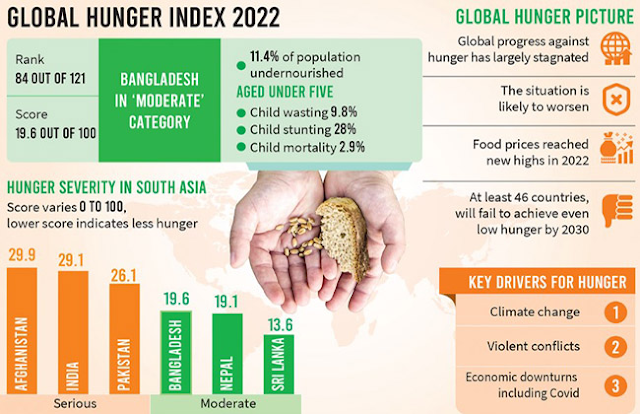
Bangladesh ranked 84th, out of 121 assessed countries on the 2022 Global Hunger Index (GHI). With an overall score of 19.6 (2022), the level of hunger in Bangladesh has been categorised as “moderate”.

On the eve of World Food Day (October 16), the launch of the 2022 GHI amid global crises and the war in Ukraine is putting global food security in peril, and the worst impacts are being felt by the very poorest.

Among South Asia, India, Pakistan, and Afghanistan are among the worst-performing countries in the region.

The GHI that tracks and measures hunger across the world says that malnutrition among children under five years in Bangladesh has slightly improved.

The country has gradually improved its ranking from 33.9 (2000), 31.3 (2007), 26.3 (2014) and 19.6 in 2022.

The report that has used the fifth National Family Health Survey (NFHS-5) and FAO (Food and Agriculture Organisation of the United Nations) Food Security Indicators as its sources for Bangladesh has highlighted that child wasting (low-weight-for-height) rate in Bangladesh, at 9.8 per cent, is satisfactory but still lots of effort needed to touch the target of “Zero Hunger” of Sustainable Development Goals (SDG) by 2030.

Despite Bangladesh being a moderate hungry country, but has fared well in undernourishment, child wasting and child stunting.

There are several reasons for the disruption, Bangladesh and other countries have failed its reach food autarky.

Some 50 nations that rely on Russia and Ukraine for the bulk of their wheat imports — including Bangladesh, Egypt, Iran, and Turkey — have been scrambling to find alternative suppliers, according to the GHI 2022 Report.

Spiralling food prices and global supply chain disruptions precipitated by the Ukraine war, the COVID-19 pandemic, climate change, and regional conflicts have worsened hunger for millions of people, requiring humanitarian and resilience-building responses to be urgently scaled up.

Incidentally, Bangladesh imports wheat from both Ukraine and Russia. Bangladesh’s food import is the lowest among countries having food shortages. Eritrea tops the list of dependencies on the external food supply in Ukraine and Russia.

The report mentions that there is another prime reason for the increase in food grain requirement in Bangladesh because of hosting more than one million Rohingya refugees since 2017.

Bangladesh took efforts in amplifying longstanding structural deficiencies in the global food system, which is inadequate for sustainably ending poverty and hunger as envisaged by the United Nations’ 2030 Agenda.

Within a global food system that has fallen short of sustainably ending poverty and hunger, citizens are finding innovative ways to improve food systems governance at the local level, holding decision-makers accountable for addressing food and nutrition insecurity and hunger.

The good news is the recent trend toward decentralising government functions has given local governments greater autonomy and authority, including over key elements of food systems.

The situation is likely to worsen in the face of the current barrage of overlapping global crises — conflict, climate change, and the economic fallout of the COVID-19 pandemic — all of which are powerful drivers of hunger.

These crises come on top of underlying factors such as poverty, inequality, inadequate governance, poor infrastructure, and low agricultural productivity that contribute to chronic hunger and vulnerability.

Globally and in many countries and regions, current food systems are inadequate for the task of addressing these challenges and ending hunger.

Hunger cannot be eradicated unless global leaders join hands to tackle the structural drivers that cause it: war, climate change, and recession.

First published in The News Times, 15 October 2022

Friday, October 14, 2022

Who Is To Blame For Failed Gaibandha By-Poll?


SALEEM SAMAD
In an unprecedented move, the Bangladesh Election Commission (EC) suspended the by-elections in Gaibandha-5 (Fulchari-Shagata) in the middle of voting on 12 October.
Such a move in recent history has surprised many and is likely to strengthen the confidence of the opposition and the ‘aam-janata’ (general public), but it would be short-lived.
Nevertheless, the EC is empowered by the state constitution to hold a credible election.
The ruling Awami League did not expect EC would take dramatic action in halting the election in the middle of the electioneering.
The leadership is not all happy with the action of the EC. The nation is eagerly expecting a formal statement from party stalwarts.
Two things made the EC go ahead with a drastic decision to stop the election squarely blaming vote fraud. First, the surveillance cameras in the polling booths were monitored from the control room of the EC, where journalists were allowed to observe.
The suspension of the by-election in Gaibandha indeed will be a warning to political parties, local leaders and their henchmen.
The question has been raised, whether it was prudent of EC to cancel the voting, which is definitely not a solution to vote fraud.
One thing is clear the government did not cooperate with the EC. The government did not lend their shoulder to EC to hold a peaceful election.
Experienced observers of elective democracy, Dr Badiul Alam Majumder of SHUJAN and Dr Nazmul Ahsan Kalimullah of JANIPOP have expressed their reservations over the action by Election Commission on logical grounds.
They explained that the recent parley between the EC, civil administration (Deputy Commissioners) and police administration (Superintendents Of Police) gave a signal of appalling partisanship in the bureaucracy.
They recommended that the gap between the EC and the local civil administration have to be significantly reduced, living no room for confusion and controversy.
Both Dr Majumder and Dr Kalimullah feel that the election is the responsibility of the Election Commission, but successful implementation lies entirely with the district administration and law enforcement.
In short, the involvement of civil society, grassroots leadership and other stakeholders should work alongside the local civil administration and law enforcement. If there are irregularities and the election is cancelled for vote fraud then the responsibility for the failure to hold the polls will be bestowed upon the government.
Well, in most countries, the EC has election cadre service officials to conduct all kinds of elections. But for Bangladesh, it will be an additional burden on the national exchequer.
It is equally true that political parties, especially the ruling party will not agree to strengthen the independence of the EC, which may jeopardise their political career, and weaken the possibility to remain in power by hook or by crook.
Since independence, it would be difficult to say which election was credible and inclusive. Elections in different regimes were tainted.
When the voters in Bangladesh have lost confidence in the ballot; when the ‘aam janata’ fear their life going to the polling centres – then democracy fails. Democracy and electioneering are twins and go parallel.
When the government officers responsible for holding a credible inclusive election fail, who is to be blamed? Blame whom, the Election Commission (EC) or the civil administration?
If the civil service and police administration are recruited on a partisan background, what else the nation should expect from them?
It is also true that the district administration and police are under constant pressure from the local political leadership and vested groups, which restrains them from functioning.
In most cases, it becomes difficult for the local civil administration and police to continue with administrative duties because of political high-handedness and fear of losing their government job.
Like, Magura vote fraud and stark inaction by the Election Commission is still remembered, Gaibandha will also be remembered, when the general elections are around the corner, at end of 2023.
Do the ruling party understand that the whole world is observing the development towards holding parliamentary elections next year? The international community expects Bangladesh will not hold free and fair elections and also credible and inclusive elections too.
First published in The News Times, 14 October 2022
Saleem Samad, is an independent journalist, media rights defender, recipient of Ashoka Fellowship and Hellman-Hammett Award. He could be reached at <saleemsamad@hotmail.com>; Twitter @saleemsamad


Thursday, October 13, 2022

Who Can Be Members Of UNHRC?

SALEEM SAMAD

Bangladesh has been elected as a member of the United Nations Human Rights Council (UNHRC) for the term of three years (2023-2025).

Bangladesh Foreign Minister Dr Abul Kalam Abdul Momen has sent messages on WhatsApp stating (quote unquote): “Bangladesh won the Human Rights Council Election today (Tuesday) at the UN with highest votes (160 votes) which vindicated again that the global leaderships have confidence on Sheikh Hasina’s government and the Human Rights track record of Bangladesh. Bangladesh government is always at the forefront of democracy, Human Rights and justice.”

A question obviously arises, who can be members of UNHCR? The Council is comprised of 47 member states, which are elected by the majority of members of the General Assembly of the United Nations through direct and secret ballots.

The General Assembly takes into account the candidate States’ contribution to the promotion and protection of human rights, as well as their voluntary pledges and commitments in this regard.

The election to the Council’s Membership is based on equitable geographical distribution. Seats are distributed as follows: African States (13 seats), Asia-Pacific States (13 seats), Latin American and Caribbean States (8 seats), Western European and other States (7 seats) and Eastern European States (6 seats).

Countries elected are Algeria, Bangladesh, Belgium, Chile, Costa Rica, Georgia, Germany, Kyrgyzstan, Maldives, Morocco, Romania, South Africa, Sudan and Viet Nam.

Bangladesh is fortunate to have been elected in the quota of Asia-Pacific States with the highest vote of 160. It definitely gives the impression that Bangladesh’s diplomacy is in a win-win situation and made commendable strides in image-building globally.

The good news is Bangladesh, Belgium, Chile, Costa Rica, Georgia, Germany, Morocco, Romania and South Africa, 23 of the 47 Council members during 2023 will be “Friends of the Responsibility to Protect (R2P)” and have been appointed as Focal Point for Group of Friends in New York and Geneva.

By the end of this year, 123 UN member states will have served as Human Rights Council Members, reflecting the UN’s diversity and giving the Council legitimacy when speaking out on human rights violations in all countries.

If we review the list of members of the past and present, it could be found that at least two-thirds of the members are governed by autocratic regimes and built-in draconian laws to suppress freedom of expression, freedom of political assembly and freedom of faith.

Hundreds of dissidents, critics, journalists and opposition are languishing in prisons in Algeria, Bangladesh, Georgia, Morocco, Sudan and Viet Nam and other countries who were and are new members of the Council.

Sudan is no doubt a failed state but has been included in the Council, surely for a purpose which is not understood well.

Many totalitarian governments and new members of the Council deliberately flout the principles of the Universal Declaration of Human Rights (UDHR). The UDHR is a milestone document in the history of human rights proclaimed by the United Nations General Assembly on 10 December 1948 as a common standard of achievements for all peoples and all nations. The Declaration is believed to be a fundamental human right to be universally protected.

Like Bangladesh, Vietnam state media boasted that being elected to the UNHRC is an “international recognition of Vietnam’s commitment to respect and protect human rights.”

However, there is still hope. Many newly elected governments in third-world countries have come to power through credible elections with people’s mandates. Those third-world countries have launched political reforms – trashed draconian laws which suppress freedom of expression and religious freedom.

To conclude, Bangladesh with membership in the Council comes with a responsibility to uphold high human rights standards. The nation under the steadfast leadership of Prime Minister Sheikh Hasina will surely reform the draconian laws, and ensure freedom of expression and freedom of assembly of opposition, critics and dissidents.

First published in The News Times, 12 October 2022

Saleem Samad, is an independent journalist, media rights defender, recipient of Ashoka Fellowship and Hellman-Hammett Award. He could be reached at <saleemsamad@hotmail.com>; Twitter @saleemsamad


Sunday, October 09, 2022

Angry Iranian Women Are Burning Their Hijabs


SALEEM SAMAD

The death of Masha Amini, a 22-year-old Kurdish woman by the so-called Morality Police has sparked a showdown of dissent on Iran’s streets since authorities crushed protests against a rise in gasoline prices in 2019.

The girl was on a family trip and arrived in Teheran, the capital of Iran. On her arrival at a metro station, the notorious Morality Police (Gasht-e Ershad) detained her for inappropriately wearing a hijab (headscarf), a strict dress code for women in the public.

She was dragged to a re-education detention centre and tortured for non-compliance with the dress code and later died from head injuries in a hospital.

Her guardians refused to accept that she died of a heart attack. They insist that she succumbed to a painful death at the hands of Islamic vigilantes.

The unprecedented anger in the streets is demanding #JusticeForMashaAmini, which has turned against the autocratic Islamic clerical establishment in Iran, since 1979.

In the third week, the demonstrations have spread to nearly 100 cities and towns since September 13 questioning the clergy’s legitimacy in power, which is indeed a serious challenge to Islamic Iran.

Besides justice for Kurdish woman, the angry #IranProtests are demanding an end to the Islamic Republic, which ruled Iran with an ‘iron hand’ blended with Islamic jargon, strict Sharia laws and intolerance to critics and dissidents.

Women in public are removing their hijab (chador in Farsi) and collectively burning in a bonfire, while many are cutting their hair in defiance of the Ayatollah’s self-composed Islamic laws.

Determined, angry and, above all, courageous in midst of the #WomenLifeFreedom campaign communicates with everyone. The women in Iran are at the forefront of the current protests.

Earlier, women have played a key role in all the protest movements of the past 40 years, including the Green Movement of 2009 and the last major nationwide protests in November 2019, which went on for several weeks before being brutally suppressed.

Like previous street protests, the barbarian Basij snipers have been deployed on rooftops to shoot and kill angry protesters.

A bitter critic of the Mullahs in Iran, the feminist journalist in exile Masih Alinejad in a tweet says: The women – of Iran are risking their lives for basic freedoms and they need the support of the international community.

In the streets of Iran, they are calling for the end of the Islamic clerical establishment’s more than four decades in power.

There is no leadership structure for the #IranProtests. ‘Generation Z’ is leading protests in the streets and online, which gave momentum to oust Ayatollah Ali Khamenei, the Supreme Leader of Iran since 1989.

Rights groups have reported the arrest of hundreds of young people, and students. Also academics, celebrities, civil society activists, human rights defenders, lawyers, litterateurs, movie stars, singers, poets, sportsmen, and at least a score of journalists.

In fact, the massive protests sparked by a young Iranian woman’s death have shaken the foundations of the Islamic Republic.

Meanwhile, nobody believes that Iranian President Ebrahim Raisi will conduct an impartial probe and that the perpetrators would be punished.

He, however, pledged to “deal decisively” with the protests and said “rioting” will not be tolerated.

Iran’s restrictive clothing laws – are rejected by a lot of Iranians. There is hardly a single woman in Iran who does not have a humiliating and violent experience with the rogue Gasht-e Ershad.

At this time, demonstrators are openly and collectively desecrating the religious symbol of the Islamic Republic.

Fury of the riot police and Basij [para-military force] crackdown on anti-government protesters has further sparked anger in the streets. The number of dead, wounded and detained protesters is rising alarmingly, rights groups claimed.

The Basij has a history of being ruthless with critics and opposition to the regime. All over the country, they are raiding the homes of thousands and dragging out critics active on social media or any dissidents who participated in the street agitations.

In absence of independent news organisations inside Iran, the protesters are dependent on social media. The activists are using Facebook, Twitter, Instagram and YouTube as a tool to vent their grievances against the Mullahs.

Nonetheless, the social media campaign further angered the regime. Quickly the authorities imposed a blackout of the internet, which severely hampered daily e-businesses.

Isik Mater from NetBlocks told the BBC: “The internet is one of the biggest tools that the Iranian authorities have got in their hands when unrest breaks out on the streets.”

Apolitical Amini’s death has unleashed anger over issues including personal freedoms and economic challenges in Iran.

The countrywide riots were in response to the bleak economic situation, runaway inflation and horrendously high gas prices.

Iran’s economic crisis, coupled with the Western sanctions, explains the popular outrage which is swiftly sparked by the latest public antagonism.

Moreover, the elimination of subsidies, unemployment, chronic inflation, and the government’s fiscal deficit enraged the general public.

With a poor global image of the country, built over four decades on appalling human rights records, and proxy wars in the Middle East, including Yemen, Gaza, Lebanon, Syria and Iraq, it would be difficult for the Ayatollahs to get international sympathy against the protest.

The veiling of women is one of its most important foundations. The clerical rulers cannot and will not compromise on the pressing issue — because abolishing the obligation to wear the hijab would be tantamount to the beginning of the end for the Islamic Republic.

First published in The News Times, 8 October 2022

Saleem Samad, is an independent journalist, media rights defender, recipient of Ashoka Fellowship and Hellman-Hammett Award. He could be reached at <saleemsamad@hotmail.com>; Twitter @saleemsamad


Wednesday, September 28, 2022

The second Iranian Revolution


SALEEM SAMAD

Thousands of enraged Iranians in a nationwide dissent against the Islamic clergy’s regime are holding demonstrations for justice for the murder of a Kurdish woman, Mahsa Amini, over the country’s abusive forced hijab dress code for women.

Mahsa Amini, 22, on 16 September was on a family trip to Iran’s capital Tehran from a liberal city of Saqez in Iran’s Kurdistan, where 10 million Kurds live.

She was detained by the notorious Morality Police (Basij para-military force) at a metro station in Tehran for not appropriately wearing a hijab (or chador in Farsi/Persian) and dragged to a centre.

The young woman died as a result of torture inflicted on her at a detention facility and the authority claimed that she died of heart failure, which her family refused to believe.

The so-called Morality Police recruited from rural Iran are Islamic vigilantes to insult to heart their dignity and detain women for violating stringent Shariah laws.

The Basij has a history to have brutally suppressed popular strife. Once again the ruthless armed group has been mobilised to quell the unrest.

In defiance, hundreds of women poured into the streets in Iran are burning their hijab and others removing their chador (headscarf) and waving in the air in busy streets and squares.

Many are cutting their hair in public, in their home and dared to post on social media as a symbol of protest, which never happened before.

The antagonism transgressed to a crossroad where protesters either insulted Iran’s supreme leader and chanted “death to the dictator”.

Nonetheless, the Kurdish woman’s death has reignited popular anger and united the dissidents and people from all walks of society, despite having different opinions.

An irate ‘unnamed woman’ removed her hijab while walking in a street in Iran posted a video on Twitter urging the Basij: “Come and arrest me….and arrest everyone campaigning for peace, freedom and human dignity.”

Iranian women are taking a huge risk and need more than expressions of solidarity, observed Yalda Zarbakhch, Head of the Farsi (Persian) service of the German news organisation Deutsche Welle (DW).

The demonstrators, especially the womenfolk must have calculated the risk factor – arrest, torture, legal harassment and intimidation of their families by the repressive regime.

Amnesty International urged that Mahsa Amini’s death must not go unpunished.

Iranian President Ebrahim Raisi called for an investigation into the death of Mahsa Amini in police custody. He also said protesting is allowed in the country but “rioting” will not be tolerated.

Despite assurance for a probe into her death, the street protests besides the demand for justice for the death of Amini are also asking to end the hegemony of the Islamic clerical ruling system.

The crackdown on the demonstrations engulfed like wildfire in more than 40 major cities and towns, including Tehran University – where the official Friday prayers (Jumma) used to be held since the revolution.

Scores of protesters were killed by riot police and hundreds of others were wounded in street battles – the number of casualties is increasing every day. A few thousand protesters were detained from all over the country, according to the rights groups.

Determined, angry and, above all, courageous women in Iran are at the forefront of the current protests and lots of Iranians have rejected the hijab dress code.

On the other hand, a critic of the Mullahs in Iran, a feminist journalist Masih Alinejad in a charged tweet says: “Iranian women [are] removing their hijab, facing guns and bullets alongside men and chanting against [the] Islamic Republic.”

Meanwhile, reformist group the Union of Islamic Iran People’s Party has called for the mandatory dress code to be repealed and appealed to allow “peaceful demonstrations”. The party remains legal but unfortunately is firmly outside the corridors of power.

For the first time, demonstrators are collectively denouncing a religious symbol of the Islamic Republic.

The latest protest coincides with the fading popularity of Ebrahim Raisi’s government which miserably failed to deliver on its promises to citizens, one year after taking office in August 2021.

Amini’s death has unleashed anger over issues including personal freedoms and economic challenges in Iran which pose an existential threat to Iran’s theocratic regime.

A recent situation report by the International Institute for Iranian Studies (Rasanah) says, these developments occurred against the backdrop of a tense domestic environment and deteriorating economic and social conditions.

Nonetheless, the recent unrest highlights the growing chasm between the government and its self-proclaimed identity which it is attempting to impose on the people through repression and society.

The ongoing unrest reflects growing popular rage and discontent, as well as a sense of deprivation and injustice, says the Rasanah study. This cycle of discontent is linked to the crisis-ridden political environment as a result of the Raisi government’s failure to deliver on promises made one year ago, both at home and abroad, political observers stated.

Iran’s bleak economic situation, runaway inflation, horrendously high gas prices and social crises explain the popular outrage which is swiftly sparked by the latest public dissent. Moreover, the elimination of subsidies, unemployment, chronic inflation, and the government’s fiscal deficit enraged the general public.

The hard-line Islamist regime of the conservative Shia Mullahs led by Ayatollah Ruhollah Khomeini came to power, after the so-called Islamic Revolution in 1979 which ousted pro-American Shah of Iran Mohammad Reza Pahlavi.

Islamic Republic’s tunnel vision policy is to “control the female body”. Whether they are Muslims or other religious and ethnic communities, the hijab was been made mandatory by the clergies in 1983 for all women.

Well, hijab means ‘curtain’ or to shut out in Arabic. Hijab, is not a religious obligation in the Quran, a divine book for the Muslims, according to verse 24:31 for modesty.

The 21st-century Muslim clergies have falsely branded hijab, niqab, burqa, chador or other headscarves as Islamic traditions and made them compulsory for women.

Renowned Bangladesh-born feminist writer in exile, Taslima Nasrin and an ex-Muslim wrote on the recent unrest in Iran: “If you encourage them not to wear burqa or hijab, and become free women who believe in women’s rights and freedom, if you encourage them to become enlightened, secular, humanist and feminist, you are really well-wishers of Muslims.”

In another development, the intermittent blackouts of the internet followed after the eruption of nationwide protests over Amini’s death.

Unfortunately, there is no private broadcast network in Iran, thus the critical voice on the internet is the “only place” where protesters can make their voices heard on social media.

Earlier, the shutdown of the internet is one of the biggest tools of the Islamist regime and was used when unrest breaks.

Exiled Iranian leader Maryam Rajavi, President of the National Council of Resistance of Iran (NCRI) founded in 1981, in a tweet urged the world [leaders] to condemn the cruel [internet] censorship and provide free access #Internet4Iran.

Political observers predict that the anti-government movement will further escalate after attention has been drawn by international news organisations, Western countries and human rights organisations.

More and more people have turned their backs on the autocratic regime, its ideology and even their theocratic “Islam”.

The Iranian dissident and critics in self-exile and expats are possibly the largest community living abroad and have lent their shoulders to the uprising.

In fact, the rulers cannot and will not make any concessions on the veiling of women — abolishing the obligation to wear the hijab is tantamount to the beginning of the end for the Islamic Republic.

Now that apolitical Mahsa Amini became a symbol of defiance in Iran, the Mullahs in Tehran and Qom (a haven for the Ayatollahs) are feeling the pinch in their shoes as they are facing the worst challenge of their regime. The Islamist leaders are spending sleepless nights in fear of losing their luxurious lifestyle and dominance in the region will extinguish. Despite cruel backlash by the state machinery, the movement went internationally viral.

First published in the International Affairs Review, 28 September 2022

Saleem Samad is an independent journalist and columnist based in Bangladesh, a media rights defender. Recipient of Ashoka Fellowship and Hellman-Hammett Award. Twitter: @saleemsamad

Tuesday, September 20, 2022

Pakistan Drowning in Debts and Floods


SALEEM SAMAD

Pakistan in the immediate past has experienced three major crises. – two of which were caused by natural hazards — the 2005 earthquake, which impacted 3.5 million people and the 2010 floods which affected more than 20 million people.

Pakistan is at a critical economic juncture. The new coalition regime of the Muslim League and Pakistan Peoples Party which is struggling to stabilize the economy is already facing the daunting task of managing a faltering economy with huge deficits.

After two years of the pandemic, the economy is in the red zone, marked by rising external debt, higher inflation, and large-scale unemployment.

The floods that occurred from the torrential monsoon deluge added fresh challenges to Shahbaz Sharif’s government in the economic crisis, which he inherited from the cricketer-turned-politician Imran Khan, who failed the nation.

The floods are not only to be blamed for climate change disaster, but it is a failure of governance on multiple levels, including deliberate neglect of Baloch, Sindhi and other ethnic and linguistic communities in Pakistan.

The devastating floods which engulfed one-third of the country have counted unofficial deaths and missing over 1500, mostly children, caused forced displacement to 33 million, and dented livelihoods.

In addition, the floods eroded a million houses and damaged around 2 million acres of crops (an estimated 45 per cent) of cultivable land in Sindh, South Punjab and Balochistan, triggering alarm bells for looming food shortage.

The floods will leave behind a trail of loss of huge livestock, the output of cotton, rice and maize crops too and also feared that the sowing of sugarcane and wheat will also take a hit.

In fact, Pakistan in the immediate past has experienced three major crises. While the nature and scale of these crises were different, two of them were caused by natural hazards — the 2005 earthquake, which impacted 3.5 million people and the 2010 floods which affected more than 20 million people.

Pakistan produces less than 1 per cent of global carbon emissions and for the past 20 years, it has ranked in the Global Climate Risk Index as among the top ten most vulnerable countries.

It could be argued that the damage caused by both disasters is the outcome of climate change as well as the politically inspired development policies of the regime in Islamabad.

The picture looks dismal of the human development index of 2021, where Pakistan plummeted to 161, which is worse than that of India (132), Bangladesh (129), and Sri Lanka (73).

Decades of neglect of Sindh and Balochistan for their defiance against Rawalpindi GHQ have irked the regime in reasonable allocation for comprehensive infrastructure development and holistic human development projects, such as investing in primary education and healthcare.

As many as 10 million Pakistanis have been pushed into poverty. An estimated 46 per cent of the population (over 80 million) was already below the poverty line, which is likely to increase due to adverse impacts of the pandemic.

The colossal loss to the economy due to devastating floods has been estimated at US$10 billion. The country’s external debts and payments make it impossible for the cash-starved government to focus on relief and rehabilitation of its affected people.

Islamabad in rapid damage control efforts, to recover from the looming economic crisis increased the prices of oil, gas, and electricity tariff. The worst scenario is drastic cuts in social expenditures have pushed millions of working-class millions into yet another struggle for survival.

In an attempt to further save from drowning, the government imposed budget cuts, withdrawal of subsidies from food, fertilisers and fuel; wage bill cuts and at a crucial moment when disadvantaged populations are in greater need of public support.

Pakistan is among the 52 countries facing a severe debt crisis. The most critical problem faced by the country’s economy is repayment and servicing of its external debt, around $38 billion to the International Monetary Fund (IMF), World Bank and other international financial institutions.

Well, the IMF has projected Pakistan’s external debt to reach $138.568 billion in 2022-23 up from $129.574 billion in 2021-22.

Central bank foreign currency reserves have fallen to nearly $10 billion, barely enough to cover a few weeks of imports.

The trajectory of debt is expected to continue to decline to 70.4 per cent of GDP by the end-fiscal year 2026, supported by a favourable interest rate-growth differential outlook, and fiscal adjustment efforts in the context of the Extended Fund Facility (EFF), a lending facility of the Fund of the IMF.

After weeks of negotiations with Islamabad in August, IMF has agreed to revive a bailout package for Pakistan to about $4.2 billion, which will relieve from the brink of a payment crisis.

Let’s not forget that Pakistan needs at least $41 billion in the next 12 months to repay debt and fund imports, according to a Bloomberg news agency report. It includes payments for $19.4 billion to the IMF, the World Bank, ADB and China.

Analysts saw the deal as crucial for Sharif’s coalition government, which came to power in April at a crucial juncture of two years of standstill during the pandemic, writes Ayaz Gul for Voice of America (VOA).

“The Agreement with the Fund [IMF] has set the stage to bring the country out of economic difficulties,” Prime Minister Shehbaz Sharif wrote in a tweet.

Earlier, in April 2020, the IMF had approved $1.4 billion in emergency financing for Pakistan under the Rapid Financing Instrument (RFI) to help the country deal with the aftermath of the Covid-19 pandemic.

Despite an appeal by the prime minister of Pakistan to the international community for comprehensive debt relief, Unfortunately, Pakistan obtained temporary debt relief worth $1.8 billion from the members of G-20 nations.

Several international anti-debt groups recommended immediate cancellation of the debt as a minimum demand since Pakistan is unable to repay its loans and these floods have worsened the condition of the country’s economy.

This demand has a legitimate legal argument based on international law, which calls for debt payment suspension on the grounds of necessity and fundamental change of circumstances, says the anti-debt groups.

First published in International Affairs Review portal, 20 September 2022

Saleem Samad is an independent journalist and columnist based in Bangladesh, a media rights defender. Recipient of Ashoka Fellowship and Hellman-Hammett Award. Twitter: @saleemsamad

Saturday, September 10, 2022

Sheikh Hasina’s “Jamdani” diplomacy

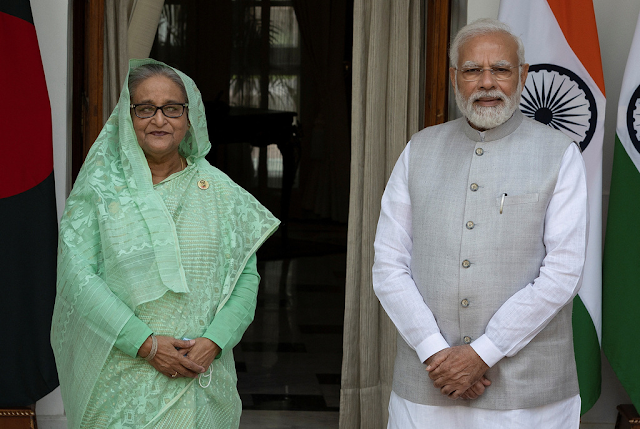
Bangladesh Prime Minister Sheikh Hasina with her counterpart Indian PM Narendra Modi at Hyderabad House, New Delhi

SALEEM SAMAD

After last week’s official visit of Bangladesh Prime Minister Sheikh Hasina to New Delhi the officials of both sides described the visit as having further strengthened relations between the two neighbouring countries, despite there being several political hiccups according to political observers.

Well, the prime ministers of Bangladesh and India have met 12 times since 2015. Each parley held has added feathers to the hats, except the recent one.

The most significant achievement was the long-standing border demarcation which was finally resolved, pending as it had been since the partition in 1947. The beleaguered citizens of the enclaves were rehabilitated, resettled, and compensated.

Road and railroad connectivity have appreciably improved and are expected to progress further. The transit through Bangladesh to the northeast Indian states is in function.

However, several crucial issues were not discussed or any consensus reached regarding them, which include river water sharing, climate change, border killings, Rohingya refugees, lopsided trade gap, energy and other pending issues.

Meanwhile, the head of German state media Deutsche Welle (DW) Bangla service Khaled Muhiuddin, not an apologetic political analyst, describes the trip as an “election campaign” for Sheikh Hasina’s upcoming national election scheduled at end of 2023.

None of the bilateral agreements – the Memorandum of Understanding (MoU) signed in Delhi comply with the state visit protocol, said the Bangladesh-born broadcaster in DW.

Bangladesh and India share 54 international rivers including the Ganges and the Brahmaputra being major rivers. The legendary rivers are linked to the livelihood of people belonging to both countries.

Presently the two countries have water-sharing agreements with only two – the Ganges in 1996 and the Feni River in 2019. The Ganges water treaty was hailed as historic.

India and Bangladesh last week inked an interim water sharing agreement for the third river Kushiyara (flowing from Assam hills) after 25 years.

Hasina at Hyderabad House in Delhi expressed her dissatisfaction over the pressing Teesta water sharing that has been hanging in balance for over a decade due to opposition from West Bengal Chief Minister Mamata Banerjee.

Banerjee argues that the water level in the Teesta has drastically reduced over the years and therefore there is very little water for West Bengal to offer to Bangladesh.

She (Banerjee) instead was pressing for an alternative proposal to link other rivers to augment the water flow in Teesta during the dry season, but Bangladesh turned down the proposal.

Earlier, an arrangement was made in 1983 that gave 39 per cent of water to India and 36 per cent to Bangladesh. The two sides agreed on another interim arrangement in 2011 that would give India 42.5 per cent and Bangladesh 37.5 per cent of the water from the Teesta for 15 years.

Banerjee deliberately poured cold water over the deal, which angered Hasina. New Delhi is equally feeling discomfited about Banerjee’s closing rooms for holding dialogue with hydrology and river-morphology experts from India and Bangladesh.

Joint River Commission (JRC) member K M Anwar Hossain said Pakistan and north-west India are being irrigated by water from the Indus river basin and most of the water canals were in Indian territory. Whereas, the two arch enemies struck the Indus basin water sharing agreement in 1950 when tensions between the two countries were at their peak.

The Hasina-Modi talks failed to reach a meaningful point on two major security concerns of Bangladesh: repatriation of Rohingya refugees and border killings, writes Shamsuddoza Sajen, an analyst in the independent newspaper The Daily Star.

The article states that when the Director-General of the Indian Border Security Force (BSF) justified the border killings by Indian border guards during a meeting in Bangladesh on July 21, 2022, had described that all Bangladeshis killed on the border were “criminals”, the Bangladesh counterpart Border Guards Bangladesh (BFB) conspicuously remained silent.

Bangladesh and India share a 4,096 kilometre border, despite India raised barbed wire fences. There are several porous points in otherwise strict border management by both sides.

Intermittent deaths along the Bangladesh–India border occur around the year. The shoot and kill policy of BSF of people illegally crossing into India from Bangladesh, cross border crimes including gun running, drug trade and cattle smuggling.

To prevent smuggling and illegal migration from Bangladesh, BSF exercises its controversial “Shoot-on-Sight” policy, which empowers border guards to shoot any person with or without cause. A large portion of the victim is cattle traders and farmers with agricultural lands near the border.

Rights organisation Odhikar’s report indicates that between 2000 and 2021 at least 1,253 were killed and another 1,156 were wounded in BSF firing.

Earlier, according to several MoUs and related treaties signed between India and Bangladesh, if citizens of the two countries illegally cross the border, it would be considered trespassing. As per law, those suspects would be handed over to the civilian authority.

From January to September 2022, six Bangladesh nationals were killed, four injured and seven abducted allegedly by Indian border guards, according to Ain o Salish Kendra (ASK), a legal aid and human rights organisation.

However, it has been observed that India has been violating treaties, shooting at anyone seen near the border or anyone trying to cross the border, which is a clear violation of international law and human rights, says Odhikar.

Hasina, nevertheless, was assured in Delhi that the border killings will be reduced and the border chiefs of both sides have agreed to stop the killings, which is embarrassing for both Dhaka and Delhi.

Critics, dissidents, opposition and media in Bangladesh are frustrated with the slow progress of signing water-sharing agreements for more than 50 rivers. Hasina’s government came under fire by media and opposition for failing to get a “single drop” of water for Teesta.

What Bangladesh received and what Bangladesh offered to India is surely important. In between parleys and visits outside her hotel, Hasina has been able to draw the attention of the Indian media, Indian top officials and the business community to her century-old traditional handloom ‘Jamdani’ saree she wore during her four-day visit. Some media dubbed her clad in a gorgeous saree as “Jamdani diplomacy”.

First published in the International Affairs Review, 10 September 2022

Saleem Samad, is a Dhaka-based independent journalist, a media rights defender, recipient of Ashoka Fellowship and Hellman-Hammett Award. He could be reached at <saleemsamad@hotmail.com>; Twitter @saleemsamad

Sunday, September 04, 2022

Why Islamic World Is Silent On The Persecution Of Uyghur Muslims?

SALEEM SAMAD

The United Nations (UN) Office of the High Commissioner for Human Rights (OHCHR) softly blames “China may have committed crimes against humanity in Xinjiang (former Turkestan province).

The human rights office releases a long-awaited report last week to expose China’s treatment of ethnic Uyghur Muslims and says ‘serious human rights violations have been committed in Xinjiang, home of 10 million Uyghurs.

Well, the bigwigs of the Chinese Communist Party in the capital Beijing calls the report ‘completely illegal and void’. China has forcefully denied any maltreatment in Xinjiang and issued a 131-page (nearly three times the length) in response to the 48-page UN report in which decried the findings as “based on the disinformation and lies fabricated by anti-China forces.”

Outgoing UN human rights chief Michelle Bachelet, who is former President of Chile says, China’s “arbitrary and discriminatory detention” of Uyghurs and other Muslims in its Xinjiang in the north-western region of China “may constitute crimes against humanity”.

The report came four years after the UN Committee on the Elimination of Racial Discrimination (UNCERD) revealed that more than one million Uyghurs were being held in visible network of detention centres across Xinjiang.

Widespread persecution, discrimination and forcible confinement have occurred in Xinjiang. Besides Uyghurs, other ethnic Hui (Chinese Muslims), Kazakhs, Uzbeks, Tajiks, Tatars, Tahurs and Russians are also locked up in internment centres, while the world remains quiet.

In the internment camps, they face appalling human rights abuses from forced labour, coerced sterilisation, and the destruction of their culture and religious identity. It’s indeed a humanitarian crisis!

Throughout persecution since 2017, the international organisations within the UN have done little or less regarding the allegations of human rights abuses in China.

The Islamic world including the influential Organisation of Islamic Cooperation (OIC) and powerful countries like Saudi Arabia, Turkey, Iran, and Pakistan remains conspicuously silent.

Except for European nations, Britain, Canada, the United States and Australia, the apologetic Muslim countries instead of rebuking the Chinese for the crime against humanity are the main beneficiaries of the Road and Belt Initiative (BRI) mega projects to keep them in good humour.

The Islamic countries and Muslim-majority nations deliberately do not wish to embarrass China for their appalling human rights abuse.

Apologetic media, international organisations and Muslim countries explain that it’s a “domestic issue”, their “internal affairs” and are “combating terrorism”.

Nevertheless, China extends its “golden heart” to the Muslim countries – also to the hard-line Islamic countries like Iran, Pakistan and Arab states.

In fact, all Muslim countries have a similar problem with their human rights record in compliance with the UN Charter of Universal Declaration of Human Rights.

In the 1971 blood war of liberation in Bangladesh, no Muslim country, Muslim leader or any Muslim aid agency helped the plight, agony and sufferings of the 10 million refugees. They either supported the marauding Pakistan military junta. Nor did they raise their hand while the military committed war crimes, genocide and rape as a weapon of war.

Similarly, the same Muslim community did not urge international bodies to protest the genocide and ethnic cleansing of Muslims in Bosnia-Herzegovina by warlord General Radovan Karadzic under the command of Serbian leader Slobodan Milosevic.

After the military intervention of NATO, the civil war ceased. International Court of Justice indicts 161 individuals, including the warlords for crimes against humanity. No jubilation in any city in a Muslim country. No statement by Muslim leaders appreciating the initiative of The Hague verdict.

Leaked official documents in Chinese reveal for the first time the systematic use by the ruling Chinese Communist Party to justify the indefinite detention on trivial grounds of millions of citizens in heavily fortified internment centres across the province.

The leak exposes what appears to be a detailed and far-reaching system of state surveillance in Xinjiang, run by the provincial local government enables to target the Uyghurs, apparently Chinese citizens to the peaceful practice of their culture or religion.

Chinese official records, verified by a team of experts commissioned by rights groups and international media, show people are transported to detention facilities for simply “wearing a veil”, growing “a long beard” or performing “Muslim prayer”.

The Chinese government admits to locking up several million Uyghurs in “vocational education and training centres”, a mass “deradicalisation programme” targeting “potential extremists”.

Thousands of siblings, parents and kith and kin were victims of arbitrary detention after their relatives living in exile slammed Chinese authorities for human rights abuse and persecution of their loved ones.

Interestingly, Xinjiang’s capital Urumqi, formerly known as Dihua, has the world’s best-sophisticated surveillance system. Each person is under the authority’s radar 24/7 with a hi-tech CCTV network with audio equipment to spy on what they discuss on the street corners and hangouts.

The OHCHR said that “serious human rights violations have been committed” in Xinjiang in the context of the government’s application of “counter-terrorism and counter-‘extremism’ strategies”.

“There are credible indications of violations of reproductive rights through the coercive enforcement of family planning policies since 2017,” the OHCHR report said.

The punitive actions by the Chinese against the Uyghur “may constitute international crimes, in particular, crimes against humanity”.

The report recommended the Chinese government take prompt steps to release all those detained in training centres, prisons or detention facilities.

It is expected that the international community must take action or be ‘wilfully complicit’.

Several exiled Uyghur leaders, however, lamented that the report was the “bare minimum” which could be expected from the international community.

“The report will do little for the people (Uyghur),” a survivor of the internment camps in exile observed.

First published in The News Times, 3 September 2022

Saleem Samad, is an independent journalist, media rights defender, recipient of Ashoka Fellowship and Hellman-Hammett Award. He could be reached at <saleemsamad@hotmail.com>; Twitter @saleemsamad

Thursday, August 25, 2022

Balochistan Atrocities From Worse, Worst To Worsen


Photo (collected from open source): Nawab Akbar Shahbaz Bugti

SALEEM SAMAD

Nawab Akbar Shahbaz Bugti, a legendary hero of Balochistan independence was martyred on 26 August 2006. His martyrdom will be observed in silence by Baloch nationalists announced all over the world.

Thousands of recruits of the Baloch Liberation Army (BLA) and other revolutionaries are fighting to liberate Balochistan from the occupation of Pakistan.

Nawab Bugti, a defiant Baloch nationalist leader was brutally murdered by the Pakistan Army on the orders of Pakistan’s President General Pervez Musharraf.

In a fierce battle with the fighters, Bugti’s fortified cave in Bhamboor hills fell after the military helicopter gunship fired air-to-surface missiles into the cave killing him and his brother, grandson, and others in the August raid.

After the downfall of General Musharraf, an arrest warrant was issued when he was accused by an anti-terrorism court. Later he was acquitted by a Pakistan court in Bugti’s assassination conspiracy for insufficient evidence.

His death sparked a countrywide anti-Pakistan protest by Baloch students and youths. Police had to quell the violent ethnic riots in different cities and towns.

Nawab Bugti, born in 1927, chieftain of the rebellious Bugti tribe was the tallest Baloch leader who was the Federal Minister, Governor, and Chief Minister of Balochistan.

The nationalists from Marri and Bugti tribes – the ferocious tribes are engaged in armed insurrection. The ongoing Baloch insurgency politically challenged the forcible inclusion of the resource-rich province into Pakistan in March 1948.

Before the 1947 partition of India and Pakistan, Balochistan consisted of four princely states under the British Raj – Kalat, Lasbela, Kharan and Makran, which is known as Balochistan. Two of these provinces, Lasbela and Kharan, were fiduciary states placed under Khan of Kalat’s rule by the British, as was Makran which was a district of Kalat.

The rulers of Kalat State first were subjected to Mughal emperor Akbar in Delhi and after 1839 to the British.

Only three months before the creation of Pakistan (in August 1947), Muhammed Ali Jinnah, the first Governor-General of Pakistan had negotiated the freedom of Balochistan under Kalat State from the British colonialist.

A series of meetings were held between the Viceroy, the British Crown’s representative based in New Delhi, Jinnah and the Khan of Kalat regarding the future relationship with Kalat State and Pakistan.

The parleys ensued in a communiqué, popularly a Standstill Agreement on August 11, 1947, which stated that: The Government of Pakistan recognises Kalat as an independent sovereign state in treaty relations with the British Government with a status different from that of Indian States.

The ruling Muslim League elites of Pakistan led by Jinnah had a change of heart and unilaterally decided to merge Balochistan with Pakistan Union on March 26, 1948.

In a violent raid, the Pakistan army occupied Balochistan’s capital Quetta and forcibly entered the Amar Palace of Mir Sir Ahmad Yar Khan Ahmedzai, Khan of Kalat, who was also the President of the Council of Rulers for the Balochistan States Union and intimidated him to sign a document of accession to Pakistan.

Balochistan is populated by ethnic Baloch, as well as Pakhtuns or Pashtuns. This largest province is the least populated region and possesses abundant natural resources in Pakistan.

For decades, disgruntled Balochi nationalists are protesting forcibly converting the Baloch population into a minority in their homeland.

In the post-Bugti era, the restive Balochistan has experienced appalling human rights abuse and untold atrocities.

Anyone who speaks up, protests or writes about the persecution by security forces in Balochistan, the next day a dead body would be dumped in a village or township to warn of the dire consequences to challenge the state.

The journalists who have published critical pieces on Balochistan faced harsh backlash from the state security apparatus.

Scores of tweets are posted every day by family members of the victims of enforced disappearances. Families, relatives and well-wishers often appear in street protests demanding the return of their loved ones. Thousands of suspects supporting or sympathisers of armed insurrection were victims of enforced disappearances.

Most of the victims of enforced disappearances never returned to their families. The dead bodies which were either returned or dumped by security forces bear the brutality, the victims have endured.

In 1970 when Bangabandhu Sheikh Mujibur Rahman was on a whirlwind tour for the election campaign in Karachi, Lahore, Peshawar, and Quetta – he was given tumultuous welcome, said Zahirul Islam Khan Panna.

When the crisis in Bangladesh was brewing at the end of 1970, the fieriest Baloch leader Nawab Bugti expressed solidarity with Bangabandhu Sheikh Mujibur Rahman’s Six-Point programme.

Z I Khan Panna, a leading human rights lawyer was a law student at Karachi University. He was hand-picked by Bangabandhu to be his fixer for the election campaign in Pakistan.

Panna met Nawab Bugti in Karachi in June 1970 and handed over an English copy of the Six-Point program, as desired by Shiekh Mujib.

Bugti was indeed a great admirer of Mujib and told his Baloch nationalist leaders that the Six-Point was a Bible to resolve the longstanding deprivation and political neglect of Balochistan.

Sher Mohammad Bugti, spokesperson of Baloch Republican Party – BRP spoke on WhatsApp from Geneva where he and BRP’s key leaders are living in exile lamented that the “Balochistan atrocity is worst than Bangladesh” in 1971 perpetrated by marauding Pakistan military.

Baloch nationalists are fighting on two fronts, he said. One is Pakistan and the second is China. The Chinese Communist Party is singing the tune of Pakistan on the Baloch crisis of their existence on the mega Belt and Road Initiative (BRI) and Gwadar Port, which is located in Balochistan.

Brahamdagh Bugti, leader of the Baloch Republican Party living in exile in Switzerland, and grandson of slain nationalist leader Nawab Akbar Bugti, says that Chinese economic projects in Balochistan were aimed at “colonising” the province, and must be resisted.

Brahamdagh Bugti, who is wanted by Pakistan rejected the possibility of holding any political negotiations with the government in Islamabad and suggested an internationally supervised referendum on the Balochistan crisis to bury the crisis once and for all.

First published in The News Times, 25 August 2022

Saleem Samad, is an independent journalist, media rights defender, recipient of the Ashoka Fellowship and Hellman-Hammett Award. He could be reached at <saleemsamad@hotmail.com>; Twitter @saleemsamad

Sunday, July 31, 2022

When The Police Became Music ‘Vigilantes’

SALEEM SAMAD

I did not know when the police were given responsibility for ensuring singers sing to the proper tune of the song, especially ‘Rabindra Sangeet’ (Tagore Songs).

Tomorrow, they will haul singers singing ‘Nazrul Geeti’ or band (or pop) music for not strictly following the music grammar.

Remember, the police arrested folk singers and send them to prison for singing folk songs, which they said had hurt the feeling of the Muslims.

During the coronavirus pandemic in 2020, two Baul (mystic) singers—Rita Dewan and Shariat Sarker were arrested separately under the repressive Digital Security Act, for allegedly “hurting the religious sentiments of Muslims.”

Social media is flooded with protests and satire posts by academics, journalists, social justice advocates, human rights defenders and of course the netizens.

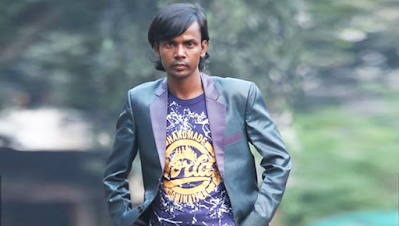
Police recently harassed a nondescript Youtuber and video-blogger Hero Alom, who was born and lives in Bograand was summoned to the office of the Detective Police.

He was not charged after he signed an apology on a piece of paper stating that he will never sing Tagore Songs in distorted tune and proper pronunciation. It is understood that some aggrieved persons had complained against Alom to the police. Is it a crime to sing inappropriately?

How do the law enforcement officers understand Hero Alom’ssongs on the YouTube channel were distorted? Are they certified by a musical institute or themselves graduates from a music college or an institute – likeChhayanaut, Bangladesh Academy of Fine Arts (BAFA), Government Music College or any recognised music institutions in the country?

If they are not certified music experts, have they consulted with a music connoisseur or teacher of RabindraSangeet? Unfortunately, they have not!

The nation has not forgotten that songs and poetry penned by Rabindranath Tagore were banned from broadcast by the Dhaka station of Radio Pakistan in 1967 during the military junta of General Ayub Khan.

Tagore is considered taboo in Pakistan since the partition in 1947. Finally, all works of Tagore were officially banned in government media (Radio Pakistan, PTV, government-owned newspapers) by the orders of powerful information and broadcasting ministerKhwajaShahabuddin and vetted by East Pakistan governor Monem Khan in 1967.

One reason is that he is an Indian. Secondly, he was dubbed as a Hindu – which fortunately he was not. His family practised Brahmmo – believing in One God, singing the Upanishad’s ‘ekeshwar’ and distanced themselves from idolatry. His father, Debendranath Tagore, adopted the Brahmofaith and does away with the rituals of Sanatan Dharma (faith).

Rabindranath Tagore is a poet of Bengal, India, and the world. Songs of Nobel laureate Rabindranath are national anthems in India, Bangladesh and Sri Lanka and of course,in the minds and hearts of the Bangalee diaspora (from both sides of Bengal) living abroad.

The Islamists in Bangladesh for decades have been demanding of the government to trash the national anthem written by Tagore, who is dubbed a Hindu and an Indian.

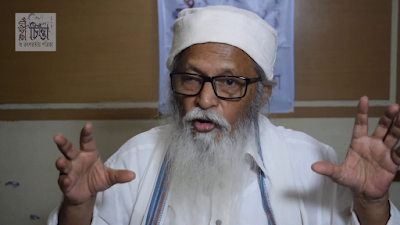
Scores of Mullahs in Waz-Mehfil(Islamic rallies) uploaded videos on YouTubethreatening to forcibly change the national anthem, which they explain compromises the culture, language and spirit of majoritarian Sunni Muslims.

Well, the Islamist has not only called to get rid of the national anthem but also dared to speak nonsense against the national flag, and state constitution. They debunkedPahelaBaishak (Bangla New Year), Ekushey February (International Mother’s Language Day) and the rich cultural heritage of Bengal.

They taunt at independence war which created Bangladesh, after a humiliating surrender of marauding Pakistan military at Dhaka on 16th December 1971. They challenge the figures of 3 million victims of genocide and said Muslim soldiers cannot kill Muslims.

In the Waz, they speak foul regarding women’s education, women’s empowerment and women in leadership.

Islamist hate-speech does attack Hindus, Christians, Buddhists and Adivasis. They warn them that the land they are born among the majoritarian Muslims. Even, they provoke the government to ban Ahmadiyya – whom they say are not Muslims.

This does not end here!

The Islamists coerced the authorities to change the school textbooks in Bangladesh. The authority deleted several pieces of literature and poetry written by Hindu litterateurs. Even the sketches in the textbooks have been replaced by girls and women in headcovers and men wearing ‘Tupi’ (cap). The boys in half-pants or shorts have been replaced with pyjama and panjabi.

Well, to conclude the police and civil administration have turned a blind eye to the Waz-Mefils spitting hate-speech against the state authority, the spirit of the liberation war, and the religious and ethnic minorities.

Not to be surprised, none of the Islamic evangelists has been prosecuted under the controversial Digital Security Act, nor faced music of justice.

Is it not true that the draconian cyber law is only used against critics of the government, opposition, journalists, netizens, cultural activists and human rights defenders and not the Islamist hate-speech mongers?

First published in The News Times, 30 July 2022

Saleem Samad, is an independent journalist, media rights defender, recipient of Ashoka Fellowship and Hellman-Hammett Award. He can be reached at: saleemsamad@hotmail.com; Twitter @saleemsamad


Wednesday, July 06, 2022

Farhad Mazhar’s Knowledge of Padma River

SALEEM SAMAD

Padma Bridge possibly received the highest media attention, as well as millions of citizens, mostly proletariat and working class were enthusiasts of the landmark communication in this century. Of course zeal of the leaders, members and sympathisers of the Awami League fervour was at a different height.

The bridge’s pre and post-inauguration obviously received media hype and the issue was a priority on the prime-time talk shows, special newspaper columns and of course the first-page stories and photo features.

In one such talkshow hosted by a New York-based exiled journalist, Kanak Sarwar, the show sought the feelings and reactions about Padma Bridge from an acclaimed poet, writer and philosopher Farhad Mazhar. Well, I heard the entire discussion and understand the discussion fairly well.

Farhad Mazhar is a trained pharmacist and played a crucial role in the establishment of Gonoshasthaya Pharmaceuticals Ltd. We often met him (Farhad) in Savar while researching with Nadira Majumder writing for Shaptahik Robbar on ‘drug imperialism’ which resulted in the announcement of a landmark drug policy in 1982.

Farhad has huge followers and fans for his outspoken philosophical debate on society, religion and politics. His poetry books are best-sellers in the Ekushey Book Fair.

He advocates Sufism and ‘Naya Krishi’ or the organic agriculture movement. His love and hate for the present regime are very well understood. In his recent interview with BBC Bangla radio, he could not defend many of his deeds, actions and statements in the last decade.

In the BBC Bangla video interview, he failed to satisfy the audience regarding his undaunted commitment to the Sunni Islamist group Hefazat-e-Islam Bangladesh (Defenders of Islam), a staunch advocate for Sharia Laws.

Among the hosts of tainted speakers (including leaders from BNP and other reactionary elements in the society), he also joined the bandwagon of Hefazat-e-Islam Bangladesh’s showdown in Motijheel in 2013. He was shown live on private TV Channels from Motijheel Shapla Square expressing his alliance with the Islamist movement.

The downtown Motijheel, a financial district in the capital Dhaka was blocked for two days. The Islamist and rightist elements had plans to cripple the financial activities and force the secular government of Sheikh Hasina to bow down.

The show of political strength ended in chaos and fiasco after riot police with armoured personal carriers(APC) and volleys of stun grenades in a pre-dawn operation literally scared the Mullahs.

Farhad defends the shut-down of the Dhaka metropolis by tens of thousands of Islamists and argues that the shadowy outfit is a “democratic” organisation.

His feminist wife Farida Akter, in an article in a popular Bangla daily, defended the misogynist Hefazat’s opposition to the women’s empowerment goals.

Many were shocked to read Farida’s illogical argument against the proposed Women’s Development Policy, 2011. She continues to oppose the policy singing to the tune of Islamists and says the policy is influenced by multinationals, corporates and a donor-driven women’s development policy.

Unfortunately, despite the nation having a woman-headed government, it has failed to implement the women’s policy for fear of Islamist antagonism.

Meanwhile, the learned Farhad Mazhar has told Kanak Sarwar’s audience that the newly build Padma Bridge was in fact the third bridge over the mighty river the Padma.

The first was Hardinge Railway Bridge (1912) and the second was Lalon Shah Road Bridge (May 2004) connecting Pakshey, Pabna and Bherapara, Kushtia, he said.

He lost in a myriad of hydrological data on the location and position of Padma River and mixed it up with the lower Ganges (Ganga in Bangla) river.

In fact, hydrological experts had determined that the Padma River is 120 km in length and begins from Goalondo to Chandpur. While the Ganges basin originates in north India from the Himalayan Mountains. It reaches the Farakka Barrage and continues on the bank of Chapai Nawabganj and flows through Hardinge Bridge and Lalon Shah Bridge.

The Ganges merged with the yawning Jamuna River at the confluence of Goalundo (once a vibrant railway and steamer ghat). From here Padma River begins its journey ending the flow of the Jamuna River.

Thus Padma Bridge is the first and until now the only longest road and rail communication bridge, beside Bangabandhu Bridge (also popularly known as Jamuna Bridge).

The all-knowing poet and philosopher have interpreted the river under Hardinge and Lalon Shah bridges as Padma River based on a myth.

The myth says that the Ganges River becomes the Padma River from Chapai Nawabganj bordering India and Bangladesh, which has been challenged by hydrological experts and river morphologists.

To continue with the debate, the massive irrigation project is Ganges-Kobadak Irrigation Project (or GK Project). The project is not a ‘Padma-Kobadak Project’. The largest surface irrigation system serves the southwestern region of Bangladesh – covering Kushtia, Chuadanga, Magura and Jhenaidah districts.

Similarly, the Ganges Barrage Project was proposed to hold back rainwater during the monsoon season because of the periodic drying up of the Ganges River in Bangladesh due to the withdrawal of the flow at Farakka Barrage. However, the Ganges Barrage Project was formally cancelled in 2017.

Hope these few pieces of information will enlighten Farhad Mazhar’s knowledge of the location and geo-position of the Padma River and also adopt the scientific knowledge of hydrologists and river morphologists and shun the myths from his mind and heart.

First published in The News Times, Dhaka, 5 July 2022

Saleem Samad, is an independent journalist, media rights defender, recipient of Ashoka Fellowship and Hellman-Hammett Award. He could be reached at <saleemsamad@hotmail.com>; Twitter @saleemsamad