Buy.com Monthly Coupon

Sunday, November 20, 2022

Why Pakistan Is Upset With The Taliban?

SALEEM SAMAD

Maryam Marof Arwin, founder of Afghanistan Women and Children Strengthen Welfare Organisation in a Twitter post lament: Afghanistan has been made a cage for Afghan women and girls.

This tweet tells a million words, which depicts the state of Afghanistan after a 16-month rule by the barbarian Taliban, who has pushed the nation into the 7th-century medieval era.

Last week, Pakistan’s envoy in his deliberation made a damning assessment of Taliban’s rule at the so-called “Moscow Format of Consultations” by key regional countries mostly neighbours held on 16 November hosted by Russia.

In an unusual move, the envoy from Islamabad tells despite assurances from Kabul, the rights of women and girls have regressed.

The assessment shared by Ambassador Muhammad Sadiq, Pakistan’s special envoy on Afghanistan, said the interim government has done little to form an inclusive government, protect the rights of women and eradicate dreaded terrorist networks.

The fourth meeting of the Moscow Format since 2017 was held with participation from Russia, Kazakhstan, Tajikistan, Iran, Pakistan, China, Turkmenistan, India, Kyrgyzstan and Uzbekistan at the level of Special Representatives or Envoys on Afghanistan.

Meanwhile, the portal Khaama Press News Agency of Afghanistan blasted the Moscow Format and argued that the meeting was ‘incomplete’ without Taliban representatives.

It is understood that Kremlin is frustrated and decided not to invite Taliban representative to Moscow for the consultation.

Russia’s displeasure was caused by negative progress made toward an inclusive Afghan government reflecting the interests of all the ethnic and political forces of the country, as promised by the Taliban’s end.

The joint statement released at the end of the consultation of the Moscow Format on Afghanistan called the Taliban a “new reality,” and stressed the formation of an “inclusive government”, respecting the interests of all major “ethnopolitical” forces.

Ambassador Sadiq in his address took an unusually harsh attitude against the Taliban regime.

In the last meeting in Moscow last year laid down broad principles to govern practical engagement with the Interim Afghan government based on i) promoting inclusivity; ii) respecting fundamental human rights including rights of women; iii) countering terrorism; and iv) sustained support to the Afghan people, including the provision of humanitarian and economic support.

The Moscow Format hoped that as friends and neighbours of Afghanistan, stood up for the Afghans. The consultation advances desired goals by bringing together the regional countries in a process of meaningful dialogue and engagement on Afghanistan.

Sadiq said the progress barometer signalled some of the worst fears, including a rapidly deteriorating security situation in Afghanistan, the mass exodus of refugees and a prolonged period of instability and violence did not materialise, the interim Afghan government had also not made the kind of progress that the international community consistently urged the interim Afghan government to promote greater political inclusivity.

Incidentally, Rawalpindi funded, trained and abetted the Taliban fighters. Earlier, to oust the Soviet invader of Afghanistan in the 70s channelled American weapons, funds and sanctuaries to the Mujahideen including Al Qaeda brainchild Osama Bin Laden.

The proliferation of military-grade weapons and violent terrorism have spilled over to Pakistan. Rawalpindi is feeling the pinch in their shoes of the threats of violence and civil war in the regions along the borders with Afghanistan.

The Taliban fighters returned to power in August 2021 and deliberately ignored all the commitments made separately in Doha as well as in Moscow.

Despite assurance from the interim Kabul government, the rights of women and girls also appeared to have regressed, not progressed, according to the Pakistani envoy. He added that the footprint of terrorist organisations in Afghanistan had yet to be fully eradicated.

The United Nations Office on Drugs and Crime (UNODC) claims that opium cultivation in Afghanistan has increased by 32% over the previous year.

Opium cultivation has caused a larger drug problem in Afghanistan. It has invited a nexus of the international network of the opium trade and money laundering.

Not to anybody’s surprise, the terror network protects the drug lords to collect funding to augment the outfit’s clandestine operations from the opium trade.

Well, the Taliban regime for their survival in the face of global economic sanctions benefitted from the opium trade.

With the lack of progress, Pakistan observed that the critical support needed by Afghanistan to deal with the humanitarian and economic crises and other challenges has faltered.

Apparently, Afghanistan remains cut off from the international banking system and faces serious liquidity challenges. Billions of Afghan assets are frozen, thus deprived of being gainfully used for the benefit of the people of Afghanistan.

The opium trade has threatened the neighbouring countries Pakistan, Iran, Tajikistan and Turkmenistan vulnerable to combating and controlling the overland drug trafficking worth $1.8 – $2.7 billion in 2021.

On the other hand, the Moscow Format of consultation appealed for help to millions of Afghans, who were in desperate need of urgent humanitarian support, including food, medicine and essential life supplies.

To conclude the stakeholder of peacebuilding in volatile Afghanistan was a collective failure of the international community to stand by the people of Afghanistan – the international commitments to provide humanitarian support to Afghanistan remain largely unfulfilled.

First published in The News Times, November 20, 2022

Saleem Samad, is an independent journalist, media rights defender, recipient of Ashoka Fellowship and Hellman-Hammett Award. He could be reached at <saleemsamad@hotmail.com>; Twitter @saleemsamad

Friday, November 18, 2022

China ‘Belting’ Pakistan on The Road to A Debt Trap


SALEEM SAMAD

The political debacle of the ambitious Gwadar International Port built by the Chinese is yet to be fully operational. It was discovered that the challenges were unbearable and the threat perception has increased manifold in the restive Balochistan province in Pakistan.
The security threat challenged by Baloch separatists and armed nationalists demanding an independent Balochistan has caused a ripple of fear for the future of the Gwadar Port and China’s ambitious connectivity with Central Asia into the Arabian Sea.
The ‘all-weather friends’ China and Pakistan signed a precursor deal to develop the Karachi coastline at the cost of $3.5 billion – another would be a debt trap.
China’s strategic shift from Gwadar to Karachi has prompted Pakistan’s ousted Prime Minister Imran Khan to dub the “jackpot” project “a revolution” in his Tweet to develop Karachi’s coast.
Chinese policy puts strategy over investment and ignores profits. The Chinese Communist Party’s (CCP) leadership has shifted from high-risk lending to hedging its bets.
The ancient silk-road was envisioned as a megaproject – Belt and Road Initiative (BRI) by China’s powerful President Xi Jinping.
However, the project seems to have hit a speed bump after reaching Gwadar and is losing its steam.
Meanwhile, China is extremely concerned about the safety and security of its personnel engaged in the construction of China-Pakistan Economic Corridor (CPEC) projects, including the Karakoram Highway linking with Gwadar.
China defending its lending practices, said they were “sincere and unselfish”, and insisted it only lent to countries that could repay.
Patterns of Chinese investments in South Asia – Bangladesh, Nepal, Pakistan, and Sri Lanka – all of which are part of BRI, depict Chinese propensity to control the domestic markets and the natural resources of the South Asian nations.
Many countries where China has offered ambitious BRI proposals could not contemplate where and when they were going to fall into a debt trap.
Some countries admitted that they have fallen into a debt trap and the mega infrastructure is being colonized, like the $306.7m Hambantota International Port in Sri Lanka built by China in 2010.
In 2016, a 70 per cent stake of the port was leased to China Merchants Port Holdings Company Limited (CM Port) for 99 years for $1.12bn. The lease was questioned during the street revolution which toppled the Rajapaksa brothers. The cash-starved Sri Lanka now wants the port back.
Pakistan is one of them. They know where the trap is. The Sunni Muslim majority nation knows they are sliding into China’s debt trap. Despite the debt trap, a strong pro-Chinese lobby with Pakistan elites and military in Rawalpindi promotes Chinese megaprojects, while the politicians have to swallow the Chinese red pills.
Pakistan is China’s gateway to Central Asia and the Middle East. CPEC’s transportation corridor will create a low-cost network of roads, railways and other infrastructure and substantially increase trade capacity between southwest China with Europe, the Middle East and North African countries.
The $62bn Gwadar project links with the persecuted Uyghur Muslims in East Turkistan (now Xinjiang Province) of China and is being built through disputed territory in Gilgit-Baltistan, Pakistan-administered Kashmir, and militant-infested Balochistan.
Well, the BRI flagship project in Pakistan fails to address the participation of the fiercely independent Baloch people, which has scaled up armed insurrections in Balochistan.
Historically, Balochistan was a princely state and once an independent nation under British Raj. Before the British colonialists quit India, signed its independence months before Pakistan’s independence in August 1947. Muslim League overzealous leaders invaded Balochistan in March 1948 with full knowledge of Mohammad Ali Jinnah, founder of Pakistan.
Gwadar has been leased to China for 43 years and the prospect of the Chinese navy converting the port into a strategic naval base will invite greater security issues.
China which they do not hide its grand plan to expand its maritime presence in the Arabian Sea and the Gulf of Oman – a major strategic global oil trade route.
The United States and its allies in the Gulf reckon China’s hegemony in the Gulf has been deemed a security issue of the oil route.
America thinks the presence of the Chinese navy will provide military backup to Iran’s naval patrol in the Persian Gulf, from yet another Chinese-built Chabahar port in Iran, not far from Gwadar.
Earlier, Communist China for decades propagated on its state radio that the United States, Japan, Britain, and European countries are economic imperialists, warmongers and backed autocratic regimes in third-world countries.
Several think tanks argue that China has become an economic giant and a new superpower – the neo-economic imperialist or another “East India Company”.
A British popular tabloid newspaper The Sun claims that China is “colonizing” smaller countries by lending them massive amounts of money, which they can never repay.
Developing countries from Pakistan to Djibouti, Maldives to Fiji, all owe huge amounts to China. Countries around the world owe huge sums to China and have fallen into a debt trap.
Some political scientists are calling it “debt-trap diplomacy” or “debt colonialism” offering enticing loans to countries unable to repay, and then demanding concessions when they default.
Alarm bells are ringing for Pakistan’s public debt is piling up, while a new narrative taking shape in the West that the BRI is creating a debt trap for developing economies, many are quick to link Pakistan’s ballooning debt to loans incurred under the CPEC.
Pakistan will have to pay back $100 billion to China by 2024 of the total investment of $18.5 billion, which China has invested on account of bank loans in 19 early harvest projects, under CPEC.
Nevertheless, Pakistan elites and media hype boast CPEC has the potential for a dramatic impact on Pakistan’s economy, but this transformation would come at a heavy price of making Pakistan a colony of China. Piling up loans from China is a big gamble for Pakistan’s economy, writes Abdul Khaliq, a debt analyst.
As China makes inroads into Pakistan, the government has given sweeping tax exemptions to Chinese companies, a situation which is creating a damaging and discriminatory playing field against Pakistani business entrepreneurs virtually abolishing the remaining locally owned manufacturing sector in the country.
In fact, Pakistan heavily relies on CPEC and has put all its eggs in one basket. Piling up loans from China and building too many hopes in the CPEC may be a big gamble for Pakistan’s economy.

First published in The New York Editorial, 18 November 2022
Saleem Samad, is a South Asia Special Correspondent for the New York Editorial. He is an independent journalist based in Bangladesh. He is a recipient of the Ashoka Fellowship and the Hellman-Hammett Award and is a correspondent of the Reporters Without Borders (@RSF_inter). He could be reached at saleemsamad@hotmail.com; Twitter: @saleemsamad

Wednesday, November 16, 2022

Why Has Pakistan Banned Joyland Movie?


SALEEM SAMAD

The controversial film Joyland received global accolades on film festival circuits for its portrayal of a transgender love affair. The movie has been banned for ‘highly objectionable material’ wasn’t a surprise for Pakistan.

The film is set in Lahore and shot in the Punjabi language revolves around the story of a young married man from a middle-class conservative family who joins an erotic dance theatre and falls in love with a starlet transgender performer. His love story elucidates the desires and secrets which is in contradiction with his patriarchal family.

The critically acclaimed film is Pakistan’s official entry for the category of Best International Feature Film for Oscars 2023.

It got its first premiere at Cannes 2022, where it received a standing ovation from the audience and jury.

Joyland has gained massive appreciation worldwide. The film received top global awards, including the Queer Palm, which is the Cannes Film Festival’s LGBTQ prize.

The movie also came away with rave reviews after it premiered at the Toronto Film Festival and the American Film Institute Festival.

Unfortunately, before the film was released in the theatres, objections were raised by Islamists, who have not seen the film citing controversial content which was deemed un-Islamic, thus unfit for screening in a Sunni Muslim majoritarian Pakistan.

Days before the release of the film, the Pakistan authority ‘uncertified’ the film and blocked it from screening in the country.

Joyland (126 minutes) was slated to be screened in movie theatres across Pakistan this week. But the religious leader forced the federal censor board to reverse its decision and declare the movie “ineligible” for Pakistan.

The Islamic Republic has a notorious history of banning movies in various categories, citing religious reasons and so-called nationalistic reasons.

A Jamaat-e-Islami Senator Mushtaq Ahmad Khan posted a tweet that he was relieved to hear about the ban. “Nothing un-Islamic can happen here [Pakistan],” Ahmad added.

Filmmaker Saim Sadiq’s Joyland received a letter from the Ministry of Information and Broadcasting days ahead of its release which blocks the film to see the light of day.

The devastated filmmaker instead of showing his frustration thanked the “written complaints” from people claiming it features “indecent and immoral” content and reminded that legally, “Joyland is still certified to release in Punjab and Sindh on November 18.”

He argued that the 18th amendment in the Pakistani constitution gives all provinces the autonomy to make their own decision. Yet the ministry suddenly caved under pressure from a few Islamist – and made a “mockery of our federal censor board by rendering their decision irrelevant,” he lamented.

Director of the film Sadiq told Al Jazeera TV network that he was dismayed at the government’s decision. He remarked that this sudden U-turn by the government is unconstitutional and illegal.

Pakistan’s parliament broke ground in 2018 by passing a law to provide legal recognition to transgender persons, some conservative hardliners have lately been campaigning to take those rights away from people.

The recent ban on Oscar contender Joyland after religious backlash is yet another example of Mullah’s intolerance and disrespect for freedom of expression and creative media.

As the visiting scholar and former ambassador, Prof Husain Haqqani says, the mullahs, military, militancy and mosque nexus have unlimited evil power in Pakistan.

Immediately after a copy of the ban notification crept into social media, celebrities have been up in arms, calling for an end to the ban and for the film to be released.

The outcry of support for the film flooded the social media space from mango people, including artists and civil society. Hashtags #ReleaseJoyland and #BanJoyland are trending in social media both in favour and against the film.

If Joyland fails to be screened in Pakistan, the nomination for Oscar Academy Award would be stopped at a roadblock.

In the starring roles in Joyland are Rasti Farooq (Mumtaz), Alina Khan (Biba), Sarwat Gilani (Nucchi), Salmaan Peerzada (Rana Amanullah), Sohail Sameer (Saleem), Sania Saeed (Fayyaz) and Ali Junejo (Haider). The screenplay was written jointly by Maggie Briggs and Saim Sadiq.

First published in The News Times, November 15, 2022

Saleem Samad, is an independent journalist, media rights defender, recipient of Ashoka Fellowship and Hellman-Hammett Award. He could be reached at <saleemsamad@hotmail.com>; Twitter @saleemsamad

Monday, October 31, 2022

US Congress To Recognise Bangladesh Genocide In 1971


SALEEM SAMAD
Recently United States Congressman Steve Chabot along with co-sponsor Congressman Ro Khanna and Congresswoman Katie Porter introduced a bipartisan resolution 1430 “Recognising the Bangladesh Genocide of 1971” in Capitol Hill, Washington DC.
The resolution demands that the United States government should recognise the genocide committed by the Pakistan armed forces during the brutal birth of the country in 1971, which disproportionately targeted members of the Hindu community, secularists, and nationalist groups in East Pakistan (now Bangladesh).
Congressman Steve Chabot is a member of the House Foreign Affairs Committee’s Subcommittee on Asia and the Pacific, and Co-Chair of the Bangladesh Caucus, introducing the resolution said, “There was a genocide. Millions of people were killed [in 1971] in what is now Bangladesh, and what was then East Pakistan.
About 80 per cent of those millions that were killed were Hindus. And it was, in my opinion, a genocide just like other genocides – like the Holocaust – happened. “
The historic resolution observes that the Pakistani ruling elite and officials harboured well-documented anti-Bangalee sentiment, considering Bangalees to be a lesser people group that had been corrupted by un-Islamic practices.
The infamous brutal crackdown “Operation Searchlight” involved widespread massacres of civilians. The operation targeted the Bangalee nationalists and especially the Hindus, who are dubbed with the demeaning word “Malaun” (cursed).
“The genocide against Bengalees and Hindus is one of the forgotten genocides of the 20th century and its lack of recognition remains an open wound for millions of people who were directly affected by the atrocities, remarked Senator Tabo”
Pakistan’s President, General Agha Muhammad Yahya Khan, is recorded as saying to his top military brass “[k]ill 3 million of them and the rest will eat out of our hands”.
Unfortunately, the genocide against ethnic Bangalees and Hindus is one of the forgotten genocides of the 20th century and its lack of recognition remains an open wound for millions of people who were directly affected by the atrocities.
Earlier, the United States based non-governmental organisations Genocide Watch and the Lemkin Institute for Genocide Prevention sought international recognition of the atrocities committed by the Armed Forces of Pakistan as ‘genocide’.
An estimated number killed in the atrocities was 3 million (an official figure of the Bangladesh government). Nearly several hundred thousand were victims of rape as a weapon of war.
The bloody war caused nearly 10 million war refugees and took shelter in camps along the borders of India for their safety and up to 50 per cent of the population was internally displaced.
On March 28, 1971, United States Consul General in Dhaka, Archer Blood, sent a telegram to Washington titled “Selective Genocide” in which he wrote “Moreover, with support of Pak[istan] military, non-Bengali Muslims are systematically attacking poor people’s quarters and murdering Bengalis and Hindus. Streets of Dacca are aflood with Hindus and others seeking to get out of Dacca…”
Senator Edward Kennedy, Chairman of the Senate Judiciary Committee in a report to the Committee on November 1, 1971, states “Nothing is more clear, or more easily documented, than the systematic campaign of terror—and its genocidal consequences—launched by the Pakistan army on the night of March 25th. Field reports to the U.S. Government, countless eye-witness journalistic accounts, reports of international agencies such as the World Bank, and additional information available to the Subcommittee document the continuing reign of terror which grips East Bengal. 
Hardest hit have been members of the Hindu community who have been robbed of their lands and shops, systematically slaughtered, and, in some places, painted with yellow patches marked ‘H’. All of this has been officially sanctioned, ordered and implemented under martial law from Islamabad.”
In a study published in 1972 titled “The Events in East Pakistan”, the Secretariat of the International Commission of Jurists states “There is overwhelming evidence that Hindus were slaughtered, and their houses and villages destroyed simply because they were Hindus.”
During the nine months of the war, the Pakistani military forces persecuted, tortured, and murdered representatives of Bangla culture and identity, including poets, musicians, professors, journalists, physicians, scientists, writers, and filmmakers.
Often debates are alive on the definition of genocide, persecution, atrocities and massacre rage among scholars and historians. The attempt to eliminate Hindus and the rape of women constitute crimes against humanity, war crimes, and genocide.
There is no confusion after the United Nations Convention on the Prevention and Punishment of the Crime of Genocide, signed on December 9, 1948, declares that genocide “means any of the following acts committed with the intent to destroy, in whole or in part, a national, ethnical, racial or religious group, as such: (a) Killing members of the group; (b) Causing serious bodily or mental harm to members of the group; (c) Deliberately inflicting on the group conditions of life calculated to bring about its physical destruction in whole or in part; (d) Imposing measures intended to prevent births within the group; (e) Forcibly transferring children of the group to another group.” and “The following acts shall be punishable: (a) Genocide; (b) Conspiracy to commit genocide; (c) Direct and public incitement to commit genocide; (d) Attempt to commit genocide; (e) Complicity in genocide.”
The resolution calls on the Pakistan authority, in the face of overwhelming evidence, to offer acknowledgement of its role in such genocide, offer formal apologies to the Government and people of Bangladesh, and prosecute, in accordance with international law, any perpetrators who are still living, the resolution said.
Meanwhile, the Human Rights Congress for Bangladesh Minorities (HRCBM) held a press conference at the National Press Club in Washington DC which was attended by journalists, human rights defenders, academics, social entrepreneurs, members of the Bangladeshi diaspora and also exiled rights defenders of Sindh and Balochistan.
Priya Saha, Executive Director of HRCBM said, “The Pakistani military and its militia forces, namely the death squad Al-Badr carried out the targeted assassination of more than 1,100 Bangla-speaking intellectuals and other professionals, to create an intellectual vacuum in the country. In Bangladesh, 1,942 mass graves were discovered.”
Speakers at the press conference discussed and answered questions about the impact of this historic resolution on the geopolitics of the Indo-Pacific and radical groups originating from Bangladesh and Pakistan.
Among the speakers were Dr Sachi Dastidar, distinguished professor emeritus at SUNY, recalled his family’s personal experience as victims of genocide.
Prof Dwijen Bhattacharjya of Columbia University and General Secretary of the Bangladeshi Hindu Buddhist Christian Unity Council in the United States believes that resolution 1430 will be departing from the 1971 United States policy on the genocide in Bangladesh.
Saleem Samad, General Sectary of the Forum for Freedom of Expression, Bangladesh said the Pakistan military committed genocide with an “intent to eliminate” a race, language, culture, heritage, traditional practices and of course religion
The ‘rape as a weapon of war’ was executed for several reasons. Firstly, to give birth to “war babies” to establish a so-called ‘superior’ race. Secondly, to change the identity of race and ethnicity. Thirdly to break the morale of a defiant nation.
Munawar “Sufi” Laghari, the Executive Director of Sindhi Foundation said the resolution to recognise the Bangladesh genocide would enable Pakistan’s ‘military establishment’ to halt ongoing ethnic persecution of Sindhi and Baloch, enforced disappearances and forced conversion of Hindus girls in the restive province of Sindh and Balochistan.
The press conference moderated by Adelle Nazrarian, Media Fellow at the Gold Institute for International Strategy (GIIS) and Communication and Legislative Director at HinduPACT urged the Bangladeshi diaspora in the United States, in particular, to work with their local representatives and requested that they support the resolution.
First published in The News Times, October 30, 2022
Saleem Samad, is an independent journalist, media rights defender, recipient of Ashoka Fellowship and Hellman-Hammett Award. He could be reached at <saleemsamad@hotmail.com>; Twitter @saleemsamad


Monday, October 17, 2022

Can EC Become A Game Changer In Elective Democracy?

SALEEM SAMAD

In every election, the same screenplay of vote fraud and election irregularities has been produced by the ruling party.

Whenever BNP, Jatiya Party or Awami League are in power till today, the election observers witnessed a similar style of forcibly taking control of polling centres by henchmen of ruling party political leaders.

The Bangladesh Election Commission’s (EC) order to pack up the ongoing by-election in Gaibandha drew widespread accolades from civil society, rights organisations and national media.

Promptly the ruling Awami League bigwigs did not hesitate to critique the EC. They churned conspiracy theories that EC’s decision will make the electronic voting system questionable.

The recent electoral episode in northern Bangladesh invited fresh controversy regarding the operation of the electronic voting machine (EVM).

Whether the EVM is an electoral tool to ensure free and fair elections in a country where political parties flex their muscles in polling centres and flout the election code of conduct?

Indeed Gaibandha polls raised some doubts, whether the EC is competent to deliver the nation, a free, fair, credible and inclusive election.

Always the ruling political parties have a nexus with district civil administrators and district police. It seems the government officials do not have accountability under the oath of the People’s Republic of Bangladesh.

Why does the ruling party abuse the nexus? The reason, the governing party possesses the ‘magic wand’ to influence the civil bureaucrats and police administration.

Their obligation to serve at the whims of their political master is obvious. The lucrative posting and promotion await for the subservient officers – the government officers cannot ignore the sugar-coated blessings of favouritism and nepotism to build their careers and accumulate wealth to live a peaceful life after retirement.

Prof Dr Nazmul Ahsan Kalimullah of Dhaka University and chairperson of JANIPOP, a voluntary election observer’s organisation explained that EC’s experience in Gaibandha proved that Bangladesh does not need a caretaker government to hold the general elections.

The EC is a constitutional body and has once again proved that it’s an accomplished organisation to hold free and fair elections.

Dr Masum Billah, a political analyst who teaches law at Jagganath University says a controversial clause in the constitution requires holding the general election keeping the existing parliament. As such, the lawmakers remaining in power flex their muscles in the election.

On the other hand, Awami League’s arch-rival Bangladesh Nationalist Party (BNP) demands that the prime minister should dissolve the parliament before the election, which is not in compliance with the constitution. “It’s a collective political failure,” Dr Billah remarks.

Among other limitations of the EC, the body does not have its cadre service of civil officers to independently conduct a national election. Unfortunately, the EC is dependent upon the civil bureaucracy and police administration to conduct the elections.

There are several instances in the last half a century when the state apparatus showed thumps down on EC’s orders.

Despite being empowered by the constitution, sometimes EC becomes a toothless tiger and is unable to take departmental actions against delinquent officers of civil administration and police department.

What is next, after the newly launched newspaper Dainik Kalbela published breaking news that the upcoming general elections will be held on 4 January 2024?

Obviously, the nation will expect high hopes from the Election Commission. The EC in many countries has demonstrated as a role model in conducting credible elections.

The Chief Election Commissioner of India TN Seshan (Dec 1990 to Dec 1996) redefined the status and visibility of the Election Commission of India.

He became best known for his electoral reforms. He curbed several malpractices like bribing or intimidating voters, use of government funds and machinery for campaigning, appealing to voters’ caste or communal feelings, use of loudspeakers and high-volume music.

In another continent, Professor Attahiru Muhammadu Jega, was Chairman of the Nigerian Independent National Electoral Commission (INEC), he organised a peaceful elections in 2015 for the first time in Nigerian history.

Well, the Bangladesh Election Commission should uphold the constitution and is expected to be game changer in elective democracy to deliver credible and inclusive elections in Bangladesh, which would be widely acceptable by the citizenry at home and abroad – the international bodies and the West too.

First published in the News Times, October 17, 2022

Saleem Samad, is an independent journalist, media rights defender, recipient of Ashoka Fellowship and Hellman-Hammett Award. He could be reached at <saleemsamad@hotmail.com>; Twitter @saleemsamad

Sunday, October 16, 2022

Bangladesh Ranked 84th In Global Hunger Index: Food Supply Chain Disrupted By Ukraine War


SALEEM SAMAD

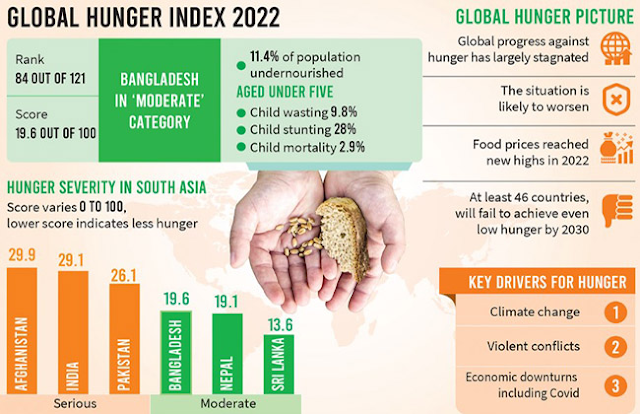
Bangladesh ranked 84th, out of 121 assessed countries on the 2022 Global Hunger Index (GHI). With an overall score of 19.6 (2022), the level of hunger in Bangladesh has been categorised as “moderate”.

On the eve of World Food Day (October 16), the launch of the 2022 GHI amid global crises and the war in Ukraine is putting global food security in peril, and the worst impacts are being felt by the very poorest.

Among South Asia, India, Pakistan, and Afghanistan are among the worst-performing countries in the region.

The GHI that tracks and measures hunger across the world says that malnutrition among children under five years in Bangladesh has slightly improved.

The country has gradually improved its ranking from 33.9 (2000), 31.3 (2007), 26.3 (2014) and 19.6 in 2022.

The report that has used the fifth National Family Health Survey (NFHS-5) and FAO (Food and Agriculture Organisation of the United Nations) Food Security Indicators as its sources for Bangladesh has highlighted that child wasting (low-weight-for-height) rate in Bangladesh, at 9.8 per cent, is satisfactory but still lots of effort needed to touch the target of “Zero Hunger” of Sustainable Development Goals (SDG) by 2030.

Despite Bangladesh being a moderate hungry country, but has fared well in undernourishment, child wasting and child stunting.

There are several reasons for the disruption, Bangladesh and other countries have failed its reach food autarky.

Some 50 nations that rely on Russia and Ukraine for the bulk of their wheat imports — including Bangladesh, Egypt, Iran, and Turkey — have been scrambling to find alternative suppliers, according to the GHI 2022 Report.

Spiralling food prices and global supply chain disruptions precipitated by the Ukraine war, the COVID-19 pandemic, climate change, and regional conflicts have worsened hunger for millions of people, requiring humanitarian and resilience-building responses to be urgently scaled up.

Incidentally, Bangladesh imports wheat from both Ukraine and Russia. Bangladesh’s food import is the lowest among countries having food shortages. Eritrea tops the list of dependencies on the external food supply in Ukraine and Russia.

The report mentions that there is another prime reason for the increase in food grain requirement in Bangladesh because of hosting more than one million Rohingya refugees since 2017.

Bangladesh took efforts in amplifying longstanding structural deficiencies in the global food system, which is inadequate for sustainably ending poverty and hunger as envisaged by the United Nations’ 2030 Agenda.

Within a global food system that has fallen short of sustainably ending poverty and hunger, citizens are finding innovative ways to improve food systems governance at the local level, holding decision-makers accountable for addressing food and nutrition insecurity and hunger.

The good news is the recent trend toward decentralising government functions has given local governments greater autonomy and authority, including over key elements of food systems.

The situation is likely to worsen in the face of the current barrage of overlapping global crises — conflict, climate change, and the economic fallout of the COVID-19 pandemic — all of which are powerful drivers of hunger.

These crises come on top of underlying factors such as poverty, inequality, inadequate governance, poor infrastructure, and low agricultural productivity that contribute to chronic hunger and vulnerability.

Globally and in many countries and regions, current food systems are inadequate for the task of addressing these challenges and ending hunger.

Hunger cannot be eradicated unless global leaders join hands to tackle the structural drivers that cause it: war, climate change, and recession.

First published in The News Times, 15 October 2022

Friday, October 14, 2022

Who Is To Blame For Failed Gaibandha By-Poll?


SALEEM SAMAD
In an unprecedented move, the Bangladesh Election Commission (EC) suspended the by-elections in Gaibandha-5 (Fulchari-Shagata) in the middle of voting on 12 October.
Such a move in recent history has surprised many and is likely to strengthen the confidence of the opposition and the ‘aam-janata’ (general public), but it would be short-lived.
Nevertheless, the EC is empowered by the state constitution to hold a credible election.
The ruling Awami League did not expect EC would take dramatic action in halting the election in the middle of the electioneering.
The leadership is not all happy with the action of the EC. The nation is eagerly expecting a formal statement from party stalwarts.
Two things made the EC go ahead with a drastic decision to stop the election squarely blaming vote fraud. First, the surveillance cameras in the polling booths were monitored from the control room of the EC, where journalists were allowed to observe.
The suspension of the by-election in Gaibandha indeed will be a warning to political parties, local leaders and their henchmen.
The question has been raised, whether it was prudent of EC to cancel the voting, which is definitely not a solution to vote fraud.
One thing is clear the government did not cooperate with the EC. The government did not lend their shoulder to EC to hold a peaceful election.
Experienced observers of elective democracy, Dr Badiul Alam Majumder of SHUJAN and Dr Nazmul Ahsan Kalimullah of JANIPOP have expressed their reservations over the action by Election Commission on logical grounds.
They explained that the recent parley between the EC, civil administration (Deputy Commissioners) and police administration (Superintendents Of Police) gave a signal of appalling partisanship in the bureaucracy.
They recommended that the gap between the EC and the local civil administration have to be significantly reduced, living no room for confusion and controversy.
Both Dr Majumder and Dr Kalimullah feel that the election is the responsibility of the Election Commission, but successful implementation lies entirely with the district administration and law enforcement.
In short, the involvement of civil society, grassroots leadership and other stakeholders should work alongside the local civil administration and law enforcement. If there are irregularities and the election is cancelled for vote fraud then the responsibility for the failure to hold the polls will be bestowed upon the government.
Well, in most countries, the EC has election cadre service officials to conduct all kinds of elections. But for Bangladesh, it will be an additional burden on the national exchequer.
It is equally true that political parties, especially the ruling party will not agree to strengthen the independence of the EC, which may jeopardise their political career, and weaken the possibility to remain in power by hook or by crook.
Since independence, it would be difficult to say which election was credible and inclusive. Elections in different regimes were tainted.
When the voters in Bangladesh have lost confidence in the ballot; when the ‘aam janata’ fear their life going to the polling centres – then democracy fails. Democracy and electioneering are twins and go parallel.
When the government officers responsible for holding a credible inclusive election fail, who is to be blamed? Blame whom, the Election Commission (EC) or the civil administration?
If the civil service and police administration are recruited on a partisan background, what else the nation should expect from them?
It is also true that the district administration and police are under constant pressure from the local political leadership and vested groups, which restrains them from functioning.
In most cases, it becomes difficult for the local civil administration and police to continue with administrative duties because of political high-handedness and fear of losing their government job.
Like, Magura vote fraud and stark inaction by the Election Commission is still remembered, Gaibandha will also be remembered, when the general elections are around the corner, at end of 2023.
Do the ruling party understand that the whole world is observing the development towards holding parliamentary elections next year? The international community expects Bangladesh will not hold free and fair elections and also credible and inclusive elections too.
First published in The News Times, 14 October 2022
Saleem Samad, is an independent journalist, media rights defender, recipient of Ashoka Fellowship and Hellman-Hammett Award. He could be reached at <saleemsamad@hotmail.com>; Twitter @saleemsamad


Thursday, October 13, 2022

Who Can Be Members Of UNHRC?

SALEEM SAMAD

Bangladesh has been elected as a member of the United Nations Human Rights Council (UNHRC) for the term of three years (2023-2025).

Bangladesh Foreign Minister Dr Abul Kalam Abdul Momen has sent messages on WhatsApp stating (quote unquote): “Bangladesh won the Human Rights Council Election today (Tuesday) at the UN with highest votes (160 votes) which vindicated again that the global leaderships have confidence on Sheikh Hasina’s government and the Human Rights track record of Bangladesh. Bangladesh government is always at the forefront of democracy, Human Rights and justice.”

A question obviously arises, who can be members of UNHCR? The Council is comprised of 47 member states, which are elected by the majority of members of the General Assembly of the United Nations through direct and secret ballots.

The General Assembly takes into account the candidate States’ contribution to the promotion and protection of human rights, as well as their voluntary pledges and commitments in this regard.

The election to the Council’s Membership is based on equitable geographical distribution. Seats are distributed as follows: African States (13 seats), Asia-Pacific States (13 seats), Latin American and Caribbean States (8 seats), Western European and other States (7 seats) and Eastern European States (6 seats).

Countries elected are Algeria, Bangladesh, Belgium, Chile, Costa Rica, Georgia, Germany, Kyrgyzstan, Maldives, Morocco, Romania, South Africa, Sudan and Viet Nam.

Bangladesh is fortunate to have been elected in the quota of Asia-Pacific States with the highest vote of 160. It definitely gives the impression that Bangladesh’s diplomacy is in a win-win situation and made commendable strides in image-building globally.

The good news is Bangladesh, Belgium, Chile, Costa Rica, Georgia, Germany, Morocco, Romania and South Africa, 23 of the 47 Council members during 2023 will be “Friends of the Responsibility to Protect (R2P)” and have been appointed as Focal Point for Group of Friends in New York and Geneva.

By the end of this year, 123 UN member states will have served as Human Rights Council Members, reflecting the UN’s diversity and giving the Council legitimacy when speaking out on human rights violations in all countries.

If we review the list of members of the past and present, it could be found that at least two-thirds of the members are governed by autocratic regimes and built-in draconian laws to suppress freedom of expression, freedom of political assembly and freedom of faith.

Hundreds of dissidents, critics, journalists and opposition are languishing in prisons in Algeria, Bangladesh, Georgia, Morocco, Sudan and Viet Nam and other countries who were and are new members of the Council.

Sudan is no doubt a failed state but has been included in the Council, surely for a purpose which is not understood well.

Many totalitarian governments and new members of the Council deliberately flout the principles of the Universal Declaration of Human Rights (UDHR). The UDHR is a milestone document in the history of human rights proclaimed by the United Nations General Assembly on 10 December 1948 as a common standard of achievements for all peoples and all nations. The Declaration is believed to be a fundamental human right to be universally protected.

Like Bangladesh, Vietnam state media boasted that being elected to the UNHRC is an “international recognition of Vietnam’s commitment to respect and protect human rights.”

However, there is still hope. Many newly elected governments in third-world countries have come to power through credible elections with people’s mandates. Those third-world countries have launched political reforms – trashed draconian laws which suppress freedom of expression and religious freedom.

To conclude, Bangladesh with membership in the Council comes with a responsibility to uphold high human rights standards. The nation under the steadfast leadership of Prime Minister Sheikh Hasina will surely reform the draconian laws, and ensure freedom of expression and freedom of assembly of opposition, critics and dissidents.

First published in The News Times, 12 October 2022

Saleem Samad, is an independent journalist, media rights defender, recipient of Ashoka Fellowship and Hellman-Hammett Award. He could be reached at <saleemsamad@hotmail.com>; Twitter @saleemsamad


Sunday, October 09, 2022

Angry Iranian Women Are Burning Their Hijabs


SALEEM SAMAD

The death of Masha Amini, a 22-year-old Kurdish woman by the so-called Morality Police has sparked a showdown of dissent on Iran’s streets since authorities crushed protests against a rise in gasoline prices in 2019.

The girl was on a family trip and arrived in Teheran, the capital of Iran. On her arrival at a metro station, the notorious Morality Police (Gasht-e Ershad) detained her for inappropriately wearing a hijab (headscarf), a strict dress code for women in the public.

She was dragged to a re-education detention centre and tortured for non-compliance with the dress code and later died from head injuries in a hospital.

Her guardians refused to accept that she died of a heart attack. They insist that she succumbed to a painful death at the hands of Islamic vigilantes.

The unprecedented anger in the streets is demanding #JusticeForMashaAmini, which has turned against the autocratic Islamic clerical establishment in Iran, since 1979.

In the third week, the demonstrations have spread to nearly 100 cities and towns since September 13 questioning the clergy’s legitimacy in power, which is indeed a serious challenge to Islamic Iran.

Besides justice for Kurdish woman, the angry #IranProtests are demanding an end to the Islamic Republic, which ruled Iran with an ‘iron hand’ blended with Islamic jargon, strict Sharia laws and intolerance to critics and dissidents.

Women in public are removing their hijab (chador in Farsi) and collectively burning in a bonfire, while many are cutting their hair in defiance of the Ayatollah’s self-composed Islamic laws.

Determined, angry and, above all, courageous in midst of the #WomenLifeFreedom campaign communicates with everyone. The women in Iran are at the forefront of the current protests.

Earlier, women have played a key role in all the protest movements of the past 40 years, including the Green Movement of 2009 and the last major nationwide protests in November 2019, which went on for several weeks before being brutally suppressed.

Like previous street protests, the barbarian Basij snipers have been deployed on rooftops to shoot and kill angry protesters.

A bitter critic of the Mullahs in Iran, the feminist journalist in exile Masih Alinejad in a tweet says: The women – of Iran are risking their lives for basic freedoms and they need the support of the international community.

In the streets of Iran, they are calling for the end of the Islamic clerical establishment’s more than four decades in power.

There is no leadership structure for the #IranProtests. ‘Generation Z’ is leading protests in the streets and online, which gave momentum to oust Ayatollah Ali Khamenei, the Supreme Leader of Iran since 1989.

Rights groups have reported the arrest of hundreds of young people, and students. Also academics, celebrities, civil society activists, human rights defenders, lawyers, litterateurs, movie stars, singers, poets, sportsmen, and at least a score of journalists.

In fact, the massive protests sparked by a young Iranian woman’s death have shaken the foundations of the Islamic Republic.

Meanwhile, nobody believes that Iranian President Ebrahim Raisi will conduct an impartial probe and that the perpetrators would be punished.

He, however, pledged to “deal decisively” with the protests and said “rioting” will not be tolerated.

Iran’s restrictive clothing laws – are rejected by a lot of Iranians. There is hardly a single woman in Iran who does not have a humiliating and violent experience with the rogue Gasht-e Ershad.

At this time, demonstrators are openly and collectively desecrating the religious symbol of the Islamic Republic.

Fury of the riot police and Basij [para-military force] crackdown on anti-government protesters has further sparked anger in the streets. The number of dead, wounded and detained protesters is rising alarmingly, rights groups claimed.

The Basij has a history of being ruthless with critics and opposition to the regime. All over the country, they are raiding the homes of thousands and dragging out critics active on social media or any dissidents who participated in the street agitations.

In absence of independent news organisations inside Iran, the protesters are dependent on social media. The activists are using Facebook, Twitter, Instagram and YouTube as a tool to vent their grievances against the Mullahs.

Nonetheless, the social media campaign further angered the regime. Quickly the authorities imposed a blackout of the internet, which severely hampered daily e-businesses.

Isik Mater from NetBlocks told the BBC: “The internet is one of the biggest tools that the Iranian authorities have got in their hands when unrest breaks out on the streets.”

Apolitical Amini’s death has unleashed anger over issues including personal freedoms and economic challenges in Iran.

The countrywide riots were in response to the bleak economic situation, runaway inflation and horrendously high gas prices.

Iran’s economic crisis, coupled with the Western sanctions, explains the popular outrage which is swiftly sparked by the latest public antagonism.

Moreover, the elimination of subsidies, unemployment, chronic inflation, and the government’s fiscal deficit enraged the general public.

With a poor global image of the country, built over four decades on appalling human rights records, and proxy wars in the Middle East, including Yemen, Gaza, Lebanon, Syria and Iraq, it would be difficult for the Ayatollahs to get international sympathy against the protest.

The veiling of women is one of its most important foundations. The clerical rulers cannot and will not compromise on the pressing issue — because abolishing the obligation to wear the hijab would be tantamount to the beginning of the end for the Islamic Republic.

First published in The News Times, 8 October 2022

Saleem Samad, is an independent journalist, media rights defender, recipient of Ashoka Fellowship and Hellman-Hammett Award. He could be reached at <saleemsamad@hotmail.com>; Twitter @saleemsamad

Wednesday, September 28, 2022

The second Iranian Revolution


SALEEM SAMAD

Thousands of enraged Iranians in a nationwide dissent against the Islamic clergy’s regime are holding demonstrations for justice for the murder of a Kurdish woman, Mahsa Amini, over the country’s abusive forced hijab dress code for women.

Mahsa Amini, 22, on 16 September was on a family trip to Iran’s capital Tehran from a liberal city of Saqez in Iran’s Kurdistan, where 10 million Kurds live.

She was detained by the notorious Morality Police (Basij para-military force) at a metro station in Tehran for not appropriately wearing a hijab (or chador in Farsi/Persian) and dragged to a centre.

The young woman died as a result of torture inflicted on her at a detention facility and the authority claimed that she died of heart failure, which her family refused to believe.

The so-called Morality Police recruited from rural Iran are Islamic vigilantes to insult to heart their dignity and detain women for violating stringent Shariah laws.

The Basij has a history to have brutally suppressed popular strife. Once again the ruthless armed group has been mobilised to quell the unrest.

In defiance, hundreds of women poured into the streets in Iran are burning their hijab and others removing their chador (headscarf) and waving in the air in busy streets and squares.

Many are cutting their hair in public, in their home and dared to post on social media as a symbol of protest, which never happened before.

The antagonism transgressed to a crossroad where protesters either insulted Iran’s supreme leader and chanted “death to the dictator”.

Nonetheless, the Kurdish woman’s death has reignited popular anger and united the dissidents and people from all walks of society, despite having different opinions.

An irate ‘unnamed woman’ removed her hijab while walking in a street in Iran posted a video on Twitter urging the Basij: “Come and arrest me….and arrest everyone campaigning for peace, freedom and human dignity.”

Iranian women are taking a huge risk and need more than expressions of solidarity, observed Yalda Zarbakhch, Head of the Farsi (Persian) service of the German news organisation Deutsche Welle (DW).

The demonstrators, especially the womenfolk must have calculated the risk factor – arrest, torture, legal harassment and intimidation of their families by the repressive regime.

Amnesty International urged that Mahsa Amini’s death must not go unpunished.

Iranian President Ebrahim Raisi called for an investigation into the death of Mahsa Amini in police custody. He also said protesting is allowed in the country but “rioting” will not be tolerated.

Despite assurance for a probe into her death, the street protests besides the demand for justice for the death of Amini are also asking to end the hegemony of the Islamic clerical ruling system.

The crackdown on the demonstrations engulfed like wildfire in more than 40 major cities and towns, including Tehran University – where the official Friday prayers (Jumma) used to be held since the revolution.

Scores of protesters were killed by riot police and hundreds of others were wounded in street battles – the number of casualties is increasing every day. A few thousand protesters were detained from all over the country, according to the rights groups.

Determined, angry and, above all, courageous women in Iran are at the forefront of the current protests and lots of Iranians have rejected the hijab dress code.

On the other hand, a critic of the Mullahs in Iran, a feminist journalist Masih Alinejad in a charged tweet says: “Iranian women [are] removing their hijab, facing guns and bullets alongside men and chanting against [the] Islamic Republic.”

Meanwhile, reformist group the Union of Islamic Iran People’s Party has called for the mandatory dress code to be repealed and appealed to allow “peaceful demonstrations”. The party remains legal but unfortunately is firmly outside the corridors of power.

For the first time, demonstrators are collectively denouncing a religious symbol of the Islamic Republic.

The latest protest coincides with the fading popularity of Ebrahim Raisi’s government which miserably failed to deliver on its promises to citizens, one year after taking office in August 2021.

Amini’s death has unleashed anger over issues including personal freedoms and economic challenges in Iran which pose an existential threat to Iran’s theocratic regime.

A recent situation report by the International Institute for Iranian Studies (Rasanah) says, these developments occurred against the backdrop of a tense domestic environment and deteriorating economic and social conditions.

Nonetheless, the recent unrest highlights the growing chasm between the government and its self-proclaimed identity which it is attempting to impose on the people through repression and society.

The ongoing unrest reflects growing popular rage and discontent, as well as a sense of deprivation and injustice, says the Rasanah study. This cycle of discontent is linked to the crisis-ridden political environment as a result of the Raisi government’s failure to deliver on promises made one year ago, both at home and abroad, political observers stated.

Iran’s bleak economic situation, runaway inflation, horrendously high gas prices and social crises explain the popular outrage which is swiftly sparked by the latest public dissent. Moreover, the elimination of subsidies, unemployment, chronic inflation, and the government’s fiscal deficit enraged the general public.

The hard-line Islamist regime of the conservative Shia Mullahs led by Ayatollah Ruhollah Khomeini came to power, after the so-called Islamic Revolution in 1979 which ousted pro-American Shah of Iran Mohammad Reza Pahlavi.

Islamic Republic’s tunnel vision policy is to “control the female body”. Whether they are Muslims or other religious and ethnic communities, the hijab was been made mandatory by the clergies in 1983 for all women.

Well, hijab means ‘curtain’ or to shut out in Arabic. Hijab, is not a religious obligation in the Quran, a divine book for the Muslims, according to verse 24:31 for modesty.

The 21st-century Muslim clergies have falsely branded hijab, niqab, burqa, chador or other headscarves as Islamic traditions and made them compulsory for women.

Renowned Bangladesh-born feminist writer in exile, Taslima Nasrin and an ex-Muslim wrote on the recent unrest in Iran: “If you encourage them not to wear burqa or hijab, and become free women who believe in women’s rights and freedom, if you encourage them to become enlightened, secular, humanist and feminist, you are really well-wishers of Muslims.”

In another development, the intermittent blackouts of the internet followed after the eruption of nationwide protests over Amini’s death.

Unfortunately, there is no private broadcast network in Iran, thus the critical voice on the internet is the “only place” where protesters can make their voices heard on social media.

Earlier, the shutdown of the internet is one of the biggest tools of the Islamist regime and was used when unrest breaks.

Exiled Iranian leader Maryam Rajavi, President of the National Council of Resistance of Iran (NCRI) founded in 1981, in a tweet urged the world [leaders] to condemn the cruel [internet] censorship and provide free access #Internet4Iran.

Political observers predict that the anti-government movement will further escalate after attention has been drawn by international news organisations, Western countries and human rights organisations.

More and more people have turned their backs on the autocratic regime, its ideology and even their theocratic “Islam”.

The Iranian dissident and critics in self-exile and expats are possibly the largest community living abroad and have lent their shoulders to the uprising.

In fact, the rulers cannot and will not make any concessions on the veiling of women — abolishing the obligation to wear the hijab is tantamount to the beginning of the end for the Islamic Republic.

Now that apolitical Mahsa Amini became a symbol of defiance in Iran, the Mullahs in Tehran and Qom (a haven for the Ayatollahs) are feeling the pinch in their shoes as they are facing the worst challenge of their regime. The Islamist leaders are spending sleepless nights in fear of losing their luxurious lifestyle and dominance in the region will extinguish. Despite cruel backlash by the state machinery, the movement went internationally viral.

First published in the International Affairs Review, 28 September 2022

Saleem Samad is an independent journalist and columnist based in Bangladesh, a media rights defender. Recipient of Ashoka Fellowship and Hellman-Hammett Award. Twitter: @saleemsamad

Tuesday, September 20, 2022

Pakistan Drowning in Debts and Floods


SALEEM SAMAD

Pakistan in the immediate past has experienced three major crises. – two of which were caused by natural hazards — the 2005 earthquake, which impacted 3.5 million people and the 2010 floods which affected more than 20 million people.

Pakistan is at a critical economic juncture. The new coalition regime of the Muslim League and Pakistan Peoples Party which is struggling to stabilize the economy is already facing the daunting task of managing a faltering economy with huge deficits.

After two years of the pandemic, the economy is in the red zone, marked by rising external debt, higher inflation, and large-scale unemployment.

The floods that occurred from the torrential monsoon deluge added fresh challenges to Shahbaz Sharif’s government in the economic crisis, which he inherited from the cricketer-turned-politician Imran Khan, who failed the nation.

The floods are not only to be blamed for climate change disaster, but it is a failure of governance on multiple levels, including deliberate neglect of Baloch, Sindhi and other ethnic and linguistic communities in Pakistan.

The devastating floods which engulfed one-third of the country have counted unofficial deaths and missing over 1500, mostly children, caused forced displacement to 33 million, and dented livelihoods.

In addition, the floods eroded a million houses and damaged around 2 million acres of crops (an estimated 45 per cent) of cultivable land in Sindh, South Punjab and Balochistan, triggering alarm bells for looming food shortage.

The floods will leave behind a trail of loss of huge livestock, the output of cotton, rice and maize crops too and also feared that the sowing of sugarcane and wheat will also take a hit.

In fact, Pakistan in the immediate past has experienced three major crises. While the nature and scale of these crises were different, two of them were caused by natural hazards — the 2005 earthquake, which impacted 3.5 million people and the 2010 floods which affected more than 20 million people.

Pakistan produces less than 1 per cent of global carbon emissions and for the past 20 years, it has ranked in the Global Climate Risk Index as among the top ten most vulnerable countries.

It could be argued that the damage caused by both disasters is the outcome of climate change as well as the politically inspired development policies of the regime in Islamabad.

The picture looks dismal of the human development index of 2021, where Pakistan plummeted to 161, which is worse than that of India (132), Bangladesh (129), and Sri Lanka (73).

Decades of neglect of Sindh and Balochistan for their defiance against Rawalpindi GHQ have irked the regime in reasonable allocation for comprehensive infrastructure development and holistic human development projects, such as investing in primary education and healthcare.

As many as 10 million Pakistanis have been pushed into poverty. An estimated 46 per cent of the population (over 80 million) was already below the poverty line, which is likely to increase due to adverse impacts of the pandemic.

The colossal loss to the economy due to devastating floods has been estimated at US$10 billion. The country’s external debts and payments make it impossible for the cash-starved government to focus on relief and rehabilitation of its affected people.

Islamabad in rapid damage control efforts, to recover from the looming economic crisis increased the prices of oil, gas, and electricity tariff. The worst scenario is drastic cuts in social expenditures have pushed millions of working-class millions into yet another struggle for survival.

In an attempt to further save from drowning, the government imposed budget cuts, withdrawal of subsidies from food, fertilisers and fuel; wage bill cuts and at a crucial moment when disadvantaged populations are in greater need of public support.

Pakistan is among the 52 countries facing a severe debt crisis. The most critical problem faced by the country’s economy is repayment and servicing of its external debt, around $38 billion to the International Monetary Fund (IMF), World Bank and other international financial institutions.

Well, the IMF has projected Pakistan’s external debt to reach $138.568 billion in 2022-23 up from $129.574 billion in 2021-22.

Central bank foreign currency reserves have fallen to nearly $10 billion, barely enough to cover a few weeks of imports.

The trajectory of debt is expected to continue to decline to 70.4 per cent of GDP by the end-fiscal year 2026, supported by a favourable interest rate-growth differential outlook, and fiscal adjustment efforts in the context of the Extended Fund Facility (EFF), a lending facility of the Fund of the IMF.

After weeks of negotiations with Islamabad in August, IMF has agreed to revive a bailout package for Pakistan to about $4.2 billion, which will relieve from the brink of a payment crisis.

Let’s not forget that Pakistan needs at least $41 billion in the next 12 months to repay debt and fund imports, according to a Bloomberg news agency report. It includes payments for $19.4 billion to the IMF, the World Bank, ADB and China.

Analysts saw the deal as crucial for Sharif’s coalition government, which came to power in April at a crucial juncture of two years of standstill during the pandemic, writes Ayaz Gul for Voice of America (VOA).

“The Agreement with the Fund [IMF] has set the stage to bring the country out of economic difficulties,” Prime Minister Shehbaz Sharif wrote in a tweet.

Earlier, in April 2020, the IMF had approved $1.4 billion in emergency financing for Pakistan under the Rapid Financing Instrument (RFI) to help the country deal with the aftermath of the Covid-19 pandemic.

Despite an appeal by the prime minister of Pakistan to the international community for comprehensive debt relief, Unfortunately, Pakistan obtained temporary debt relief worth $1.8 billion from the members of G-20 nations.

Several international anti-debt groups recommended immediate cancellation of the debt as a minimum demand since Pakistan is unable to repay its loans and these floods have worsened the condition of the country’s economy.

This demand has a legitimate legal argument based on international law, which calls for debt payment suspension on the grounds of necessity and fundamental change of circumstances, says the anti-debt groups.

First published in International Affairs Review portal, 20 September 2022

Saleem Samad is an independent journalist and columnist based in Bangladesh, a media rights defender. Recipient of Ashoka Fellowship and Hellman-Hammett Award. Twitter: @saleemsamad