Buy.com Monthly Coupon

Thursday, May 21, 2020

Happy encounters with Prof Anisuzzaman

SALEEM SAMAD
It would be an aspersion to write an obituary of a stalwart like Professor Anisuzzaman, who is embedded in the history of Bangladesh. He may not be a tall person, but the gigantic litterateur had a loud voice indeed, which had been heard in all the regimes which governed the country.
He never compromised to speak up to establish a secular nation and also demanded justice for those marauding Pakistan army henchmen for committing crimes against humanity during the brutal birth of Bangladesh. Prof Anisuzzaman, popularly known as 'Anis Sir', was a bitter critic of giving political space to Islamist parties advocating 'political Islam' regime in a secular, tolerant and pluralist society. Well, it was summer in Kolkata. Maulana Abul Kalam Azad Institute of Asian Studies, India (MAKAIAS), a state-run think-tank, organised a seminar on Bangladesh and India in 1996 at the colonial era majestic Great Eastern Hotel.
Dr. Ranabir Samaddar, a leading Indian scholar and Director of MAKAIAS selected me to present a paper. He cautioned that the paper should be taken seriously as it was an academic exercise, not journalism. My presentation was scheduled for the second day. I was excited to learn that the session would be chaired by the revered personality Prof Anisuzzaman. He flew from New Delhi, where he was on a stint as Visiting Scholar at Jawaharlal Nehru University (JNU).
On the podium, he was quickly introduced to the paper presenters from Jadavpur University, Kolkata University and from Punjab University. He was visibly confused when he heard that I was a journalist and the paper was my first.
He told the gathering of eminent academics that as the last speaker I would speak for five minutes only. I was embarrassed and to express my anger I abruptly stopped my presentation on the fifth minute, seeking an apology from the audience due to time constraints. Within moments there was pandemonium in the seminar room. The chairperson hesitantly extended another five minutes for me.
This time I retorted, "I request the chair for another 15 minutes, please." Hearing the murmuring in the room, which included several senior journalists from Kolkata, he said: "Okay, another 10 minutes only, but please finish up!" Moments after my speech, the floor was opened for questions and comments. Unfortunately, not a single question was directed towards the three academics.
My paper was on rural women in Bangladesh who violently protested the donor dictated development projects. At that time the exiled writer Taslima Nasreen's book Lajja (Shame) by Penguin India had been published. The Indian media were vocal about her ordeal in Bangladesh. My thematic paper drew a barrage of comments. Finally, Anis Sir patted me on the back and softly said in Bangla to take notes.
Like a reporter, I wrote down the issues raised in the hall. Despite being nervous, I confidently responded that there were thousands of Taslima Nasreens in Bangladesh's villages. Then why were we only talking about the feminist writer? This comment caused another round of uproar in the hall, but it was time for a lunch break.
While leaving the podium Anis Sir asked, 'Have we met in Dhaka?" I  smiled. "Sir, we met several times, but me as a reporter."  I quickly added that two of his favourite students, who were senior teachers in universities in Chittagong and Dhaka, were my childhood friends. He asked me, "Who?" I replied again, "Sir, your best students you love the most."
Months later one of his favourite students related to me what Anis Sir had told him: "I have never heard of a journalist who would impress a room full of academics."
One morning in 1997, he called me and requested me to visit his quarters at the Dhaka University campus. On my arrival, he said he had returned from Kolkata. He gave me the book, "State, Development and Political Culture: Bangladesh and India", edited by Barun De and Ranabir Samaddar and published by Har-Anand Publications, New Delhi, 1997. He said, "I have read your article with deep interest in the book, which you presented at Kolkata.
It's indeed a brilliant piece. I never thought the agitations of village women against foreign projects could be a unique research theme." I smiled in appreciation. While living in self-exile in Canada I had an opportunity for an unlimited "jompesh adda" with him in Toronto for a couple of days in the summer of 2008. I quietly said, "Sir, do you remember you wanted to elbow me out at the Kolkata seminar?" He heartily laughed and told others that was when he accidentally met me! Laughter again!
Well, twice I met Prof Anisuzzaman early this year. On 19 February at a reception in honour of his 83rd birth anniversary at Dhaka Club hosted by Khondoker Rashidul Huq (Naba Bhai). Final exchange of pleasantries was on 11 March at the launching of singer Anamika Tripura's musical album on Rabindranath Tagore at the National Museum.
Thus I will never hear Anis Sir say: "Saleem, sob khobor bhalo toh!"

First published in the Asian Age, 21 May 2020

Saleem Samad is an independent journalist, media rights defender, recipient of Ashoka Fellowship and Hellman-Hammett Award. Twitter @saleemsamad; Email:saleemsamad@hotmail.com

Tuesday, May 19, 2020

Bangladesh: Alarming crackdown on freedom of expression during coronavirus pandemic


ARTICLE 19 is alarmed by the Bangladesh Government’s crackdown on freedom of expression since the coronavirus pandemic began.
In particular, there has been an upsurge in attacks on media critical of the government’s response to the coronavirus pandemic in Bangladesh. The Government is increasingly using the deeply flawed Digital Security Act 2018 to harass, charge and arrest journalists. There have also been restrictions on dissent by the public: medical professionals have been told not to talk to the media; social media is being monitored; and government employees have been told not to like, share or comment on social media posts that are critical of the Bangladeshi government.
While the crackdown on freedom of expression has escalated during the pandemic, it also fits in a wider pattern of serious restrictions of critical voices in Bangladesh, where there are currently dozens of journalists, bloggers and activists in prison for simply expressing their opinion.
“It is shocking that during the coronavirus pandemic the government is using the Digital Security Act to prevent journalists from doing their job. This act criminalises freedom of expression and is characterised by vague definitions, broad provisions and sweeping powers,” said Faruq Faisel, Regional Director of ARTICLE 19.
“Both journalists and members of the public must be allowed to express criticism of the Government’s response to the coronavirus pandemic without fear of arrest.
“The government should immediately release all journalists and ensure that the rights to freedom of expression and access to information are respected in Bangladesh.”

Surge in journalist arrests during coronavirus pandemic
Since the coronavirus pandemic hit Bangladesh, there has been a surge in arrests of journalists, activists and others who criticised the Bangladesh Government for its lack of preparedness and poor response to the pandemic. Since the start of the pandemic, 16 journalists have been arrested.
Many have been charged under the 2018 Digital Security Act. It is becoming increasingly difficult for journalists and bloggers to report about the crisis. As well as the arrests outlined below, in April, journalists’ movements were restricted to allegedly stop the spread of coronavirus.
On 6 May, 11 people – including a cartoonist, two journalists and a writer- were charged under the Digital Security Act with “spreading rumours and carrying out anti-government activities”. They were alleged to have posted about, “the coronavirus pandemic to negatively affect the nation’s image and to create confusion among the public through the social media and cause the law and order situation to deteriorate”. Four were remanded in prison; the others are bloggers and journalists who live outside Bangladesh.
The four men in detention are:

  • Ahmed Kabir Kishore: he had his phones and computer confiscated after posting a series of critical satires about alleged corruption in the government’s coronavirus response.
  • Mushtaq Ahmed: he published an article on the shortage of personal protective equipment for doctors.
  • Tasneem Khalil, the editor of Netra News: he published a leaked UN memo estimating that two million Bangladeshis could die unless immediate steps were taken to curtail the virus.
  • Didarul Bhuiyan, an activist with the Humanitarian assistance monitoring committee set up to monitor the government’s humanitarian activities in response to the pandemic. He published a report revealing that the most marginalised groups had received the least amount of government support.

In the same week, three journalists from Dainik Grameen Darpan in Narsingdi have also been arrested: news editor Ramzan Ali Pramanik, staff correspondent Shanta Banik, and online news portal Narsingdi Pratidin publisher and editor Shaon Khondoker Shahin. They were arrested after reporting about the death in custody of a man who broke the lockdown rules.
The Forum for Freedom of Expression, Bangladesh (FExB) reported that in April, “nearly two dozen journalists were attacked, intimidated, harassed, or arrested for reporting on pilferage, corruption, and lack of accountability in food aid meant for poor people who are facing extreme hardship during the lockdown”.

Coronavirus and freedom of expression
As well as arrests come as the government is cracking down on any critical voices on the government’s coronavirus response. Human Rights Watch reported that on 7 May, the government issued a circular prohibiting its employees from liking, sharing or commenting on any posts that are critical of the Bangladesh government.
The elite unit of the police, the Rapid Action Battalion (RAB) is monitoring social media and had by 10 April reportedly arrested 10 people for spreading false information about coronavirus.

Coronavirus and freedom of information
Public access to information during the coronavirus pandemic should be a priority to ensure people know how to protect themselves, what to do in case of emergencies and what regulations are in place. ARTICLE 19  in a new report, Ensuring the Public’s Right to Know in the COVID-19 Pandemic, highlighted governments’ obligations on access to information and public health under human rights law.
Reliable, accurate, and accessible information about the pandemic is essential to reducing the risk of transmission of the virus and to protecting the population against dangerous disinformation.
Amid growing criticism of the response to the coronavirus pandemic, medical personnel have been told not to speak to the media. The pandemic should absolutely not be used to silence whistleblowers, who reveal gaps in public health planning and implementation. They should be fully protected from retribution. Authorities can only use sanctions against those who use the pandemic to conduct illegal or unsafe practices and threaten or harm whistleblowers.
Governments should be transparent about the crisis and make all actions they are taking publicly available. Journalists must be able to criticise the authorities and scrutinise their response to the crisis. In addition, journalists play an important role in informing the public. They can identify new hotspots of the virus, provide information on protective measures, and expose falsehoods.

The 2018 Digital Security Act
The Digital Security Act was passed by the Parliament of Bangladesh to ensure digital security and to help prevent crimes committed on digital platforms. It replaced the widely criticised Information and Technology Act, which was frequently used to curtail freedom of expression. But the Digital Security Act is even more repressive than the legislation it replaced.
We have documented that this year alone, a total of 60 cases have been filed against more than 100 people, including 22 journalists. This is a significant increase compared to 2019 when 63 cases were filed under this law across the country and 2018 (34 cases).
ARTICLE 19 has warned that the act is deeply flawed given its lack of clarity and overly broad definitions. It grants a carte blanche to the Bangladesh Government to make rules around collection and preservation of data and suppress any critical voices. It lacks clear definitions, prohibits criticism of the government and criminalises freedom of expression. It further gives the Digital Security Agency the power to block or remove online information.
Bangladeshi journalists, and national and international human rights organisations have also criticised the act. Amnesty International called the Digital Security Act “an attack on freedom of expression that is even more repressive than the legislation it has replaced”. Human Rights Watch said it “utterly undermines any claim that the government of Bangladesh respects freedom of speech”.
The United Nations High Commissioner for Human Rights, the European Union and the United States have all criticised the act for violating Bangladesh’s international human rights law.

International Human Rights Law
Bangladesh is obliged to ensure the right to freedom of expression, as enshrined in the International Covenant on Civil and Political Rights. The rights of freedom of expression and access to information may be restricted, but restrictions must be provided by law, pursue a legitimate aim, and be necessary and proportionate. Responding to a public health crisis is one of those legitimate aims but that does not give countries authority to waiving freedom of expression rights in total.

Recommendations
The Bangladesh Government must implement the following recommendations without delay:

  • Amend the Digital Security Act 2018 and make sure it is in line with international human rights law and standards.
  • Release all journalists arrested under the Digital Security Act and end the harassment of those reporting on coronavirus.
  • Guarantee freedom of expression to media and social media platforms.

Article 19 posted the media statement on 19 May 2020

Pakistan looking to ‘secularize’ terrorism

SALEEM SAMAD
Amid the coronavirus pandemic taking a heavy toll of human lives globally, the General Head Quarters (GHQ) of the dreaded Pakistan army in Rawalpindi is attempting to “secularize terrorism” in restive Kashmir.
Rawalpindi has given birth to another jihadist terror network, The Resistance Front (TRF). The GHQ has developed the expertise in recruiting and abetting Islamic militias to fight and kill innocent people in a bid to establish “Naya Pakistan” of Imran Khan.
From Afghanistan to Bangladesh, Balochistan to Kashmir, Iran to India, the deep state has been engaged to destabilize the region, which the South Asian nations have strongly reacted to in regional forums.
Pakistan’s maiden brutal operation “Raiders in Kashmir” was in autumn 1948. Mohammad Ali Jinnah’s blue-eyed boy Brigadier Akbar Khan, Burma war front veteran, pushed hundreds and thousands of ferocious tribesmen and unleashed a reign of terror in the picturesque valley for 5 days.
Presently the so-called “Azad Kashmir” is also known as Pakistan Occupied Kashmir (POK) and rest of Jammu and Kashmir is Indian Administered Kashmir. 
Thus Kashmir remained in GHQ’s terror map.
Shabir Choudhry, a political activist from POK has written to British Leader of Opposition, Keir Starmer, informing that Pakistan continued to violate the UN Security Council’s resolutions on Kashmir. 
The withdrawal of the Pakistan army never materialized; instead, it infiltrates “jihad warriors” to commit violence and terrorism on the other side of Line of Control (LoC).
Rawalpindi’s skill in creating fright among the people was imported to brutally suppress the nation during the brutal birth of Bangladesh in 1971.
The hawkish General’s terrorism model was developed in the terror lab in POK and was transplanted in the Eastern War Theatre, a delta with the long monsoon season.
The shadowy lobby in Eastern Command of the Pakistan army in Dhaka implemented their sadistic plan to raise several terror groups and also brought in the paramilitary Rangers and Mujahid militias to implant fear-mongering among the local people.
Besides forming the “Shanti Committee” by staunch supporters of Islamic Pakistan with political leaders, the occupation forces also established the infamous razakars and raised 50,000 militias. The paramilitary East Pakistan Civil Armed Force (EPCAF) was attached to border security force East Pakistan Rifles (EPR), while the Al Badr and Al Shams units contributed another 5,000 militia each.
The strengthening of the groups of armed militias was mostly recruited locally to resist the Mukti Bahini’s onslaught and neutralize the dream to achieve independence of the people in towns and villages.
Al Badr was a secret death squad recruited largely from Islami Chhatra Sangha (later rechristened as Islamic Chhatra Shibir), a youth organization of the Islamist party Jamaat-e-Islami.
The secret death squad was responsible for enforced disappearances of nationalist supporters, savage torture, and brutal extrajudicial killings of thousands of intellectuals, teachers, and professionals all over the country.
To come out clear from the grey list of the Financial Action Task Force (FATF) -- the anti-terror financing watchdog -- Rawalpindi not only overnight floated TRF, but also the Joint Kashmir Front, Jammu Kashmir Ghaznavi Force, and other such new groups.
Well, the new terror group TRF has created waves in cyberspace streaming from Rawalpindi since October 2019. 
Pakistan’s spy agency ISI’s pandora’s box was exposed, like a chameleon, to secularize terrorism in Jammu and Kashmir by doing away with Lashkar-e-Tayyiba, Jaish-e-Mohammed, and Hizbul Mujahideen, which had gained notoriety, and merging them into one common non-Islamist label to make it look like an indigenous rebel movement with a modern outlook.
The Pakistani deep state’s idea of “bleeding India through a thousand cuts” is being experimented with for the last several decades, even as Islamabad gets little diplomatic or proxy military success in the Union Territory of Jammu and Kashmir, which has been relatively peaceful ever since the abrogation of Article 370, concluded an Indian conflict researcher Aditya Raj Kaul.

First published in the Dhaka Tribune, 19 May 2020

Saleem Samad is an independent journalist, media rights defender, recipient of Ashoka Fellowship and Hellman-Hammett Award. Twitter @saleemsamad; he can be reached at saleemsamad@hotmail.com

Monday, May 18, 2020

Weaponizing Media Regulation

S. BINODKUMAR SINGH
On May 16, 2020, Police arrested two people from the Lamchari village of Matlab Dakkhin upazila (sub-District) in Chandpur District in a case filed under the Digital Security Act (DSA). The arrestees – Sumon Biswas and Adhir Chandra Mallik – had been allegedly making derogatory comments about Islam, Prime Minister Sheikh Hasina and the Bangladesh Police on Facebook for the preceding few days.
On May 6, 2020, the Rapid Action Battalion (RAB) arrested cartoonist Ahmed Kabir Kishore, writer Mushtaq Ahmed, and two others – Didarul Islam Bhuiyan, an activist of a platform called 'Rashtrachinta', and Minhaz Mannan Emon, a businessman – under DSA, allegedly for making anti-Government posts on Facebook, from the capital, Dhaka city. A total of 11 persons were accused in the case filed under DSA. The seven others accused in the case were Tasnim Khalil, Shahed Alam, Saer Zulkarnain, Ashiq Imran, Phillipp Schuhmacher, Shapan Wahid and Asif Mohiuddin. These seven live outside Bangladesh.
On May 5, 2020, Mahtab Uddin Talukder, Sunamganj District correspondent of private television channel SATV, was arrested from his residence under the DSA for posting a status on his Facebook page allegedly defaming Sunamganj-1 Constituency’s ruling Awami League (AL) Member of Parliament (MP) Moazzem Hossain Ratan. The MP had been interrogated by Anti-Corruption Commission (ACC) officials on February 18, 2020, for his alleged involvement in money laundering and the casino business.
Among various provisions of the Digital Security Act, the followings are the more alarming:
Section 17 Punishment for Illegal Entrance in Critical Information Infrastructure, etc.-(1) If any person intentionally or knowingly in any Critical information infrastructure - a. Illegally enters, or b. By means of illegal entrance, harms or destroys or renders inactive the infrastructure or tries to do so, then the above activity of that person will be an offense under the Act. (2) If any person of Sub Section (1) - a. Commits any offense within the Clause (a) then, the person will be penalized by imprisonment for a term not exceeding 7 years or by fine not exceeding BDT 2.5 million or with both. b. Commits any offense within Clause (b) then, the person will be penalized by imprisonment for a term not exceeding 14 years or with fine not exceeding BDT 10 million or with both. (3) If any person commits the offense mentioned in sub-section (1) for the second time or recurrently commits the offense then, he will be punished with lifetime imprisonment or with fine not exceeding BDT 50 million or with both.
Section 29 Publishing and distributing defamatory information, etc.-(1) If a person publishes or distributes any defamatory information mentioned in section 499 of the Penal Code (Act XLV of 1860) via a website or any other electronic format, they will get a maximum penalty of 3 years in jail or BDT 5 lakh in fine, or both.
Section 32 Offence and penalty for breach of Official Secrets-(1) If a person commits a crime or assists someone in committing a crime under the Official Secrets Act, 1923 (Act No XIX of 1923) via a computer, digital device, computer network, digital network or any other digital media, they will get a maximum penalty of 14 years in jail or BDT 2.5 million in fines, or both. (2) If a person commits a crime mentioned in the sub-clause 1 for a second time or repeatedly, they will be sentenced to life in prison or a maximum fine of BDT 10 million, or both.

  • In addition to the sweeping provisions themselves, it is the protracted jail sentences prescribed that are a cause of worry and source of intimidation. According to the International Federation for Human Rights, there have been more than 1,000 cases filed under the DSA since it was introduced in 2018.
  • Indeed, the Sampadak Parishad (Editors' Council), a nationwide professional association of newspaper Editors, has been protesting against the DSA since it came into effect on October 8, 2018. The Editors' Council identified fundamental flaws in the DSA:
  • In trying to make a law to prevent crimes through digital devices and provide security in the digital sphere, the act ends up policing media operations, censoring content and controlling media freedom and freedom of speech and expression as guaranteed by our constitution.
  • The act gives unlimited power to the police to enter premises, search offices, bodily search persons, seize computers and networks, servers, and everything related to the digital platforms. According to the Act, the police can arrest anybody on suspicion without warrant and do not need any approval of any authorities.
  • The act suffers from vagueness and uses many terms that can be misinterpreted and used against the media.
  • DSA will create an atmosphere of fear and intimidation which will make journalism and especially investigative journalism virtually impossible.
  • Other than media professionals, the law will create panic among all users of computers, computer networks, etc.

On June 18, 2019, Asia Internet Coalition, a Coalition of which Facebook, Google, Amazon, LinkedIn, Twitter, and Yahoo!, among others, are members, pointed out that Bangladesh’s DSA creates several obstacles to the conducive use of the internet ecosystem due to several vague obligations, unchecked powers, disproportionate penalties, and unworkable compliance requirements.
DSA has become a custom-made judicial weapon for silencing ‘troublesome’ journalists and has created an environment of fear and intimidation under which normal functioning of journalists has become extremely risky, if not impossible. Not surprisingly, since the enactment of DSA, self-censorship has reached unprecedented levels because editors are reluctant to risk imprisonment or the closure of their media outlets.
Further, blocking access to news websites and consequently stifling press freedom is another developing phenomenon in Bangladesh. In December 2019, authorities in Bangladesh blocked access to Netra News, a Sweden-based investigative journalism portal, within three days of the outlet carrying allegations of corruption against Obaidul Quader, the country’s Minister of Road Transport and Bridges, and General Secretary of the ruling AL. In March 2019, the Bangladesh Government blocked Al Jazeera's English news website hours after it published an article detailing the alleged involvement of Tarique Ahmed Siddique, Prime Minister Sheikh Hasina's Security Adviser and head of the Directorate General of Forces Intelligence (DGFI), the country's military intelligence agency, in the disappearance of three men as part of a business dispute involving his wife. In December 2018, the Bangladesh Telecommunication Regulatory Commission (BTRC) had ordered 54 news portals to be blocked to prevent spread of propaganda ahead of the December 30 National Election. In November 2017, Indian news website The Wire was cut off after it published a story on the alleged role of the DGFI in the disappearance of an academic, Mubashar Hasan.
Meanwhile, radical Islamist militants continue to murder journalists and bloggers who dare to defend an overly secular vision of society. According to partial data compiled by the South Asia Terrorism Portal (SATP), a total of at least 36 journalists and bloggers have been killed since the commencement of the 2013 Shahbagh Movement. The last incident of killing was on June 11, 2018, in which Shahzahan Bachchu (60), an outspoken proponent of secular principles and owner of a publishing house 'Bishaka Prokashoni' was gunned down in his ancestral village, Kakaldi in Munshiganj District.
Unsurprisingly, Reporters Sans Frontières, in its 2020 World Press Freedom Index dropped Bangladesh to 151st out of 180 countries – the lowest ranking it has ever received. It was at the 150th position in 2019 and 146th in 2018.
Legitimate concerns regarding the abuse of the Internet and social media, particularly by extremist and terrorist formations as well as by unscrupulous political and criminal elements, do require legislation for the regulation of these media. But the sweeping provisions of DSA, and the use against journalists carrying out legitimate investigations and reportage, cannot be part of a legitimate response to these concerns. The arbitrary arrests and a crackdown on freedom of expression under the draconian DSA raise critical questions of intent and accountability of the Government. Ensuring the freedom of the Media, as well as the safety of media professionals and the civil discourse, both from state intimidation as well as from the threat from radical Islamist forces, even as the state is empowered to act against intentional malfeasance, must be the objective of both legislation and practice with regard to regulation of the Media. Freedom of the Media and acceptance of criticism are crucial for the survival of democracy in Bangladesh.

The article was first published in the Volume 18, No. 47, May 18, 2020 of SOUTH ASIA INTELLIGENCE REVIEW

S. Binodkumar Singh is a Research Associate, Institute for Conflict Management, New Delhi, India

Tuesday, May 12, 2020

Cybercrime laws continue to silence journalists, writers and whistleblowers in Bangladesh

SALEEM SAMAD
The global outburst after a series of arrests, detentions, harassments, and intimidation of journalists and whistleblowers in Bangladesh amid lockdown in response to the coronavirus pandemic has shaken the myth of transparency and accountability of the Covid-19 healthcare management and food aid to disadvantaged people.
The outburst of civil society and rights group after 11 persons, including journalists, writers, cartoonists, bloggers, and micro-bloggers on social media were arrested and booked under the controversial Digital Security Act, allegedly for “spreading rumours and misinformation on Facebook.”
Among the dozen accused under cybercrime laws, the arrests of writer Mushtaq Ahmed, cartoonist Ahammed Kabir Kishore, social justice activist Didarul Islam Bhuiyan, and stockbroker Minhaz Mannan Emon have sparked protests by the civil society and media too.
An aide-memoire, that Minhaz Mannan’s brother is Xulhas Mannan, who was brutally hacked to death in April 2016 for publication of a gay rights magazine Roopbaan.
The four whistleblowers were slapped with cybercrime laws Section 21, Section 25(1) (b), Section 31, and Section 35 for “knowingly posting rumours against the father of the nation, the liberation war, and the coronavirus pandemic to negatively affect the nation’s image,” and to “cause the law and order situation to deteriorate,” which their colleagues and relatives denied.
Regrettably, the cybercrime laws were never applied for the disreputable sermons of the “waz-mongers” on social media for spreading rumours regarding the coronavirus pandemic.
The “waz-mongers” often dare to vilify the Liberation War, state constitution, national flag, national anthem, women’s empowerment, women’s leadership, secularism, Ekushey February, Pahela Baishakh, and whatnot.
Possibly, I have not missed hearing any of the Muslim zealots been booked under the Digital Security Act? The controversial law is deliberately misapplied to silence the journalists, writers, and whistleblowers.
The digital security laws, instead of checking for cyber crimes, hackers, mongers, fake news, and sexual harassment on social media, the laws were discriminately applied only against journalists and whistleblowers.
In a flashback of my ordeal in November 2002 during the repressive regime of Khaleda Zia, I was arrested and tortured in police custody. British TV Channel 4 hired me as fixer for a documentary on the widespread persecution of Hindus post-elections on October 1, 2001.
I was arrested along with two British and Italian TV crew, war-crimes historian Prof Muntassir Mamoon, and writer and documentary filmmaker Shahriar Kabir. We were charged under sedition laws and accused of defilement of the image of Bangladesh.
Fortunately, the superior court had rescued us from being awarded the death penalty.
It was understood how much the High Court judges were angry with the regime. How much the mainstream media in Bangladesh was frustrated with Khaleda’s administration for hobnobbing with the anti-liberation nexus.
The Bangladesh Federal Union of Journalists criticized the detention of several journalists under the controversial Digital Security Act. Since 2018, 180 journalists have been intimidated by the cybercrime law, which challenges the justice system, the statement read.
Finally, the Sampadak Parishad (Editors’ Council) has once again reiterated its demand to repeal the notorious Digital Security Act.
If the state allows the police and civil administration to discipline the media, they will surely shrink the space for freedom of expression, which will undermine the tenets of democracy and the elected government too.

First published in the Dhaka Tribune, 12 May 2020

Saleem Samad is an independent journalist, media rights defender, recipient of Ashoka Fellow, and Hellman-Hammett Award. Twitter: @saleemsamad; he could be reached at saleemsamad@hotmail.com

Tuesday, May 05, 2020

Violence against journo swells in lockdown

SALEEM SAMAD

Violence against journo swells in lockdown

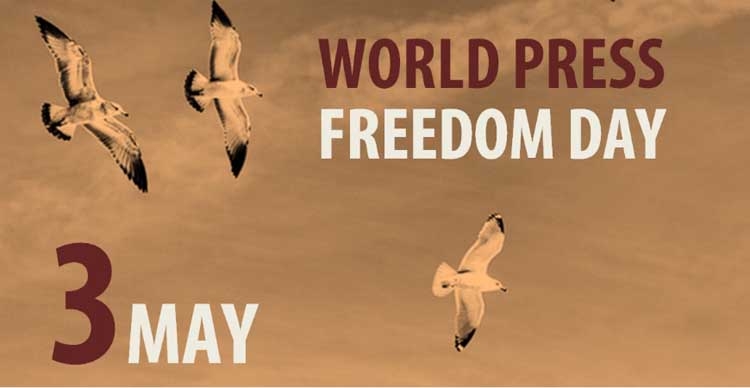
The UNESCO declares 3rd May as World Press Freedom Day and is a reminder to governments of the need to respect their commitment to press freedom and is also a day of reflection among media professionals about issues of press freedom and professional ethics.
Meanwhile during first 30-days of lockdown, since 26 March, the journalists and citizen-journalists are frequently targeted by state and non-state actors while reporting in social distancing, which the media rights defenders deemed as a serious threat to freedom of expression.
When Prime Minister Sheikh Hasina took an effort to scale-up food aid for the disadvantaged population in response to the nationwide shutdown, the media organizations, journalists and whistleblowers had to take the brunt of vengeance by local leaders and government officials including the police during the 30 days of lockdown.
Nearly twenty journalists were attacked, intimidated, harassed, or arrested for reporting on pilferage of food aid meant for poor people, who are facing extreme hardship during the lockdown.
The Forum for Freedom of Expression, Bangladesh (FExB), a network of media rights defenders expressed deep concern over series of violence, intimidation, and judicial harassment of journalists and news organisations during the lockdown.
The platform states that Thakurgaon district is the worst place for journalism in the country after six journalists were subjected to judicial harassment within a week.
Two editors, Toufique Imrose Khalidi of bdnews24.com, Mohiuddin Sarker of jagonews24.com along with three other local journalists were accused under draconian Digital Security Act.
After ten days of publication of news in two news portals on misappropriation of open market sale (OMS) rice, the Baliadangi Upazila's Swechchhasebak League, also a local ruling party leader Mominul Islam filed a case against the journalists.
In a separate case, police sued Al Mamun, a local journalist in Thakurgaon under notorious cybersecurity laws for criticising the district civil administration in Facebook for its failure to take effective measures to contain the spread of coronavirus during the lockdown.
Another journalist in Thakurgaon, Abdul Latif Litu, a correspondent of Bangladesh Pratidin was assaulted by police at a check post during the lockdown.
Sagor Chowdhury, an editor of a local news portal in Borhanduddin Upazila, Bhola posted a video on Facebook on embezzlement of food aid which angered the son of Jashim Uddin Hyder, president of Borhanuddin Upazila Awami League and also chairman of Boro Manika Union Parishad.
However, Borhanuddin Upazila police arrested the perpetrator Nabil Hyder, a member of the Chattra League of Dhaka University who posted a video on the Facebook assaulting Sagor Chowdhury.
In Habiganj, three journalists Shah Sultan Ahmed, a local journalist of Protidiner Sangbad, Mujibur Rahman, correspondent of Dainik Amar Sangbad and Bulbul Ahmed, correspondent of private TV Channel-S were attacked with a cricket bat by Mahibur Rahman Harun, chairman of Aushkandi Union Parishad.
Sultan posted a video on Facebook which revealed that the local Aushkandi Union Parishad was distributing 5 kg of rice instead of allocation of 10 kg for each ultra-poor fishing community.
Nasir Uddin Rocky, a staff reporter of Dainik Jugantor in Chittagong was crossing a check-post in a motorbike. The police arrested the journalist but was released unconditionally.
A similar incident at a check post in Bogura, police assaulted two journalists Majedur Rahman, correspondent of Shomoy TV, and Shahjahan Ali of Ekattor TV. The journalists were dragged to the police station in handcuff and were released without charges.
In the capital Dhaka, police arrested Golam Sarwar Pintu, journalist of Dainik Bangladesher Alo after a Dhaka city councillor of Ward 38 filed a case under notorious Digital Security Act with Badda Police Station.
Pintu's crime was the publication of news regarding angry urban-poor community held protest demanding food aid during the lockdown.
In a check-post in Dhaka police assaulted Tuhin Howlader, court correspondent of Bangladesh Pratidin.
Again in the southern district of Barishal, Bangla Vision TV correspondent Kamal Hossain was attacked by hooligans when he tried to cover a gathering - in violation of the lockdown.
Rezwan Karim Sabbir, a Jaintapur Upazila correspondent of Dainik Nayadiganta was hospitalized at Sylhet Medical College with serious head injuries after he was attacked by Abul Hasim, who was annoyed by an article in which the journalist had reported a local coronavirus case.
Not far from the capital, Chairman of Amirganj Union Parishad in Narsingdi mercilessly attacked Baten Biplob, Senior Crime Reporter of SATV and Sajal Bhuiyan, Narsingdi correspondent of SATV.
Baten Biplob in his Facebook post described the barbaric attack on journalist Sajal Bhuiyan who was profusely bleeding and crying in pain.
Meanwhile, international media rights organisation Reporters Without Borders (RSF) has also expressed alarm in the increase of violence and judicial harassment of journalists trying to cover coronavirus-related issues in Bangladesh in the month since a general lockdown was imposed on the population.

First published in The Asian Age05 May 2020
Saleem Samad, is an independent journalist, media rights defender, recipient of Ashoka Fellow (USA) and Hellman-Hammett Award. Twitter @saleemsamad, Email:saleemsamad@hotmail.com

Monday, April 27, 2020

FExB/মুক্ত প্রাকাশ on 30 Days Audit of Media in Lockdown


Dhaka, 27 April 2020:
The government imposed a countrywide lockdown from 26 March 2020 and extended for the third consecutive period until 05 May 2020 for containment of the outbreak of the coronavirus.
Forum for Freedom of Expression, Bangladesh (FExB) or মুক্ত প্রাকাশ(in Bangla), a network of media rights defenders has expressed deep anguish and grave concern over the developments during 30 Days of Lockdown which has taken a toll on Bangladesh news organisations, journalists, whistleblowers, and citizen-journalists.
The country is reeling from the COVID-19 crisis and the vulnerable segments of our society are the most at risk. Besides the “healthcare warriors”, the journalists are also on the frontline. The journalists and citizen-journalists are frequently targeted by state and non-state actors while reporting on the COVID-19 outbreak, which FExB reckons to be a serious threat to freedom of expression.
When Prime Minister Sheikh Hasina took an effort to scale-up food aid for the disadvantaged population in response to the nationwide shutdown, the media organizations, journalists and whistleblowers had to take the brunt of anger and vengeance by local leaders and government officials including the police.
Nearly twenty journalists were attacked, intimidated, harassed, or arrested for reporting on pilferage, corruption, and lack of accountability in food aid meant for poor people who are facing extreme hardship during the lockdown.
FExB states that Thakurgaon district is the worst place for journalism in the country after six journalists were subjected to judicial harassment within a week.
On 19 April, two editors Toufique Imrose Khalidi, Editor-in-Chief of bdnews24.com, Mohiuddin Sarker, acting editor of jagonews24.com along with three other journalists Rahim Suvho, Thakurgaon correspondent of bdnews24.com and a local journalist Shaown Amin were accused under draconian Digital Security Act.
After ten days of publication of the news in two news portals on misappropriation of open market sale (OMS) rice, the Baliadangi Upazila’s Swechchhasebak League, also a local ruling party leader Mominul Islam filed a case against the journalists. The case is under investigation and none has been arrested.
It was also alleged that other journalists posted aggressive, false, and defamatory information against him (Mominul Islam) and his brother a Union Parishad chairman Aminul Islam Amin on their Facebook pages.
In a separate case on 15 April, police sued Al Mamun, correspondent of Dainik Odhikar district correspondent under notorious cybersecurity laws for criticising the district civil administration in Facebook for its failure to take effective measures to contain the spread of coronavirus during the lockdown.
On 21 April, another journalist in Thakurgaon Abdul Latif Litu, a local correspondent of popular newspaper Bangladesh Pratidin and private TV channel News 24 was assaulted by police at a check post during the lockdown.
FExB is deeply concerned regarding the series of attacks, intimidation, and judicial harassment of journalists and other media organisations all over the country, during the 30 Days of Lockdown.
On 31 March 2020, Sagor Chowdhury, a freelance video-blogger and editor of a local news portal 360degree was publicly assaulted by Nabil Hyder, son of Jashim Uddin Hyder, president of Borhanuddin Upazila Awami League and also chairman of Boro Manika Union Parishad over posting a live video on Facebook. Police arrested the perpetrator Nabil Hyder, a member of the Chattra League of Dhaka University.
On 1 April 2020, three journalists Shah Sultan Ahmed, Nabiganj Upazila correspondent of the Dainik Protidiner Sangbad in Habiganj, Mujibur Rahman, correspondent of Dainik Amar Sangbad and Bulbul Ahmed, correspondent of private TV Channel-S were attacked with a cricket bat by Mahibur Rahman Harun, chairman of Aushkandi Union Parishad and also a local leader of the ruling party. Sultan was shifted to Osmani Medical College in Sylhet with critical injuries.
Earlier, Sultan posted a live video on Facebook which revealed that the local leader (Harun) was distributing each of the families 5 kg of rice instead of the allocation of 10 kg.
On 10 April 2020, Nasir Uddin Rocky, a staff reporter of vernacular daily Dainik Jugantor in Chittagong was on his way to the newspaper office riding a motorcycle. At a check-post, the police arrested the journalist, later released unconditionally. The police officer was suspended.
On 12 April 2020, police in Bogura at a check-post, arbitrarily handcuffed and assaulted two journalists Majedur Rahman, correspondent of a private channel Shomoy TV and Shahjahan Ali of a private channel Ekattor TV. The journalists were dragged to the police station and were released. The delinquent police officers were suspended.
On 14 April 2020, police arrested Golam Sarwar Pintu, journalist of Dainik Bangladesher Alo after Sheikh Salim, a Dhaka city councillor of Ward 38 filed a case under notorious Digital Security Act with Badda Police Station.
Pintu’s crime was the publication of news regarding angry urban-poor community held protest demanding food aid during the lockdown.
On 16 April 2020, police assaulted Tuhin Howlader, court correspondent of a vernacular daily Bangladesh Pratidin in the capital Dhaka.
On 18 April, Bangla Vision TV correspondent Kamal Hossain was attacked by hooligans in Barishal when he tried to cover a gathering that had formed – in violation of the lockdown – because members of the local Department of Narcotics were selling alcohol to the public.
On 21 April, Rezwan Karim Sabbir, a Jaintapur upazila correspondent of the daily Nayadiganta and the Dainik Sylhet Mirror, a member of the Sylhet Jaintapur Press Club, was hospitalized at Sylhet Medical College with serious head injuries after he wa attacked by Abul Hasim, who was annoyed by an article in which the journalist had reported a local coronavirus case.
On 23 April 2020, Chairman of Amirganj Union Parishad in Narsingdi mercilessly assaulted Baten Biplob, Senior Crime Reporter and TV Anchor of SATV KHOJ, and Sajal Bhuiyan Narsingdi correspondent of TV channel SATV.
Baten Biplob in his Facebook post described the barbaric attack on journalist Sajal Bhuiyan who was profusely bleeding and crying in pain. He was admitted to Narsingdi government hospital. The perpetrators were not arrested and the police administration is not cooperating, it was alleged.
FExB demands to end impunity and to bring them to justice of the local leaders, police, and district administration officials responsible over the attacks, judicial harassments, intimidations, and arrests of frontline “media warriors”. #
Endorsed and signed by Media Rights Defenders:
1.        Dr. Aireen Jaman, General Secretary, PEN International, Bangladesh, London;
2.        Faruq Faisel, South Asia Regional Director, Article 19, London;
3.        Saleem Samad, Correspondent, Reporter Without Borders (RSF), Paris;
4.        Ahmed Swapan Mahmud, CEO, VOICE, Dhaka
5.        Khairuzzaman Kamal, Representative International Federation of Journalists (IFJ), Brussels;
6.        Mainul Islam Khan, Representative, Committee to Protect Journalists (CPJ), New York;
7.        Biplob Mostafiz, Member, Mukto Prakash (FExB), Media Rights Defender;
8.        Sayeed Ahmad, Representative, Front Line Defenders, Dublin, Ireland;
9.        Ahamad Ullah, Member, Bangladesh Manabadhikar Sangbadik Forum (BMSF), Dhaka;
10.     GM Mourtaza, CEO, CCD Bangladesh; Rajshahi.
 
For more information, please contact Saleem Samad: Mobile: +88-01711-530207; Email: ForumForFExB@gmail.com, Twitter: @saleemsamad; Faruq Faisel: Mobile: +88-01730-710267, Email: faruq@article19.org. Twitter: @faruqfaisel

Tuesday, April 21, 2020

Asian countries flatten coronavirus curve

Photo: Reuters
Asian models that actually combated Covid-19
SALEEM SAMAD
Globally nations are convinced that washing hands with soap, wearing a mask, maintaining social distance, and staying home are prime health safety tips to fight the coronavirus pandemic.
The scenario in Taiwan, however, is similar but strikingly different from most countries in Asia, Africa, America, and Europe struggling to combat the Covid-19 crisis.
In a new coronavirus twist, South Korea, Singapore, Vietnam, and Hong Kong are examples of containment that have been hailed for using those lessons learned from combating the new coronavirus, officially Covid-19 and a relative of SARS.
By the time the virus began to spill over China’s frontiers in January, many health think-tanks believed that territories having proximity would take the major brunt for a large-scale outbreak.
Singapore, Taiwan, and Hong Kong territories are closely interconnected with mainland China, unilaterally imposed travel restrictions on nationals returning from China, contravening the World Health Organisation’s (WHO) insistence that a travel ban was not necessary.
The precaution, nevertheless, came at a significant economic cost to these international hubs, which all rely on mainland China as their biggest trading partner and source of tourists too.
Amid these grim trends, South Korea has emerged as a sign of hope and a model to imitate as coronavirus cases have dropped sharply to a single digit. 
The South Korean president hoped that containment progress gave hope that the coronavirus outbreak is “surmountable” in other parts of the world.
Well, after after the deadly SARS epidemic in 2003, Taiwan established a Central Command Centre for Epidemics. The country had introduced national drills in educational institutions, government establishments, and factories for preparedness on bio-safety.
The Command Centre has quickly compiled a list of 124 “action items,” including border controls, school and work policies, public communication plans and resource assessments of hospitals, according to an article in the Journal of the American Medical Association.
The 210 countries typically struggling with the coronavirus pandemic have gambled on a containment strategy. It has socked hundreds of countries that have imposed strict shutdowns and stay-home policies to hear that Taiwan, South Korea, Hong Kong, Singapore, and Vietnam residents venture outside only by necessity while national emergency remains enforced.
Unlike wealthier Asian neigbours, Vietnam does not have the capabilities to conduct mass testing, but surprisingly the country has zero fatalities with no new cases in the last several days. The status of coronavirus cases was 268 and 202 recovered as of April 20.
Hong Kong, an autonomous state of China promptly imposed border control from early February and made quarantine in hospitals mandatory for those returning from mainland China.
Hong Kong’s population of 7.5 million had had just 1,026 confirmed cases of Covid-19 infection, recovery of 602 and four deaths as of April 20, according to a new study published in the health journal Lancet.
A study by Harvard University’s Centre for Communicable Disease Dynamics estimates Singapore detected almost three times more cases than the global average due to its strong disease surveillance and fastidious contact tracing.
In Singapore, amid the coronavirus outbreak, quarantine, and isolation protocols were strictly enforced. 
The government has deployed plainclothes police officers to track persons in quarantine and used government-issued mobile phones to keep tabs on them.
The challenges remain for Taiwan, Hong Kong, and Singapore of a growing number of recovered Covid-19 patients relapsing especially in South Korea, raising fresh concerns among scientists and health authorities after the countries successfully flattened the curve. 

First published in The Dhaka Tribune on 20 April 2020

Saleem Samad is an independent journalist, media rights defender, recipient of Ashoka Fellow (USA) and Hellman-Hammett Award. Twitter @saleemsamad; he can be reached at saleemsamad@hotmail.com

Monday, April 13, 2020

This dystopia Lockdown is stranger than fiction

SALEEM SAMAD

The current lockdown is a scenario straight out of movies and paperback thrillers.
When Peter May’s manuscript was pitched -- with a bizarre scenario of a global pandemic -- it was refused by several publishers for being too unrealistic. Now it is scheduled to hit the bookstore on April 30.
The dystopian novel has turned into reality. His current publisher Quercus Books hopes that familiarity with a pandemic will appeal to a wide audience.
Well, the novel did not mention Wuhan in China. Instead, he chose London as an epicentre of a global pandemic that forced authorities to compel a lockdown to save lives.
Obviously, the novelist abandoned the project and eventually forgot that he had written it, until a fan contacted him on Twitter suggesting he should write something for the age of the coronavirus, refreshing his memory and prompting him to retrieve the file from a Dropbox folder.
When he read the manuscript for the first time since he wrote the book 15 years ago, he was shocked at how accurate it was.
The story, in brief, says London city is in lockdown. Violence and civil disorder simmer and authorities have no alternative but to declare martial law. No one is safe from the deadly virus. The British prime minister himself is dead. Health and emergency services are overwhelmed. 
Armed vigilantes block a neighbour’s driveway with a tree to force them into home quarantine.
However, the story was not based on the imagination of the Scottish screenwriter and novelist. He had painstakingly browsed hundreds of pages of British and the United States pandemic preparedness documents from 2002 to make it as realistic as possible.
The much talked about book Lockdown was finally published 15 years later; that’s our reality due to coronavirus, which has so far infected more than 1 million people globally.
Available in paperback, the 416- page crime thriller titled Lockdown predicted in 2005 a world in quarantine, which has finally seen the light of the day.
The current coronavirus pandemic has severely squeezed the value chain of the book distributors to reach the bookstores globally. However, the publication is only available through Amazon UK on Kindle format ($4.99) for now. It also will be available in paperback ($13.58) and audio-book from April 30.
The 69-year-old Peter May was born and raised in Scotland, United Kingdom. He was an award-winning journalist at the age of 21 and a published novelist at 26. When his first book was adapted as a major drama series for the BBC, he quit journalism and became one of Scotland’s most successful television dramatists.
He created three prime-time drama series, presided over two of the highest-rated serials in his homeland as script editor and producer, and worked on more than 1,000 episodes of ratings-topping drama before deciding to leave television to return to his first love, writing novels. He has won several literature awards.
“At the time I wrote the book, scientists were predicting that bird flu was going to be the next major world pandemic,” May told the American TV channel CNN.
“The everyday details of how you get through life, the way the lockdown works, people being forbidden to leave their homes. It’s all scarily accurate,” he quipped.
Well, the invisible enemies of bird flu and coronavirus are very different, but the lockdown scenario hits close to home for millions of people currently self-isolating to prevent the virus from spreading.

First published in the Dhaka Tribune on 13 April 2020

Saleem Samad is an independent journalist, media rights defender, recipient of Ashoka Fellow (USA) and Hellman-Hammett Award. Twitter: @saleemsamad. Reach him at saleemsamad@hotmail.com

Monday, April 06, 2020

Iran using coronavirus to lobby for lifting of sanctions

Photo: Reuters
SALEEM SAMAD

Is Iran using the coronavirus to lobby for lifting of sanctions?
Amid the coronavirus pandemic, the Islamic Republic of Iran’s clerics -- President Hassan Rouhani and Foreign Minister Mohammed Javad Zarif -- shrewdly appear to be investing significant political capital in a global campaign to have all sanctions against the theocratic regime lifted.
Iran clerics blame the imposition of economic sanctions by the United States to have caused a heavy toll in the Covid-19 public health crisis -- the confirmed cases are nearly 58,500 while deaths have risen to more than 3,600, as of April 6.
Taking the crisis as an issue with the West, Tehran has launched a new diplomatic campaign admitting its failure of clinical management of the pandemic.
The Iranian leaders are desperate for the US to lift its sanctions and are placing significant pressure on the international community to release financial resources, including those which are frozen by the Trump administration, as explained by Dr Majid Rafizadeh, an Iranian-American political scientist based in the US.
Not very surprisingly, several US lawmakers, including Sen Bernie Sanders, Rep Ilhan Omar, Sen Elizabeth Warren, and Rep Alexandria Ocasio-Cortez have succumbed to the excuse given by the regime’s foreign minister Javad Zarif.
Fortunately, the US sanctions do not include medical or humanitarian restrictions, which could impact the fight against Covid-19, argues Iran watchers.
The outbreak of the virus has nothing to do with the much-talked-about US sanctions, instead of the clerical regime’s failure to contain the crisis efficiently.
“If the timeline of the Iran cleric’s activities is analyzed, it could be understood from the stubbornness of the regime,” says Hanif Jazayeri, an Iranian opposition activist based in London.
In January, the regime’s supreme leader authorized more than $215 million for the Islamic Revolutionary Guards Corps (IRGC) backed Quds Force, engaged in proxy wars in Gaza, Lebanon, Iraq, Syria, and Yemen.
Iran’s regime recently spent $67m redecorating the Zeynab Shrine in Syria with funds that could instead be used in the fight against the pandemic.
When the first case of a coronavirus victim was detected in mid-February in the religious city of Qom, authorities covered up its existence when they asked the people to take part in the sham parliamentary elections.
President Hassan Rouhani has overtly ruled out quarantining any cities and instead “donated” 3 million face masks to China as a “sign of long-term and traditional friendship between two countries.”
On the other hand, the IGRC has been caught hoarding millions of medical supplies, including disinfectants, gloves, and masks, while selling them on the black market at 10 times the price.
Ever since the outbreak, the Mahan Air, affiliated with the IRGC, has continued its flight to and from China, the geographical source of Covid-19.
Despite the conflict, the US has offered to support Iran during the coronavirus crisis via the Swiss Humanitarian Trade Arrangement and also exempted the donation of medicine to Iran from US sanctions. Unfortunately, the US offer was outright rejected by the regime in Tehran.
The WHO has sent Iran diagnostic kits and protective equipment for health care workers, including 7.5 tons of medical supplies. The United Arab Emirates also sent two planeloads of hygienic items to Iran, while Kuwait pledged to help Iran with $10m without any restriction.
Nevertheless, Iran’s Foreign Minister continues to threaten the international community that, if the sanctions against Iran are not lifted, the widespread coronavirus pandemic will endanger other countries’ national security.
The Rouhani-Zarif duo is trying to cash in on the coronavirus tragedy by pushing the US and the international community to lift all sanctions against the Iranian regime.

First Published in the Dhaka Tribune on 6 April 2020

Saleem Samad is an independent journalist, media rights defender, and recipient of Ashoka Fellow (USA) and Hellman-Hammett Award. Twitter @saleemsamad, Email saleemsamad@hotmail.com