Buy.com Monthly Coupon
Showing posts with label moderate Muslim democracy. Show all posts

Thursday, August 06, 2020

Can Bangladesh shun political Islam?


SALEEM SAMAD

For millions of people in an impoverished Bangladesh, it seems to have ushered a political blessing. The nation which fought a bloody war of independence in 1971 against Pakistan to establish secularism and democracy was obliterated by subsequent military juntas and pro-Islamic governments.

The first constitution has enshrined secularism, democracy, socialism, and nationalism as the key political philosophy of the independence of Bangladesh, which reflects the spirit of the independence war when the eastern province severed from Pakistan in 1971.

After the assassination of the architect of Bangladesh independence Sheikh Mujibur Rahman in a military putsch in 1975, the military-backed government of General Ziaur Rahman, a former Mukti Bahini commander, with a swagger stick doctored the constitution’s guiding principle and scribbled “Bismillah’ir Rahman’ir Rahim (Faith in Allah)” in 1979 to establish legitimacy of his military government.

After Mujib’s daughter Sheikh Hasina, leader of the Awami League swept to power in 2008 pledged to restoration of secularism and the trial of war criminals.

The Supreme Court in its landmark verdict forbids political parties that advocate political Islam. The apex court also asked to reinstate the four key principles in the constitution.

In separate voluminous judgements in July and August of 2010, the apex court pulled down the Fifth Amendment of 1979 and Seventh Amendment of 1986, including provisions that allowed religious-based politics, which was legitimized by tyrannical rules from 15 August 1975 to 9 April 1979 and 24 March 1982, and 10 November 1986 respectively.

The court in a ruling said the Seventh Amendment retroactively legitimized the very acts that successfully engineered the coups by former Chief of Army Staff Lt. Gen. Husain Muhammad Ershad unseated an elected government of President Justice Abdus Sattar in March 1982.

General Ershad in a bid to woo moral support of majoritarian Sunni Muslims had rewritten the constitution which determines “Islam as state religion” of a once secular nation.

The higher court judges noted, “The proclamation of martial law and its regulations and orders and all actions under this law shall remain illegal until Qayamat (the Last Day of Judgment). “The martial law was beyond the mandate of the constitution and will be invalid for eternity,” and said, “a usurper is a usurper.” It is deemed that the judgement squarely blamed both the military leaders have acted as a usurper to grab the state power.

The apex court’s verdict on the Fifth Amendment said, “The perpetrators of such illegalities should also be suitably punished and condemned so that in future no adventurist, no usurper, would dare to defy the people, their constitution, their government, established by them with their consent.”

The court dubs the “extra-constitutional adventurers” as predators of democracy who ushered military regimes.

General Zia was assassinated in a military coup d’état in 1982 and General Ershad was ousted in 1990, after a bloody pro-democracy revolution. He served a prison sentence for corruption but is a key ally coalition of the ruling party and died last year of old age complications.

Excited by hearing the superior court verdict Shahriar Kabir, a secularist, researcher and staunch advocate for the trial of the war criminals said the people’s mandate in the last general election for the restoration of secularism and trial of perpetrators responsible for the crime against humanity in 1971.

“Religious based politics was prohibited after brutal birth of Bangladesh. We have seen youths belonging to Jamaat-e-Islami (JeI) were engaged as henchmen of marauding Pakistan military. They raised Al-Badr, a death squad to kidnap and murder hundreds of intellectuals who could not escape for their safety and security,” he explained.

All the JeI leaders of the secret militia group Al-Badr were handed down maximum punishment for war crimes and crimes against humanity by the International Crimes Tribunal.

The journalist and film-maker Kabir said General Zia, after the assassination of Sheikh Mujib in a bid to gain political support, withdrew the ban on religious politics and allowed Islamic parties to regain grounds.

The Bangladesh Nationalist Party founded by assassinated General Rahman, presently led by his widow, Begum Khaleda Zia appealed the apex court’s first ruling on the Fifth Amendment last January and lost her in a crucial legal battle which was detrimental to her party.

Notwithstanding, Bangladesh is a Sunni Muslim-majority nation, most people practice a moderate version of Sunni Islam. In the long run, the country’s politicians want the country to transform into a secular democracy rather than “Islam as State Religion”.

Pending a verdict from the Appellate Division of the Supreme Court, the Bangladesh Election Commission has struck off the name of Jamaat-e-Islami (JeI) as a political party. Officially the Islamist party was unable to participate in the 2014 and 2018 general election. Unfortunately, the Islamist party failed to satisfy the Election Commission that it is a Bangladesh origin party, upholds the Bangladesh constitution, and expresses solidarity with the independence of Bangladesh.

JeI handbook and various published documents, the party did not accept the state constitution and demanded to override it with Quran and Sharia Law upon 164 million secular and moderate Muslim majority nation. Unfortunately, the party failed to muster moral support of the majority.

Besides, the party didn’t recognise Bangladesh independence. JeI was politically, morally, and physically supported by the marauding Pakistan military.

Regarding banning of Islamic parties, Sheikh Hasina told the Jatiya Sangsad (parliament) said the Islamic parties will not be banned, while “Bismillah’ir Rahman’ir Rahim” and state religion Islam will remain in the constitution.

Social justice activist Kabir is visibly disturbed regarding the delay in banning of religious-based political parties, especially JeI which opposed the independence of Bangladesh.

He said the prime minister’s statement in parliament has confused the nation and contradicts the verdict of the superior court. The Islamic parties would continue to function and overtly campaign against the war crimes trial.

First published in The South Asian Digest on 6 August 2020

Author is an independent journalist, media rights defender in Bangladesh. Recipient of Ashoka Fellowship and Hellman-Hammett Award

Monday, August 26, 2013

Religion and after: Bangladeshi identity since 1971

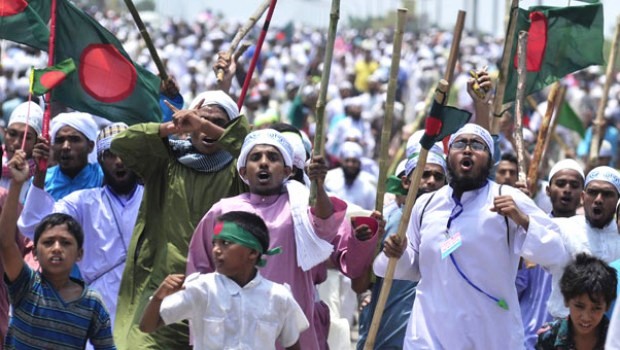
Angry Islamist demand for Islamic state governed by controversial Sharia law, which subjugates women

Secularism was one of the cornerstones of Bengali nationalism, but its spirit was enforced only by pen and paper. How can demands to ban religion from politics be satisfied?

The United Nations categorizes Bangladesh as a moderate Muslim democracy. Meanwhile, the current Foreign Minister called Bangladesh a secular country. She defined Bangladesh to be a "non-communal country” with a “Muslim majority population”. The Foreign Minister further added that the concept of a moderate Muslim democracy cannot be applied in the case of Bangladesh because it fought its war of independence on basis of the ideal of secularism. For Bangladesh, embracing religion or creating a secular identity has been a major contestation in the creation of its national identity. Identity questions for Bangladesh still stand: is it a country of secular Bengalis or Muslim Bangladeshis?

This split personality of Bangladesh confounds the international observer. For an outsider, it makes perfect sense to call it a moderate Muslim democracy as a Muslim majority population lives in a country that recognizes Islam as the state religion. Since the Shahbag movement has erupted with the demands of the death penalty for the war criminals, international media remains substantially silent about it. Perhaps one of the reasons could be their inability to comprehend why a population of Muslim origin are angered over using religion (read Islam) for political purposes? As we look at the issues brought forward by the Shahbag movement, we need to analyse it from a historical perspective. We are not talking about redressing the wound that was created 42 years back; rather how it was ‘silenced’ to maximize narrow political gains for the major political parties of the country.

'Secularism' in independent Bangladesh
Many point to the 1947 division of the subcontinent on the basis of the Two Nation theory with ‘religion’ at its core as the principle factor that tied religion to politics in this region. It was primarily the overwhelming support of the Muslims of Bengal in the 1946 election that decided the fate of the Two Nation theory. But does this mean that people of East Bengal supported the Two Nations theory with a religious fervour? The answer is quite the opposite. Historians have shown that support in East Bengal was mobilized with the aim of economic emancipation from West Bengal. The people of East Bengal gathered under the umbrella of Fazlul Haque’s leadership, who provided a non-communal approach to the issue of Hindu-Muslim relations and brought the economic issues to the forefront. As research shows, the massive support coming from the rural areas of Bengal for the dream of Pakistan was aimed at resolving their basic ‘dal-bhat’ (rice-lentil: considered Bengali people’s basic food at that period) problem. Islam was not the primary political mode of thought in Bengal nor was able to present itself as an ‘ideological’ alternative to the existing political thoughts.

However, the Two Nation Theory, formulated on the basis of Hindu-Muslim division, turned out to truly be a theory of two nations as it depicted East and West Pakistan as inherently different from each other. They do not understand why we subaltern Muslims do not agree to speak Urdu. They do not understand why we Muslims are mesmerized with the Hindu poet Tagore. While students protested Jinnah’s proclamation that, “Urdu, and only Urdu shall be the national language of Pakistan”, the seed of a new nation was sown as early as 1948 on the campus of the University of Dhaka. The Bengali Language Movement gave birth to the idea of a new nation, within the geographic border of former East Pakistan.

While secularism was one of the cornerstones of Bengali nationalism, its spirit was enforced only by pen and paper but not in practice - apprehension that secularism could be easily misinterpreted as atheism. Even while secularism was preached in the pre-1971 period, Article 2 of the Awami League’s election manifesto in 1970 stated that no law would be enacted against the dictums of the Quran and the Sunnah. Similarly, political leader Maulana Bhashani declared, “we want food and we want clothes but we do not want them excluding Allah”. Such contradictions extended far. Upon his return from Pakistan via London in 1972, at the one hand, Sheikh Mujib declared himself as a Muslim and Bangladesh as the second largest Muslim country as secularism was embedded as one of the four principles of the Constitution of the People’s Republic of Bangladesh.

Secularism versus religiosity
History shows that there was a public fear and rejection of secularism back in 1972. A public procession was carried out against it on the streets of Dhaka that chanted “Joy Bangla joy-heen, Lungi chere dhuti pin” on the day of the formal acceptance of the constitution. This particular slogan stated that the traditional Awami League slogan of Joy Bangla, i.e., victory to Bangladesh, became meaningless in independent Bangladesh and would be devoid of ‘victory’. Moreover, the traditional Bengali Muslim men’s attire lungi would be replaced by traditional Hindu men’s attire dhuti due to adoption of secularism as a state principle. The ultimate failure of the government, alongside rampant corruption, was to give in to these Islamic emphases by the regime of the Awami League in an attempt to regain its lost popularity. Simultaneously, as a reaction to the Awami League’s pen and paper commitment to ‘secularism’, the alternative was to embrace ‘religion’ in its fullest form and was manifested in Bangladeshi nationalism.

While the Shahbag movement is asking for a fair trial of war criminals, it cannot remain confined by only banning Jamaat-e-Islami’s politics or overall politics based on religion. Rather, the whole issue of secularism versus religiosity has to be taken into consideration to redress the way politicians have misused religion. We have not forgotten the electoral slogan of the Awami League, BNP and Jamaat-e-Islami during the 1996 election: La ilaha illallha, Naukar malik tui Allah (There is no God but Allah, and Allah is the Owner of boat); La ilaha illalha, Dhaner shishe Bismillah (There is no God but Allah, and Allah willing, vote for the paddy sheaf); Vote diley pallay, Khushi hobe Allah (Allah would be pleased if you vote for scale). It is a country where an electoral campaign still starts from Sylhet, by visiting Islamic shrines and seeking blessings of the Pirsfor a good result in election.

We have changed our traditional age-old greetings from ‘Khuda Hafiz’ to ‘Allah Hafiz’ with the excuse that ‘Allah’ is Arabic while ‘Khuda’ originates from Persian. We do not even know or probably do not even care about the fact that ‘hafiz’, an original Persian word and etymologically derived from Arabic ‘hifz’, remains attached with the phrase. But we are happy to replace Khuda with Allah with an aim to prove ourselves as true Muslims. Is that a true representation of Bangladesh, of our national culture? On a similar note, in any public gathering, it is excruciating to see how the sari, the traditional Bengali attire for women, is disappearing and is being increasingly replaced by salwar-kamiz. While the younger generation have embraced the latter with the excuse of it being more manageable and convenient, the older generation is much more direct in expressing how the sari is ‘unIslamic’ dress that reveals significant female body parts while salwar-kamiz does not.

Our whole national culture is in transition. Otherwise why is YouTube still banned in Bangladesh? Why is it necessary for the editor of a renowned newspaper to apologize to the Khatib of Baitul Mukarram over the publication of a cartoon that allegedly insulted religious sentiments? Not so long ago, Facebook was also banned in the country under the same accusation. Scholar Rafiuddin Ahmed indeed pointed it out very succinctly, “a Bengali Muslim may have seen himself primarily as a ‘Muslim’ the other day, as a ‘Bengali’ yesterday, and a ‘Bengali Muslim’ today, depending on objective conditions, but on none of these occasions did his thoughts and his idea of destiny become separated from his territorial identity”.

Secularism as a top-down approach
The fact remains that secularism cannot be imposed from the top, merely as a state directive. The term secularism itself was coined and introduced in the English vocabulary in 1851 by George Jacob Hollyake in order to create a conscious difference between secularism and atheism. It is the same tension that we face in our country right now. Moreover when secularism is imposed as a top-down approach, it looks like nothing short of an attempt to ‘catch up’ with the West or try to prove to the West that “look, we have denounced religion; we are modern too!” This is a typical crisis that non-Western societies face: how to define themselves as modern so the West understands. But what is overlooked here is that secularism cannot just be imposed as an ‘add and stir’ method, for non-Western societies have their own uniqueness to add both to the concepts of modernity and secularism.

There is no singular way to be modern; there is no singular way to be secular, especially not by incorporating it into the Constitution while ignoring the drastic changes in the social fabric of a country. Moreover, countless research shows that while a non-Western society is being modernized, it does not shake off its religious legacies and historical experiences. Rather its own values, culture and religion formulate the core of a resistance identity in response to the intrusion of Westernization. Secularism therefore cannot be perceived from only mainstream and liberal conceptions as it is presented through the Western lens.

As one scholar has put it, 1971 shows that Bangladesh rejected the Pakistani interpretation of fundamentalist Islam but this did not mean that Bangladesh has rejected Islam from its own identity. The inability of the elites to understand this fact has trapped them into the secular-religious divide. Schendel has rightly pointed out that the post-independent, or first leaders of Bangladesh failed to deliver the dreams of nationalism, secularism, socialism and democracy based on a vernacular cultural model. Such failure essentially led towards creating the dichotomy between the religious and the secular and between anti-1971 and pro-1971.

There is no legal way to tackle the rise of religiosity in Bangladesh. Instead, the failure to acknowledge these silent ‘religious’ transitions, where political parties are interested only in the bigger share of the pie using religion, will only add to the existing tension and divide the unity of the country further between the religious and the secular. Instead we must continue to implore why we are rapidly turning more religious than before, and why consider it a solemn duty to continuously project this religious identity.

First published in Open Democracy, 19 April 2013


Lailufar Yasmin is a doctoral student at Macquarie University, Sydney, Australia and teaches in International Relations at University of Dhaka, Bangladesh. Her research interest includes secularism, IR theory and Islam

Saturday, January 28, 2012

Bangladesh: Coup bid against Sheikh Hasina foiled

SALEEM SAMAD

In late December last year, a secret letter went from New Delhi to Dhaka. It was delivered directly to Sheikh Hasina, 65, the prime minister of Bangladesh. It warned her that Islamist radicals embedded within the Bangladesh Army were planning a coup. Hasina had reason to fear coups. On the night of August 15, 1975, her father, Bangladesh's first president Sheikh Mujibur Rahman, her mother and three brothers were massacred by officers of the Bangladesh Army. Hasina and her sister would have been dead as well, but were abroad on a tour of Europe.

Along with the letter, India had worked out a contingency plan to evacuate the prime minister, her cabinet and key figures of her Awami League party in the event of a coup. There was a military plan as well. Indian helicopter gunships would be launched from two airbases in West Bengal and Tripura into Dhaka to provide air cover for the operation. Landing zones and evacuation sites were identified in and around the capital for the air corridor.

All through December, Bangladesh's spy agency, the Directorate General of Forces Intelligence (DGFI), which reports directly to Hasina, quietly went to work. It was headed by Major General Sheikh Mamun Khaled, whom Hasina had personally chosen. They tapped phone communications, smss and emails of suspects in the conspiracy. Social networking sites were monitored. A series of arrests was made from December-end to January.

Opposition leader Begum Khaleda Zia of the Bangladesh National Party (BNP), who is anti-India by conviction and hates Hasina with a rare passion, alleged at a public rally in Chittagong that army officers were becoming victims of "sudden disappearance". The army's media wing, the Inter-Services Public Relations Directorate (ISPR), warned Khaleda to refrain from making any statements. The army was worried that public discourse might soon include details of the impending coup.

The coup attempt began innocuously. Posts on a Facebook group, 'Soldiers Forum', instigated soldiers to work against the government. Major Syed Mohammad Ziaul Haq, a graduate of the military academy who was training at the Military Institute of Science and Technology, Dhaka, was identified as the mastermind. He used a mobile phone with a UK number to share details of the conspiracy with 11 other army officers. On his Facebook account, he bragged that "mid-level officers of Bangladesh Army are bringing changes soon". On January 8, the banned fanatical organisation Hizb ut-Tahrir (Party of Liberation) distributed provocative leaflets based on his post.

Major Zia regularly updated his Facebook account with "information" on arrests of army officers by "anti-terrorism agents", including those of India's external intelligence agency, the Research and Analysis Wing (R&AW). His messages spread to blogs and were even picked up by a pro-BNP newspaper, Amar Desh. The DGFI and other security agencies kept the suspected plotters under surveillance. They discovered that the likely date of the coup was January 10 or 11. One by one, the plotters were picked up and are now detained in military headquarters, Dhaka.

On January 19, the army unveiled the plot. In its first ever press conference, held at the Army Officers' Club in Dhaka, ISPR spokesperson Brigadier General Muhammad Masud Razzaq took questions, didn't reveal specifics, but talked about the threat to Hasina's "pro-secular and democratically elected government". Brigadier Razzaq claimed between 14 and 16 former and active mid-level radical Muslim officers were behind the conspiracy to topple the government and install an Islamist regime. Two retired officers, Lt Col Ehsan Yousuf and Major Zakir, were arrested on charges of conspiracy to overthrow the government and they "admitted their role in the plot". Major General Mohammad Kamruzzaman, commander of the Comilla-based 33rd Infantry Division, was removed from his command and detained in Dhaka. Another brigadier, Tariqul Alam, commander of 71st Brigade of 9th Division, and Major General Shabbir Ahmad, commander of the Rangpur-based 66 Division, are under surveillance. Eleven other officers from Dhaka and other cantonments across the country have been confined in the capital.

Bangladesh Army chief General Mohammad Mainul Islam says the major general and some religious bigots had planned to indoctrinate pious officers. "They had targeted the deeply religious officers, who they felt would be amenable because they were pious, to execute their conspiracy to overthrow the democratically elected government," he says.

On January 21, Hasina said, "I would like to thank the Bangladesh Army. Had they not unearthed the conspiracy in time, a great disaster could have taken place. The army saved the patriotic forces and the country as well by throttling the conspiracy to topple the democratic government." She accused arch-rival Khaleda of plotting to overthrow her government. The BNP dismissed this as well as allegations that self-exiled BNP leader Tarique Rahman, Khaleda's son, was involved in the aborted coup attempt.

The Bangladesh Army says Major Zia, the alleged coup mastermind, evaded arrest. His whereabouts are unknown. Yet, it was the resurfacing of an underground Islamist organisation that caused concern. The Bangladesh Army linked the conspirators to the Hizb ut-Tahrir. The Tahrir, an international Sunni pan-Islamist political organisation, advocates an Islamic Caliphate governed by Shariah law. Founded in 1953 in Jerusalem, it has spread to more than 40 countries, and is also active in Pakistan.

The Hasina government had banned the Tahrir in October 2009. Agencies such as the Rapid Action Battalion, National Security Intelligence and Detective Branch repeatedly claimed they had succeeded in containing them. They based these claims on the detention of key figures such as Towfiq Elahi, a teacher of a prominent private university, and Dr Golam Haider Rasul, 45, who practises at Dhaka's United Hospital, besides hundreds of others. Tahrir leader Maulana Mamunur Rashid, principal of a Dhaka madrassa, remains a fugitive.

Nearly 500 Tahrir members were detained mostly for organising rallies and distributing leaflets. Police officers now admit their inability to curb the well-funded organisation merely through arrests. "It's tough because families of the detained activists get money from their global network," says Lt Col Ziaul Ahsan, director of the Intelligence Wing of the elite anti-crime Rapid Action Battalion. Most of the detained militants released on bail rejoin the outfit. The outfit has resurfaced more aggressively after its ban.

Besides the men in uniform, the Hizb ut-Tahrir has spread its invisible tentacles among the social elite, government professionals, academics and politicians. "They have a new approach to radicalism, the cuckoo's eggs in the crow's nest (trying to covertly embed themselves in society)," says Nazmul Ahsan Kalimullah, a political scientist in Dhaka University.

Since their 1975 putsch that killed Mujib, the Father of the Nation, the military in Bangladesh has overthrown the civilian government four times. The army has killed two elected presidents and coerced three other presidents into declaring military-backed emergency. The last coup was in January 2007 and since then, attempts have been made to keep the military in the barracks.

The Supreme Court has been a key force. A landmark judgment by a full bench headed by former chief justice Mohammad Tafazzul Islam on July 28, 2010, declared three military regimes between August 15, 1975, and February 1979 as illegal. The new constitution, adopted by Parliament in November 2011, has restored equality of religions. But as UK-based terror analyst Chris Blackburn says, "The recent coup plot shows that extremism in South Asia has many forms. There has always been a trend within the ranks of the military to push the importance of religion in binding a country together. There are certainly officers who see themselves as guardians of both state and religion. But I still think it is too early right now to speculate on Hizb ut-Tahrir's role in the attempted coup. They are an extremist group."

Hasina has been under threat since she swept to power in early 2009. More than 1,000 paramilitary border guards of Bangladesh Rifles, now renamed Border Guards Bangladesh, revolted against the military's hegemony over their institution. It was symptomatic of the unrest in the armed forces. India helped even then. Sources in the prime minister's office said that as soon as the mutiny broke out, India kept its special forces 50 Parachute Independent Brigade on standby to fly into Dhaka in case of an emergency. New Delhi's support for Hasina is clear. In her third stint as prime minister, Bangladesh has ceased to become a safe haven for militant groups operating in India.

The military has moved in swiftly to initiate a court of inquiry against the rogue officers. The military brass, meanwhile, reassured the president of its secular credentials and their support. "There is no room for religious zealots in the Bangladesh Army," army chief General Islam told a seminar in Dhaka a week after the botched coup. The civilian government can only hope that it is true.

First published in India Today, New Delhi, January 28, 2012
@ Copyright 2011 India Today Group