SALEEM SAMAD
THE DREADED Taliban of Afghanistan on Monday (Sept 27) warned Bangladesh to refuse a request of the Americans to deploy combat troops in Afghanistan to ensure security and stability in the war-ravaged country.
United States Special Envoy to Afghanistan and Pakistan Richard Holbrooke made a request recently before Foreign Minister Dipu Moni at a bi-lateral meeting in New York. Dipu Moni assured the US envoy of further talks on the issue.
Two days after the request was made the SITE intelligence group published a report with the headline "Afghan Taliban reacts to US requesting troops from Bangladesh" on September 27, reports The Daily Star.
The undaunted Talibans responded by posting messages in Arabic and Pashto on its website while Jihadist forums called on Dhaka to spurn the US request, the USA authoritative monitoring service SITE said.
"(We) believe that the leader of Bangladesh has enough Islamic knowledge and political wit not to involve his people in the fight against Islam and against the Afghan people by sending a few hundred soldiers to Afghanistan," the message said.
"Assuming that the leader would commit such a historic mistake, the religious Muslim people of Bangladesh will not allow their leaders to assist the eternal enemy of Islam against an Islamic neighboring country."
Bangladesh is yet to accept the proposal to assist the coalition forces fighting them in Afghanistan.
Diplomatic analysts in Dhaka, however, say it is risky to send troops to Afghanistan right now and the decision of sending troops should be made after consulting the United Nations and other Muslim-dominated countries, reports BDNews24.
In a decade Bangladesh deployed combat troops in Haiti and Kuwait at the request of Washington.
Muslim majority Bangladesh is a major contributor to the United Nations peacekeeping missions across the world. It has no troops in Afghanistan, except for aid workers engaged in school education and medical doctors in the villages in strife-torn Kandahar province. [END]
First published in DesPardes.com, September 28, 2010
Saleem Samad, is a journalist based in Bangladesh, an Ashoka Fellow for trend-setting journalism and recipient of prestigious Hellman-Hammet Award. He has recently returned from exile in Canada. He could be reached at SaleemSamad@hotmail.com


Tuesday, September 28, 2010


Wednesday, September 22, 2010
Media bashed in Bangladesh Parliament

SEVERAL MEMBERS of Parliament (MPs) have voiced annoyance, vengeance and demanded action against four newspapers including their editors in the parliament on September 21.
The heated discussion was participated by the speaker, three ministers, and six lawmakers. The ruling party and its alliance lawmakers several times lauded and supported speeches castigating the newspapers by thumping desks. The opposition remained abstain from the session.
The lawmakers expressed their outrage over several news articles, commentaries and cartoons critiquing lawmakers and cabinet ministers for controversial practices and controversial statements.
The three ministers – Local Government Minister and also General Secretary of Awami League Syed Ashraful Islam, Jute and Textile Minister Abdul Latif Siddqui and Shipping Minister Shahjahan Khan and other lawmakers asked the Speaker of the Parliament to summon the editors for tarnishing the image of the parliament. The lawmakers named Prothom Alo, Dainik Samakal, Amadher Shomoy, and Dainik Inqilab.
The dailies recently published articles on issues of tax-free cars for lawmakers, tax-free remuneration and allowances and their “half-hearted interest” in the law-making process.
Awami League MPs Suranjit Sengupta, Sheikh Fazlul Karim Selim, Nurul Islam Sujon, Jatiya Party MPs Fazle Rabbi, Mujib-ul-Haque and JSD MP Moinuddin Khan Badal took part in an unscheduled discussion during question-answer session.
Apparently addressing the media the ministers said, they are not given licence to say whatever they like. They suggest to legal action against the fourth estate and their editors.
"Summon Prothom Alo's editor MATIUR RAHMAN (m) and ask what was his role was during the state of emergency (2007-2009)," angry Abdul Latif Siddqui demanded. He questioned many print and electronic media role during the state of emergency. "We will be harsh against them."
Informing the parliament the Shipping Minister Shahjahan Khan said that recently a human-chain was held demanding arrest of Prothom Alo's editor Matiur Rahman in connection with his alleged involvement in the August 21 bomb attack on now Prime Minister Shiekh Hasina (f).
Speaker Abdul Hamid, cited a news item recently run by Dainik Samakal on legislators' tours abroad. He said lawmakers going abroad and taking part in international conferences cannot be considered "trips of luxury".
The speaker also cited a news headline of Amader Shomoy which tantamount to "slur" on him (Speaker). He cited another article of Dainik Inqilab and accused it of distorting his comments made in parliament.
Awami League lawmaker Sheikh Fazlul Karim Selim (m), however, said time has come to enact privilege act for the parliament and its members. He said it is possible to take legal action against anybody on contempt of parliament based on constitutional provisions.
However, there is no privilege acts to punish the print and electronic media practitioners.
Defending freedom of the press, freedom of expression and democratic tolerance veteran parliamentarian Suranjit Sen Gupta (m) explained that "we do not want to take action against anybody. We want a friendly relation with the media, not enmity."
Gupta said newspapers are considered the fourth estate so "We (lawmakers) should all act responsibly". He said there may be criticism but there should not be any hostility. He urged the MPs not have animosity towards the media.
"The parliament is sovereign," he said, adding that this parliament has to protect its dignity.
He said contempt of parliament is tantamount to contempt of the speaker, and democracy cannot be protected with contemptuous attitude toward parliament.
Moinuddin Khan Badal (m), spoke differently. "I think we should accept that media will criticise the MPs as they are public figures," he remarked and said the journalists could write whatever they thought in a democratic system.
The Speaker despite his criticism on the media did not issue any ultimatum or directives as urged by the ministers and parliamentarians.
Bangladesh Information Minister Abul Kalam Azad (m) assured the media practitioners and information rights groups not to worry for some “isolated comments.” He reiterated that Bangladesh government is committed to absolute freedom of press and making best efforts to establish the right to information. [END]
Saleem Samad, is a Bangladesh based journalist, an Ashoka Fellow for trend-setting journalism and recipient of prestigious Hellman-Hammet Award. He has recently returned from exile in Canada. He could be reached at SaleemSamad@hotmail.com
Tuesday, September 21, 2010
Bangladesh Anthrax Scare Threatens $400 Million In Exports

Special to All Headline News
Dhaka, Bangladesh (NewsBahn)
BANGLADESH REMAINS on high alert for reports of fresh anthrax infections creeping far and wide in the countryside amid a significant fall in consumption of beef and mutton.
Fisheries and Livestock Minister Abdul Latif Biswas has declared a nationwide anthrax threat.
The government, fearing the panic taking deep roots in the economy, has formed a national committee for control of anthrax infection before the Eid-ul-Azha, the Moslem festival of sacrifice of cattle in November.
Manufacturers of finished leather and leather goods, who yearly make nearly half a billion dollars in export earnings, are equally nervous. Last year earnings from exports of finished leather amounted $226 million and exports of leather shoes and leather goods earned more than $200 million.
Usually beef and mutton is in high demand during the festival of Eid-ul Azha. Nearly 40 per cent of the annual supply of rawhide is procured during the festival, said Mohammed Aftab, president of the Bangladesh Hides and Skin Merchants Association.
The anthrax infection, which began in a northern Bangladesh village Aug. 20, has gradually spread to half the country. Public health officials have raised the number of confirmed infections to nearly 600. The current outbreak has been described as the biggest in the country in two decades.
Health officials visiting the affected areas blamed consuming beef from sick cows that were not vaccinated as the cause of the anthrax spread.
Institute of Epidemiology, Disease Control and Research (IEDCR) said no one had died from the infection and all affected persons were under treatment.
Anthrax is a potentially lethal bacterium that exists naturally in the soil and commonly infects livestock, which ingest or inhale its spores while grazing. It can be transmitted to humans who handle or eat infected animals.
Anthrax commonly affects hoofed animals such as cattle, sheep and goats, but humans who come into contact with the infected animals can get sick.
Abu Hadi Noor Ali Khan, professor of the veterinary department at Bangladesh Agricultural University, said the outbreak could not be contained without an adequate supply of anthrax vaccine.
“Only the government produces anthrax vaccines and the vaccines produced so far this year can vaccinate less than 5 per cent of the cattle,” Khan told English daily The New Age.
Most of the consumers in cities and small towns deliberately avoid beef curry and beef kabab from their daily platter for fear of being infected. Young people have resorted to ordering chicken or vegetarian menu, especially in popular hangouts such as KFC, Pizza Hut and other fast food outlets.
IEDCR director Mahmudur Rahman said all the cases were not anthrax, as many panic-stricken people are dubbing regular infections or any skin abnormalities as anthrax infections.
Meat traders have threatened to strike the capital if the government does not come up with an effective solution against anthrax within two weeks.
“No anthrax patient has been found in the city yet. Instead blamed the media and the government for creating panic over the infection,” claimed Golam Mortuza Montu, president of Bangladesh Meat Traders Association.
A cattle market on the fringe of the capital Dhaka is empty of livestock for sale. The number of cattle coming to the city has dropped radically. Many butchers have hung "no meats available" signs in front of their shops while others have barely managed to sell their stock. #
First published in All Headlines News (AHN), September 20, 2010
Saleem Samad, is a Bangladesh based journalist, an Ashoka Fellow for trend setting journalism and recipient of prestigious Hellman-Hammet Award. He has recently returned from exile in Canada.
Monday, September 20, 2010
All America is hallowed ground for freedom

RECENTLY, I returned to Baltimore after spending a summer researching Islam, finance, and politics in Bangladesh. I still haven't unpacked--I want to preserve the memories of hospitality and gratitude that couldn't be captured in my field notes. The smell of wood smoke on clothes worn as my village host prepared me an elaborate Ramadan fast-breaking meal. The parting gift of pungent spices from an Islamic bank officer who accompanied me across my rural field site, answering my questions for hours. And when I arrived home, an email from one of Bangladesh's most senior figures in Islamic banking and politics was waiting for me, asking if I made it back safely.
As I recovered from jet lag the day after my return, a passenger asked a cab driver in New York City if he was Muslim. When the cab driver responded affirmatively, the 21-year old passenger offered the traditional "Assalamu alaikum" greeting, then apparently slashed the driver's throat and stabbed his arms and face. According to news reports, this horrific act will be charged as a hate crime.
The cab driver was an immigrant. He came to America 25 years ago from Bangladesh.
Critics of the proposed "Ground Zero" Cordoba House insist that America is exceptional because opposition to different religions and religious institutions is expressed peacefully. This is not true. Violence against Muslims is not systematic or state-sponsored, but it still occurs. These individual violent acts are all but sanctioned by media and political figures who undermine the humanity of Muslims by calling their religion inherently violent, or an existential threat to "American values," or an innate threat to national security.
A less severe position is that Muslims can be good Americans, but projects such as Cordoba House are insensitive. According to these critics, constitutional rights should be subject to good taste.
Commissioners Richard Land and Nina Shea of the U.S. Commission on International Religious Freedom(USCIRF), a federal advisory body, have opposed Cordoba House as insensitive and as a potential security risk, respectively. USCIRF commissioner chair Leonard Leo directs a Tea Party group collecting signatures against Cordoba House, billed on its website as an "affront to decency and common sense."
The irony of American advocates of religious freedom opposing a Muslim community center would make for pitch-perfect political comedy a l� The Daily Show if it wasn't so deeply troubling. As a former USCIRF employee, the deep disconnect between these commissioners' overseas advocacy and their domestic intolerance of the religious freedom of Muslims suggests to me that Islamophobia has worked its way well into the mainstream.
During my tenure at USCIRF from 2007 to 2009--first in communications and then as South Asia researcher--commissioners defended the right of religious minorities to build and maintain their religious institutions, no matter the popular objections or prevailing social norms. Among the countries in my portfolio, commissioners argued for the rights of Christians to maintain churches in Orissa, India, despite strong anti-Christian sentiment grounded partially in the fear of "forced conversions." In Pakistan, commissioners defended the right of persecuted Ahmadis to call themselves Muslims and call their houses of worship mosques--despite the widespread, impassioned belief that Ahmadis are not 'real' Muslims. Commissioners criticized Sri Lankan government for citing security concerns while restricting the freedom of individuals to worship where and how they pleased.
Indeed, USCIRF advocacy is generally dedicated to upholding Article 18 of the Universal Declaration of Human Rights, which states that every individual has the right, "alone or in community with others and in public or private, to manifest his religion or belief in teaching, practice, worship and observance." Commissioners Land, Leo, and Shea should protect Cordoba House under Article 18 with the same vigor they have extended to foreign countries.
In Bangladesh this past summer, I met many Muslim Bangladeshis who excitedly told me about friends or relatives living in the United States, while gamely answering my probing questions about Islam. How shameful that being Muslim in the United States is now suddenly enough to have one's religious freedom restricted via popular pressure--or even to get one killed.
To my host community in Bangladesh, and to my fellow Americans: that cab driver's life is just as innocent and just as valuable as any of the 3,000 lost on September 11, 2001. All of America is hallowed ground for the freedoms that have made this country great. There is no greater affront to decency than to allow the slow erosion of our commitment to tolerance. #
First published in The Washington Post, August 30, 2010
Bridget Kustin is a doctoral student and member of the Drishtipat Writers' Collective
Thursday, September 09, 2010
A coyote in a sheep’s clothing
 JAMAL HASAN
NOWADAYS WE are hearing more and more that lofty terminology “moderate Muslims”. Is there any such thing called moderate Muslims? When I think about the mindset of the expatriat Bangladeshi Muslims, I tend to think it is indeed a rarity.
In my opinion, when any Muslim starts to talk about Sharia or rant “Islam is a way of life”, the moderation in his or her world view immediately evaporates. The Islamic tradition encourages politicization of the theological belief. Some critics of Islam say Islam comes with the whole package where jihad and politics are integral part. I would say it is still possible to defang the entity of political Islam. Imam Feisal Abdul Rauf has not convinced me he is a socalled moderate Muslim.
Last night in an interview with CNN’s Soledad O’Brien his sly oratory indicated he was slickier than a cunning fox. He was no sheep; he is rather a coyote in a sheep’s clothing. The Imam brought the bogeyman of radical jihadists in his argument against moving the Ground Zero Mosque.
The question is, aren’t we fighting the radical elements of the Middle East? So, do we have to care if they dislike the move? The Imam said, he was against politicizing any religion. I thought it was Imam Rauf, the charlatan who was boastfully bragging USA was a Sharia compliant country.
Any sufi and aplolitical individual has no business in delving into Sharia business. It is the political Islamists who are always concerned of the draconican Islamic law. Imam Feisal in his 2001 Sixty Minutes interview said bluntly, the USA was partly responsible for the 9-11 attack: http://www.youtube.com/watch?v=CHKV9GbjFko Did he show any indication that he deviated from his past thinking?
Imam Feisal Abdul Rauf is out and out a dishonest person. And, of course, he is anything but a moderate Muslim. #
Jamal Hasan is Bangladesh born social justice activist and advocate of trial of crime against humanity. He is presently living in Washington DC
Sunday, September 05, 2010
Bangladesh Leads Way With International Crimes Tribunal

MATT CROOK
AS CRITICISM over the lack of progress in Sri Lanka’s war inquiry is mounting and a defiant military regime in Burma resists increasing pressure for a UN war crimes inquiry, Bangladesh has high hopes for a war crimes tribunal that has been 40 years in the making.
Bringing to justice key perpetrators of atrocities committed during Bangladesh's 1971 liberation war for independence is the only way the nation will ever be able to heal, rights activists say.
“We must have this tribunal, not just to move the nation forward, but also for the crimes that were committed. For the nation to move forward, this must be taken care of,” said Akku Chowdhury, who fought in the war.
Chowdhury, who is now trustee of Bangladesh’s Liberation War Museum, took up arms against the rampaging Pakistani military at age 18.
The 1971 war saw up to three million people killed and 400,000 women raped at the hands of Pakistani forces and their collaborators, while up to 10 million fled their homes and sought sanctuary in India, authorities say.
“On March 25, 1971, the Pakistani army unleashed a military operation which they called Operation Searchlight. This operation resulted in the killing of hundreds of thousands of innocent people in Dhaka city [the capital of Bangladesh, then East Pakistan],” he said, adding that while many who were responsbile are dead or have fled to Pakistan, an unknown number remain in Bangladesh.
An International Crimes Tribunal was set up in Bangladesh in March and five leaders of Jamaat-e-Islami, the country’s largest Islamic political party, are on trial for their alleged collaboration with Pakistani forces.
Struggles in Other Countries
Elsewhere in Asia, Sri Lanka’s government-backed inquiry into alleged war crimes committed during a decades-long civil war that claimed the lives of up to 100,000 people has been criticized as a failure so far.
The US state department last month slammed investigators for failing to produce results after being tasked with looking into alleged war crimes committed in the closing stages of the conflict, which ended last year.
Questions over the impartiality of the government-appointed team were raised by the state department, while rights groups’ calls for an international investigation have been ignored by the government.
In August, the US supported calls for the UN to set up a war crimes inquiry in Burma, where the ruling military regime stands accused of violently cracking down on ethnic minorities.
In November, Burma will hold its first election in two decades, but, in a country where more than 2,000 political prisoners including opposition leader Aung San Suu Kyi are forbidden from participating in the poll, human rights campaigners are unconvinced it will do anything more than attempt to legitimize military rule in a country.
Burma’s leadership has a history of reacting negatively to criticism from international circles and, unsuprisingly, calls for a war crimes inquiry have not been well received by the nation’s leadership.
In Timor-Leste, calls for an international tribunal to investigate alleged crimes against humanity committed during a bloody 24-year occupation by the Indonesian military have been dismissed by the governments of both countries.
More than 100,000 people died in Timor-Leste between 1975 and 1999, and much of the country’s infrastructure was destroyed by the departing Indonesian army and its collaborators.
Hopes for a Fair Trial in Bangladesh
Bangladesh’s war crimes trial has its own points of concern.
“It’s important to have the tribunal function properly and it’s important to have a fair and just trial in respect of the atrocities committed during our liberation struggle,” said Adilur Khan, secretary of human rights NGO Odhikar.
“There are lots of concerns how far it’s going to be a standard trial free from politicking,” he added.
“We are not sure how much they have succeeded in getting evidence. They have newspaper documents, they have other printed documents, but they haven’t developed much on the forensic side.”
There are also concerns about Bangladesh’s International Crimes (Tribunals) Act of 1973.
Last year, citing changes in international criminal law since the 1970s, Human Rights Watch wrote to Prime Minister Sheikh Hasina saying, “additional amendments to the 1973 law are necessary to ensure that trials under the Act are carried out in accordance with Bangladesh's international human rights obligations, international criminal law and Bangladesh's constitution.”
Making a Stand
Despite worries about how the trial will play out, Khan says it is essential in any country to bring war criminals to justice to avoid perpetuating a culture of impunity.
“Any killing which goes without proper trial or ensuring justice keeps room open, space for impunity,” he said.
Between January and June this year, 61 people in Bangladesh were killed extra-judicially, 29 allegedly by the Rapid Action Battalion force and 25 allegedly by police, according to Odhikar.
Trying war criminals not only sets a precedent against such killings, but also shows a clear stance against religious violence, says journalist and human rights activist Shahriar Kabir.
“Bangladesh is a poor country. We know that. We have a lot of agendas—addressing poverty, corruption, day-to-day problems—but if you look into the election result of 2008, it was mainly because of the commitment to try the war criminals,” he said.
Prime Minister Sheikh Hasina’s ruling Awami League pledged to set up the tribunal and subsequently won the 2008 general election with an overwhelming majority.
Bangladesh’s Supreme Court in July announced it was restoring secularism in the country’s Constitution, rejecting amendments made in 1975 that allowed religious political groups.
“Since the killers got impunity in 1971, they became very powerful in Pakistan and later they controlled everything in Pakistan and finally they created Al-Qaeda,” Kabir said.
Members of the Pakistan army responsible for the 1971 atrocities continued to dominate Pakistani politics with little international attention, bolstering a culture of extremism that rights groups want to cut out of Bangladesh.
“The trial is needed if you want to end killing in the name of political Islam,” he said.
Letting the World Know
After Bangladesh won its Liberation Struggle with support from India and the Soviet Union, Pakistan’s Cold War alliance with the United States meant that there was little pressure from the international community to investigate the atrocities.
“It’s important to establish the fact there was a genocide to the international community,” Chowdhury said.
“Globally, because the Vietnam war was at its height and there was Cambodia and all this came into focus, what the Pakistanis did in Bangladesh was overshadowed by the global scenario,” he said.
On the streets of Dhaka, everyone from fruit vendors to cigarette sellers is watching the tribunal's progress intently. Rickshaw puller Masud Rana, 32, said his father was lucky to escape with his life after becoming a freedom fighter during the liberation war.
“I support and want this trial, but I want it done properly. There was so much severe crime at that time so we all want justice,” he said. “There has to be a proper investigation.”
First published in The Irrawaddy (Covering Burma and Southeast Asia), September 4, 2010
Saturday, September 04, 2010
Bangladesh army’s advancing business interests

KAMAL AHMED
THE ARMY is becoming increasingly involved in business activities. The Bangladeshi army has over the years played a key role in the country’s political life, but it has now also emerged as a major player in the business arena, with interests spread across all the major sectors of the economy.
Following the example of the Pakistan army, it has been thriving under successive civilian governments. But there are now signs of unease about it within the force itself and within wider society. Evidence of the army’s wealth and influence is not hard to find. The five star Dhaka Radisson hotel – which offers guests use of the nearby deluxe army golf course – is owned by the Bangladesh Army Welfare Trust (AWT) and was established on military land.
‘Commercial advantage’
There are five other top hotels in Dhaka, but none can provide a package that exploits military real estate.
The military’s interests include the hotel and hospitality trade. Capitalising on its success with the Dhaka Radisson, the AWT is now building another five-star hotel in the port city of Chittagong.
A leading hotelier who did not wish to be identified told the BBC that the use of cheaper military-land amid sky-rocketing land prices in Dhaka has given the army a clear commercial advantage against other players.
In addition to a recently-built fast-food shop aimed at the affluent middle class in Dhaka, the army’s other big business these days is the Trust Bank. Set up under civilian rule, it has now grown into a fully-fledged commercial bank with about 40 branches nationwide.
In 2007, the military-backed caretaker government granted it exclusive rights to receive fees for passports. Former senior civil servant Akbar Ali Khan says that this is against the government’s procurement rules – and there should have been an open tender to ensure that the cheapest and best passport service was selected.
Impropriety denied
While bank officials say it played by the rules and received no special favours from the government, its audited accounts – first released in 2007 – caused much controversy. They revealed that the-then army chief, Gen Moeen U Ahmed, got loans several times larger than the rules allow. The army’s business empire is thought to be worth around $500m. At the time, he was chairman of the Trust Bank by virtue of the fact that he was head of the army. And Bangladesh was being ruled by an army-backed interim government. Gen Ahmed denies any impropriety, arguing that questions over the size of the loan are an attempt “to malign” him.
And there are other parts of the forces which have their own banks. The Civil Defence Force runs the Bangladesh Ansar and Village Defence Party Bank – known as the Ansar VDP Bank. This bank, set up in 1995 by the government, has not yet received any banking licence and functions like a credit society.
But the army’s interests do not end here.
Ice cream sales
If you are buying any ice-cream in rural areas of the country, you may be getting a product of an army-owned business, that of the Sena Kallyan Sangstha (SKS). The SKS is a welfare foundation whose function is to care for the welfare of veterans and family members of servicemen. Among other things, the SKS now owns concerns in food, textiles, jute, garments, electronics, real estate and travel.
It is now evident that the Bangladeshi armed forces have been largely following the business model developed so successfully by their Pakistani counterparts. In Pakistan, the military’s Fauji Foundation has a huge involvement in trade and industry.
Using the Pakistani model, the AWT was founded in 1998 during the previous rule of the Awami League led by the Prime Minister Sheikh Hasina. The irony is that military business interests have thrived more under civilian rule than under martial law regimes.
The growth of military involvement in commerce has had serious repercussions for the armed forces themselves. The official probe into the country’s worst ever mutiny by the paramilitary Bangladesh Rifles (BDR) border guards in 2009 – which left at least 68 high ranking military officials dead – bears this out.
Commission Chairman M Anisuzzaman Khan said that the mutiny was partly fuelled by resentment among the BDR’s rank-and-file over the corruption of army officers engaged in the retail sale of consumer items. It recommended that no forces – military or civil defence – should be allowed to engage in commercial or business activities. ”Law and order forces are meant for defending the country, they are not supposed to run factories or business units,” Mr Khan said.
Unease
But an empire worth at least $500m is growing daily and becoming stronger. Plans obtained by the BBC reveal that the army’s business ambitions include power plants and even the insurance businesses – no potential business sector seems out of its sights. Critics argue that the army should concentrate on serving the country. Although the army headquarters agreed to respond to the queries made by the BBC, our repeated requests for interviews did not materialise and no response was actually made. But a number of retired generals have expressed their unease over the army’s extensive exposure in the fields of trade and industry.
Lt Gen (Retired) Mahbubur Rahman – who entered politics few years back and served as the chairman of the standing committee on the Ministry of Defence in the previous parliament – told the BBC that the military “should keep within its charter of duties and not engage or get involved in any financial transactions – especially for business”. ”We have witnessed how such activities can bring disaster,” he said.
A number of leading figures in business and civil society have admitted that many army-owned businesses are virtually indistinguishable from other commercial enterprises in the way they operate. But as its ambitions develop, it seems that the debate about whether or not the army should engage in such activities will also grow. #
First published online in BBC News, Dhaka, Bangladesh
Friday, September 03, 2010
'Caretaker Parties' in intensive care

SHAMIM AL AMIN
POLITICAL PARTIES that sprouted up during the tenure of military-installed interim government (2007-2008) have become sidelined since the Awami League government took office.
The parties that appeared to have become serious contenders at the national political stage faded away almost as soon as the larger players came into the scene in the warm-up to the national elections of Dec 2008.
The interim government's anti-corruption agenda, evidently targeted against political leaders, and the regime's bid to get the heads of the two main parties out of politics — what soon came to be dubbed as the 'minus two formula' — gave rise to formation of parties by quarters close to the military-controlled government and the then military chief, Gen Moeen Uddin Ahmed.
At different times during the nearly two-year state of emergency Syed Muhammad Ibrahim, a retired major general and decorated freedom fighter, formed the Bangladesh Kalyan Party, Moeen's relation and former BNP leader Ferdous Ahmed Quraishi floated the Progressive Democratic Party (PDP) and former Jatiya Party leader Sheikh Shawkat Hossain Nilu floated the National People's Party (NPP).
Nobel laureate Muhammad Yunus had also tried to float a political party, dubbed Nagorik Shakti, roughly meaning 'Citizens' Power', but gave up after a few briefings due to a lukewarm response.
These parties were active during the unconstitutional regime often flouting the state of emergency but seldom causing the ire of authorities quite unlike the mainstream parties.
The bar on political activities strictly imposed on the major parties seemed to become rather flexible and in fact non-existent when it came to the activities of these new parties.
The caretaker government, headed by former Bangladesh Bank governor Fakhruddin Ahmed, was installed after the promulgation of state of emergency on January 11 in 2007, when the Awami League's resolve to boycott and prevent the national elections scheduled barely two weeks later were threatened with widespread violence and chaos.
The fact that the caretaker government headed by president Iajuddin Ahmed, a BNP crony, who also appointed himself the de facto prime minister of the caretaker regime, hardly helped matters either.
PROGRESSIVE DEMOCRATIC PARTY
Quraishi announced formation of PDP on June 21, 2007. The party held different political programmes, including regular press briefings on Saturdays, during the state of emergency.
But other than a press conference on Wednesday, the party has not held any political programme after the Awami League-led government assumed office in Jan 2009.
In Wednesday's presser, Quraishi demanded the trial of the deposed military ruler Hussein Muhammad Ershad for usurping power in 1982.
Asked why the party was inactive, Quraishi said: "We've gone through major changes after the (last) general elections. We took time to observe the situation. Moreover, many of our members left the party after the elections."
He said the party was being reorganised and would become active after the Eid-ul-Fitr, which falls in mid-September.
Asked about the party's active nature during, or rather, despite the state of emergency, the PDP chief said: "We followed what other parties did at that time. Nothing more."
BANGLADESH KALYAN PARTY
Gen Ibrahim floated the Kalyan Party on Dec 4, 2007. Very active at that time, the party has had no activities for a long time.
Ibrahim, however, claimed that the party did have activities and that they were at a social level and nothing too large to be noted.
He said their activities included distribution of winter clothes, organising founding anniversary programme and Iftar gatherings.
Asked why his party is less active, the Kalyan Party chief said: "There was no fear of the big elephants during emergency. But now the sheep are in great distress and in much fear of the big elephants."
He said politics could not be changed unless the voters were made aware of their rights and responsibilities.
NAGORIK SHAKTI
Yunus sought people's opinions on February 11, 2007 about the formation of Nagorik Shakti. Two and a half months later, he publicly announced abandoning his political move in an open letter to the countrymen.
In the letter, he said: "I'm not getting the kind of support from people who can contribute to formation of a strong and bright alternative (to the present political parties)."
NATIONAL PEOPLE'S PARTY
Nilu announced formation of National People's Party at a meeting at the Election Commission in 2007.
NPP, however, has not carried out any political programmes during the present government other than a recent roundtable.
He could not be contacted for comments since he was abroad.
MAJOR PARTIES' VIEWS
Two major political parties — ruling Awami League and opposition BNP — do not see any significance of the parties founded during the caretaker government.
Awami League presidium member Obidul Kader said: "Some parties always emerge during emergency. But those without public support will eventually vanish."
He suggested exploring the public support base of the parties.
BNP standing committee member Nazrul Islam Khan said indicating the small parties as well as the ruling Awami League: "The people will decide about those who took undue benefit by manipulating the constitution and democracy as well as about those who claim caretaker government is the result of their movement." #
Syndicated by bdnews24.com, September 2, 2010
Shamim Al Amin is bdnews24.com correspondent
Monday, August 23, 2010
Bangladesh bans enforced Islamic dress code

After Bangladesh higher courts have banned Fatwa (religious edicts), demands secularism to be reintroduced in state constitution, now come another blow to the Mullahs and religious bigots – banning of make-believe religious dress code….
A BANGLADESH court has ruled that people cannot be forced to wear skull caps, veils or other religious clothing in workplaces, schools and colleges.
The ruling came after reports that a college in the north had forced students to wear veils.
The high court also ruled that women cannot be prevented from taking part in sports or cultural activities.
The court said that wearing any form of religious clothing, for students and employees, should be a personal choice.
It has also asked the authorities to explain why it should not be made illegal to prevent girls from taking part in sports and cultural activities.
In April this year, the court ordered schools and colleges not to force women to wear the burqa, a garment that covers the entire body except the eyes and hands.
Mahbub Shafique, one of the lawyers who filed the latest litigation, told the BBC how this ruling goes a step further.
"The difference between these two is that, this particular ruling today doesn't apply only on females it also applies to males as well.
"Because any kind of religious attire is imposed, that has been declared illegal to some extent."
The repeated interventions by the court show that these orders are likely to be ignored by most people living outside the capital Dhaka.
Though Bangladesh is a Muslim-majority nation, most people practise a moderate version of Islam.
In the long run, the country's politicians want the country to transform into a secular democracy rather than an Islamic republic. #
First published BBC News online, 22 August 2010
Wednesday, August 18, 2010
Bangladesh made boat reaches France

The mission of the sail was to highlight the problems facing Bangladeshi fishermen, for whom the sea is becoming increasingly dangerous due to the global warming.
The two-member sailors led by French born Corentin de Chatelperron, 26 deserves pat on their back!
Monday, August 16, 2010
Master'da Surja Sen appears in Bollywood movie

ASHUTOSH GOWARIKER has made period films before, including the Oscar-nominated Lagaan and the Mughal extravaganza Jodhaa Akbar. But Khelein Hum Jee Jaan Sey (KHJJS) is his first historical, in the true sense of the word.
This time he’s going strictly by Manini Chatterjee’s book, Do And Die — The Chittagong Uprising: 1930-34. The movie features Abhishek Bachchan as Surja Sen, Deepika Padukone as Kalpana Datta and Sikander Kher as Nirmal Sen.

He points out that the Chittagong uprising spearheaded by the trio was the biggest revolution in India against the British. “We have heard and read of it but few know exactly why it was triggered off and the people behind it. And curiosity has faded over the 63 years since Partition when Chittagong went to East Pakistan and later became a part of independent Bangladesh,” Gowariker rues. “Hopefully, after the film’s release, people will be more aware of this long-forgotten chapter in the history of India.”
Interestingly, Gowariker went to Bangladesh for a recce of the location of the 1930 uprising. To his shock, nothing from the era has remained. “That’s why I opted for the village Sawantwadi on the Maharashtra-Goa border. It opens into the Arabian Sea like Chittagong does to the Bay of Bengal. The topography is similar, complete with flora and fauna,” he says. “Besides, it was easier to cart a crew of over 300 to Sawantwadi than it would have been to fly them to Chittagong.”
Heritage structures restored
‘We redid the entire palace’
Ashutosh Gowariker had several heritage structures restored so he could film there. “A considerable portion of the palace, where the King and Queen of Sawantwadi still live, was falling to ruins. We had it carefully reconstructed, and rebuilt the garden so the British cantonment could camp out there,” he says.
No doubt there were delays due to bureaucratic red-tapism but the filmmaker says that extra time had been taken into account when planning the production and didn’t knock their schedule haywire. “My team got in touch with the officers at the Archaeological Survey of India and local authorities for the required permissions,” he says. “It took us about four to five months to restore the structures, including a few bungalows. We also worked on the coastal landscape, and made the jungles and hilly terrain more accessible for the film crew.” #
The author Hiren Kotwani could be reached at hiren.kotwani@hindustantimes.com
First published in The Hindustan Times, Mumbai, Indian, August 15, 2010
© Copyright 2009 Hindustan Times
Friday, August 13, 2010
ISI-backed LeT establishing junction in Bangladesh to launch attacks on India
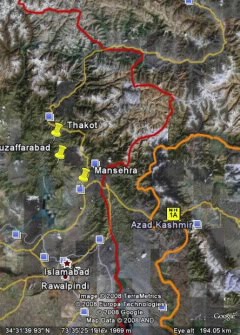
THE ARREST of three Lashkar-e-Taiba (LeT) operatives from a madrassa in Chittagong, one of Bangladesh's largest cities, in November last year, has underlined the expanding reach of the Pakistan based militant group, and security analysts believe that militants are now trying to establish their base in the country to launch attacks on India that could inflame regional troubles.
The LeT, which carried out the deadly November 2008 Mumbai terror attacks, is believed to be working swiftly to prepare a base for itself in Bangladesh from where it can target India easily.
The Bangladesh government has been trying hard to check the spread of the extremist group, but the country's internal political squabbling is making the task difficult.
"Unfortunately, Bangladesh has become the junction point of people who are interested in militancy. It is not likely to be eradicated very soon. The two major political parties have never been able to come to a common approach to the problem," The Christian Science Monitor quoted a former army official and a security analyst Syed Muhammed Ibrahim, as saying.
US military experts and Western military officials have also raised concerns over the LeT's expanding movement.
"Right now our concern is the movement of Lashkar-e-Taiba, and specifically their positioning in Bangladesh and Nepal, the Maldives, and Sri Lanka," Admiral Robert Willard, head of the US Navy's Pacific Command, had told a recent Senate hearing.
"What LeT has been able to do is lay a very solid foundation in Bangladesh. They're playing for the longer game. They're building up the infrastructure, building up the support networks," said John Harris, a terrorism expert at the S. Rajaratnam School of International Studies in Singapore.
The greater cause of worry, as underlined by the official who led the last November raids on the Chittagong madrassa, is the arrested extremists' claim of getting assistance from the Inter Services Intelligence (ISI).
"They explained that the ISI helped them with the preparation of their passports. They were taken to Pakistan for training. They are all here to organize attacks against India," the official, who requested anonymity, said. (Asian News International)
First published in Sify, August 8, 2010
Monday, August 09, 2010
End of Battle

THERE IS no way Bangladeshi politics can rid itself of the personal schism of the two ‘begums' unless one leaves the scene.
Eighteen months after the assumption of power by Awami League (AL) and the crushing defeat of Bangladesh Nationalist Party (BNP) in the last general elections, political environment in that impoverished South Asian country is as polarized as it was before. There is no respite as far as charges and counter-charges against each other are concerned. In order to exert pressure on the AL led government, BNP leader Khaleda Zia announced general strike on June 27 and also decided to continue the boycott of parliament.
Bangladesh is a democracy in terms of holding elections but in reality, like many post-colonial states, it has not settled down as a stable country. Rampant corruption, energy shortages, poor infrastructure, climatic change causing serious environmental degradation and deepening of poverty are the issues which question the credibility and legitimacy of those who wield power but are at the same time also involved in the excessive abuse of power.
Indeed, 160 million people of Bangladesh are paying the price of unabated political strife between Sheikh Hasina, Prime Minister and Khaleda Zia, the former Prime Minister. Both begums, regardless of enormous price of their confrontation are unwilling to patch up their personal discord and schisms. Both have not learned lessons from the past and are still a victim of paranoia and personal grudge against each other. Both are oblivious to the plight of millions of people of their country who live in an abject poverty and have no promising future.
When this writer asked the editor of a Dhaka-based English weekly magazine, "Is there any sign of reconciliation between the two parties or are they adamant on confrontation?" she responded: "No sign of reconciliation whatsoever. And Awami League is going all out to keep BNP down by using the war criminal trial. BNP is most of the time out of parliament in protest, so that parliament too is totally an ineffective tool for any democratic practice. When BNP is in power, it uses corruption and criminal cases to keep Awami League in submission and vice versa. There is no reconciliation in the foreseeable future."
The problem is around 70% of the population of Bangladesh is under 35 and by engaging in a relentless war of words and political confrontation, both Awami League and BNP seem to augment the level of pessimism and gloom particularly among the young people. When asked the question that what is the present situation of their fight, the editor responded that, "it is still very much on. They cannot see eye to eye on a single issue. When they come face to face, on very rare occasion like the Armed Forces Day, they just exchange the briefest of greeting, with strained smiles and pleasantries that ring hollow. The media has a field day on such occasions and the newspapers and TV challenges can talk of nothing else other than what they said to each other, what color saris they wore, their expressions, etc."
When the question about the prospects of rapprochement between the BNP and AL was put before a Chittagong University academician, he responded, "As the ideologies of the two parties are different, so it can be easily said that the possibilities of reconciliation between these is very low. Both parties want to be in power.
Consequently whenever a party comes in power then it always tries to deter the adversary one making whimsical issues and to stay long time in power. Another important point here that BNP always bears liberal ideology, in contrast, Awami League (AL) poses secular ideology but both the parties believe in democracy. But the process of belief is different. In a sense, it can be called vice versa. As a matter of fact, neither of these parties wants to leave their interests. They are very much rigid regarding their policies and strategies also. Whenever a decision is taken by one, whether the decision is right or wrong, another one strongly protest it. This is the culture of the two political parties of Bangladesh.
There are various reasons to prove why the political tussle between BNP and AL primarily revolve around the two begums. Personal vendetta, ego-centric approach, intolerance, suspicion, grudge and mistrust shape the basis of battle between Sheikh Hasina and Khaleda Zia. If Hasina represents the force of Bengali nationalism, Khaleda Zia advocates the Islamic characteristics of the majority of people of Bangladesh defined as Bangladeshi nationalism. The two still thrive on dynastic politics and are least concerned about the ordeals of common people. While in power, both were charged of corruption, nepotism and incompetence. The only example when the two begums pursued a common approach was during the last days of General Ershad when both AL and BNP launched non-cooperation movement which forced Ershad to step down in 1990 and pave the way for general elections. Otherwise, there is a long history of personal discord and vendetta.
In the June 12, 2010 issue of London Economist under the title, "Bangladesh That's not the way to do it," it was maintained that, "18 months after Sheikh Hasina's Awami League won parliamentary election in landslide, Bangladesh's politics is back to normal: personal, vindictive and confrontational. Demoralized and in disarray, the BNP has just 30 seats in parliament, down from 193 in 2001. The two ladies' feud and obsession with the past have hobbled development for decades. But the habits of confrontation are hard to break."
Four factors tend to deepen polemics and confrontation between BNP and AL. First, the role of India, because if AL has a soft corner for India and wants to follow a submissive approach vis-à-vis New Delhi's covert objectives in Bangladesh, BNP pursues a hard line policy. BNP opposes AL's stance on providing corridor to India via Bangladesh to the North East states on the argument that such a concession given to New Delhi will undermine the sovereignty of Bangladesh.
Second, the role of Pakistan. While, AL follows a hard line approach on Pakistan and uses the tragedy of 1971 in order to justify its hostility towards Islamabad, BNP pursues a moderate policy based on reconciliation between the two Muslim countries, as was evident during its two stints in power (1991-1996 and 2001-2006). AL's obsession with war crimes and its decision to go for the trial of those who collaborated with Pakistan Army during 1971 is considered as an evidence of its policy to be hard on relations with Pakistan. Therefore, both BNP and AL possess divergent positions on India and Pakistan which undoubtedly also impacts on Bangladesh's domestic politics.
Third, while AL considers Sheikh Mujib as the Father of the Nation and an unmatched leader of Bangladesh, BNP terms Zia-ur-Rehman as a nationalist who not only declared the independence of Bangladesh on a radio broadcast on March 26, 1971 but also selflessly worked for the development and modernization of his country. He was called as a leader who pursued a forward looking approach for his country and was above corruption and nepotism. Finally, BNP is soft on the Islamic identify of Bangladesh whereas AL adheres to secular nature of state based on Bengali nationalism. Other issues like control over the power structures and the university campuses also contribute in widening the schism between the two political parties of Bangladesh. Furthermore, both BJP and AL have some common characteristics like lust for power, personal fiefdom, corruption, nepotism and letting down their voters.
If the phasing out of the two begums takes place in the foreseeable future, their legacy may continue to haunt the people of Bangladesh for a long period of time. Although, the military cannot directly intervene to depoliticize the country because of adverse repercussions domestically and internationally, it can certainly pull the strings from behind. If Bangladesh wants to proceed for a better and prosperous future, it must change its political destiny by inducting tolerance, accountability, rule of law and better work ethics. Since the people of Bangladesh gave a lot of sacrifice for democracy and social justice, they do not deserve ‘internal colonization' ‘bad governance' ‘corruption' and above all absence of ‘rule of law.' #
First published in Southasia magazine, Karachi, Pakistan, July 2010
Dr. Moonis Ahmad is professor of International Relations, Karachi University and specializes on Bangladesh. He has authored several books including Paradigms of Conflict Resolution in South Asia, 2003
Sunday, August 08, 2010
Articles Of Faith, Restored
 Photo AFP: Ruling party activists rejoice decision to revert to secularism
Democracy and secularism get a new life in Bangladesh, courtesy a Supreme Court ruling
SALEEM SAMAD
LARGE SECTIONS of Bangladeshis have often rued the loss of the “spirit and letter” of the Liberation War that had helped them emerge as a new country from East Pakistan 39 years ago. A series of military rulers from the mid-1970s till 1990 had inserted or deleted provisions in their constitution to legitimise their regimes, or those they supported, resulting in the dilution of the basic tenets the country was founded on.
But a Supreme Court ruling late last month, hailed by thousands as a “landmark judgement”, has now handed Sheikh Hasina’s Awami League government an opportunity for a major course correction. If it brings the required amendments to the constitution, it can not only stop military rulers from coming to power in future but also restore the secular character of the nation.
The original constitution of Bangladesh, which came into being within a year of the country’s birth in 1971, had chosen democracy, nationalism, secularism and socialism as the four basic guiding principles of the nation. But after the assassination of the country’s founding father, Sheikh Mujibur Rahman, in an army putsch in 1975, a series of military officers took turns running Bangladesh. And it was in 1979, in the second year of Zia-ur-Rahman’s presidency, that the 5th amendment was incorporated in the constitution to legitimise his rule. In subsequent years, however, it provided other generals the perfect legal cover to run the nation.
On July 28, a six-member bench of the appellate division of the Bangladesh Supreme Court ruled the controversial 5th amendment to the country’s constitution to be illegal and nullified it. “We are putting on record our total disapproval of martial law and suspension of the constitution or any part thereof in any form,” the SC said in its ruling.
The court also restored Article 12 of the constitution which prohibits religion-based politics and communalism in all forms, and which Zia had deleted. The SC in its ruling said that by “omitting secularism”, one of the basic principles the country was founded on, the military rulers had “destroyed” not only one of the bases of “our struggle” but also changed the “basic character” of the republic.
The ruling Awami League, predictably, has been elated by the SC’s ruling. “The amendments that were enforced by military rulers during their misrule have been declared illegal and repealed by the Supreme Court,” law minister Shafique Ahmed told Outlook. He said there was no hindrance now to reinstating secularism in the country’s constitution.
Following the apex court’s ruling, the Sheikh Hasina government has set up a 15-member committee comprising members from different parties to look into the amendments.
The Awami League and its grand alliance enjoy a clear majority in the parliament with 263 out of the 300 seats. The League itself has 230 seats in the ruling alliance. The Bangladesh National Party, which was founded by Zia and is now run by his widow Begum Khaleda Zia, has only 30 seats, while its alliance partners from the Islamist parties, including the Jamaat-e-Islami, have just three seats. Independent members make up the remaining four seats.
If Sheikh Hasina wants, she could easily amend the constitution and restore the original tenets on which it was based in parliament, since her grand alliance enjoys an overwhelming majority in the House. But questions are being raised in various quarters in Bangladesh on how far she is willing to go.
The declaration of the 5th amendment as illegal by the SC definitely helps her prevent future military rulers from grabbing power. But the apex court has also created a scenario in which she could even ban religion-based political parties from contesting elections in the country. If she does that, it surely would break the alliance of the main opposition party, Khaleda Zia’s BNP, and also jeopardise its chance of putting up a meaningful fight against the League in the coming years.
The League government has already launched a drive against those involved in war crimes during Bangladesh’s liberation struggle. As part of this, four senior leaders of the Jamaat-e-Islami have been arrested and now await trial for their crimes “against humanity”.
The Jamaat has already criticised her move to revert to the 1972 constitution. “People want to move the country forward. But the government is trying to create impediments for its progress and development,” says the acting emir of the Islamist party, Makbul Ahmad.
There are clear indications, however, that the Jamaat is losing ground in Bangladesh. The party’s standing in parliament has come down from 15 to two seats as a large number of voters in the 2008 elections, particularly women in rural areas, fed up with its push for strict adherence to Shariat law, had turned against the Islamist outfit.
However, the BNP, which had lost heavily in the last elections, has decided to remain silent and watch carefully the evolving scenario in Bangladesh.
BUT SHEIKH Hasina also has a former military ruler and an Islamist as a coalition partner. Husain Mohammed Ershad, a former general who replaced Zia in 1979 and ruled Bangladesh for close to a decade, is now an ally of the government with his Jatiyo Party having 27 MPs. It was Ershad who during his rule had rewritten the constitution and made Islam “the state religion” of the country.
Despite its landmark ruling, the SC has not dealt with this portion of the constitution that Ershad had incorporated. Sheikh Hasina has made it clear in parliament that she was not willing to change Islam as the state religion nor is she in a mood to ban religion-based parties. This has obviously led to dissatisfaction in the secularist camp.
Shahriar Kabir, who has been actively campaigning for trying those responsible for war crimes and restoring the secular credentials of the country, is one of those who is less than elated with the government’s ambiguity. “The prime minister’s statement has confused the nation and it seriously contradicts the verdict of the Supreme Court. It seems the war criminals have nothing to fear any more,” says an agitated Kabir.
Many in the Awami League perhaps share his views, but if Sheikh Hasina has decided to move with caution, so will they. Because few doubt that Bangladesh is now in the cusp of history. #
First published in OUTLOOK magazine, India, August 16, 2010
Saleem Samad is an Ashoka Fellow, a journalist based in Dhaka. He specializes in security, intelligence and conflict issues on Bangladesh and neighbouring states of India. Recently he has returned from Canada after living in exile for six years
Friday, August 06, 2010
Is Muslim Majority Bangladesh Poised To Convert Into A Secular Nation?

For millions of people in impoverished Bangladesh, it seems to have ushered a political blessing. The nation which fought a bloody war of independence in 1971 against Islamic Pakistan to establish secularism and democracy was obliterated by military juntas and autocratic governments.
Bangladesh's first constitution included secularism, democracy, socialism and nationalism as the key political philosophy which reflects the spirit of the independence war when the eastern province severed from Pakistan in 1971.
After the assassination of the “founding father” Shiekh Mujibur Rahman in a military putsch in 1975, the military-backed government of General Ziaur Rahman doctored the constitution's guiding principle and scribbled "Bismillah’ir Rahman’ir Rahim (Faith in Allah)" in 1979.
The Bangladesh Supreme Court in its landmark verdict forbids political parties which advocate Islamic philosophy. The apex court also asked to reinstate the four key principles in the constitution which existed 38 years ago.
In the 184-page judgement released recently, the court discarded most of the Fifth Amendment of 1979, including provisions that allowed religious based politics, which was legitimised by tyrannical rules of military generals during the period of August 15, 1975 to April 9, 1979.
Law Minister Shafique Ahmed claimed that there is no hindrance to reinstate “secularism in the constitution” as advised in the Supreme Court's ruling. "The amendments that were enforced by military orders during the four years of misrule have been declared illegal and repealed by the Supreme Court."
Another military junta leader General Husain Muhammad Ershad, a key ally of the ruling party dared to rewrite the constitution which determines “Islam as state religion” of once secular Bangladesh. Ahmed explained that the amendment made by third military ruler will not be affected by the court verdict.
Excited Shahriar Kabir, a secularist writer and staunch advocate for the trial of the war criminals is extremely busy in appearing on prime-time talk-shows in vibrant electronic media on the landmark judgement. He said the people’s mandate in the last general election for restoration of secularism and trial of perpetrators responsible for crime against humanity in 1971.
In an election strategy Mujib’s daughter Shiekh Hasina led Awami League swept to power in 2008. Her party’s electoral promises were restoration of secularism and trial of war criminals.
“Religious based politics was banned after brutal birth of Bangladesh. We have seen youths belonging to Jamaat-e-Islami were engaged as henchmen of marauding Pakistan’s occupational forces. They raised Al-Badr, a death squad to kidnap and murder hundreds of intellectuals who could not escape for their safety and security,” he explained.
The journalist and film-maker Kabir said General Zia, after the assassination of President Mujibur Rahman in a bid to gain political support for his legitimacy of usurping power to the surprise of all, withdrew the ban on religious politics and allowed Islamic parties to regain grounds.
Most of his hand-picked cabinet ministers were drawn from Muslim League, Maoist and other rogue Islamic groups. Kabir said, incidentally most were blamed for their alleged involvement in crime against humanity.
General Zia despite being a Mukti Bahini (guerrilla force) commanding officer and took military assistance from India to liberate the country from the repressive rule of Pakistan, he did not hesitate to restore two-nation theory of independent Islamic states in Indian sub-continent. He also got rid of secularism and inserted Bismillah’ir Rahman’ir Rahim (Faith in Allah) in the constitution.
The court recommends "suitable punishment" to “extra-constitutional adventurers”, the predators of democracy who ushered military regimes and sanctioned martial laws. Well the military leaders are either assassinated, hanged or are fugitives, except for the third military leader General Ershad, who founded Jatiya Party.
The Bangladesh Nationalists Party founded by assassinated President General Zia, led by his widow, Begum Khaleda Zia appealed the apex court's first ruling on the Fifth Amendment in last January and apparently lost her legal battle in a crucial political path of her party, which was in power three times.
Author of Bangladesh constitution Dr. Kamal Hossain, an international jurist said the court verdict could be translated into reality by government order for changes in fundamental principles.
The judgement which did not come as a surprise, is a major threat to Islamic parties. The Islamic parties which propagates strict Sharia law for 158 million secular and moderate Muslim majority nation. The Islamic radicals also advocate Qur’an and Sunnah to over-ride the people’s constitution. Secularist, however argue that Sharia targets women to subjugate them and force them to wear purdah (veil).
Tormented by Fatwa’s (Islamic edicts) and confrontation with Mullahs, the rural women entrepreneurs engaged in micro-credit with support of Grameen Bank, micro-finance institutions and NGOs, the women population in the rejected the Islamic parties. The empowered rural women topped the list in national elections held anywhere in the world, according to Carter Institute. The women and 20 million new registered voters played a crucial factor in the last general election which caused landslide victory for Awami League and its allies.
According to independent Bangladesh Election Commission there are eleven registered Islamic parties. Reacting to comments by ruling party politicians regarding the unprecedented judgement, Chief Election Commissioner Dr. ATM Shamsul Huda made it clear that the Election Commission is not authorised to ban any political party and that the authority lies with the government only.
“The Commission will not impose any ban on any party. It is the responsibility of the government. If the government bans any registered political party, the Commission would cancel the registration as per ‘The Representation of the People Order (RPO) Act’,” he said, as journalists asked if the EC would go for outlawing religion-based political parties.
Recently five senior leaders of the Islamist party Jamaat-e-Islami were arrested and are waiting to stand trials for the crime against humanity at the International War Crimes Tribunal. The special court has been set up, as an election pledge by the present government.
In the wake of judgement, Bangladesh Jamaat-e-Islami accused the government of a conspiracy to push the country into anarchy by reverting to the 1972 constitution.
“People want to move the country forward. The government stands against the people is an impediment to the country’s progress and development,” Acting Amir (chief) Makbul Ahmad of Islamist party.
The party leader called upon all Islamic, patriotic parties and the Muslims to stand against what it described the government’s anti-Islam mindset.
Whether the Islamic parties will be banned or restricted is still not clear. At the Jatiya Sangsad (parliament) Prime Minister Shiekh Hasina remarks frustrated many political observers and her party’s secular advocates.
She said that Islamic parties will not be banned, while “Bismillah’ir Rahman’ir Rahim” and state religion Islam will remain in the constitution. Possibly her government does not wish to jeopardise Awami League and allies for another term in the election scheduled in three years.
Earlier Hasina in a rare gesture asked her ministers to keep quite on the constitutional issue and religious based political parties as crucial changes in the fundamental principles of state policy are now under a close scrutiny. Her prolific party leaders were busy in deliberation in half-a-dozen TV talk-shows every late night.
She mentioned that a constitutional amendment is a sensitive issue and formed a 15 member bi-partisan special committee for recommendation to the parliament.
Social justice activist Kabir is upset. He said the prime minister’s statement in parliament has confused the nation and it somewhat contradicts the verdict of the superior court. It seems that the war criminals and their defenders have nothing to fear anymore. The Islamic parties would continue to function and overtly campaign against the war crimes trial, which began in United States and Britain.
First published in the CounterCurrents.org 6 August 2010
Saleem Samad is a writer and journalist, an Ashoka Fellow for journalism. He has recently returned from exile in Canada. He fled from Bangladesh after security agencies during the Islamic-nationalist government (2001-2006) intimidated him to leave the country. He could be reached at saleemsamad@hotmail.com
Tuesday, August 03, 2010
View from Pakistan: Lessons from Bangladesh

The poison of General Zia’s bigotry has spread like a cancer in Pakistan’s body politic. Had he not emerged on the scene, it is possible that Pakistan would have taken the regular course of a confessional state to a modern, inclusive and democratic state
BRAVO! BANGLADESH has done it. It has successfully reversed the cynical Islamisation of its local General Zia. Not only is one fortified by their action that a Muslim majority nation state is capable of rolling back the Islamist project but as a Pakistani I am glad that at least some part of the former original Pakistan is now firmly allied with the principles that Jinnah laid down in his famous August 11, 1947 speech.
Bengalis have never been any less proud as Muslims than Pakistanis. Say what they may, champions of the so-called ideology of Pakistan cannot deny that had it not been for peasant nationalism in Bengal, the Pakistan movement would have fallen flat on its face. While opportunistic landowners jumped onto the Pakistan bandwagon in what became West Pakistan, it was the common man in the then East Pakistan who waged the struggle for a new nation. It may also be remembered that Huseyn Shaheed Suhrawardy, the founder of the Awami League, was also one of the founding fathers of Pakistan and that the Awami League was, at one point in its history, the Jinnah Awami Muslim League.
In 1965, when the Quaid-e-Azam’s sister rose to take on a dictator, it was again East Pakistan that rallied to her cause. And how did we pay them back? I do not wish to go into the atrocities of 1971.
One of the many steps taken by this new confident and independent People’s Republic of Bangladesh is the banning of Maulana Maududi’s hate-filled literature. Maulana Maududi is widely disliked in Bangladesh for his role against the Bengalis. There are some who object to this decision on grounds of ‘freedom of speech’. Well sirs, mind telling us where is the freedom of speech for non-Muslim minorities? It is quite like how some years ago many of our proud Pakistani Muslims defended Yousaf Youhanna’s conversion to Islam on the grounds of freedom of religion. And then someone asked, “What if he converts back to Christianity?” Silence.
What is sad, however, is that Maududi’s abuse against Pakistan and its founding father far outweighs his abuse against Bangladesh and yet Pakistan continues to tolerate Maududi’s legacy. Much of his horrendous abuse against the Quaid-e-Azam has been documented in detail. What is more, Maududi and his party openly supported usurper General Zia’s illegal military dictatorship.
The truth is that under the 1973 Constitution, a complete separation of church and the state may not be immediately possible, but if Pakistan can undo General Zia’s legacy, it will become a much better place to live in. For us, it is an urgent undertaking. We have now learnt that the dead body of Prem Chand, who died in the Margalla plane crash, was marked ‘Kafir’. Is there no end to such bigotry? Some might argue that this is because we asked for a Muslim majority state and a partitioned India. Be that as it may, it bears repeating that Jinnah tried very hard to keep Hindus safe and secure in Pakistan and his efforts paid off partially in Karachi. He also spoke of non-Muslim Pakistanis as being equal Pakistanis and having the closest association with the rest of Pakistan. Today, the minorities are marked separately as if they are less human, let alone less Pakistani.
To drive the message of equality and inclusiveness of Pakistani identity home, Jinnah appointed as his law minister Mr Jogindranath Mandal, a Bengali scheduled caste Hindu, and got Jagganath Azad, a Hindu Urdu poet, to write Pakistan’s first national anthem. Mr Azad had to escape for his life soon afterwards when things became unbearable for the Hindus in Lahore and soon after Jinnah’s death Mr Mandal was driven out. A transcript of Mandal’s signed statement is readily available on the internet. It is nothing less than heartbreaking for a Pakistani who wants to see this flag flying high.
Perhaps the founding fathers should have been more militant in their secularism given that they had gotten the state by mobilising a religious identity, like Kemal Ataturk and Ismet Inonu did in Turkey. Their Turkish nationalism grew out of the group identity of Muslims of Anatolia and Thrace and they deployed Islam to mobilise the Turks, Kurds, Macedonians and even the Arabs living in Anatolia during the war of independence in a much more blatant fashion than the founding fathers of Pakistan. Yet, after the emergence of the modern Turkish Republic, Ataturk and Inonu began to redefine Turkish nationalism in completely secular terms. Consequently, even Turkish Jews are Turks before they are Jews.
In stark contrast to Turkey, especially after Jinnah, Pakistani secularism has met with one defeat after another. We are now at a point in our history that the highfalutin articles of the constitution protecting religious freedom in Pakistan have been defeated in the courts of law. Pakistan may have ratified the International Convention on Political and Civil Rights, but in reality the application of this is impossible unless of course Pakistan’s leaders realise the urgency of the matter.
The poison of General Zia’s bigotry has spread like a cancer in Pakistan’s body politic. Had he not emerged on the scene, it is possible that Pakistan would have taken the regular course of a confessional state to a modern, inclusive and democratic state. While Islamisation was always a going concern in Pakistan since the Objectives Resolution, it was General Zia who ensured that it would always be negative and exclusionary, catering to the Maududian ideology. Pakistan must decisively roll back General Zia, taking a cue from Bangladesh, and declare all the changes inflicted on the legal and constitutional system of Pakistan from Zia’s coup to that grand explosion in the sky, null and void. This would give Pakistan a fighting chance to slowly dig itself out of the hole it has dug itself into.
Remember the war against the Taliban is a generational undertaking. It will be fought in our schools, colleges and courts for the next 50 years. Let us prepare for the battle by learning from Bangladesh. #
First published in The Daily Times, Labore, Pakistan, August 02, 2010
Yasser Latif Hamdani is a lawyer. He also blogs at http://pakteahouse.wordpress.com and can be reached at yasser.hamdani@gmail.com
Subscribe to:
Posts (Atom)